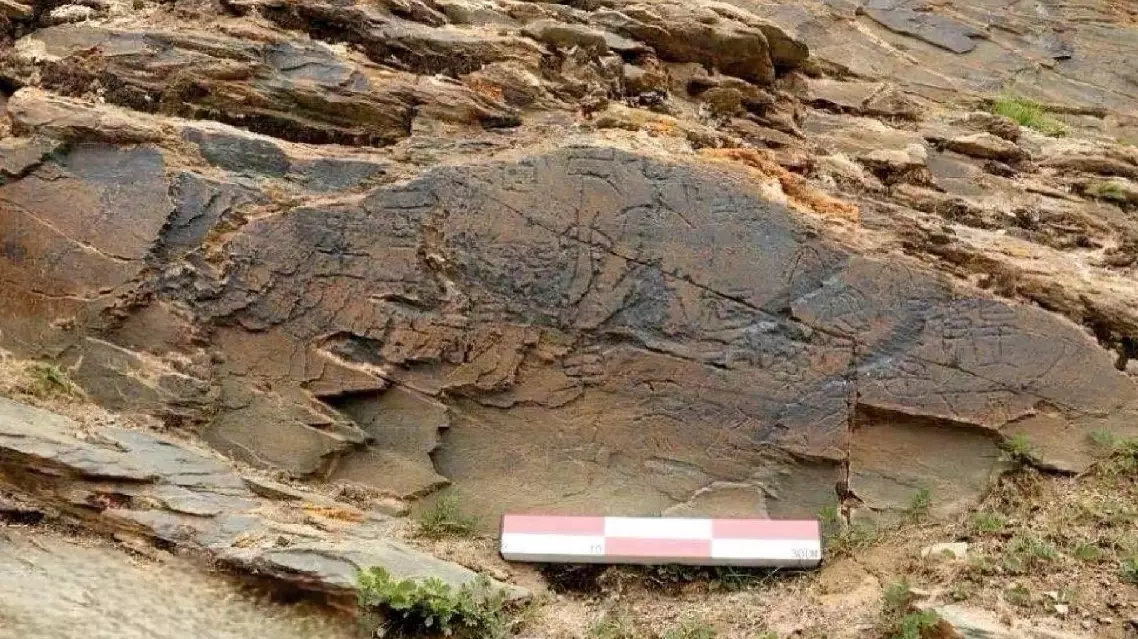
Chinese authorities have verified the authenticity of an engraved stone, discovered on the Qinghai-Tibet Plateau, as the only known Qin Dynasty (221 - 207 BC) engraved stone preserved at its original site and located at the highest altitude so far.
The stone was found on the northern shore of the Gyaring Lake in Maduo County, northwest China's Qinghai Province, at an altitude of about 4,300 meters.
The inscriptions are carved on a wall surface with a total length of 82 cm and a maximum width of 33 cm. Covers about 0.16 square meters, the area carved with characters is about 19 cm above the ground.
The entire text consists of 37 characters, arranged vertically from right to left in columns each consisting of two to four characters. The script style belongs to Qin zhuan (small seal script).
Deng Chao, director of the Department of Cultural Relics and Historic Sites of the National Cultural Heritage Administration (NCHA), said they have harnessed modern technologies to assess the facticity of the stone and will step up its protection efforts.
"Through high-precision information enhancement technology, the engraved characters on the stone exhibit distinct chisel marks, carved by using flat-edged tools consistent with the the Qin Dynasty stone engraving capacity. Mineral and metal element analysis has ruled out the possibility of modern alloy tools being used for engraving. Both the interior of the engraved marks and the surface of the stone contain weathered secondary minerals, indicating prolonged exposure to weathering and eliminating the possibility of recent carving," he said.
"The Qin-era stone inscription remains largely intact, with most characters clearly legible. As it bears a complete date including year, month, and day, unrecorded in historical texts, it stands as China's only known Qin-era stone inscription preserved at its original site and at the highest elevation. It shall be protected and managed as a national key cultural relic site. We will give it priority consideration during the selection process for the ninth batch of national key cultural relic sites," said Deng.
The finding holds significant historical, artistic and scientific value.
Emperor Qinshihuang of the Qin Dynasty unified China for the first time.
China confirms authenticity of Qin Dynasty engraved stone
A former television host from Taiwan, Zhai Xuan, has made a pivotal decision to leave mainstream broadcasting in order to create content that provides a better understanding of the Chinese mainland and cross-strait relations.
Zhai, a seasoned television host with over a decade of experience in Taiwan's media landscape, recently addressed an audience at an event in Beijing, where she revealed her complete transition into independent online media.
In her remarks, she articulated her aspiration to bridge what she perceives as a significant information gap between audiences on both sides of the Strait, highlighting her commitment to fostering a deeper understanding and connection through her new endeavors.
"I was really surprised by all the fake news. There were stories saying people on the mainland can't afford tea eggs or that they live in mud houses and in Taiwan, this was the main information many people received," said Zhai.
Zhai said she initially began producing online videos to challenge such perceptions while continuing her work as a television host.
In April 2025, she travelled to the mainland with her father to fulfill her late grandfather's wish to return to his hometown. The trip, which reunited family members separated since 1949, was recorded in a video series titled "Journey to Find Our Roots", drawing attention from viewers in both Taiwan and the mainland.
"Many people in Taiwan told me that after watching, they wanted to apply for a mainland travel permit immediately and go looking for their relatives. Some had long forgotten these things, but after seeing my story, they began thinking about their hometowns and family members they had never met and decided to search for their roots," Zhai shared her story at the event.
By mid-2025, Zhai said she began to feel increasing pressure amid rising political tensions and a tightening atmosphere around cross-Strait exchanges in Taiwan.
After more than 12 years in the industry, Zhai resigned from her position, believing it was the right thing to do.
"At that moment, I felt this was a major issue,not just for me, but for Chinese people on both sides of the Strait. If I backed down then, I wouldn’t be standing on the right side," said Zhai.
Since leaving television, Zhai has broadened her online programming to encompass a range of daily-life topics, including practical guidance on applying for a mainland travel permit and using commonly employed mobile applications, in addition to content that delves into historical memory and cultural connections across the Strait.
As the debate over cross-Strait relations continues in Taiwan, Zhai said she remains committed to her current path.

Former Taiwan TV host bridges cross-Strait divide via online media