KANSAS CITY, Mo.--(BUSINESS WIRE)--Sep 16, 2025--
Trially®, the AI-first clinical trial recruitment platform, today announced it has secured $4.7 million in funding and launched Margo, its agentic AI solution that multiplies trial enrollment by converting patient matches into participants.
This press release features multimedia. View the full release here: https://www.businesswire.com/news/home/20250910493277/en/
Clinical trial recruitment remains one of healthcare’s most urgent challenges: With 86% of clinical trials delayed due to recruitment failures, the pharmaceutical industry is losing over $600,000 every day while patients wait years for treatments that could save their lives.
Trially is the first fully integrated AI platform to tackle the root cause of delay. Its HIPAA-compliant LLM agents safely analyze unstructured medical data to instantly match, connect and enroll patients in relevant trials — transforming a process that once required 100s of hours of manual chart reviews and cold calling into instant enrollment opportunities.
According to ClinTrial Research’s Chief Commercial Officer, Sam Searcy, "Trially’s proprietary AI has improved our ability to pre-screen candidates, reducing the time and resources typically spent on manual EHR chart reviews while improving the diversity and quality of our patient pools.”
“Patients like James Hicks shouldn’t have to wait 10 years for life-saving treatments while trials are running in their own backyard,” said Kyle McAllister, Co-founder and CEO of Trially. “We’re bridging the gap between life-saving medicine and the people who need it now.”
Meet Margo: Agentic AI that converts patient matches into participants
Margo is the newest addition to Trially’s platform, which unifies three powerful offerings:
“Recruitment has always been the bottleneck in clinical research,” said McAllister. “With Margo, we’re not just matching patients, we’re engaging and enrolling them. That’s what sets Trially apart: we can identify patients with ~95% screening accuracy and then agentic AI can engage them at the exact moment it matters most.”
The Numbers Tell a Compelling Story:
The Seed round was led by Flyover Capital, with participation from Alpaca, Atria, Blu Ventures, Looking Glass Capital, Redbud, The Council, and Gaingels.
“Clinical trial recruitment has been the industry’s Achilles’ heel for decades,” said Thad Langford, Founding Partner at Flyover Capital. “Trially is the first solution we’ve seen that not only identifies eligible patients, but also engages and enrolls them. We’re thrilled to back Kyle and the Trially team as they accelerate access to life-saving treatments.”
With its new funding, Trially will accelerate adoption of its platform across research sites, pharmaceutical sponsors, CROs and physician networks, ensuring sponsors can avoid costly delays and patients can access life-saving treatments when it matters most.
About Trially
Trially AI is shaping the future of clinical trial recruitment by matching, engaging and enrolling qualified patients faster. Proven to multiply enrollment rates by up to 6x, reduce screen failures by 73% and automate screening with ~95% accuracy. Trially AI automates patient matching and agentic outreach from any source – including EHRs, fully compliant with HIPAA, SOC 2, FDA CFR 21 Part 11 and ISO 27001. Designed for physicians, research sites, CROs and pharmaceutical sponsors, Trially empowers you to achieve outstanding results in clinical research. For more information visit trially.ai.
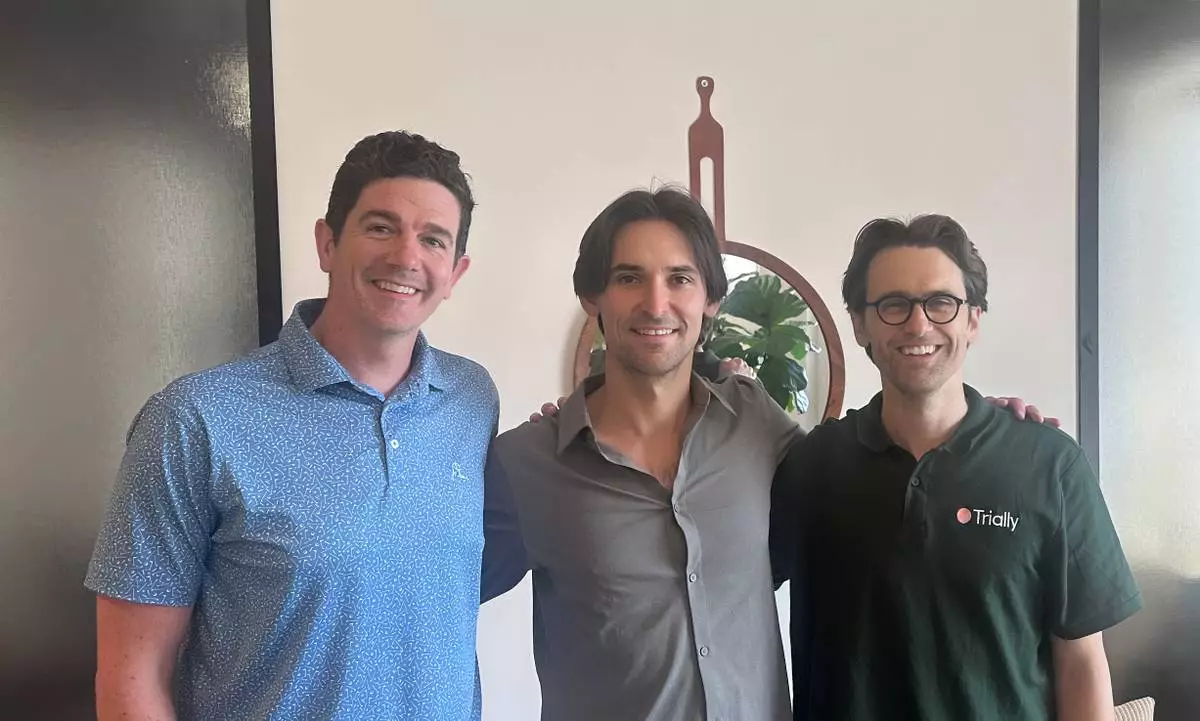
Trially Founders, from left to right: Kyle McAllister, CEO & Co-founder; Ramon Prieto, CTO & Co-founder; Trevor Welch, CPO & Co-founder.
Stocks fell on Wall Street Friday as another pullback in big technology companies weighed on the market.
The S&P 500 was down 1.1% as of 2:01 p.m. Eastern time and on track for a weekly loss. The benchmark index is pulling back from the all-time high it set last week. The Dow Jones Industrial Average fell 257 points, or 0.5%.
The Nasdaq composite was down 2.1% and headed for its first weekly loss in five weeks. Weakness for AI stocks has been a major drag on the tech-heavy index this week.
Technology companies were the biggest drag on the broader market. Micron Technology fell 4.1%, Advanced Micro Devices dropped 5.1%, Broadcom was down 3.6% and Intel lost 4.7%. The declines in heavyweight tech stocks outweighed losses in most other parts of the market, and slightly more U.S. stocks were rising than falling within the S&P 500.
It’s been a choppy week for chipmakers and other big tech stocks central to the artificial intelligence industry. Investors are now worried that the companies, which have relied on debt markets to finance an investment spree into their technology, may not be able to keep borrowing and spending as heavily with yields in bond markets worldwide recently climbing to their highest levels in years.
Netflix’s stock fell 3% a day after the company announced that Chief Content Officer Bela Bajaria will be replaced by Peter Rice. The news comes just days after Netflix said that it plans to lay off about 6% of its workforce, amounting to nearly 1,000 positions.
Big banks and other financial companies gained ground. JPMorgan rose 0.9%, Citigroup gained 0.5% and Wells Fargo was up 0.7%.
European markets were broadly higher and Asian markets rose.
In the bond market, Treasury yields held relatively steady. The yield on the 10-year Treasury was at 5.10%. It had topped 5.30% earlier this month and touched its highest level since 2002 because of worries about high inflation, signals of a strong U.S. economy and other factors.
Yields are down despite reports this week showing that inflation at the consumer and wholesale level rose more in the U.S. than economists expected.
The reports could persuade the inflation-fighters at the Federal Reserve to hike their key interest rate before the end of this year. The central bank increased its key interest rate by a quarter-point to about 3.9% in September, its first increase in three years.
Wall Street traders expect the Fed will keep its short-term rate unchanged at policy meeting this month, but the odds of a rate increase at the December meeting have jumped to 74.3% from 50.2% a month ago, according to data from the CME Group.
On Friday, Federal Reserve Chairman Kevin Warsh offered no fresh signals about potential interest rate policy moves by the Fed while attending a meeting of financial leaders in Bangkok.
Elsewhere in the market, shares in Tesla fell 2.5% after the electric vehicle company unveiled a new model of its Roadster sports car that can thrust itself up in the air.
Alcoa jumped 3% after reporting quarterly results that topped Wall Street estimates.
Expectations are high for growth in profits from all kinds of companies this reporting season, which began in earnest this week. That’s what’s allowed U.S. stocks to set records despite high inflation and the many other worries weighing on Wall Street.
In energy markets, oil prices remained elevated as the global oil supply continues to be under pressure without a deal between the U.S. and Iran to end the Iran war.
Brent crude, the international standard, was up 3.1% at $109.21 per barrel. That is up from around $72 a barrel in late February before the start of the war. Brent climbed into triple digits last month, the first time since July.
The national average for gasoline is at $4.33 a gallon on Friday, according to AAA. While that’s lower than the $4.37 a gallon that it averaged last month, it’s sharply higher than the $3.06 a gallon from a year ago.
Oil remains well-supported as uncertainties surrounding the situation in the Middle East and concerns over oil flows in the Strait of Hormuz had the market “pricing in a significant risk premium,” ING commodities strategists Warren Patterson and Ewa Manthey wrote in a commentary Friday.
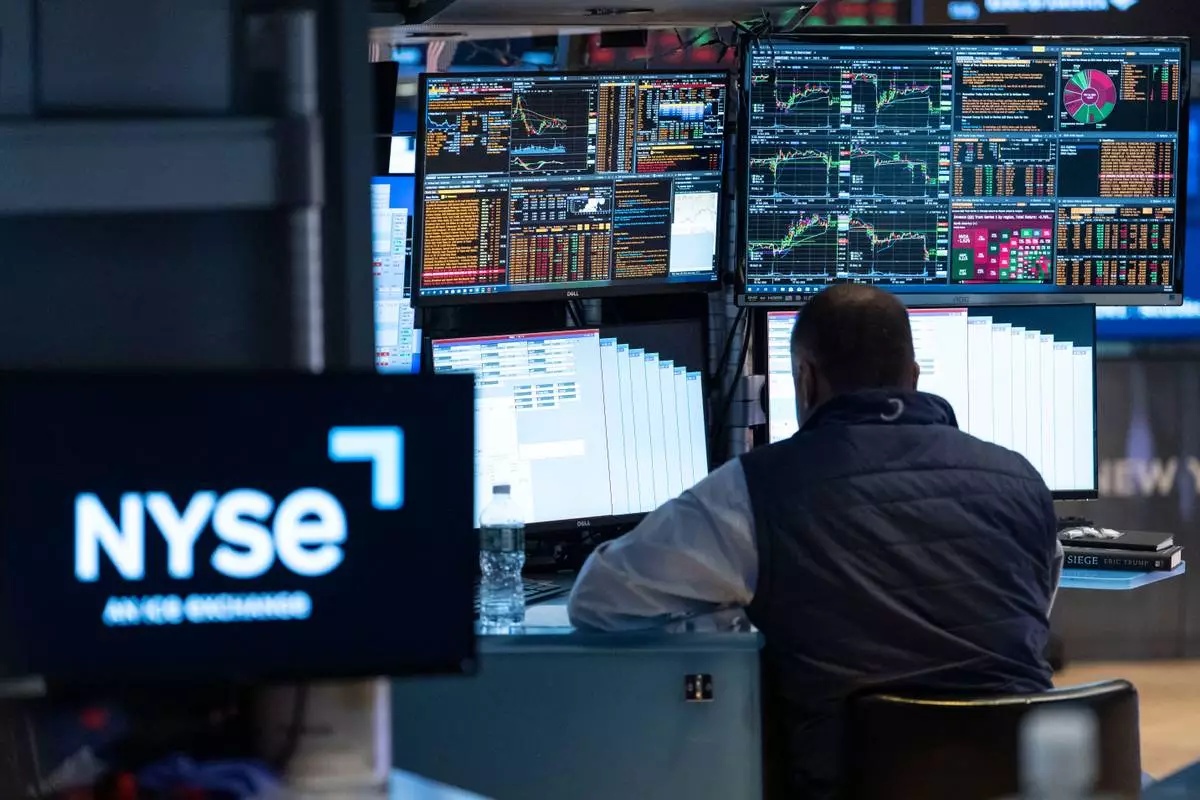
Specialist Dilip Patel works on the floor of the New York Stock Exchange, Thursday, Oct. 8, 2026, in New York. (AP Photo/Yuki Iwamura)
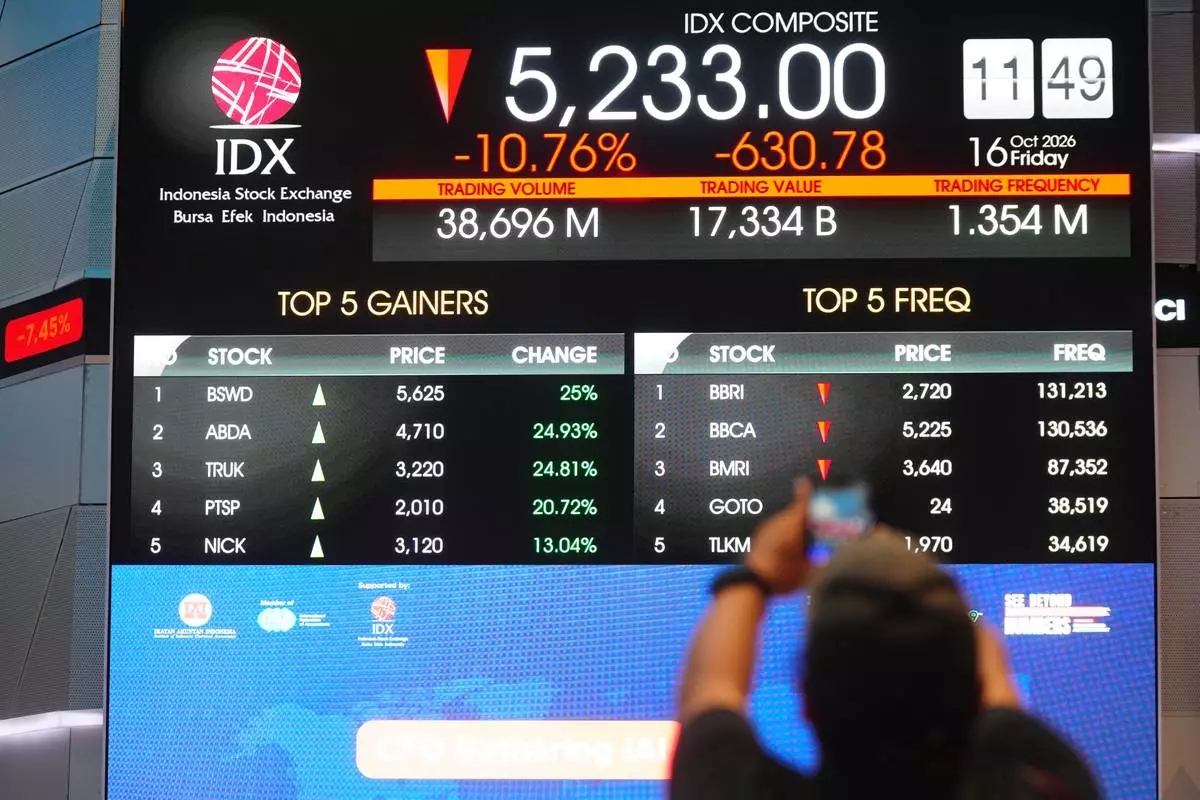
A man uses his mobile phone to take photos of the electronic screen displaying Indonesia Composite Index at the Indonesia Stock Exchange in Jakarta, Friday, Oct. 16, 2026. (AP Photo/Tatan Syuflana)
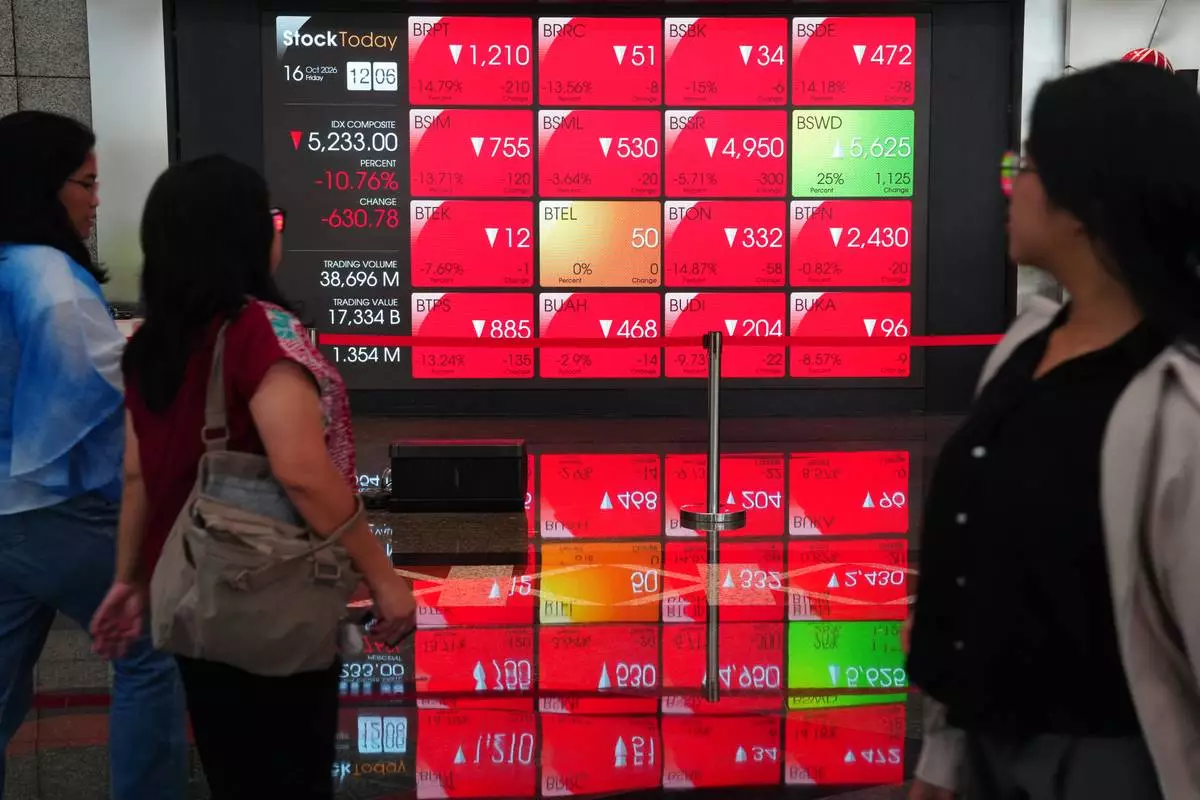
People walk past an electronic screen displaying stock prices at the Indonesia Stock Exchange in Jakarta, Friday, Oct. 16, 2026. (AP Photo/Tatan Syuflana)

A screen shows the Korea Composite Stock Price Index (KOSPI) at the foreign exchange dealing room of the Hana Bank headquarters in Seoul, South Korea, Friday, Oct. 16, 2026. (AP Photo/Ahn Young-joon)

A screen shows the Korea Composite Stock Price Index (KOSPI), the foreign exchange rate between U.S. dollar and South Korean won, SK Hynix and Samsung Electronics Co. stock prices at the foreign exchange dealing room of the Hana Bank headquarters in Seoul, South Korea, Friday, Oct. 16, 2026. (AP Photo/Ahn Young-joon)
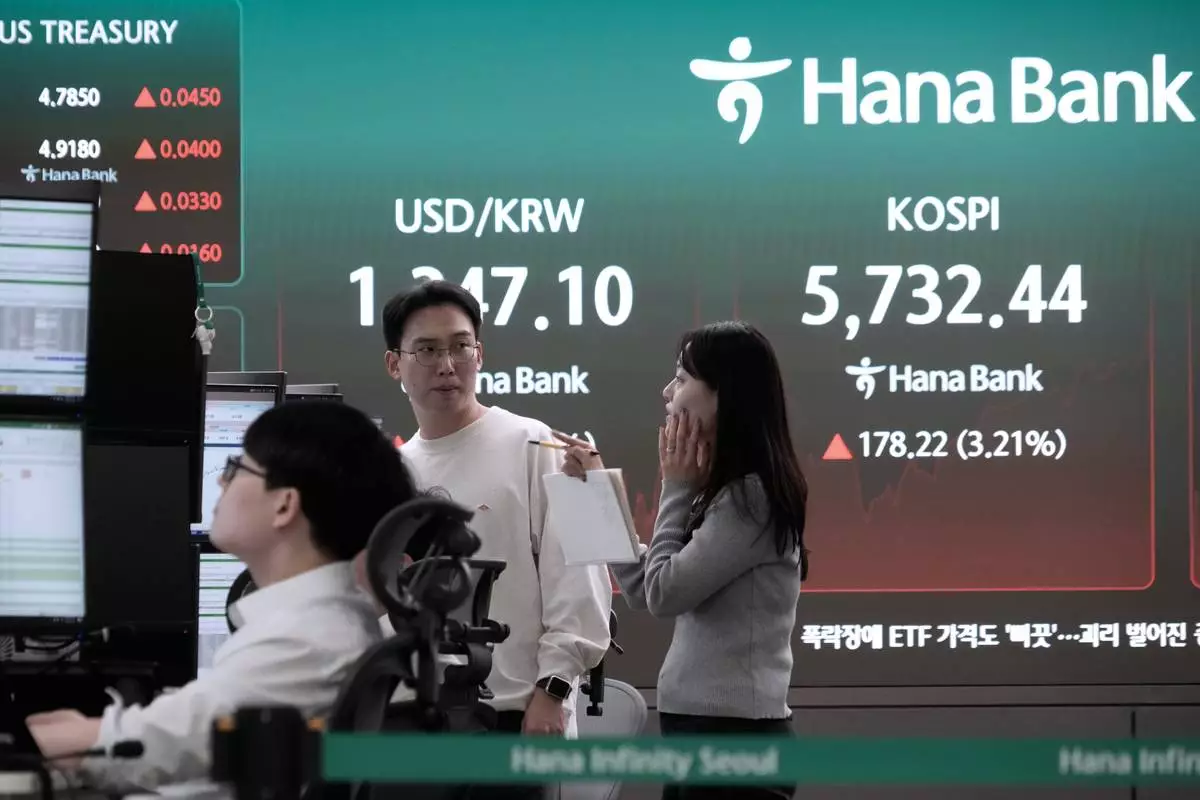
Currency traders work near a screen showing the Korea Composite Stock Price Index (KOSPI) and the foreign exchange rate between U.S. dollar and South Korean won at the foreign exchange dealing room of the Hana Bank headquarters in Seoul, South Korea, Friday, Oct. 16, 2026. (AP Photo/Ahn Young-joon)
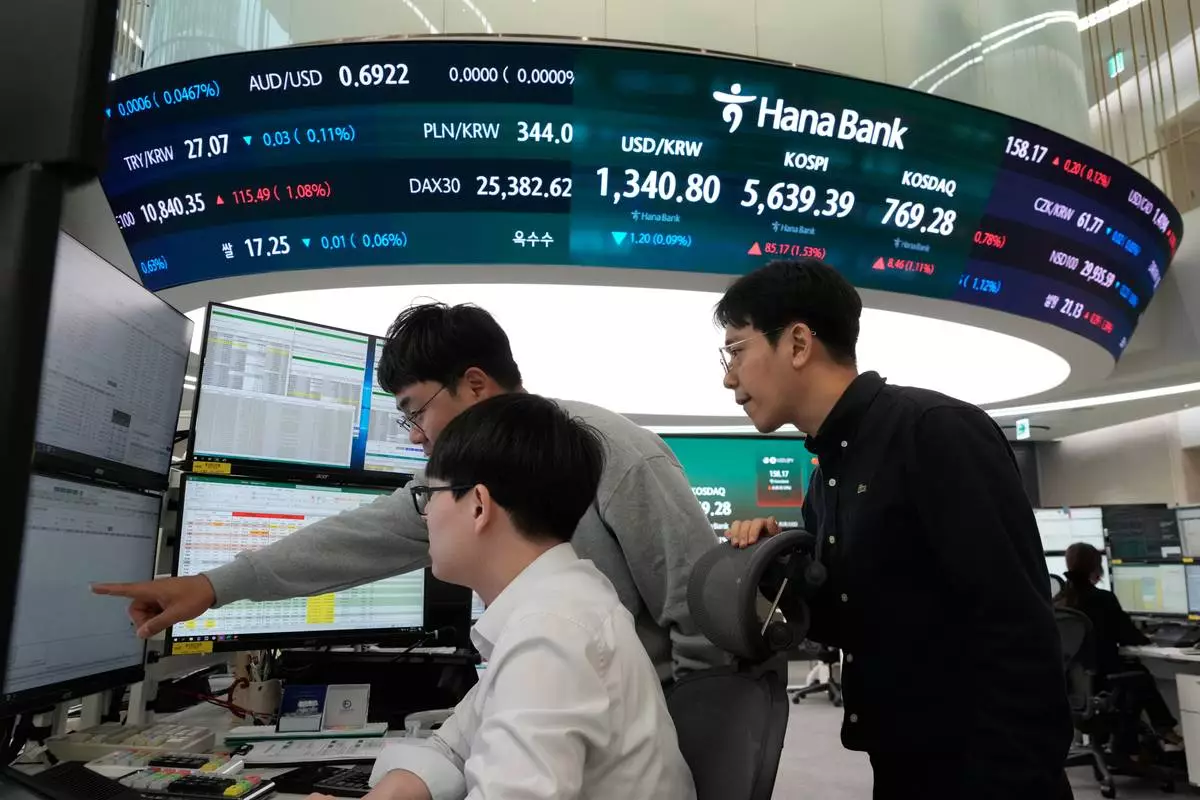
Currency traders work at the foreign exchange dealing room of the Hana Bank headquarters in Seoul, South Korea, Friday, Oct. 16, 2026. (AP Photo/Ahn Young-joon)