|
Lunit highlights global leadership in cancer AI alongside world health experts with dedicated APEC HLMHE session and WBS 2025 Leaders' Dialogue
SEOUL, South Korea, Sept. 16, 2025 /PRNewswire/ -- Lunit (KRX:328130.KQ), a leading provider of AI for cancer diagnostics and therapeutics, today announced its participation in two major global health gatherings taking place in Seoul this week: the 15th APEC High-Level Meeting on Health and the Economy (APEC HLMHE) and the World Bio Summit 2025 (WBS 2025).
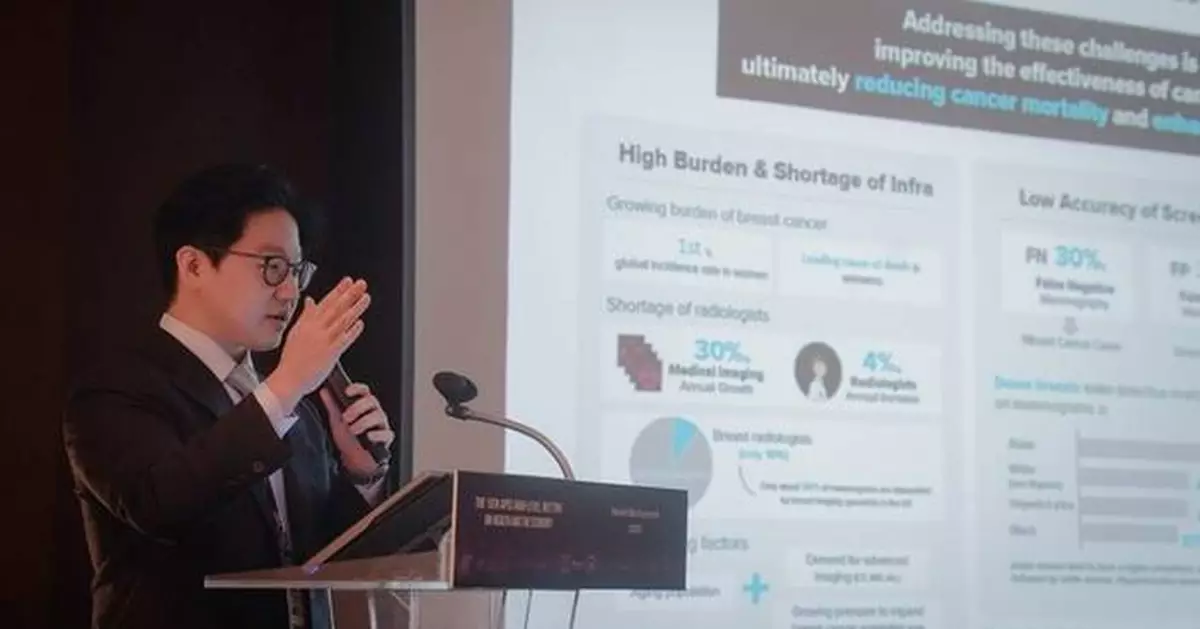
Lunit was the only company from Korea invited to lead a dedicated session at APEC HLMHE, held September 15-16 at Shilla Hotel Seoul, underscoring its role as a recognized global leader in AI-powered solutions that cover the entire cancer care continuum. The session on September 16 drew an audience of more than 300 policymakers, healthcare leaders, and industry experts.
During the session, Lunit CEO Brandon Suh, together with senior executives and research leaders, outlined how AI is transforming cancer screening and treatment across APEC member economies. Key themes included:
- Korea's AI leadership: government reimbursement approval, large-scale clinical adoption at more than 7,000 sites worldwide, and validation by the National Cancer Center.
- Global case studies: how AI is enabling cancer screening in Southeast Asia, Australia, and Singapore, supporting health equity and cost-effective care delivery.
- Future vision: advancing multimodal AI that integrates imaging, genomics, and clinical data to drive precision medicine, and proposing new APEC-level collaborations such as shared data infrastructure and cross-border training.
On September 17, Suh will also serve as moderator of the WBS 2025 Leaders' Dialogue at the opening ceremony, bringing together senior figures such as Dr. Philippe Duneton, Executive Director of Unitaid, and other international healthcare leaders.
In addition, Lunit is showcasing its AI portfolio throughout both events with an on-site booth, offering demonstrations of its flagship solutions in cancer screening and AI pathology.
"AI is no longer a future vision—it is delivering tangible impact for patients and across healthcare systems today," said Brandon Suh, CEO of Lunit. "By collaborating with governments, multilateral organizations, and research institutions, we aim to ensure that the benefits of AI-powered cancer care reach every corner of the world."
About Lunit
Founded in 2013, Lunit (KRX:328130.KQ) is a global leader in AI for cancer diagnostics and therapeutics. With a mission to conquer cancer through AI, Lunit develops AI-powered solutions for medical imaging and biomarker analysis to enable precise diagnosis and personalized treatment. Lunit's FDA-cleared Lunit INSIGHT suite supports cancer screening at over 7,000 medical institutions in more than 65 countries, while Lunit SCOPE is used in research partnerships with global pharma giants focused on biomarker development and companion diagnostics. Lunit clinical studies have been featured in top-tier journals—including The Lancet Digital Health and Journal of Clinical Oncology—and presented at major conferences such as ASCO and RSNA. Headquartered in Seoul with global offices, Lunit is driving the worldwide fight against cancer. Learn more at lunit.io.
Lunit highlights global leadership in cancer AI alongside world health experts with dedicated APEC HLMHE session and WBS 2025 Leaders' Dialogue
SEOUL, South Korea, Sept. 16, 2025 /PRNewswire/ -- Lunit (KRX:328130.KQ), a leading provider of AI for cancer diagnostics and therapeutics, today announced its participation in two major global health gatherings taking place in Seoul this week: the 15th APEC High-Level Meeting on Health and the Economy (APEC HLMHE) and the World Bio Summit 2025 (WBS 2025).
Lunit was the only company from Korea invited to lead a dedicated session at APEC HLMHE, held September 15-16 at Shilla Hotel Seoul, underscoring its role as a recognized global leader in AI-powered solutions that cover the entire cancer care continuum. The session on September 16 drew an audience of more than 300 policymakers, healthcare leaders, and industry experts.
During the session, Lunit CEO Brandon Suh, together with senior executives and research leaders, outlined how AI is transforming cancer screening and treatment across APEC member economies. Key themes included:
- Korea's AI leadership: government reimbursement approval, large-scale clinical adoption at more than 7,000 sites worldwide, and validation by the National Cancer Center.
- Global case studies: how AI is enabling cancer screening in Southeast Asia, Australia, and Singapore, supporting health equity and cost-effective care delivery.
- Future vision: advancing multimodal AI that integrates imaging, genomics, and clinical data to drive precision medicine, and proposing new APEC-level collaborations such as shared data infrastructure and cross-border training.
On September 17, Suh will also serve as moderator of the WBS 2025 Leaders' Dialogue at the opening ceremony, bringing together senior figures such as Dr. Philippe Duneton, Executive Director of Unitaid, and other international healthcare leaders.
In addition, Lunit is showcasing its AI portfolio throughout both events with an on-site booth, offering demonstrations of its flagship solutions in cancer screening and AI pathology.
"AI is no longer a future vision—it is delivering tangible impact for patients and across healthcare systems today," said Brandon Suh, CEO of Lunit. "By collaborating with governments, multilateral organizations, and research institutions, we aim to ensure that the benefits of AI-powered cancer care reach every corner of the world."
About Lunit
Founded in 2013, Lunit (KRX:328130.KQ) is a global leader in AI for cancer diagnostics and therapeutics. With a mission to conquer cancer through AI, Lunit develops AI-powered solutions for medical imaging and biomarker analysis to enable precise diagnosis and personalized treatment. Lunit's FDA-cleared Lunit INSIGHT suite supports cancer screening at over 7,000 medical institutions in more than 65 countries, while Lunit SCOPE is used in research partnerships with global pharma giants focused on biomarker development and companion diagnostics. Lunit clinical studies have been featured in top-tier journals—including The Lancet Digital Health and Journal of Clinical Oncology—and presented at major conferences such as ASCO and RSNA. Headquartered in Seoul with global offices, Lunit is driving the worldwide fight against cancer. Learn more at lunit.io.
** The press release content is from PR Newswire. Bastille Post is not involved in its creation. **

Lunit Showcases AI-Powered Cancer Ecosystem at APEC High-Level Meeting on Health and the Economy and World Bio Summit 2025
LAS VEGAS, Jan. 17, 2026 /PRNewswire/ -- At CES 2026, Flowtica was not the loudest presence on the show floor. Over the course of the week, however, the Singapore-based AI company became one of the most closely watched, drawing sustained attention from media, investors, and industry observers.
That attention has now translated into availability. Following its appearance as a CES 2026 Innovation Award Honoree, Flowtica has officially opened sales of Flowtica Scribe, its AI recording pen that quietly stood out in a field dominated by phone-dependent and screen-heavy solutions.
Flowtica Scribe did not make its first public appearance at CES. The product launched on Kickstarter several months earlier, where it attracted thousands of users and established early validation. CES marked a different stage for the company. The focus shifted away from introduction and toward closer examination, with many observers asking whether the idea could hold up beyond early enthusiasm.
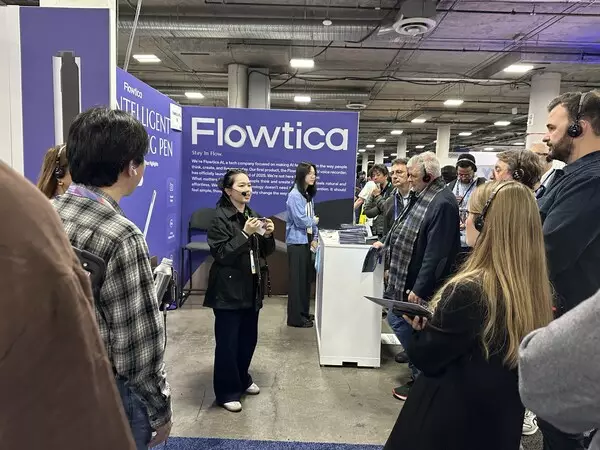
Throughout the exhibition, Flowtica's booth at Eureka Park became a steady meeting point for investors and journalists. Conversations rarely centered on specifications or feature lists. Instead, discussions focused on a more fundamental question: whether AI recording tools are beginning to converge on forms that genuinely fit into professional life.
Flowtica's answer was visible in its choice of form. By embedding AI into a pen, an object already accepted in boardrooms, consultations, investor meetings, and sales conversations, the company avoided many of the social and practical frictions that continue to limit phone-based recorders. The result was a device that felt less like a new category of gadget and more like a natural extension of existing behavior.
This restraint is deliberate. Flowtica Scribe is designed to remain unobtrusive, with no screen and no demand for user attention during conversations. Recording, organization, and interpretation take place quietly in the background, allowing users to remain focused on the discussion itself. Among on-site observers, this approach positioned Flowtica as one of the more pragmatic entrants in an increasingly crowded AI recording market.
Hardware, however, represents only part of Flowtica's differentiation. The company places equal emphasis on what happens after recording ends. Its AI functions as a continuously evolving insight system that can operate autonomously while remaining responsive to clear user guidance when needed. Over time, it adapts to individual working rhythms and priorities, shifting the emphasis from capturing everything to identifying what truly matters.
Rather than simply storing conversations, Flowtica helps determine which moments should be retained, revisited, and translated into next actions. Key insights are designed to integrate naturally with existing productivity tools, including calendars and task systems, allowing them to fit into established workflows rather than compete with them.
As interest in Flowtica Scribe built during CES, one question surfaced repeatedly. When would the product be available beyond the show floor?
With sales now officially open through Flowtica's website, the company moves from exhibition attention to real-world deployment. For Flowtica, this moment appears less like a conclusion and more like a transition, from being observed to being used.
As the AI recording market continues to mature, competition is shifting away from novelty and early adoption toward durability. The defining question is no longer whether a system can record conversations, but whether it can remain useful over time.
Flowtica enters this next phase with an approach that is measured and quietly confident, placing its bet not on spectacle, but on long-term relevance.
** The press release content is from PR Newswire. Bastille Post is not involved in its creation. **
The AI Recording Pen That Turned Heads at CES Is Finally for Sale