Chinese Vice President Han Zheng on Wednesday met with Malaysia's Deputy Prime Minister and Minister of Energy Transition and Water Transformation Fadillah Yusof, who is attending the 22nd China-ASEAN Expo and the China-ASEAN Business and Investment Summit in Nanning, capital of south China's Guangxi Zhuang Autonomous Region.
Noting that China and Malaysia are good neighbors, good friends and good partners, Han said China is willing to work with Malaysia to implement the important consensus reached by the two countries' leaders, deepen exchanges and cooperation in areas such as politics, economy, trade and culture, and promote in-depth and solid development of a high-level strategic China-Malaysia community with a shared future.
Fadillah said Malaysia firmly adheres to the one-China principle and is willing to maintain close high-level exchanges with China and enhance cooperation in the fields of economy, trade, energy, water resources, tourism and more.
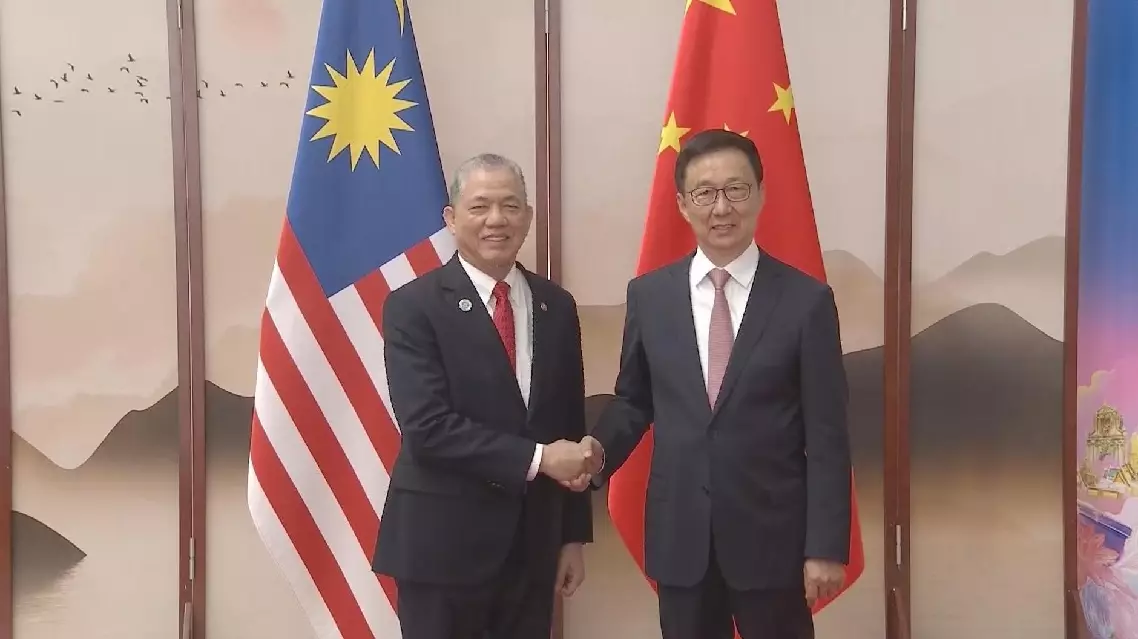
Chinese vice president meets Malaysia's deputy PM
China unveiled a large wind-assisted propulsion system for ships in the coastal city of Dalian, northeast China's Liaoning Province, on Friday, marking a major leap forward for the country in the field of high-end vessel marine environmental protection equipment.
The wind-assisted propulsion system - rotating sail system (WAPS-RSS), is developed by Luoyang Ship Material Research Institute of China State Shipbuilding Corporation Limited (CSSC).
The system's rotor has diameter of 5 meters, is 35 meters high, and weighs 150 tons.
Experts say that the system can efficiently capture wind energy while the ship is sailing, providing additional thrust for the vessel.
On average, it can save fuel consumption by 5 to 25 percent for large ocean-going vessels, and lower carbon emissions accordingly.
It relies on the Magnus effect, which is much like a loop in table tennis, featuring a rapidly spinning sphere that causes the surrounding air to rotate. Pressure decreases on the side with faster airflow and increases on the side with slower airflow, creating a lateral pressure difference that generates lateral thrust.
"Standing on the deck, the powerful thrust generated by its rotation assists the ship's sailing. Our system - the world's largest rotary sail - reaches a maximum rotational speed of 180 revolutions per minute and can generate a maximum of 355 kilonewtons of thrust. Additionally, the system's intelligent control integrates multiple sensors to detect real-time wind and ship conditions. Through smart algorithms, it automatically adjusts to maintain optimal performance at all times, maximizing the utilization of wind energy," said Guo Yu, vice president of SunRui Marine Environment Engineering Company Limited under Luoyang Ship Material Research Institute.
Not only does the system's performance meet international advanced standards, but the project team has also overcome a series of engineering challenges, including the fabrication of giant composite structures, complex system integration, and intelligent coordinated control.
Compared with mainstream international technological approaches, it offers greater production efficiency and cost advantages.
Currently, the system has secured its first batch of orders and will complete actual vessel applications as scheduled.
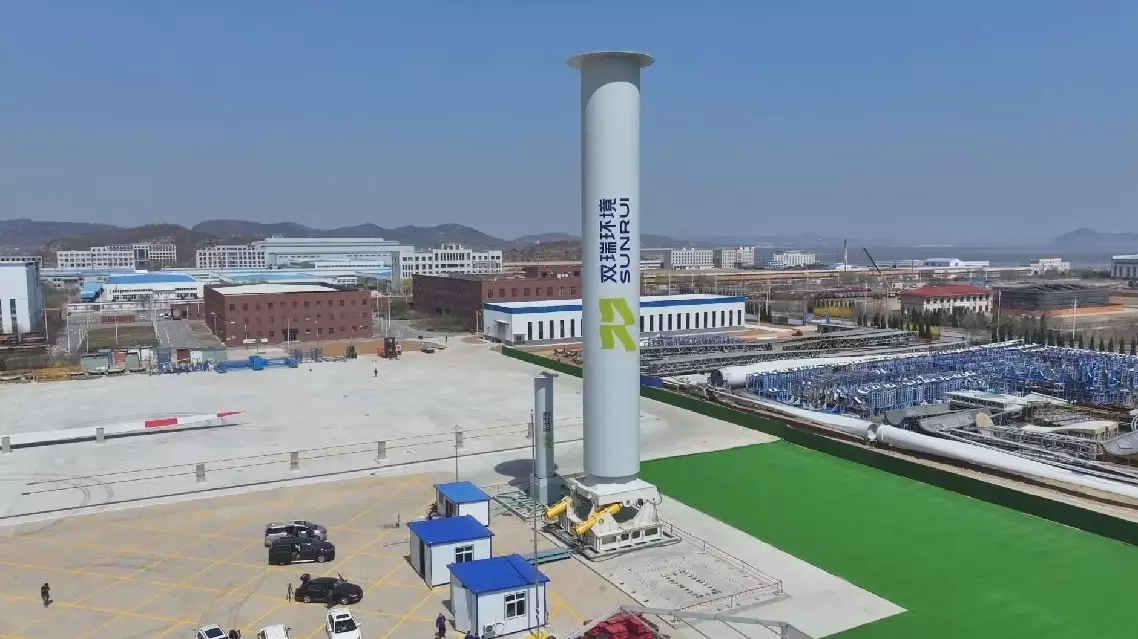
China unveils large wind-assisted propulsion system for ships