ANCHORAGE, Alaska (AP) — The brawny bruins on the Alaska Peninsula are ready to brawl it out to see which will win this year’s fattest bear title in the wildly popular annual online voting contest known as Fat Bear Week.
The main event featuring adult bears starts next week, but first up Thursday is what the National Park Service calls a “chubby cubby appetizer.” Fat Bear Jr. voters can cast ballots through Friday for their favorite adolescent ursine, with the winner advancing to the big show.
The contest, which began in 2014, is meant to showcase the resiliency of the brown bears, which pack on the pounds each fall to survive the harsh winter by gorging on salmon at Brooks River in remote Katmai National Park and Preserve. People can watch the bears on livestream cameras.
“It really is an opportunity for people to think about how bears survive, what they need to do to survive, what the ecosystem provides them and look at their individual success stories, as well,” said explore.org naturalist Mike Fitz, who started the contest when he was a ranger at Katmai.
This year's sockeye run has been abundant, so voters can expect some especially corpulent contestants.
Here’s a closer look at the popular online event:
The 12 bears — which will be announced Monday — will be featured in the single-elimination, bracket-style tournament. All voting is done online at www.fatbearweek.org, with the winner declared Sept. 30.
The first round features eight bears squaring off in four separate contests to advance to the second round. Four bears receive first-round byes.
There are about 2,200 brown bears within Katmai, a 6,562-square-mile (16,997-square-kilometer) park on the Alaska Peninsula, which extends from the state’s southwest corner toward the Aleutian Islands. To be featured in the contest, the bears must frequent the area of the main Brooks Camp.
Actually weighing the bears would be a dangerous and monumental task, so it's up to voters to judge size by looks alone. Male brown bears at Katmai weigh about 700 to 900 pounds (318 kg to 408 kg) mid-summer and can bloat to over a 1,000 pounds (454 kg) by September or October, thanks to successful foraging.
A 1,200-pound (544 kg) male bear isn’t unusual at Katmai. Others have been estimated to be about 1,400 pounds (635 kg). Females are about half to two-thirds the size of adult males.
There are factors other than girth to consider, Fitz said.
Voters could consider the challenges some contestants have had to overcome, such as the multitasking females who protect their young and produce milk for the cubs while also fattening up for winter themselves.
There’s precedent for a mama bear to take the prize. Grazer, the two-time defending Fat Bear Week champion, beat one of the biggest bears in the Brooks River, Chunk, in last year’s final.
Even though the contest is virtual, the two bears did actually fight it out in the park months earlier. Chunk attacked one of Grazer’s cubs after it fell over a waterfall, an attack that was broadcast live. Grazer fought off Chunk, but the cub later died.
Chunk is back at the park this year but returned to Brooks River in June with a broken jaw, Fitz said. The right side of his jaw is hanging loose and will never heal properly.
It probably happened in a fight with another bear. When they attack each other, they target the head and neck, and sometimes they lock jaws. The torque can snap a brown bear’s mandible.
The good news for Chunk is that he’s already adapted to his new disability and it doesn't seem to have affected his appetite. He remains one of the largest bears on the river.
Brooks Falls is famous for brown bears snagging salmon out of the air as the fish try to jump upstream to get to their spawning ground.
That didn’t happen much this year, as an exceptional salmon run reduced the need for bears to compete for fishing spots at the falls.
“We are kind of expecting really to have some of the fattest bears we’ve ever seen in the event,” Fitz said.
Fat Bear Jr. is going to have a familial feel to it this year.
In one semifinal Thursday, cub 128 Junior will face off against a pair of cubs competing together.
Cub 128 Junior is the offspring of two-time champ Grazer and sibling of the bear killed by Chunk last year.
She will face the 803s, cubs from bear 803. They are known for being mischievous, trying to get into vehicles and boats, and playing with one of the livestream cameras.
The other semifinal pits siblings from the same spring litter of bear 26. 26 Female is smaller and lighter in color than her brother, 26 Male, and a little more subdued. The male is bolder than his sister, which might give him an edge if food is limited.

Grazer, a female bear who is the two-time defending champion in the popular online Fat Bear Week competition, is shown Sept. 27, 2024, in Katmai National Park and Preserve, Alaska. (M. Carenza/National Park Service via AP)
MADISON, Wis. (AP) — Democrats across the country are proposing state law changes to rein in federal immigration officers and protect the public following the shooting death of a protester in Minneapolis and the wounding of two people in Portland, Oregon.
Many of the measures have been proposed in some form for years in Democratic-led states, but their momentum is growing as legislatures return to work amid President Donald Trump’s national immigration crackdown following the killing of Renee Good by an Immigration and Customs Enforcement agent in Minneapolis. Republicans are pushing back, blaming protesters for impeding enforcement of immigration laws.
Democratic Gov. Kathy Hochul wants New York to allow people to sue federal officers alleging violations of their constitutional rights. Another measure aims to keep immigration agents lacking judicial warrants out of schools, hospitals and houses of worship.
Oregon Democrats plan to introduce a bill to allow residents to sue federal agents for violating their Fourth Amendment rights against unlawful search and seizure.
New Jersey’s Democrat-led Legislature passed three bills on Monday that immigrant rights groups have long pushed for, including a measure prohibiting state law enforcement officers from cooperating with federal immigration enforcement. Democratic Gov. Phil Murphy has until his last day in office Tuesday to sign or veto them.
California lawmakers are proposing to ban local and state law enforcement from taking second jobs with the Department of Homeland Security and make it a violation of state law when ICE officers make “indiscriminate” arrests around court appearances. Other measures are pending.
“Where you have government actions with no accountability, that is not true democracy,” Democratic state Sen. Scott Wiener of San Francisco said at a news conference.
Democrats in Georgia introduced four Senate bills designed to limit immigration enforcement — a package unlikely to become law because Georgia’s conservative upper chamber is led by Lt. Gov. Burt Jones, a close Trump ally. Democrats said it's still important to take a stand.
“Donald Trump has unleashed brutal aggression on our families and our communities across our country,” said state Sen. Sheikh Rahman, an immigrant from Bangladesh whose district in suburban Atlanta’s Gwinnett County is home to many immigrants.
Democrats in New Hampshire have proposed numerous measures seeking to limit federal immigration enforcement, but the state's Republican majorities passed a new law taking effect this month that bans “sanctuary cities.”
In Tennessee, instead of considering a Democratic measure that would limit civil immigration enforcement at schools and churches, Republican House Speaker Cameron Sexton said he was working with the White House on a separate package of immigration-related bills. He hasn't said what they would do.
The Trump administration has opposed any effort to blunt ICE, including suing local governments whose “sanctuary” policies limit police interactions with federal officers.
States have broad power to regulate within their borders unless the U.S. Constitution bars it, but many of these laws raise novel issues that courts will have to sort out, said Harrison Stark, senior counsel with the State Democracy Research Initiative at the University of Wisconsin Law School.
“There’s not a super clear, concrete legal answer to a lot of these questions,” he said. “It’s almost guaranteed there will be federal litigation over a lot of these policies.”
That's already happening.
California in September was the first to ban most law enforcement officers, including federal immigration agents, from covering their faces on duty. The Justice Department said its agents won't comply and sued California, arguing that the laws threaten the safety of officers who are facing “unprecedented” harassment, doxing and violence.
The Justice Department also sued Illinois last month, challenging a law that bars federal civil arrests near courthouses, protects medical records and regulates how universities and day care centers manage information about immigration status. The Justice Department claims the law is unconstitutional and also threatens federal officers’ safety.
Minnesota and Illinois, joined by their largest cities, sued the Trump administration this week. Minneapolis and Minnesota accuse the Republican administration of violating free speech rights by punishing a progressive state that favors Democrats and welcomes immigrants. Illinois and Chicago claim “Operation Midway Blitz” made residents afraid to leave their homes.
Homeland Security spokesperson Tricia McLaughlin accused Minnesota officials of ignoring public safety and called the Illinois lawsuit “baseless.”
Associated Press writers John O’Connor in Springfield, Illinois; Sophie Austin in Sacramento, California; Mike Catalini in Trenton, New Jersey; Jonathan Mattise in Nashville, Tennessee; Anthony Izaguirre in Albany, New York; Claire Rush in Portland, Oregon; and Jeff Amy in Atlanta contributed.
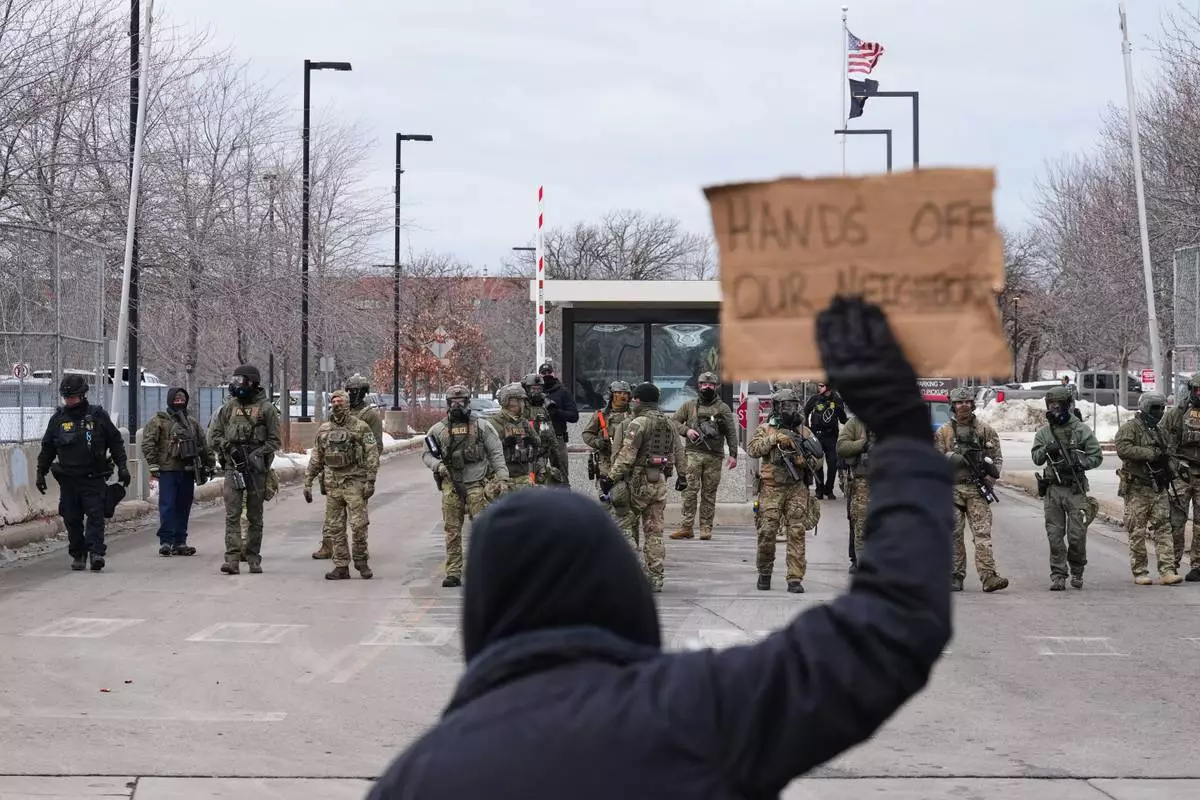
Protesters confront federal immigration officers outside the Bishop Henry Whipple Federal Building, Tuesday, Jan. 13, 2026, in Minneapolis. (AP Photo/Adam Gray)