LONDON--(BUSINESS WIRE)--Sep 18, 2025--
Vialto Partners, a leader in global work, tax, and immigration solutions, today announced the appointment of Matthew Harrison as UK Partner, where he will lead the firm's rapidly growing private client tax team in London. Matthew will play a pivotal role advising individuals, trustees, and family offices on all aspects of personal taxation, with a particular focus on international tax matters. He will report directly to James Bruce, UK Chief Executive Officer.
This press release features multimedia. View the full release here: https://www.businesswire.com/news/home/20250918943478/en/
Matthew joins Vialto Partners with nearly two decades of experience in private tax advisory. Most recently, he served as a Director within EY’s Private Client Tax practice, where he advised high net worth individuals, their trusts, and other family investment vehicles, with a particular focus on the remittance basis of taxation. He was also central to discussions with HMRC on the 2025 Finance Act, where he led on introducing new regime change for foreign income and gains. Prior to this, Matthew held various senior roles at Withers, Babbé, and STP Advisors Limited, where he advised across a broad range of private client tax solutions.
Vialto Partners’ private client offering is designed to meet the growing demand for bespoke mobility services at a time when regulatory complexity, wealth mobility, and cross-border compliance pressures are intensifying. Unlike providers that focus narrowly on immigration or tax, Vialto delivers a holistic, end-to-end service model—covering tax, immigration, payroll, social security, compensation, and relocation— all underpinned by advanced technology and deep local expertise.
“High-net-worth individuals often fall outside the traditional corporate mobility model, requiring bespoke support that spans tax, immigration, and personal relocation,” said James Bruce, UK Chief Executive Officer. “Matthew’s experience with complex, high-touch cases makes him uniquely positioned to address these challenges and further elevate our private client offering across EMEA and reinforce Vialto’s leadership in this fast-growing market.”
“I’m delighted to be joining Vialto Partners at such a pivotal time for the firm,” said Matthew Harrison, UK Partner. “In today’s increasingly complex world, clients require bespoke, cross-border solutions. Vialto’s deep bench of sector experts is positioned to deliver on this need, and I look forward to contributing to that success.”
This appointment underscores Vialto Partners’ commitment to becoming the partner of choice for private clients worldwide, delivering seamless mobility solutions that combine tax, immigration, and mobility expertise with cutting-edge technology designed to anticipate tomorrow’s challenges.
About Vialto Partners
Vialto Partners is a leading provider of integrated solutions for global work, including immigration, tax, managed services, and digital transformation. Trusted by multinational organizations around the world, Vialto combines deep technical expertise with cutting-edge technology to solve the most complex cross-border challenges and enable seamless mobility experiences.
Learn more at www.vialto.com

Matthew Harrison
LONDON (AP) — Britain’s government is expected to approve a “mega” Chinese Embassy close to London’s financial district after years of controversy and political wrangling over the potential security risks it poses to the U.K.
Lawmakers from across the spectrum have urged planning officials to reject China’s application for the new embassy. Critics fear the proposed new building, on a huge site close to London’s financial district and crucial data cables, will be used as a base for espionage. Others say the supersized embassy — set to be the biggest Chinese Embassy in Europe — will pose a heightened threat of surveillance and intimidation to Chinese dissidents in exile.
The decision was initially slated for October, but it was repeatedly postponed after multiple allegations of Chinese spying and political interference piled pressure on the British government.
British media have reported that the decision to approve the embassy will come this week, ahead of Prime Minister Keir Starmer's expected trip to China. The closely watched visit would be the first made by a British prime minister since 2018.
A final decision on the embassy is expected by Jan. 20, the deadline set by the government.
Here's a look at why the embassy has been the focus of protests and Sino-British tensions for years:
The proposed embassy at Royal Mint Court — the former site of the U.K.’s coin maker, near the Tower of London — will cover about 20,000 square meters (215,278 square feet) and replace several Chinese official buildings across London.
Critics say the new site sits too close to underground fiber optic cables carrying sensitive financial information between London’s two main financial districts.
Conservative Party lawmaker Alicia Kearns said that risks handing over access to data that would give China’s government “a launchpad for economic warfare against our nation.” She cited news reports that the building complex would include 208 secret basement rooms close to the data cables.
Dissidents have also been among hundreds of people who have protested the plans, saying a mega-embassy housing large numbers of officials would further China’s repression of activists abroad.
Lawmakers from the governing Labour Party who oppose the plan say concerns include “the recent track record of Chinese espionage cases, interference activities and issuing of bounties against U.K.-based Hong Kongers.”
The site was bought by China’s government for 225 million pounds ($301 million) in 2018, but plans for the embassy have been delayed since.
Local officials rejected the initial application over concerns that the embassy would attract many large protests, affecting the safety of residents and tourists. China resubmitted its proposals after the Labour government took power last year.
Bronwen Maddox, director of the London think tank Chatham House, said she believed Britain's government should approve the proposed mega-embassy “given that MI5 and MI6 (U.K. intelligence agencies) have said they are not worried about the city cables underneath it."
“I guess that you could see why there is cause for concern, but what I think the government should be much tougher on is what exactly is China going to do with that embassy, never mind the building; what about the people in it? Why does it need so many? What are they going to do?"
China has complained about the seven-year delay in approving the project, saying the U.K. was “constantly complicating and politicizing the matter.”
“The development scheme of the new Chinese Embassy is of high quality and has been highly recognized by local professional bodies,” the Chinese embassy said in a statement in October. “The application complies with diplomatic practice and local regulations and procedures.”
Chinese Foreign Ministry spokesman Lin Jian has warned that if the embassy isn’t approved, “the consequences arising therefrom shall be borne by the U.K. side.”
Recent high-profile cases involving alleged Chinese espionage have raised alarms about the embassy.
In November, the domestic intelligence agency, MI5, issued an alert to lawmakers warning that Chinese agents were making “targeted and widespread” efforts to recruit and cultivate them using LinkedIn or cover companies.
Authorities believe the alleged “headhunters” were trying to gain access to sensitive information about Parliament and Britain’s government.
Beijing has strongly denied the claims, calling them “pure fabrication and malicious slander.”
Earlier, Britain’s government faced questions on whether it had interfered in the trial of two alleged Chinese spies in order to preserve good ties with China.
Former parliamentary researcher Christopher Cash and academic Christopher Berry were charged last year with spying for Beijing. But their trial collapsed at the last minute because the U.K. government refused to brand China a threat to national security, the country’s chief prosecutor said.
Facing criticism that he is not taking a tough enough stance on the security risks, Starmer has stressed that while protecting national security is non-negotiable, Britain needs to keep up diplomatic dialogue and cooperation with the Asian superpower.
“This is not a question of balancing economic and security considerations. We don’t trade off security in one area, for a bit more economic access somewhere else,” he has said.
Last year, Starmer said Chinese President Xi Jinping personally raised the matter during a phone call.
Opposition lawmaker Priti Patel derided Starmer as “Beijing’s useful idiot in Britain.”
“Starmer’s ‘reset’ with Beijing is a naive one-way street, which puts Britain at risk while Beijing gets everything it wants,” she said.
Associated Press writer Danica Kirka contributed to this report.
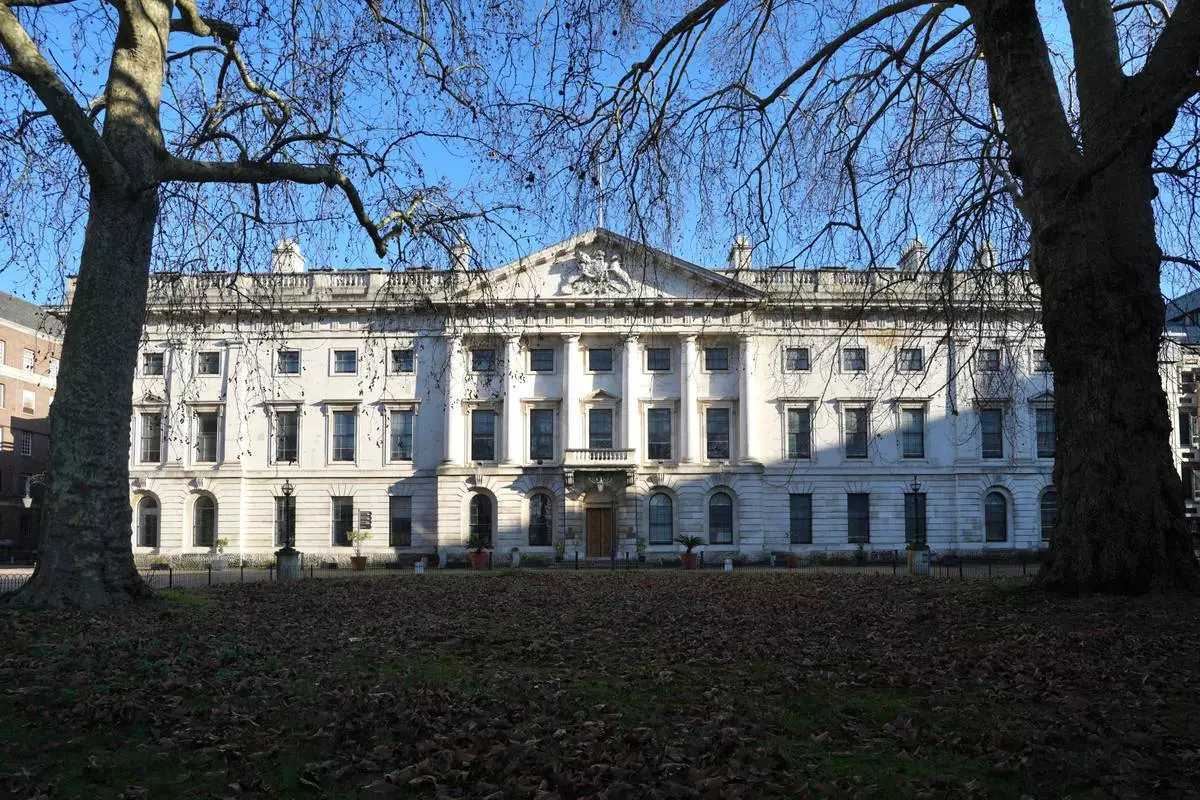
A general view of Royal Mint Court where is planning site for the new London Chinese embassy, near London's financial district, Wednesday, Jan. 14, 2026. (AP Photo/Kin Cheung)
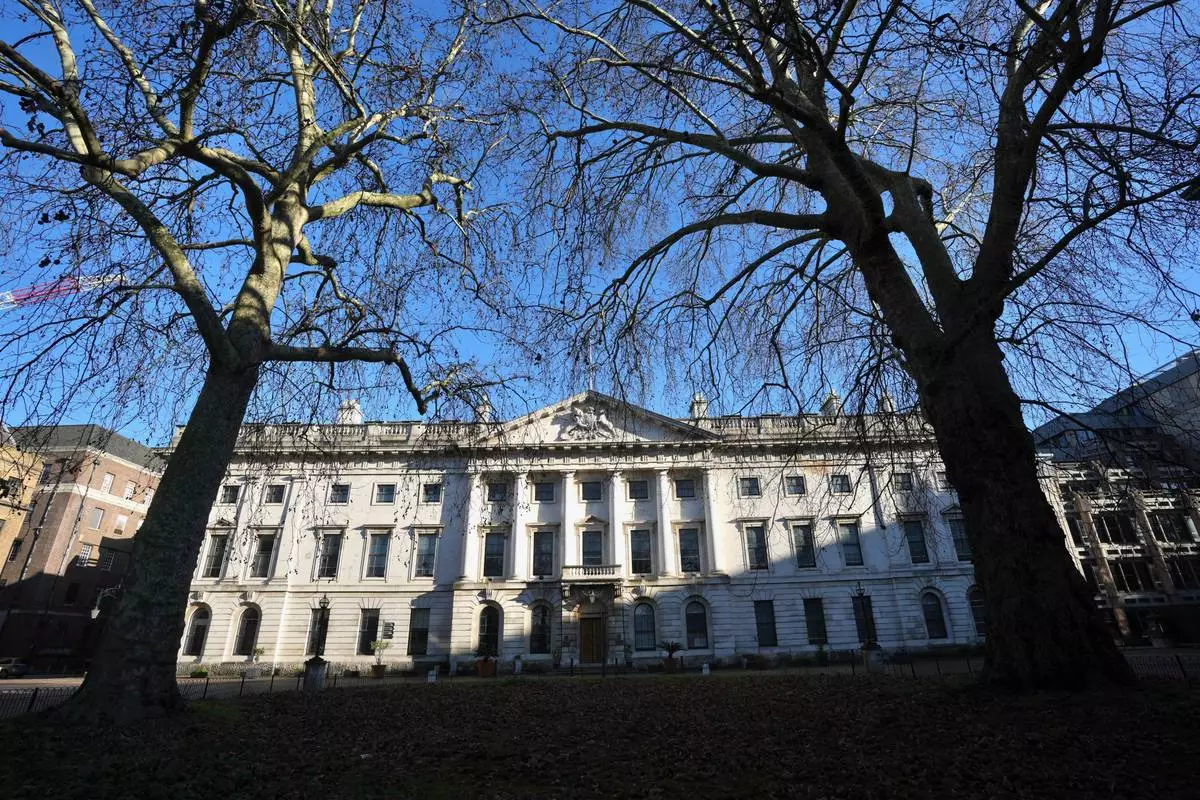
A general view of Royal Mint Court where is planning site for the new London Chinese embassy, near London's financial district, Wednesday, Jan. 14, 2026. (AP Photo/Kin Cheung)
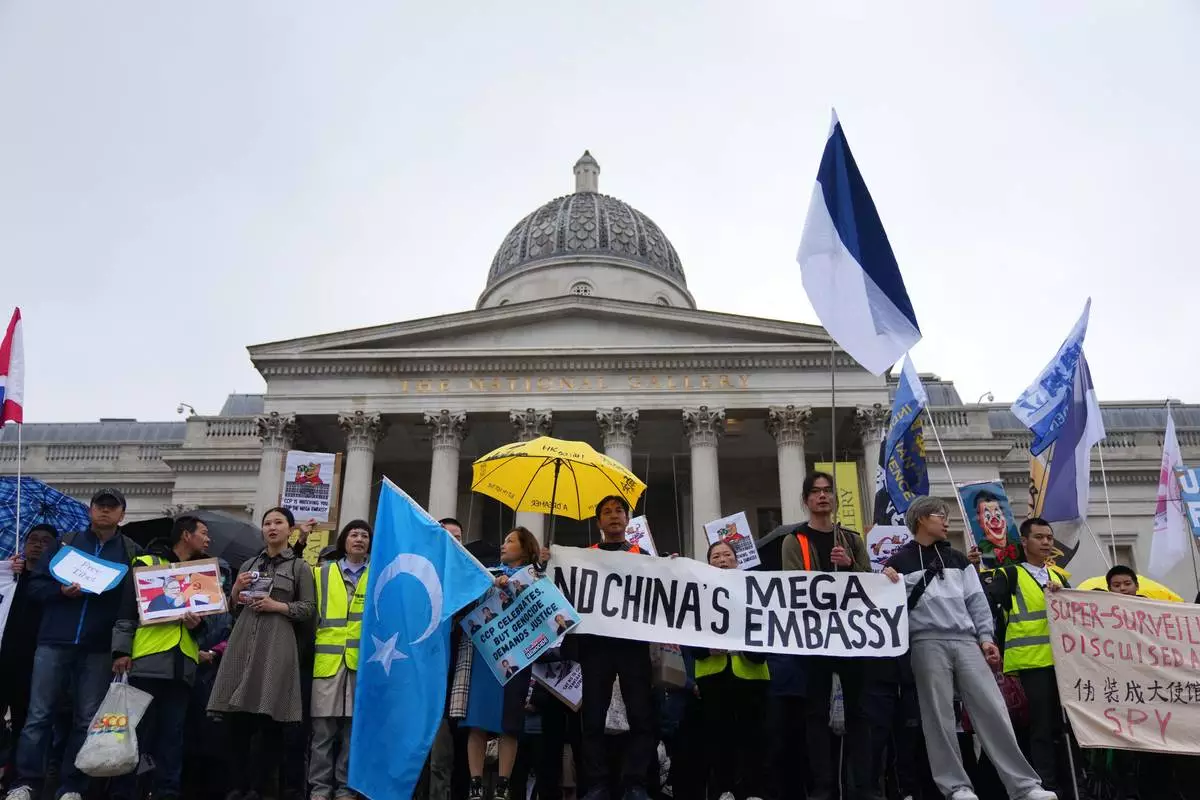
FILE - Protesters hold umbrellas, placards, and flags as they demonstrate against the proposed building of a new Chinese embassy, and to mark the 11th year of the Umbrella Revolution in Hong Kong, in London, Sunday, Sept. 28, 2025. (AP Photo/Joanna Chan, file)
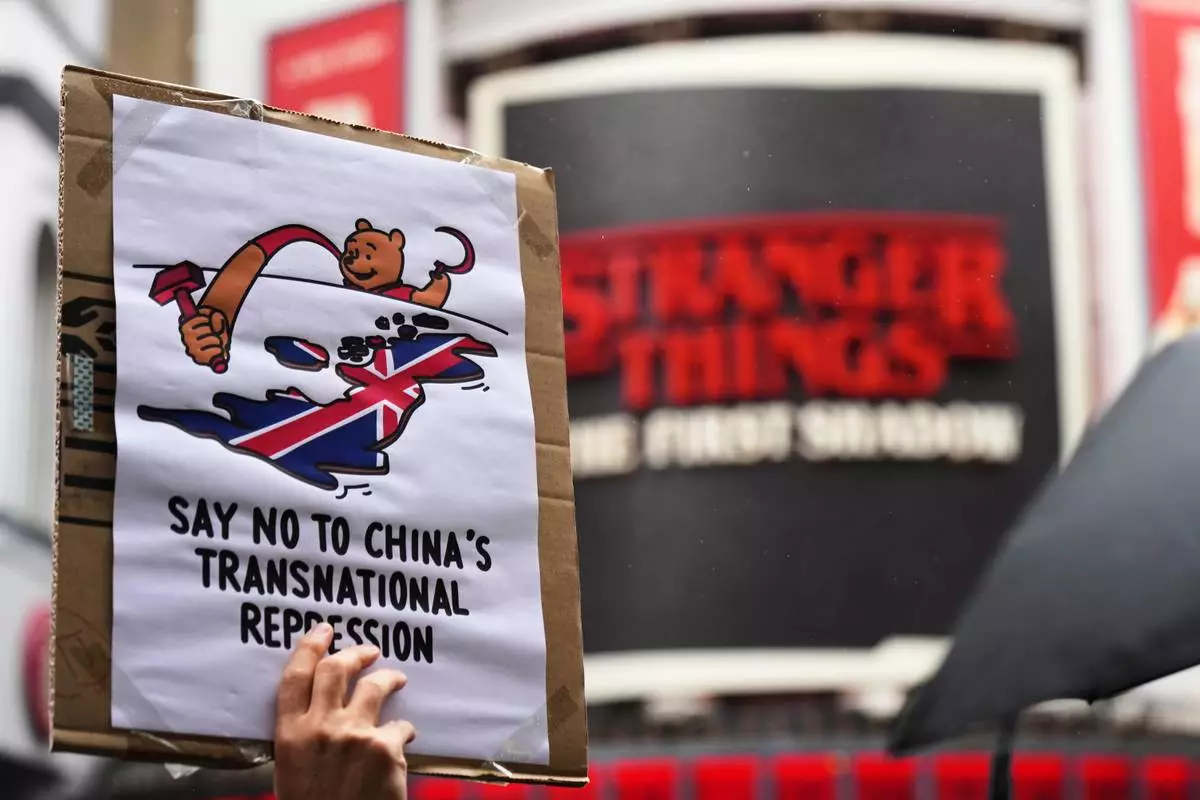
FILE - Protesters hold umbrellas, placards, and flags as they demonstrate against the proposed building of a new Chinese embassy, and to mark the 11th year of the Umbrella Revolution in Hong Kong, in London, Sunday, Sept. 28, 2025. (AP Photo/Joanna Chan, file)