China's Ministry of Industry and Information Technology (MIIT) released the New-type Energy Storage Technology Development Roadmap (2025-2035) on Wednesday at the main forum of the World Energy Storage Conference 2025, providing guidance and reference for further promoting high-quality industrial development and high-level industrial security.
This roadmap focuses on five key subfields: electrochemical energy storage, mechanical energy storage, electromagnetic energy storage, cold thermal energy storage, and hydrogen storage. It outlines key products, essential materials and components, as well as development goals for various fields leading up to 2035.
"From a national perspective, the roadmap systematically evaluates the development status of different technology industrial chains. On the enterprise level, it also presents specific indicators for product development and outlines future development direction," said Zhang Yanli, associate researcher at the Equipment Industry Development Center of the MIIT.
Currently, the country's new-type energy storage technologies are developing rapidly, with a surge of innovative achievements emerging.
A newly released energy storage system in China is the world's first to achieve zero degradation over five years and can be mass-produced on a large scale. It boasts a storage capacity of 6.25 megawatt-hours (MWh) of high energy within a single 20-foot container, with energy density increased by 30 percent.
Meanwhile, the application scenarios for new technologies are also continuously expanding. At present, Shanghai's Mingdong Container Terminal, a key hub for global trade, is undergoing new energy transformation of fuel equipment.
"Custom battery packs have been specifically developed, featuring an electrophoretic powder coating and painting process on the battery housing, making them fully capable of withstanding the high-salinity and high-humidity environment of the port," said Zhou Gong, product engineer at China's CATL, the world's largest battery maker.
In the first half of this year, the country's installed capacity of new-type energy storage had reached 94.91 million kilowatts, representing an increase of approximately 29 percent compared to the end of 2024.
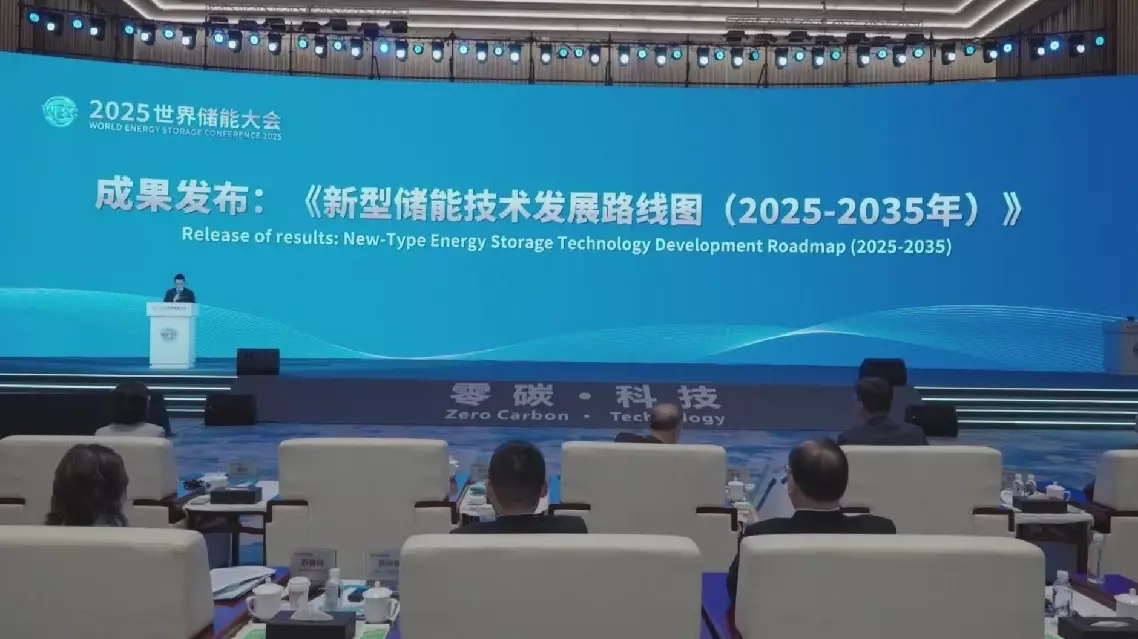
China releases New-type Energy Storage Technology Development Roadmap (2025-2035)
Smart technologies have reshaped China's ecological and environmental monitoring system, Huang Runqiu, minister of Ecology and Environment, said Thursday in Beijing on the sidelines of the fourth session of the 14th National People's Congress(NPC).
"Regarding ecological and environmental monitoring, we have been promoting the digitalization, informatization, and intelligentization of the entire monitoring process in recent years, reshaping the ecological and environmental monitoring system. For instance, in water environment monitoring and sampling, we have used intelligent drones which can quickly locate sampling points, collect samples accurately, return rapidly, and they are safe and reliable, improving work efficiency by over 70 percent. They are particularly advantageous for sampling during flood seasons and in remote areas," Huang told the press.
"In terms of environmental sample analysis, we have developed 'lights-out laboratories' in recent years. As the name suggests, these labs operate without lights and are unattended. Through robotic arms, robots, and intelligent management systems, they achieve full-process automation and intelligence from sample handover, testing, and analysis to report generation. This has significantly enhanced work efficiency, increasing it by more than eightfold compared to traditional labs. More importantly, it reduces human interference, human error, and even data falsification," he said.
Thanks to the improved ecological and environmental supervision capabilities, the number of environmental violation cases nationwide has decreased from 130,000 five years ago to 43,000 last year, representing a decline of 68 percent, Huang said.
The minister said China has already applied environmental DNA technology in the biodiversity monitoring work.
"In the field of biodiversity monitoring, monitoring aquatic organisms remains a weak point. However, significant progress has been made in recent years as we have developed environmental DNA technology. Although this chip is very small in size, it contains DNA detection information for aquatic organisms, including the finless porpoise and the Chinese sucker, from 19 state-controlled sections in the Jiangsu segment of the Yangtze River. The results showed that over the past five years, more than 20 species of aquatic organisms have increased in this river section, fully demonstrating the tangible effectiveness of the ten-year fishing ban in the Yangtze River," Huang said while showing a chip to reporters.
The 14th NPC, China's national legislature, concluded its fourth session on Thursday.
Smart technologies reshape China's ecological, environmental monitoring system: minister