Dong Yuanfu, a painted pottery inheritor in Turpan City of northwest China's Xinjiang Uygur Autonomous Region, has dedicated over three decades of his life to preserving the ancient art and intangible cultural heritage.
What began as a childhood hobby of molding clay toys grew into his life's passion. Today, Dong scales mountains to gather soil, shapes vessels, and paints intricate designs, engaging in a dialogue with a civilization from three millennia ago at the potter's wheel.
The inheritor of the intangible cultural heritage of painted pottery stressed that painted pottery is more than a simple artifact for him. It has become his life, an inseparable part of his being.
"I first came to know about painted pottery when I was 11 or 12 years old. I started by making some small articles such as small tanks or cars. When I held the finished products in my hands, the sense of accomplishment led me to an obsession with painted pottery," he said.
The painted pottery techniques of Turpan date back more than 3,000 years. During the flourishing era of the Silk Road, Turpan became a vital hub of trade and cultural exchange, creating fertile ground for the development of painted pottery techniques.
Over the centuries, these techniques have drawn on their rich heritage, evolving continuously and culminating in today's exquisite delicacy and complexity, where every link is intricately interconnected. The regions surrounding Turpan contain unique kaolin clay found high in the mountains. It must be painstakingly dug out with pickaxes, carried down in sacks, and then crushed and mashed into mud.
"Then, it is crushed and turned into a slurry. And then, the mud is precipitated and refined. While the whole process is exhausting, it can turn the kaolin clay into fine and resilient clay for pottery," Dong said.
"Shaping is a key step that requires considerable skill. As the machine turns, the clay rises and slowly transforms. Each adjustment and application of force will decide the final shape of the painted pottery," he continued.
"Then, painting the patterns instills a soul into the pottery. The patterns on the painted pottery of Turpan are prized treasures of Chinese culture. The fire pattern represents an ancient totem passed down through generations, while the continuous weaving pattern represents infinite life and auspicious eternity. There is a story behind each pattern. It may be awe of nature, or yearning for a good life," he said.
Rapid socioeconomic growth brought the dominance of industrial porcelain. Today, people use painted pottery less and less in daily life. Most craftsmen have laid aside their ancestral skills, while the younger generation shows little interest in inheriting or learning the tradition. As a result, this ancient art is in danger of being forgotten, according to Dong.
Confronting the impact of industrialization and the risk of this craft being lost, he began training villagers through classes.
"We began training some villagers last year. After about three months, they were able to make small items on their own," he said.
"For me, painted pottery is a way of life, a passion, and a form of perseverance. My biggest wish is that more people could take part in making and inheriting the craft of painted pottery. And I would like to have more opportunities to demonstrate the techniques of painted pottery to more people, so they appreciate it and become involved," he said.
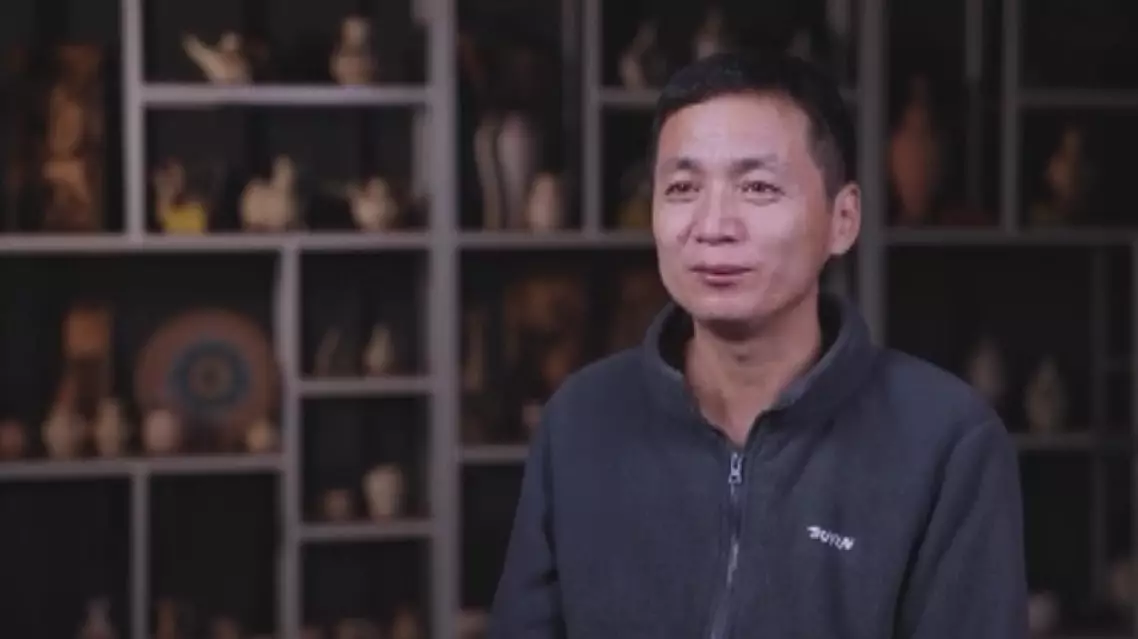
Guardian of painted pottery art in Xinjiang keeps cultural heritage alive