OREM, Utah (AP) — It took two decades for Utah Valley University to evolve from a small community college into the state's largest school, boasting of having one of the safest campuses in the nation.
It took only seconds for that image to be shattered by the assassination of right wing activist Charlie Kirk.
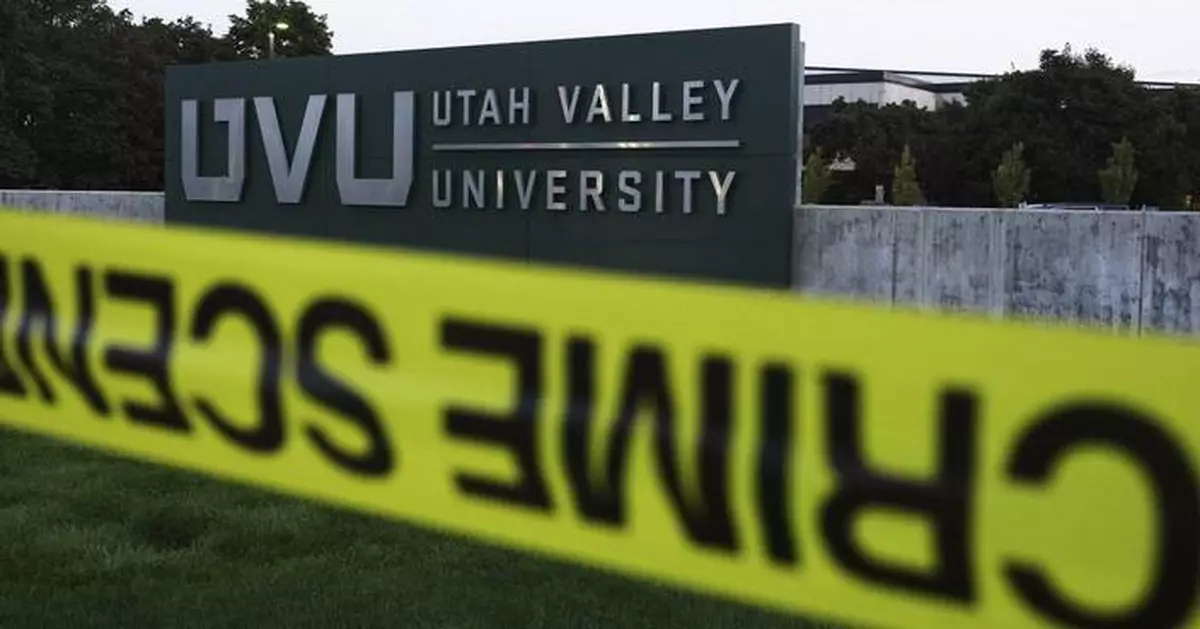
The sprawling campus of nearly 50,000 students beneath the Wasatch Mountains will be forever tethered to the events of Sept. 10, when a bullet took down the founder of Turning Point USA as he spoke to a large crowd at an outdoor amphitheater in the middle of campus.
The university — largely unknown outside Utah until now — was fixed in an unwanted national spotlight during the search for Kirk’s killer. Students and faculty returned to classes this week still reeling with grief, fear and anxiety, and confronting a thorny question: How do they deal with UVU's sudden infamy?
“This has put the university on the map and given it more attention than it’s ever received,” said branding expert Timothy Calkins, a professor at Northwestern University. “They certainly didn’t want this situation. But they have to find some way to come back.”
University leaders say they're focused right now on the safety of students and their community, but they're already starting to think about how to reshape the school's shattered identity.
Kyle Reyes, one of Utah Valley University’s vice presidents, said he hopes the school can be a model of healing and embracing difficult dialogue.
“We know that the eyes are on us and we’re not going to shy away from demonstrating our resilience collectively on this,” Reyes said.
The school has had only minimal violence for years, according to data collected by the U.S. Department of Education. UVU's most recent report for its main campus in Orem, covering 2021-2023, showed police investigated or received reports on four aggravated assault allegations, 13 rape allegations, one apparent arson and no cases of murder or manslaughter. Kirk's killing was the first murder on campus that administrators are aware of, University spokeswoman Ellen Treanor said.
University officials cite this data to support the claim that it is “one of the safest colleges in the country.”
UVU also touts its strong connections to the Church of Jesus Christ of Latter-Day Saints, as home to the world’s largest education institute for young Mormons. Its mascot is the wolverine. “Just like wolverines, UVU students are determined, ambitious, and fearless,” the university’s website says.
Student Marjorie Holt, 18, who is studying elementary education at UVU, was late to the Kirk rally and arrived minutes before he was shot. She ran with others to shelter inside a nearby building in the immediate aftermath.
In the days since, Holt took time off from work and went home to spend a night with her family in Salt Lake City. She said she feels like the university failed Kirk and his family by not providing better security. She worries about going to classes in a building near the crime scene.
Yet as Kirk's shooting deepens the nation's political divides, Holt believes the shared trauma has brought UVU closer together.
“We're all people who, you know, loved him or hated him,” she said of Kirk. “We're all still coming together no matter how we believed, and I feel like this has made our school closer than ever.”
When students returned Wednesday, they reported classes were quieter than usual. Matthew Caldwell, 24, said that in history class, “it felt as if the professor was more understanding of all beliefs and that ultimately it’s about sharing those beliefs.”
Student body President Kyle Cullimore urged his classmates during a Friday vigil to stop putting labels on one another and see each other as human so that UVU can be a “place where disagreement doesn’t erase our dignity.”
Other schools that became synonymous with shootings offer different templates for addressing the fallout.
The Columbine High School massacre of 1999 ushered in heightened security and training for shooters at schools across the U.S. On the same day Kirk was killed, those protocols were put to test in a shooting at Colorado's Evergreen High School when two students were injured and the shooter took his own life. It's the same school district as Columbine, and officials credited years of preparation and training for avoiding more casualties.
Following shootings at Virginia Tech University in 2007, Connecticut's Sandy Hook Elementary School in 2012 and Florida's Marjory Stoneman Douglas High School in 2019, student victims and family members funneled their grief into activism for gun control.
In Uvalde, Texas, officials voted to demolish Robb Elementary School after a mass shooting that killed 19 students and two teachers.
At Kent State University, where National Guard soldiers killed four students and wounded eight others at a Vietnam War protest in 1970, Professor Johanna Solomon said the school has since leaned into its role as a place to freely express ideas.
There were struggles along the way. Starting in 1986, the Ohio school began changing athletics uniforms, letterhead and signage to highlight “Kent” and put “State University” in small letters underneath, trying to distance itself from the shooting. The change was dropped in 2000, said Karen Cunningham, a professor in Kent State's School of Peace and Conflict Studies that was established in response to the 1970 shootings.
“I'm very proud of their decision to realize as a university that it wasn't escaping or forgetting what happened,” said Solomon. “Leaders have a really stark choice after things like this happen, and one is to lean into division and the other side is to humanize people, to bring people together.”
As UVU students ventured back last week, Republican Utah Gov. Spencer Cox met with a small group on campus. “It has been rough, right, for all of us,” he acknowledged. The world only knows one thing about UVU now, he said — and he wants everyone to know the rest of the story.
“This place is incredible and it’s incredible because of the students that are here, amazing faculty,” Cox said. “The world desperately needs change, but they’re not going to find it from politicians. It’s got to come from you.”
__
Brown reported from Billings, Mont.
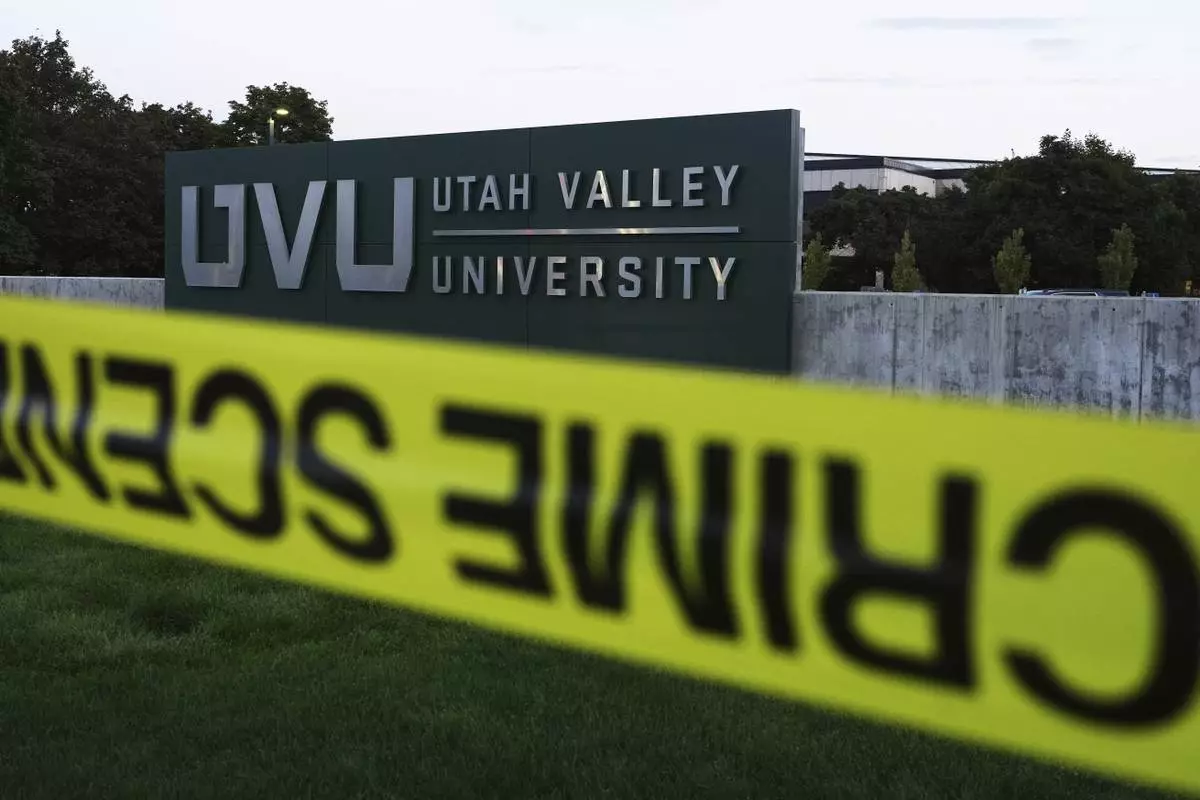
Crime scene tape surrounds Utah Valley University after Turning Point USA CEO and co-founder Charlie Kirk was shot and killed , Saturday, Sept. 13, 2025, in Orem, Utah. (AP Photo/Lindsey Wasson)
The U.N. Security Council scheduled an emergency meeting Thursday to discuss Iran's deadly protests at the request of the United States, even as President Donald Trump left unclear what actions he would take against the Islamic state.
Tehran appeared to make conciliatory statements in an effort to defuse the situation after Trump threatened to take action to stop further killing of protesters, including the execution of anyone detained in Tehran’s bloody crackdown on nationwide protests.
Iran’s crackdown on the demonstrations has killed at least 2,615, the U.S.-based Human Rights Activists News Agency reported. The death toll exceeds any other round of protest or unrest in Iran in decades and recalls the chaos surrounding the country’s 1979 Islamic Revolution.
Iran closed its airspace to commercial flights for hours without explanation early Thursday and some personnel at a key U.S. military base in Qatar were advised to evacuate. The U.S. Embassy in Kuwait also ordered its personnel to “temporary halt” travel to the multiple military bases in the small Gulf Arab country.
Iran previously closed its airspace during the 12-day war against Israel in June.
Here is the latest:
In a joint statement, the foreign ministers of Canada, France, Germany, Italy, Japan, the United Kingdom, the United States and the European Union’s main foreign policy chief said the G7 members were “gravely concerned” by the developments surrounding the protests, and that they “strongly oppose the intensification of the Iranian authorities’ brutal repression of the Iranian people.”
The statement, published on the EU’s website Thursday, said the G7 were “deeply alarmed at the high level of reported deaths and injuries” and condemned “the deliberate use of violence” by Iranian security forces against protesters.
The G7 members “remain prepared to impose additional restrictive measures if Iran continues to crack down on protests and dissent in violation of international human rights obligations,” the statement said.
China’s Foreign Minister Wang Yi has spoken with his counterpart in Iran, who said the situation was “now stable,” China’s Ministry of Foreign Affairs said.
Abbas Araghchi said “he hoped China will play a greater role in regional peace and stability” during the talks, according to the statement from the ministry.
“China opposes imposing its will on other countries, and opposes a return to the ‘law of the jungle’,” Wang said.
“China believes that the Iranian government and people will unite, overcome difficulties, maintain national stability, and safeguard their legitimate rights and interests,” he added. “China hopes all parties will cherish peace, exercise restraint, and resolve differences through dialogue. China is willing to play a constructive role in this regard.”
“We are against military intervention in Iran,” Turkish Foreign Minister Hakan Fidan told journalists in Istanbul on Thursday. “Iran must address its own internal problems… They must address their problems with the region and in global terms through diplomacy so that certain structural problems that cause economic problems can be addressed.”
Ankara and Tehran enjoy warm relations despite often holding divergent interests in the region.
Fidan said the unrest in Iran was rooted in economic conditions caused by sanctions, rather than ideological opposition to the government.
Iranians have been largely absent from an annual pilgrimage to Baghdad, Iraq, to commemorate the death of Imam Musa al-Kadhim, one of the twelve Shiite imams.
Many Iranian pilgrims typically make the journey every year for the annual religious rituals.
Streets across Baghdad were crowded with pilgrims Thursday. Most had arrived on foot from central and southern provinces of Iraq, heading toward the shrine of Imam al-Kadhim in the Kadhimiya district in northern Baghdad,
Adel Zaidan, who owns a hotel near the shrine, said the number of Iranian visitors this year compared to previous years was very small. Other residents agreed.
“This visit is different from previous ones. It lacks the large numbers of Iranian pilgrims, especially in terms of providing food and accommodation,” said Haider Al-Obaidi.
Europe’s largest airline group said Thursday it would halt night flights to and from Tel Aviv and Jordan's capital Amman for five days, citing security concerns as fears grow that unrest in Iran could spiral into wider regional violence.
Lufthansa — which operates Swiss, Austrian Airlines, Brussels Airlines and Eurowings — said flights would run only during daytime hours from Thursday through Monday “due to the current situation in the Middle East.” It said the change would ensure its staff — which includes unionized cabin crews and pilots -- would not be required to stay overnight in the region.
The airline group also said its planes would bypass Iranian and Iraqi airspace, key corridors for air travel between the Middle East and Asia.
Iran closed its airspace to commercial flights for several hours early Thursday without explanation.
A spokesperson for Israel’s Airport Authority, which oversees Tel Aviv’s Ben Gurion Airport, said the airport was operating as usual.
Iranian state media has denied claims that a young man arrested during Iran’s recent protests was condemned to death. The statement from Iran’s judicial authorities on Thursday contradicted what it said were “opposition media abroad” which claimed the young man had been quickly sentenced to death during a violent crackdown on anti-government protests in the country.
State television didn’t immediately give any details beyond his name, Erfan Soltani. Iranian judicial authorities said Soltani was being held in a detention facility outside of the capital. Alongside other protesters, he has been accused of “propaganda activities against the regime,” state media said.
New Zealand’s Foreign Minister Winston Peters said Thursday that his government was “appalled by the escalation of violence and repression” in Iran.
“We condemn the brutal crackdown being carried out by Iran’s security forces, including the killing of protesters,” Peters posted on X.
“Iranians have the right to peaceful protest, freedom of expression, and access to information – and that right is currently being brutally repressed,” he said.
Peters said his government had expressed serious concerns to the Iranian Embassy in Wellington.
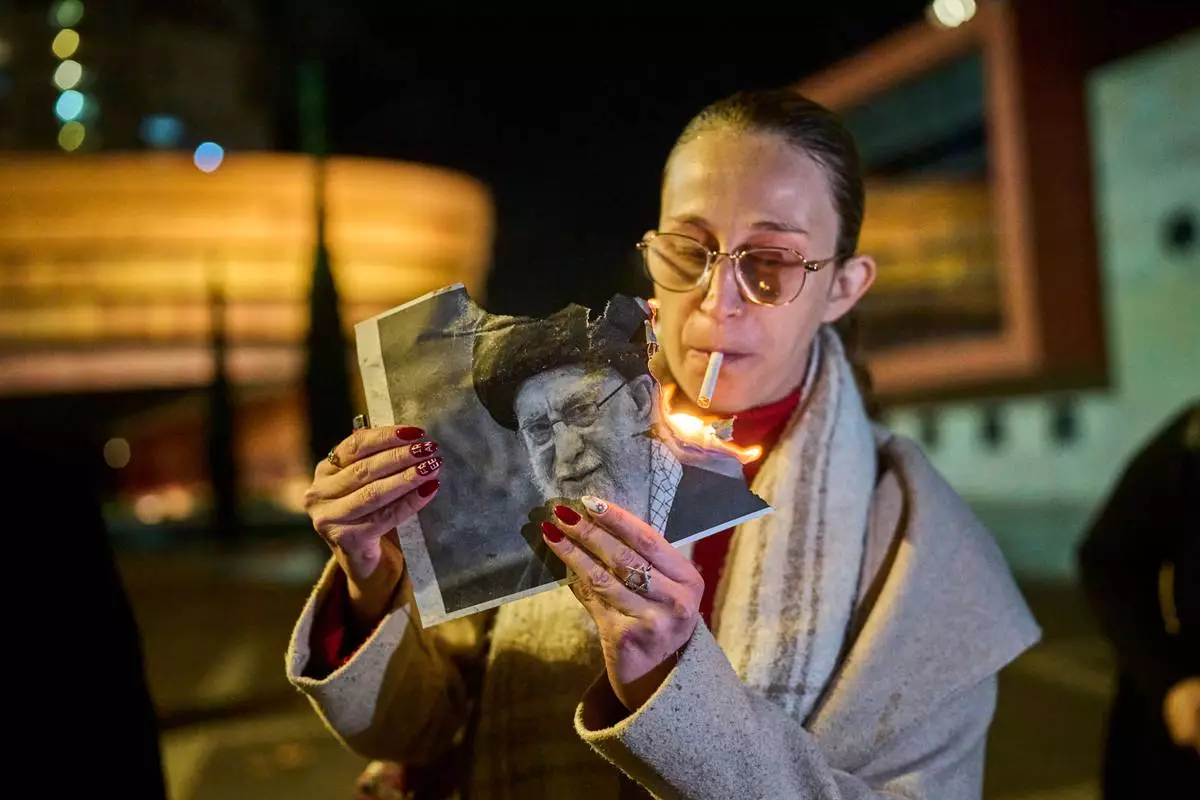
A demonstrator lights a cigarette with a burning poster depicting Supreme Leader Ayatollah Ali Khamenei during a rally in support of Iran's anti-government protests, in Holon, Israel, Wednesday, Jan. 14, 2026. (AP Photo/Ohad Zwigenberg)
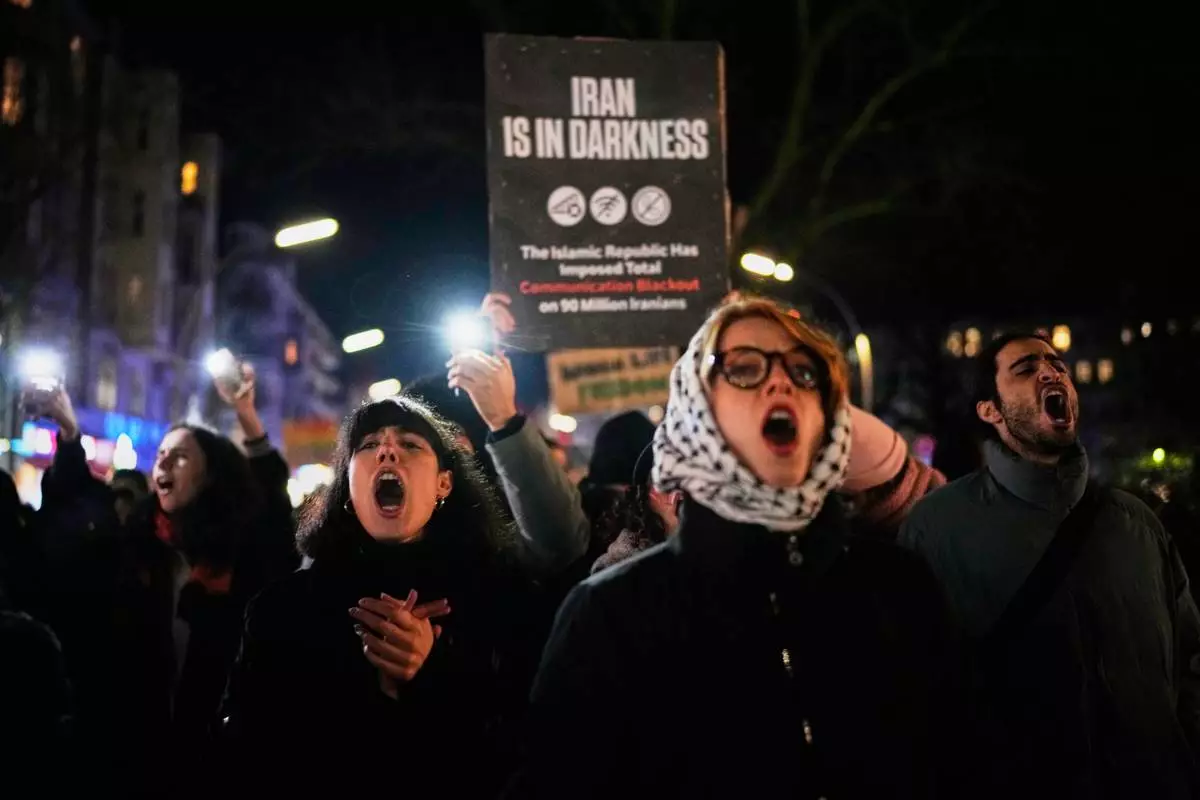
Protesters participate in a demonstration in support of the nationwide mass protests in Iran against the government, in Berlin, Germany, Wednesday, Jan. 14, 2026. (AP Photo/Ebrahim Noroozi)
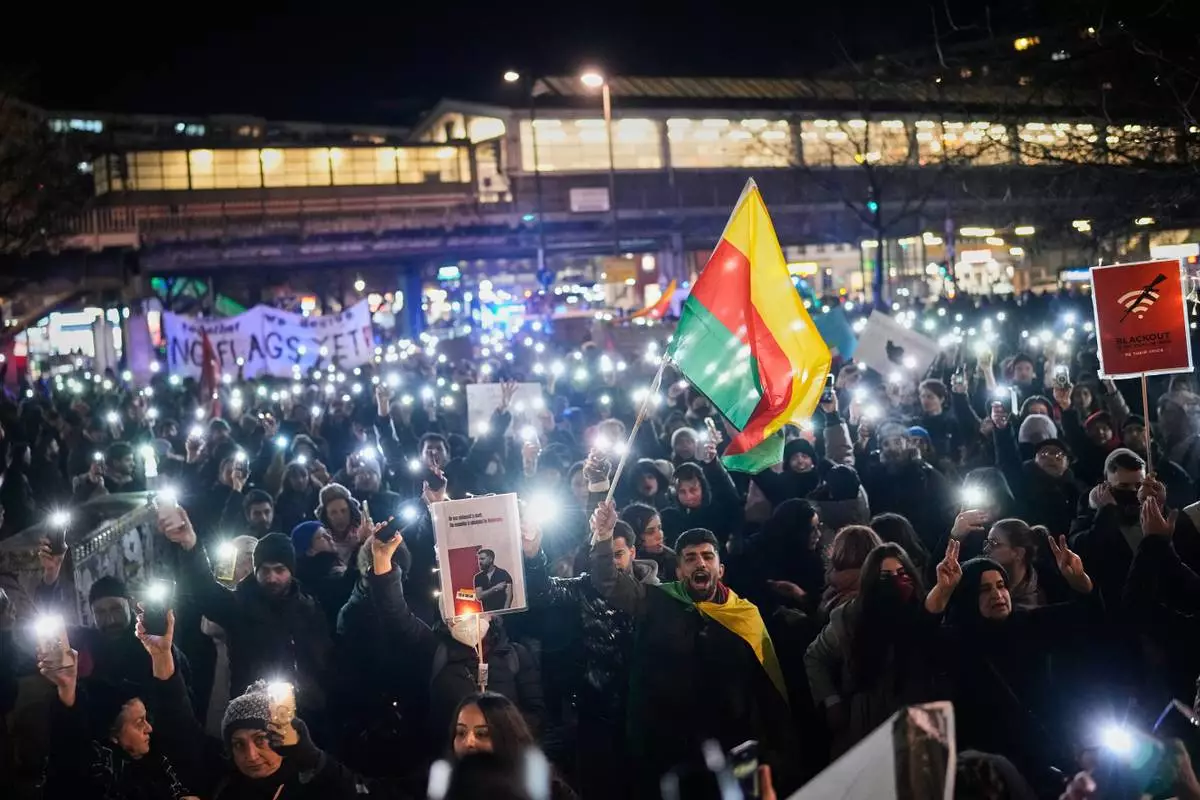
Protesters participate in a demonstration in support of the nationwide mass protests in Iran against the government, in Berlin, Germany, Wednesday, Jan. 14, 2026. (AP Photo/Ebrahim Noroozi)