Xinjiang has greatly expanded the construction of power grids and transmission routes in recent years, laying the foundations for plans to use the region's abundant coal, wind and solar resources to distribute power to millions of households in central and east China.
Spanning over 3,000 kilometers, a ±1100 kV ultra-high-voltage transmission line runs from the western corner of China to its eastern edge -- beginning in Xinjiang's Zhundong and ending in southern Anhui Province.
Along the line, workers operate drones in order to carry out crucial inspections, ensuring its safe and stable operation.
"Compared to the past when we had to use binoculars and walked the lines for inspection, drones are much more efficient and are not restricted by terrain. Equipped with infrared imagers and Light Detection and Ranging (lidar), they allow for faster, all-round inspections without blind spots," said Guo Jing, deputy team leader of the East Xinjiang Operations Division of Xinjiang Power Transmission and Transformation Company.
For these grid inspectors, there is little room for error. The line is used to carry out a massive transfer of power generated in Xinjiang to the manufacturing and business centers in the east China.
Thanks to the two-to-three-hour time difference, much of the region's green energy resources can be used to meet peak demand in the east.
At 8:00 in Beijing, when the morning rush pushes power demand to its peak, Xinjiang's wind farms are just beginning to generate, sending clean electricity across thousands of kilometers to the capital. By 20:00, when urban demand surges again at night, Xinjiang's solar farms are still at full output, delivering power across mountains and rivers to cities in central and east China.
Behind this precise power distribution lies millisecond-level intelligent scheduling.
"In the power dispatch control center, where all of Xinjiang's power data is collected, we monitor system load, renewable generation and demand across all regions in real time. With the automatic generation control system, we can allocate surplus renewable energy from southern Xinjiang to the north, and then transmit it nationwide," explained Zhu Qing, director of the power dispatch control department under the State Grid Xinjiang Electric Power Company's power dispatch control center.
As a key sending hub in China's west-to-east power transmission program, Xinjiang has five major outbound transmission routes passing through northwest China's Gansu, east China's Anhui and southwest China's Chongqing: from Hami to Dunhuang, Yandun to Shazhou, Hami South to Zhengzhou, Zhundong to Anhui, and Hami to Chongqing
To fully harness its coal, wind and solar resources, by the end of 2024, Xinjiang had built 32 kV ultra-high-voltage substations and 98 transmission lines with a total length of 12,300. Xinjiang has built the largest number of 750 kV substations of any provincial-level region in the country, as well as the longest 750 kV power transmission lines, achieving the widest coverage in the country.
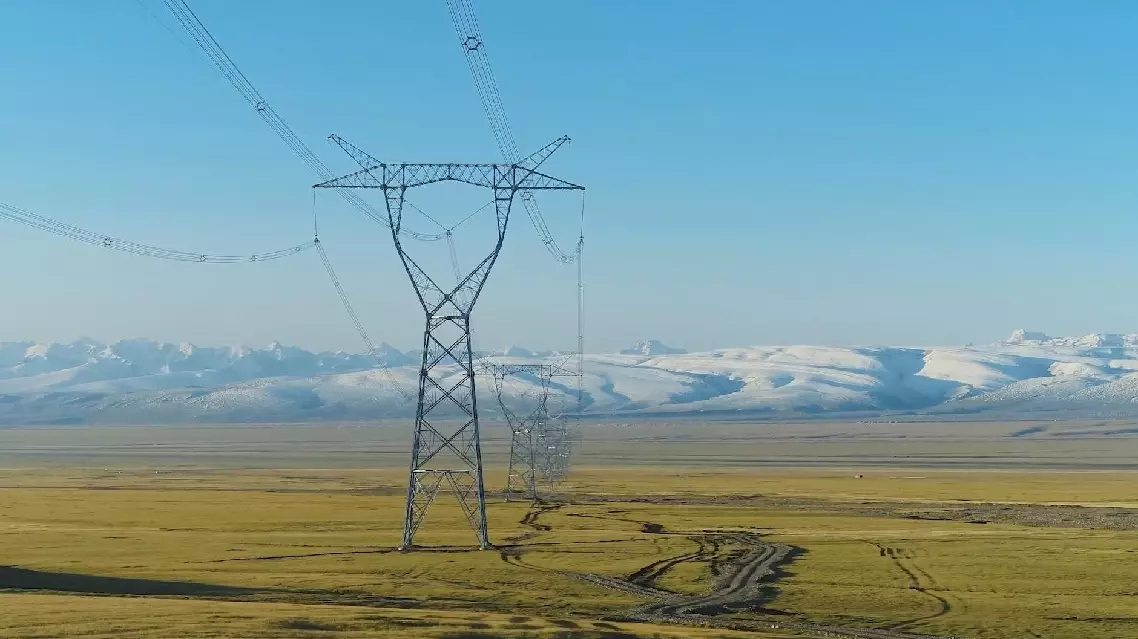
Xinjiang moves forward as power distributor, contributes to China's energy transformation
Xinjiang moves forward as power distributor, contributes to China's energy transformation
Xinjiang moves forward as power distributor, contributes to China's energy transformation