A young student from the Dominican Republic has shared her colorful journey across major Chinese cities and sites during her one-year stay in the country for a master's degree.
Rua, a 23-year-old woman from the sunny Caribbean island nation, embarked on a solo journey to China in 2025, moving from Santo Domingo to Beijing.
In her recap of her travels, she said it has been a year of firsts for her as she became an actress, learned to ride a bicycle, and enrolled in a master's degree program in directing at the Beijing Film Academy.
"For the first time, I came to Beijing to study the career of my dreams, directing at Beijing Film Academy," she said.
Arriving in a new country, she naturally faced numerous challenges, but what she felt most was the joy of exploration. She made the most of her time in China by traveling extensively, from the seashore of Qingdao to the grasslands of Inner Mongolia, and from cosmopolitan Shanghai to the ancient capital of Nanjing.
"More than ever before this year, I've had the opportunity to travel around China, and wow, what an experience it has been," she said.
Each city brought a unique charm to her journey, while all of her destinations showcased China's profound culture, which deeply fascinated her. The people, the harmony between tradition and modernity, and the country's broad development opportunities captured her heart in a short time.
Rua specially recalled her experience of celebrating the Spring Festival with a Chinese family, which left a deep and warm impression on her.
"This year, I also had the opportunity to celebrate Chinese New Year in Fujian, Fuzhou, with a family that more or less adopted me, or at least sentimentally," she said.
"I remember that on New Year's Eve, we went to their hometown in Fujian and together we cooked in the afternoon, preparing for the dinner. We watched TV, eating fruits, eating snacks. We talked and then when the night came, everyone in the family sat together in round tables enjoying a drink, eating the specialty seafood, laughing. And later on in the night, the young people assembled and we went to set off fireworks in the street. It was a really fun experience and also a very memorable day for me," Rua recalled.
With many adventures ahead of her, the young woman said she has made up her mind that China is where she wants to stay for many years.

Student from Dominican Republic shares colorful experience traveling around China
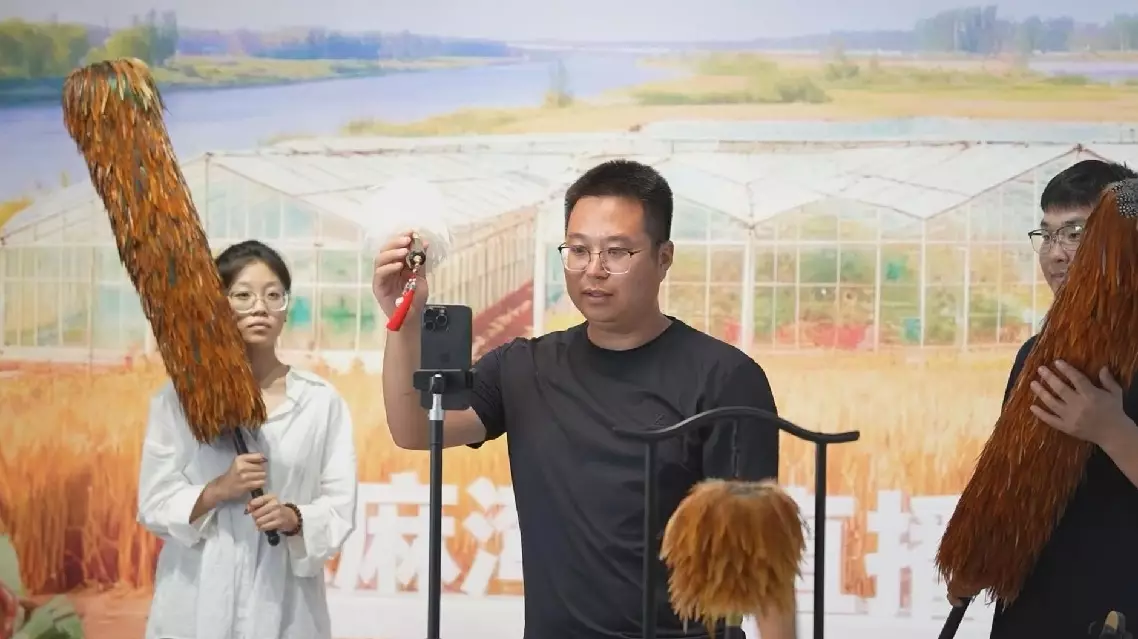
An age-old feather duster craft in north China's Hebei Province has found new life online, as livestreaming turns a village tradition into a source of income for elderly residents. In Luan'nan County, Tangshan City, Liu Wenhao, Party secretary of Zhangmawan Village, is promoting the village's handmade feather dusters alongside fellow villagers in livestreams. Since 2024, he has led villagers in bringing the traditional craft online, quickly turning it into an internet sensation.
Elderly villagers now craft dusters while also serving as online hosts, participating in livestreams and welcoming tourists. Liu Huiying is one of them.
"This is no small income. I earn about 20,000 yuan (about 2,981 U.S. dollars) a year, which is more than enough. They call me an internet celebrity. I'm happy," she said.
The feather duster craft has a long history in Zhangmawan. Once a sideline for villagers during the agricultural off-season, craftsmen worked from dawn to dusk only to sell a single duster for 0.3 to 0.5 yuan. Sales were slightly better at rural fairs, but earnings were barely enough to make a living. As modern cleaning products diversified, traditional feather dusters gradually faded from daily life.
In recent years, with the rise of short-video platforms, several young people in the village began experimenting with short videos. Their first video showing the making of a feather duster garnered more than 600,000 views.
"Our village's traditional craft was well-known throughout the region. So we thought, with so many people here skilled at making feather dusters, why not sell them online and help boost their incomes?" said Liu.
Zhangmawan has more than 200 residents over the age of 60. To boost their incomes and pass on the craft, product transformation was key. Young villagers pooled their ideas and decided to enter the cultural and creative market.
While veteran artisans persisted in handmade production, younger people focused on innovative designs, launching new items such as car hangings, bag charms, desktop ornaments and cat teasers, tailored to modern aesthetics and lifestyles.
Online popularity has also boosted offline tourism. The village has leveraged its advantages to offer craft workshops, rural sightseeing, farm meals and educational study tours, attracting a large number of visitors and children.
"You can hang it on a schoolbag or car keys -- it can go in many places. And if something gets dirty, you can use it to sweep," said Meng Shixuan, a young visitor.
"We want to keep updating our cultural and creative feather duster products, and through short videos and livestreaming, develop the village's study tour and sightseeing businesses to provide more jobs and income opportunities," Liu said.
Chinese village turns traditional feather duster craft into online hit