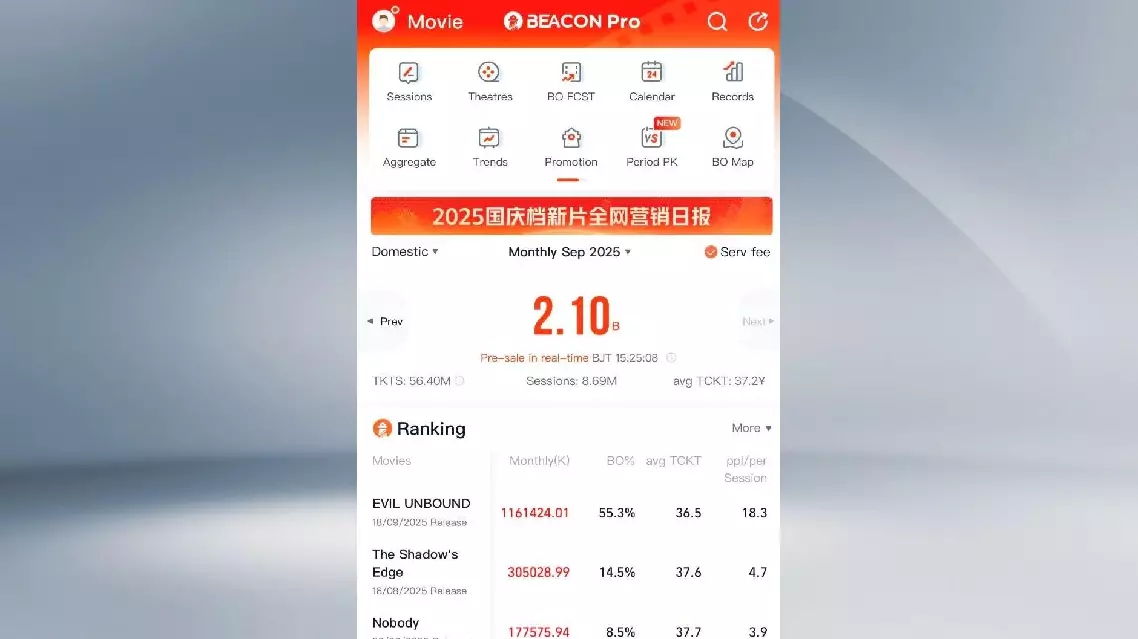
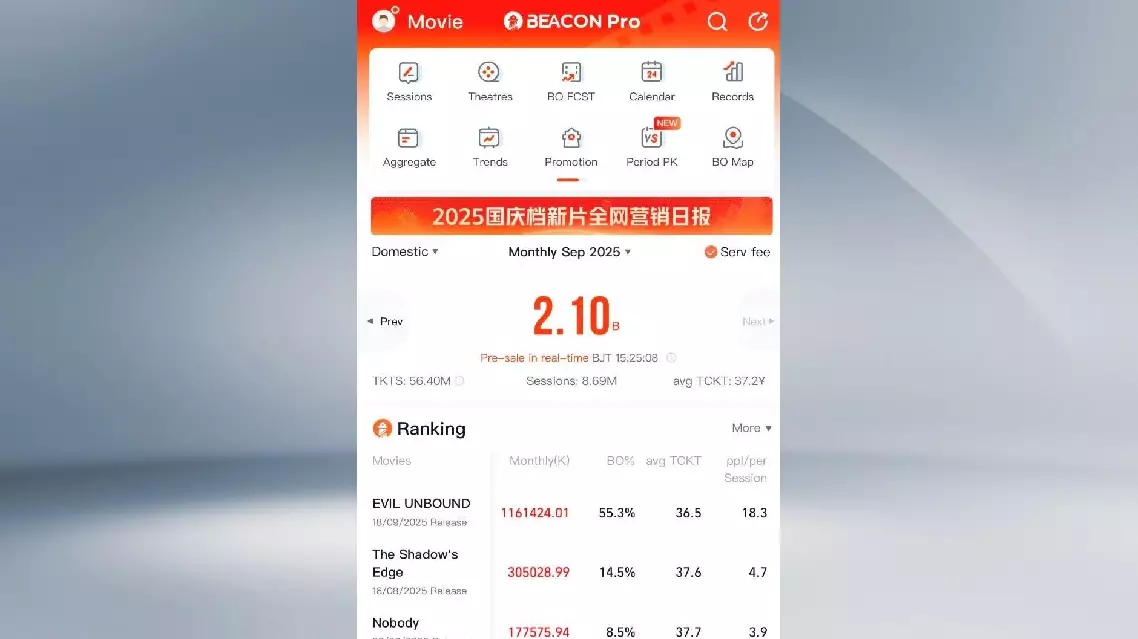
China's September box office had soared past a record high of 2.1 billion yuan (about 295 million U.S. dollars) as of Sunday, fueled by a wave of high-performance domestic releases spanning historical drama, action spectacle and animated fantasy, according to data from ticketing platform Beacon.
Leading the charge is the harrowing World War II film "Evil Unbound," which has shattered multiple box office records and sparked international conversation.
Released just four days ago, "Evil Unbound," a Chinese-produced historical drama exposing the atrocities of Japan's infamous germ warfare Unit 731 during World War II, has already grossed over 1.16 billion yuan (about 163 million U.S. dollars) (including presales).
The film has set two new records in Chinese cinema history: highest single-day screening count and highest opening-day screening count for any film ever released in China.
Beyond its commercial triumph, "Evil Unbound" has ignited global interest. Screened across North America and Australia, the film has resonated deeply with international audiences.
Viewers in multiple countries have praised it as a powerful, necessary reckoning with history -- an unflinching portrayal of Japan's wartime brutality and a plea to never let such horrors be repeated.
Hot on its heels is "The Shadow's Edge," a crime-action thriller starring action legend Jackie Chan alongside veteran actor Tony Leung Ka-fai. The film has raked in over 300 million yuan (about 42 million U.S. dollars) so far in September alone, pushing its cumulative total past 1.18 billion yuan (about 166 million U.S. dollars).
Also holding strong is the animated fantasy "Nobody," a spinoff from the acclaimed Chinese folktales series. With cumulative earnings surpassing 1.63 billion yuan (about 229 million U.S. dollars) -- including over 177 million yuan (about 25 million U.S. dollars) in September, the film continues to enchant audiences with its lush, classically inspired visuals and imaginative re-telling of traditional Chinese folklore.
Adding to the month's momentum, acclaimed director Chen Kaige has officially announced the release date for his long-awaited war epic, "The Volunteers: Peace at Last," set to premiere nationwide on September 30.
The film will dramatize the complex, grueling armistice negotiations that accompanied the War to Resist U.S. Aggression and Aid Korea (1950-1953) -- 158 formal meetings, 733 informal sessions, five interruptions, and 747 days of talks -- the longest ceasefire negotiation in modern military history.
"Peace at Last" is the final installment in Chen's "Volunteers" trilogy. The first two films -- "To the War" and "The Battle of Life and Death" -- grossed over 868 million yuan (about 122 million U.S. dollars) and 1.2 billion yuan (about 168 million U.S. dollars) at China's box office, respectively.
Record-breaking WWII drama "Evil Unbound" leads China's box office
Record-breaking WWII drama "Evil Unbound" leads China's box office
Nobel laureate James Heckman has hailed the “dynamism” of the Chinese society, reflecting on his extensive experience conducting research on the country and being granted the Chinese Government Friendship Award.
Hackman, an American economist and winner of the 2000 Nobel Memorial Prize in Economic Sciences, shared his insights on China's development based on years of research in an exclusive interview with China Media Group (CMG) in Beijing, which was released on Friday.
As a founding figure in microeconometrics, Heckman was jointly awarded his Nobel Prize with Daniel McFadden for their groundbreaking contributions to the development of microeconometric theory and methods, particularly their outstanding work on the principles and methods for analyzing selective sampling.
Over the years, Heckman has dedicated himself to researching and addressing global socioeconomic issues, with a particular focus on human capital, early childhood development, and social mobility. The "Heckman Curve," named after him, demonstrated the positive impact of early childhood development on individual and societal progress, as well as national human capital accumulation, and has been widely cited by policymakers around the world.
In the past decade or so, China has become a major focus of Heckman's research. In 2014, China launched a rural home-based early childhood education program, and Heckman has served as an advisor, providing academic guidance and recommendations for the program's design and research.
On Sept. 30, 2019, Heckman received the Chinese Government Friendship Award, the highest honor granted by the Chinese government to foreign experts. Ever a humble academic, Heckman said he never expected to receive such a prestigious award.
"I certainly didn't know that I was gonna get it. I'm not even sure I deserve it. I'm sure there are people who have given more to China than me. But I am working a lot in China. I find it a very interesting place. But it's the dynamism," he said.
Speaking on his thoughts during the most formative years of his research in China, the economist drew a vivid parallel between the vitality of the Chinese society during its reform-era and the oil-driven prosperity of his father's childhood in the U.S. state of Oklahoma.
"That was oil boom country in the 1920s and 30s when my father was young. And he told me a lot about the boom towns that were there. So I felt that kind of dynamism also at work in China, who was was opening up the markets. There was a lot of entrepreneurship. People were going in and trying new ideas. There was an expansion of the country's production and exchange with the world," the Nobel laureate said.
That vibrancy has extended to the current Chinese society and academia, he added.
"You could feel the optimism and everybody's body in their faces, and then the projects they were describing. So I like that very much. There was a sense that there was vitality, which I saw a real sense of vitality and engagement, and engagement with Chinese scholars and engagement with Chinese coming into the world in a very general way," he said.
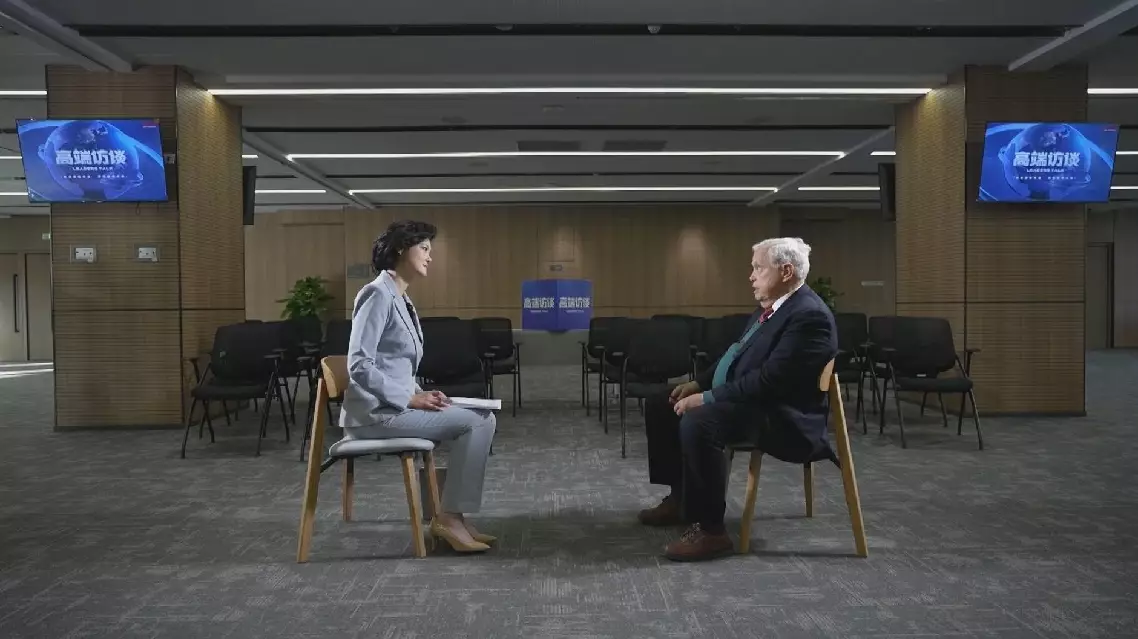
Nobel laureate hails dynamism of Chinese society