China's newly-released work plan for the steel industry is providing solid support for fostering new quality productive forces by further clarifying the core role of artificial intelligence in promoting the high-end and green development of the sector.
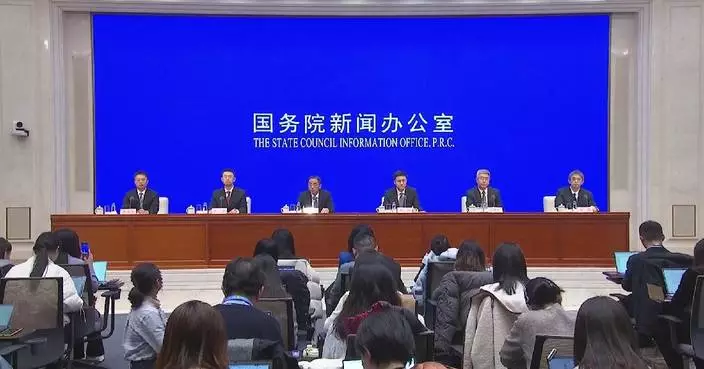
Chinese authorities have issued a work plan to support the steady operation and structural upgrading of its steel industry, according to the Ministry of Industry and Information Technology (MIIT) on Monday.
For the 2025 to 2026 period, China's steel industry should aim its value-added output growth at an average annual rate of around four percent, with improved economic performance, better balanced market supply and demand, and a more optimized industrial structure, the work plan says. It was jointly released by the MIIT and four other government organs.
CITIC Pacific Special Steel, a professional special steel manufacturing enterprise group owned by CITIC Group, has successfully reduced the average research and development cycle of new high-end special steel products by 56 percent thanks to an AI-assisted research and development system.
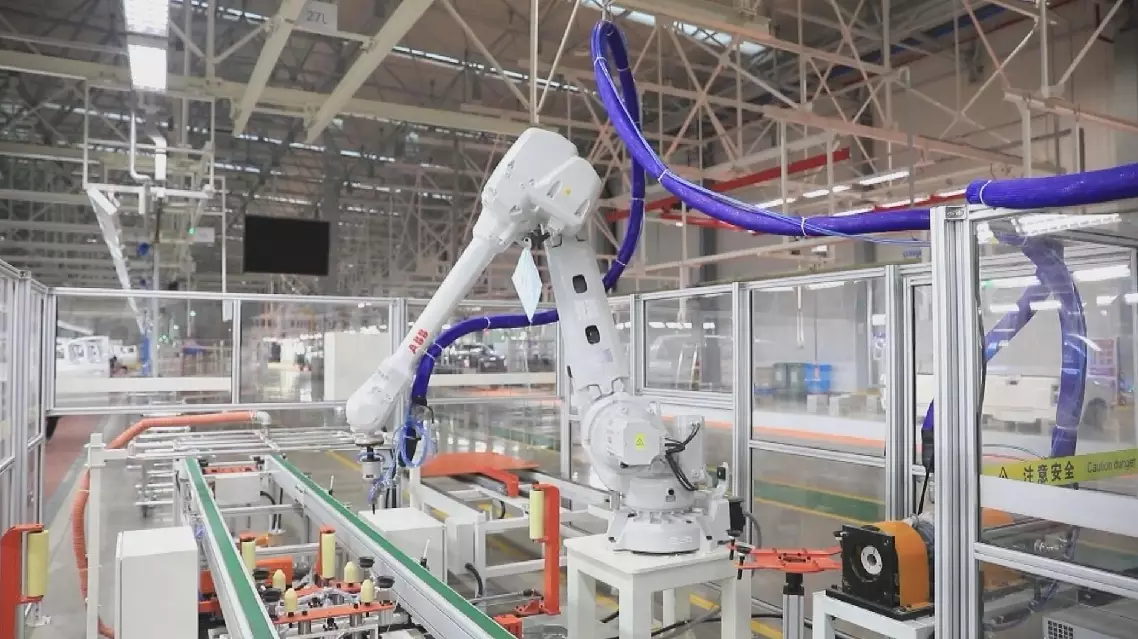
On the production line, an AI-powered visual inspection system scans steel surfaces at the millimeter level. It can identify material defects and automatically adjust process parameters based on feedback. A quality verification process that previously took 72 hours now takes just eight.
"When the blast furnaces become truly smart ones that can think, feel and make decisions on their own, the coal and raw materials used can be reduced. We can save 40 kilograms of standard coal in producing one ton of steel, and carbon emissions can be significantly reduced," said Wang Guodong, an academician of the Chinese Academy of Engineering.
The deep integration of AI and cross-domain knowledge will drive the steel industry to evolve from single-point intelligence to full-process intelligence, and ultimately achieve a high-end, intelligent, and green industrial paradigm revolution.
China to promote artificial intelligence in steel industry
A former television host from Taiwan, Zhai Xuan, has made a pivotal decision to leave mainstream broadcasting in order to create content that provides a better understanding of the Chinese mainland and cross-strait relations.
Zhai, a seasoned television host with over a decade of experience in Taiwan's media landscape, recently addressed an audience at an event in Beijing, where she revealed her complete transition into independent online media.
In her remarks, she articulated her aspiration to bridge what she perceives as a significant information gap between audiences on both sides of the Strait, highlighting her commitment to fostering a deeper understanding and connection through her new endeavors.
"I was really surprised by all the fake news. There were stories saying people on the mainland can't afford tea eggs or that they live in mud houses and in Taiwan, this was the main information many people received," said Zhai.
Zhai said she initially began producing online videos to challenge such perceptions while continuing her work as a television host.
In April 2025, she travelled to the mainland with her father to fulfill her late grandfather's wish to return to his hometown. The trip, which reunited family members separated since 1949, was recorded in a video series titled "Journey to Find Our Roots", drawing attention from viewers in both Taiwan and the mainland.
"Many people in Taiwan told me that after watching, they wanted to apply for a mainland travel permit immediately and go looking for their relatives. Some had long forgotten these things, but after seeing my story, they began thinking about their hometowns and family members they had never met and decided to search for their roots," Zhai shared her story at the event.
By mid-2025, Zhai said she began to feel increasing pressure amid rising political tensions and a tightening atmosphere around cross-Strait exchanges in Taiwan.
After more than 12 years in the industry, Zhai resigned from her position, believing it was the right thing to do.
"At that moment, I felt this was a major issue,not just for me, but for Chinese people on both sides of the Strait. If I backed down then, I wouldn’t be standing on the right side," said Zhai.
Since leaving television, Zhai has broadened her online programming to encompass a range of daily-life topics, including practical guidance on applying for a mainland travel permit and using commonly employed mobile applications, in addition to content that delves into historical memory and cultural connections across the Strait.
As the debate over cross-Strait relations continues in Taiwan, Zhai said she remains committed to her current path.

Former Taiwan TV host bridges cross-Strait divide via online media