With abundant sunshine, unique climate conditions and strong government support, northwest China's Xinjiang Uygur Autonomous Region has transformed its agricultural sector by promoting e-commerce, connecting farmers with enterprises, and encouraging crop diversification.
Xinjiang's natural environment, characterized by around 3,000 hours of sunshine annually, has given the region a major advantage in agriculture. This is roughly 50 percent more sunlight than the national average, with wide temperature swings that benefit the production of high-quality crops such as cotton and melons.
In Wenquan County of the Bortala Mongolian Autonomous Prefecture, local efforts are helping lesser-known but valuable agricultural ventures thrive, with the help of determined local entrepreneurs and targeted government programs.
Liu Shan, a graduate in international politics from Russia's MGIMO University, returned to her hometown to support her family's sunflower seed factory.
"Our factory provides a number of long-term positions for our villagers to increase their income, and they can also take care of their families," said Liu, sales manager of Shengwang Food Co., Ltd. in Wenquan County.
She helped set up a live-stream broadcasting studio to expand sales online and reach a wider market. This progress, she said, would not have been possible without government involvement.
"Our government introduced social [media] influencers to our factory. They have selected the agricultural products of our factory and sales online to boost our selling. They provided us sustainable financial and policy support. It is very important for us," she said.
Ma Wanbao, founder of the Wanbao Yongsheng Cooperative, specializes in mushroom cultivation.
"The big temperature swings here are perfect for mushrooms. They really thrive in such conditions," Ma said.
Initially, Ma struggled to find ways to sell his harvest. Like many farmers unfamiliar with digital tools, he faced barriers in market access until the local government stepped in.
"Six years ago the local government in Bortala helped us set up a live-streaming station at my cooperative. That's when we started to sell through e-commerce. Sometimes we even go live right in the fields. Our cooperative's facilities were also built with government support. They've made a huge difference in helping farmers increase their income. I am grateful for our policies here," Ma said.
Today, his cooperative supports 47 local families, who now sell mushrooms across China.
Entrepreneurship and government policy are also changing lives in the field of traditional Chinese medicine.
Han Yuhua, 61, started cultivating mugwort in 2018 after attending a training program in Nanyang City, central China's Henan Province. She now produces value-added products that combine Xinjiang cotton with mugwort floss and collaborates with manufacturers introduced by the local authorities.
"This quilt is made from mugwort floss and Xinjiang cotton. The local government introduced manufacturing companies to work with us farmers," said Han Yuhua, founder of Bowen Xiukang Mugwort.
To date, she has received subsidies totaling 25,000 yuan (about 3,500 U.S. dollars) and continues to integrate cultural heritage into her product line.
"This is a traditional Kazakh pattern. Xinjiang is home to many ethnic groups and we want to create products that showcase all of their unique cultures," she said.
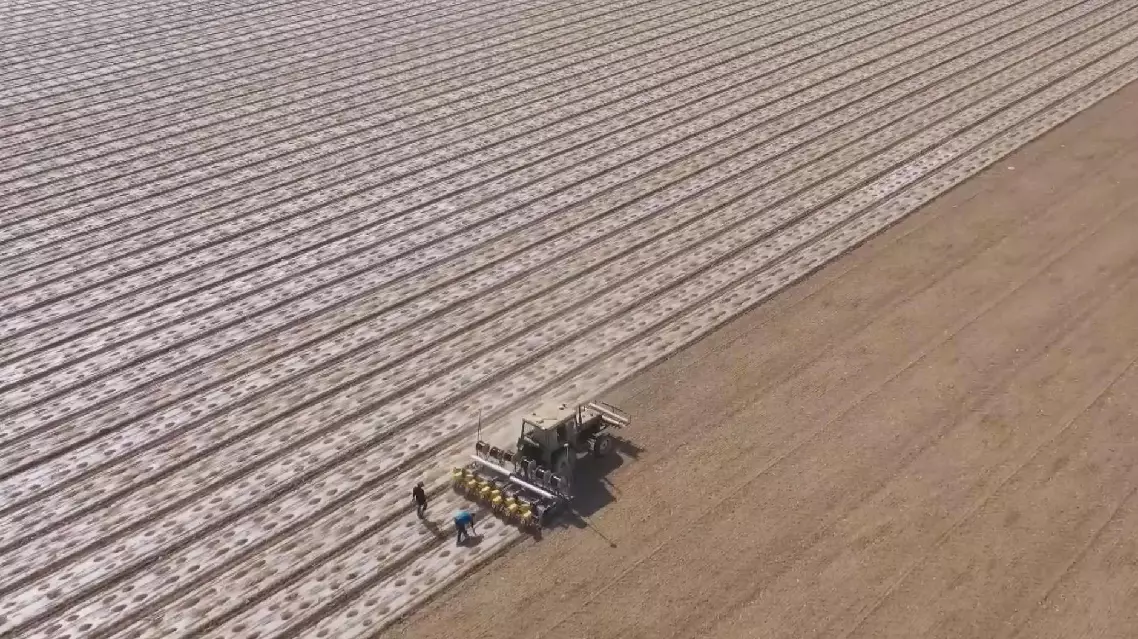
Northwest China's Xinjiang boosts rural growth through specialized agriculture, support policies