In northwest China's Xinjiang Uygur Autonomous Region, Horgos, once a key post along the northern route of the ancient Silk Road, has grown into one of China's busiest land ports.
Horgos Port's development can be traced through six generations of the national gate built here, each reflecting a new stage in the port's role as a frontier hub.
In 1952, the first national gate of Horgos Port was built to strengthen border management. In 1986, the second-generation gate expanded to 894 square meters, as cross-border activity began to pick up.
By 1991, the third gate -- doubling the size of its predecessor -- was put into use. A year later, Horgos launched a border trade market, which later grew into the largest of its kind in inland China back the 1990s.
In 1996, the fourth-generation gate opened, featuring separate halls for passenger checks and freight lanes for vehicles. In 2008, as trade shifted toward bulk commodity imports and exports, the fifth gate was built to handle increasing traffic.
The Belt and Road Initiative in 2013 brought rapid changes. "On March 19, 2016, Horgos launched its first China-Europe freight train, marking the formal opening of a major transport corridor connecting Asia and Europe," said Buyinbatu Sarna, officer at Horgos Railway Port under China Railway Urumqi Group.
In 2018, the sixth-generation gate rose as a new landmark, coinciding with the full opening of the Western Europe-Western China Highway. Since then, efficiency at the port has soared.
"It used to take two to three days for a truck to clear customs at the fourth-generation gate. Now, it only takes six hours. With the opening of the sixth-generation gate and stronger opening-up policies, the outbound traffic has been growing every year, from just five vehicles daily to 300," said Yu Chengzhong, chairman of Horgos Jinyi International Trade Group Co., Ltd, an agricultural product company based in the city.
Data show that since 2018, annual vehicle crossings at Horgos Port surged from around 6,000 to 420,000, nearly a 70-fold increase. Cargo throughput rose from 36.73 million tons to nearly 45.57 million tons, keeping Horgos the busiest land port in Xinjiang for seven consecutive years.
The Horgos Railway Port has also emerged as an important passage for international land freight. Train trips there grew from fewer than 400 in 2016 to 8,730 in 2024, with cargo volumes climbing year after year.
Standing at the China-Kazakhstan border, the Horgos Area of China (Xinjiang) Pilot Free Trade Zone has become another major symbol of cross-border connectivity. Spanning over 5.6 square kilometers, it is China's first cross-border trade cooperation zone, hosting thousands of shops and goods from across the world.
"It is very convenient here [at the pilot free trade zone], as travelers only need to show one of the five types of documents, such as a passport, to enter without a visa. Since the center began operating in 2012, we have facilitated 50 million visitor entries for business, cultural exchanges, and cross-border tourism," said Dai Yanan, police officer at the Horgos Border Inspection Station.
From camel caravans to freight trains, Horgos has grown from a quiet frontier town into a modern trade hub. In 2024, its foreign trade value exceeded 100 billion yuan (over 14 billion U.S. dollars) for the first time, underscoring its role as a vital gateway between China and the world.
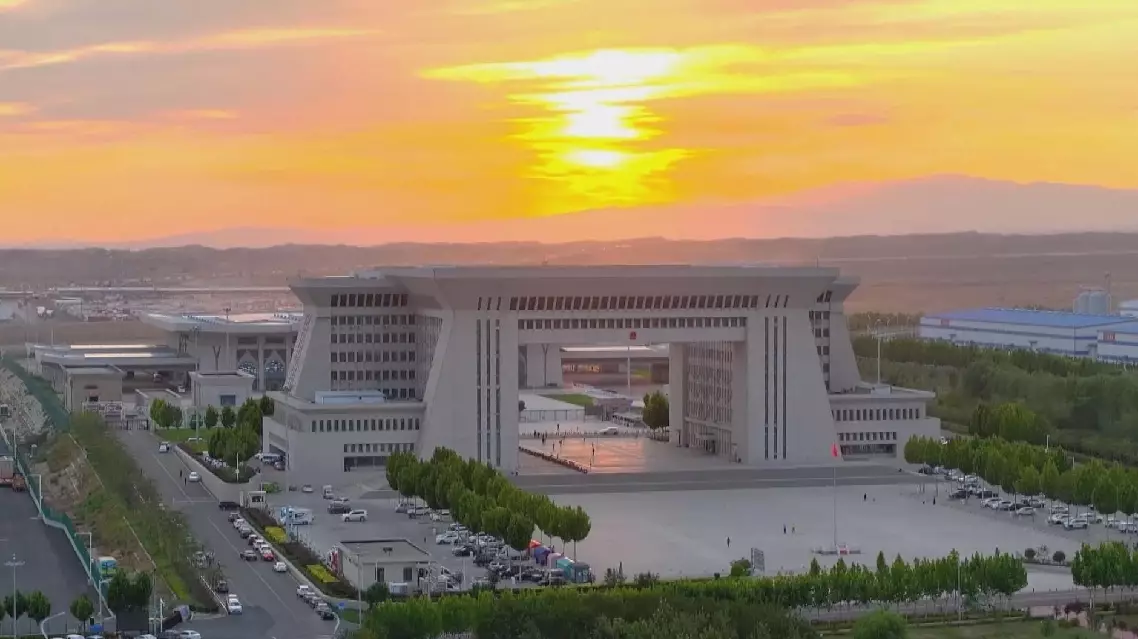
Horgos Port marks transformation from ancient gateway to modern trade hub
A video featuring a former member of Unit 731, a notorious Japanese germ-warfare unit during World War II (WWII), was released on Thursday in northeast China's Harbin, revealing details of how the unit used meteorological data to conduct horrific bacterial experiments on human beings.
The video was released by the Exhibition Hall of Evidence of Crimes Committed by Unit 731 of the Japanese Imperial Army, in which former Unit 731 member Tsuruo Nishijima detailed how the unit used meteorological data to carry out a bacterial dispersal experiment.
The video was recorded in 1997 by Japanese scholar Fuyuko Nishisato and donated to the exhibition hall in 2019, according to the hall, which was built on the former site of the headquarters of Unit 731 in Harbin, the capital city of Heilongjiang Province.
Jin Shicheng, director of the Department of Publicity, Education and Exhibition of the exhibition hall, said that Nishijima joined Unit 731 in October 1938 and served in the unit's meteorological squad. The squad was not a simple observation section but rather an auxiliary force supporting the unit's field human experiments by measuring wind direction, wind speed, and other conditions to ensure optimal experimental results, according to Jin.
Nishijima confirmed in the footage that "the meteorological squad had to be present at every field experiment." He testified to the "rainfall experiments" conducted by Unit 731, which involved aircraft releasing bacterial agents at extremely low altitudes.
At a field-testing site in Anda City, Heilongjiang, Unit 731 aircraft descended to about 50 meters above the ground. They sprayed bacterial culture liquids onto "maruta" -- human test subjects -- who were tied to wooden stakes. Each experiment involved about 30 people, spaced roughly 5 meters apart. After the experiments, the victims were loaded into sealed trucks and transported back to the unit, where their symptoms and disease progression were recorded over a period of several days.
"Unit 731's bacterial weapons were dropped by aircraft from a height of 50 meters in the open air. Therefore, the meteorological squad needed to observe wind direction and speed, which directly affected the precision and accuracy of the bacterial weapons deployment," said Jin.
Nishijima recounted the harrowing experience of the human test subjects.
"They were fully aware that inhaling the substances would certainly lead to death, so they closed their eyes and held their breath to avoid breathing them in. Their resistance prevented the experiment from proceeding. To compel them to comply, they were forced at gunpoint to open their mouths and lift their heads," said Nishijima.
These experiments, disguised as "scientific research," were in fact systematic tests of biological warfare weapons conducted by the Japanese military. The data generated from these inhumane activities became "research findings" shared among the Japanese army medical school, the medical community, and the military at large.
"At that time, the entire Japanese medical community tacitly approved, encouraged, and even participated in the criminal acts of Unit 731. The unit comprised members from Japan's medical and academic sectors who served the Japanese war of aggression against China. Thus, Unit 731 was not just a military unit but represented an organized and systematic criminal enterprise operating from the top down," said Jin.
Unit 731 was a top-secret biological and chemical warfare research base established in Harbin as the nerve center for Japanese biological warfare in China and Southeast Asia during WWII.
At least 3,000 people were used for human experiments by Unit 731, and Japan's biological weapons killed more than 300,000 people in China.
Video offers details of Japan's germ-warfare crimes in northeast China