SEATTLE (AP) — A federal trial beginning in Amazon's hometown this week is set to examine whether the online retailing giant tricked customers into signing up for its Prime service and made it difficult to cancel after they did so.
The Federal Trade Commission sued Amazon in U.S. District Court in Seattle two years ago and has alleged more than a decade of legal violations, including of the Restore Online Shoppers' Confidence Act, a 2010 law designed to help ensure that people know what they're being charged for online.
Jury selection began Monday, with opening statements to follow.
Prime provides subscribers with perks that include faster shipping, video streaming and discounts at Whole Foods for a fee of $139 annually, or $14.99 a month.
It's a key — and growing — part of Amazon's business, with more than 200 million members. In its latest quarterly report, the company in July reported more than $12 billion in net revenue for subscription services, which is a 12% increase from the same period last year. That figure includes annual and monthly fees associated with Prime memberships, as well as other subscription services such as its music and e-books platforms.
The company said it does clearly explain Prime's terms before charging customers, and that it offers simple ways to cancel membership, including by phone, online and by online chat.
“Occasional customer frustrations and mistakes are inevitable — especially for a program as popular as Amazon Prime,” Amazon said in a trial brief filed last week. “Evidence that a small percentage of customers misunderstood Prime enrollment or cancellation does not prove that Amazon violated the law.”
But the FTC said Amazon deliberately made it difficult for customers to purchase an item without also subscribing to Prime. In some cases, consumers were presented with a button to complete their transactions — which didn’t clearly state it would also enroll them in Prime, the agency said.
“Amazon has long known that millions of its customers struggled with enrollment and cancellation of its subscription service, Prime,” the FTC said in its trial brief. “Millions of consumers accidentally enrolled in Prime without knowledge or consent, but Amazon refused to fix this known problem, described internally by employees as an 'unspoken cancer' because clarity adjustments would lead to a drop in subscribers.”
Getting out of a subscription was often too complicated, and Amazon leadership slowed or rejected changes that would have made canceling easier, the complaint said.
Internally, Amazon called the process “Iliad,” a reference to the ancient Greek poem about the lengthy siege of Troy during the Trojan war. The process requires the customer to affirm on three pages their desire to cancel membership.
U.S. District Judge John Chun, an appointee of former President Joe Biden, issued an order last week affirming that the Restore Online Customers' Confidence Act applies to Prime. He also limited some of the legal defenses Amazon may offer at trial and sided with the FTC on its claim that Amazon violated the law by collecting customers' billing information before disclosing Prime's terms.
But Chun said several other issues remain for the jury to decide, including whether Amazon’s disclosures of the material terms of Prime membership are “clear and conspicuous” and whether the “Illiad” cancellation method is “simple,” as the law requires.
Chun also ruled that two Amazon executives named as individual defendants — Neil Lindsay and Jamil Ghani — were so entwined with the Prime program that they will personally face liability if the jury sides with the FTC. A third, Russell Grandinetti, could also potentially face personal liability if the jury so decides.
Amazon said a statement Monday: “The bottom line is that neither Amazon nor the individual defendants did anything wrong — we remain confident that the facts will show these executives acted properly and we always put customers first.”
The FTC, which declined to comment Monday, began looking into Amazon's Prime subscription practices in 2021 during the first Trump administration, but the lawsuit was filed in 2023 under former FTC Chair Lina Khan, an antitrust expert who had been appointed by Biden.
The agency filed the case months before it submitted an antitrust lawsuit against the retail and technology company, accusing it of having monopolistic control over online markets.
In July, Chun admonished Amazon for withholding 70,000 documents from the FTC, including documents improperly marked as containing internal legal advice, saying that conduct was “tantamount to bad faith.”
Meanwhile, like other tech companies, Amazon has been attempting to forge friendlier ties with President Donald Trump, who repeatedly criticized the company during his first term.
In December, Amazon donated $1 million to Trump’s inauguration fund. Amazon founder Jeff Bezos, along with other tech leaders, was also a guest at the inauguration.
Earlier this year, Amazon’s Prime Video service began streaming “The Apprentice,” the long-running TV show that boosted Trump’s profile before he ran for president. The company is also working on a documentary that offers an “unprecedented behind-the-scenes look” into the life of first lady Melania Trump.

FILE - An Amazon Prime driver makes a delivery outside an apartment building in Pittsburgh, March 10, 2025. (AP Photo/Gene J. Puskar, File)
BETHLEHEM, West Bank (AP) — Mohamad Al-Assi ran beneath the concrete wall as the sun rose over Bethlehem. His Nikes pounded the gravel, his breath fogging the air as graffiti and paint splatter blurred past with each stride.
The road along the barrier separating Israel from the occupied West Bank makes up a stretch of a marathon route that Al-Assi and thousands of others ran on Friday. The event is open to people in other parts of the world running in solidarity with the Palestinians and another, shorter race was happening in Gaza.
The race, known as the Palestine Marathon, was held for the first time in three years and was among the first big international events in the West Bank since the start of the Israel-Hamas war. Festivals, conferences and holiday festivities that once drew thousands have been scaled back or canceled because of the war in Gaza and heightened Israeli restrictions.
It marked a turning point for Al-Assi, 27, who was released from Israeli detention six months ago. Video from that day shows him gaunt-faced and hollow-eyed, his once muscular legs weakened after more than two and a half years of prison.
He began training in December, gradually upping his mileage every month since. He ran 62 miles (100 kilometers) that first month, and in April reached 135 miles (217 kilometers), according to his account on the tracking app Strava.
He jogs in the morning after his mother wakes him up in their home in Dheisheh, a Palestinian refugee camp made up of graffiti-covered cinderblock homes in tangled alleyways.
“The main difficulties we face are the cars on the roads and the presence of Israeli security forces along the route where I train,” Al-Assi said.
He had to suspend his training several times because of military operations in the camp.
“I would return home feeling hopeless because I couldn't do what I had intended to do,” Al-Assi said.
In the West Bank, runners cannot complete a 26.2-mile (42.2-kilometer) course without hitting a checkpoint or military gate, which is why Friday's marathon route looped around the same circuit twice.
They ran up through the narrow streets of two Palestinian refugee camps and down to a farming town next to Bethlehem where fields are divided by the concrete wall, barbed wire and cameras. The course hooked back to finish at Bethlehem’s Manger Square.
Organizers say the race highlights restrictions facing Palestinians in the occupied West Bank, where checkpoints can disrupt even routine commutes and where open land for hiking, biking and running is increasingly taken by Israeli settlements and outposts.
“Marathon runners anywhere may ‘hit a wall’ under the physical and emotional strain of completing the 42-kilometer race course," they said on the marathon's website.
But in the West Bank, they added, "runners literally hit the Wall.”
At a time when the West Bank’s economy is struggling and in the shadow of Gaza's fragile ceasefire and stalled rebuilding efforts, the atmosphere in Bethlehem was celebratory. Crowds gathered near the Church of the Nativity to cheer runners at the race's early morning start and finish. Bagpipes blared and drummers pounded out traditional rhythms through streets along the route.
On a beachside road in Nuseirat in central Gaza — which is roughly the length of a marathon — 15 disabled people, including amputees, ran a 2K, and a couple thousand of people ran a 5K. Thirteen years after the U.N. agency for Palestinian refugees, known as UNRWA, canceled a 2013 marathon because Hamas forbade women from participating, the women were back.
Haya Alnaji, a 22-year-old woman who ran in the 5K, said the number of people taking part reflected that Palestinians in Gaza were determined to live and persevere despite the devastation wrought by more than two years of war.
“All of Gaza loves sports,” she said.
Al-Assi was arrested in April 2023, and imprisoned under administrative detention, which allows Israel to hold detainees for months without charge. Between 3,000 and 4,000 Palestinians are being held under that system, according to Israeli rights groups and the Palestinian Prisoners Society.
In October 2023, Al-Assi was sentenced for transferring money to suspicious entities, a charge he denies. Israel closely monitors money transfers — particularly to Gaza — for fear that funds could end up in the hands of militants. Palestinians, however, say donations and charitable contributions are often swept up in the dragnet. Israel’s military, Shin Bet and Prison Service did not answer questions about Al-Assi's charges.
In Israeli prisons — where detainees routinely complain of inadequate diets — Al-Assi said nearly everyone goes hungry. The weight he lost eroded the endurance built through 10 years of training.
“I have more muscle mass than fat, so when I lost weight, the loss came from my muscles rather than fat,” he said. “This had a major impact on my physical fitness.”
He also had to regain the mental fortitude to run a marathon.
“I was emotionally shattered after spending such a long period in prison,” he said.
On Friday, he collapsed to his knees, bowing and thanking God after finishing second overall, as supporters and journalists encircled him. He dedicated his run to Palestinians still in Israeli detention.
“After 32 months in prison, Mohamad Al-Assi is first in his class!” he shouted through tears, raising his hands and looking up to the sky.
__ Imad Isseid contributed from Bethlehem, West Bank and Abdel Kareem Hana from Nuseirat, Gaza Strip.
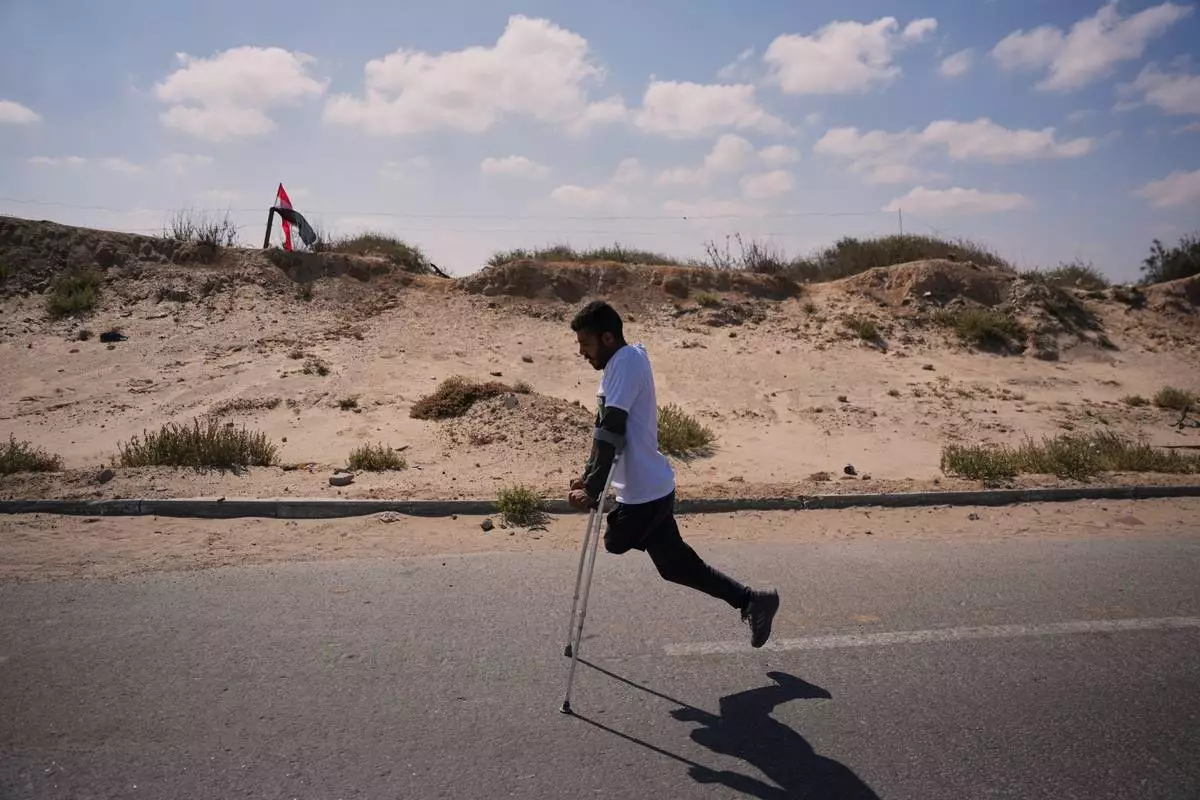
A Palestinian amputee runner takes part in the 2-kilometer Palestine Marathon along the coastal road near Nuseirat in the central Gaza Strip, Friday, May 8, 2026. (AP Photo/Abdel Kareem Hana)

Palestinian runners take part in the 5-kilometer Palestine Marathon along the coastal road near Nuseirat in the central Gaza Strip, Friday, May 8, 2026. (AP Photo/Abdel Kareem Hana)

Runners participate in the Palestine Marathon in the West Bank city of Bethlehem, Friday, May 8, 2026. (AP Photo/Mahmoud Illean)
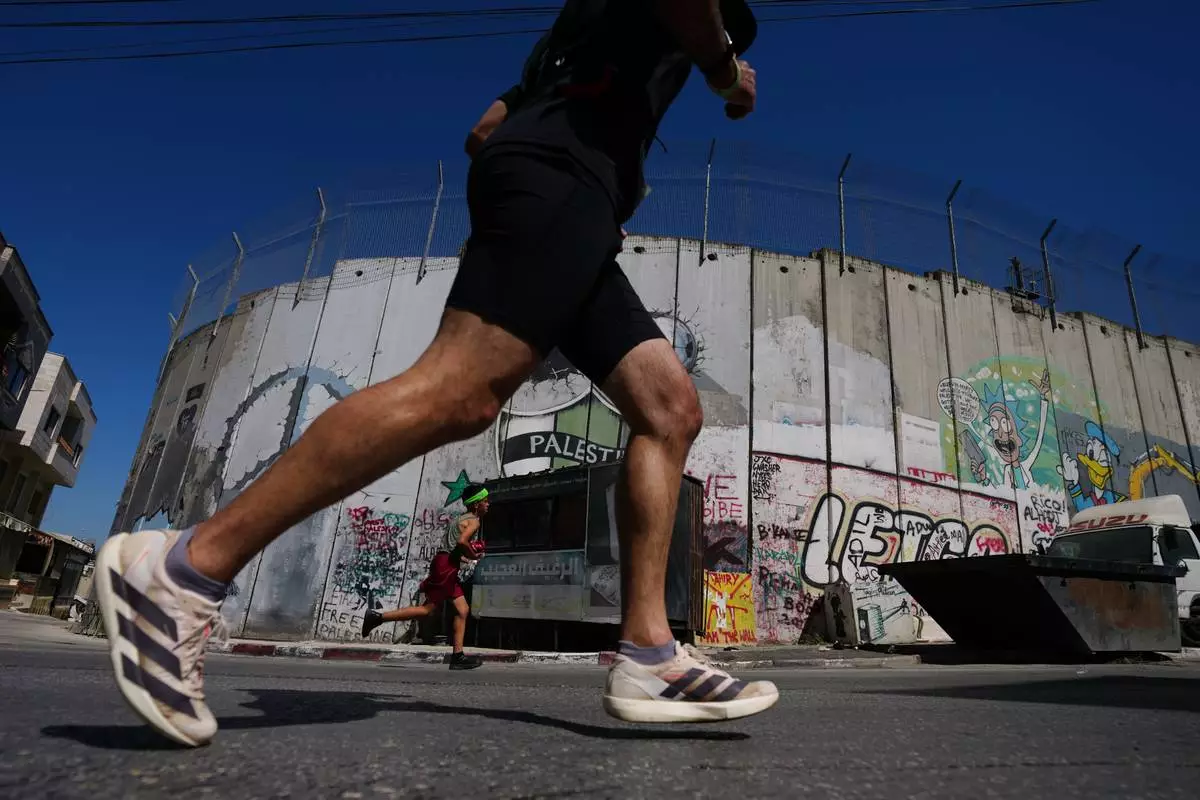
Runners pass by Israel's separation wall as they compete in the Palestine Marathon in the West Bank city of Bethlehem, Friday, May 8, 2026. (AP Photo/Mahmoud Illean)

Palestinian Mohamad Al-Assi, who was released from Israeli detention six months ago, runs past Israel's separation wall as he trains ahead of the Palestine Marathon in the West Bank city of Bethlehem, Thursday, May 7, 2026. (AP Photo/Sam Metz)