Skip to Content Facebook Feature Image

In front of drowning nations, Trump calls climate change a 'con job.' Here are the facts and context

News

In front of drowning nations, Trump calls climate change a 'con job.' Here are the facts and context
News

News

In front of drowning nations, Trump calls climate change a 'con job.' Here are the facts and context

2025-09-24 22:47 Last Updated At:22:50

NEW YORK (AP) — Some countries' leaders are watching rising seas threaten to swallow their homes. Others are watching their citizens die in floods, hurricanes and heat waves, all exacerbated by climate change.

But the world U.S. President Donald Trump described in his speech at the United Nations General Assembly on Tuesday didn't match the one many world leaders in the audience are contending with. Nor did it align with what scientists have long been observing.

More Images
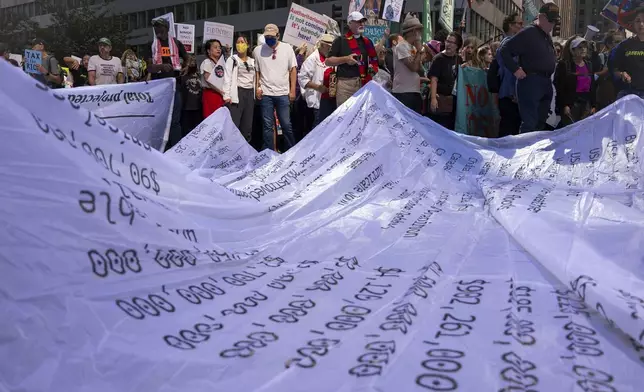
People set up a "Climate Polluters Bill" the length of an Olympic swimming pool (50 meters long) through Manhattan at the "Make Billionaires Pay" climate protest, Saturday, Sept. 20, 2025, in New York. The bill was created by Greenpeace and lists the costs of hundreds of climate-related natural disasters. (AP Photo/Angelina Katsanis)
People set up a "Climate Polluters Bill" the length of an Olympic swimming pool (50 meters long) through Manhattan at the "Make Billionaires Pay" climate protest, Saturday, Sept. 20, 2025, in New York. The bill was created by Greenpeace and lists the costs of hundreds of climate-related natural disasters. (AP Photo/Angelina Katsanis)

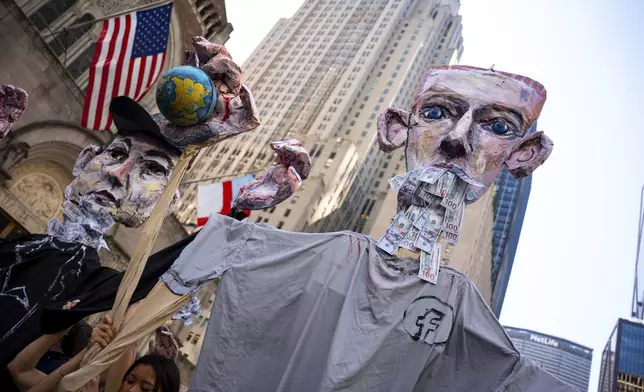
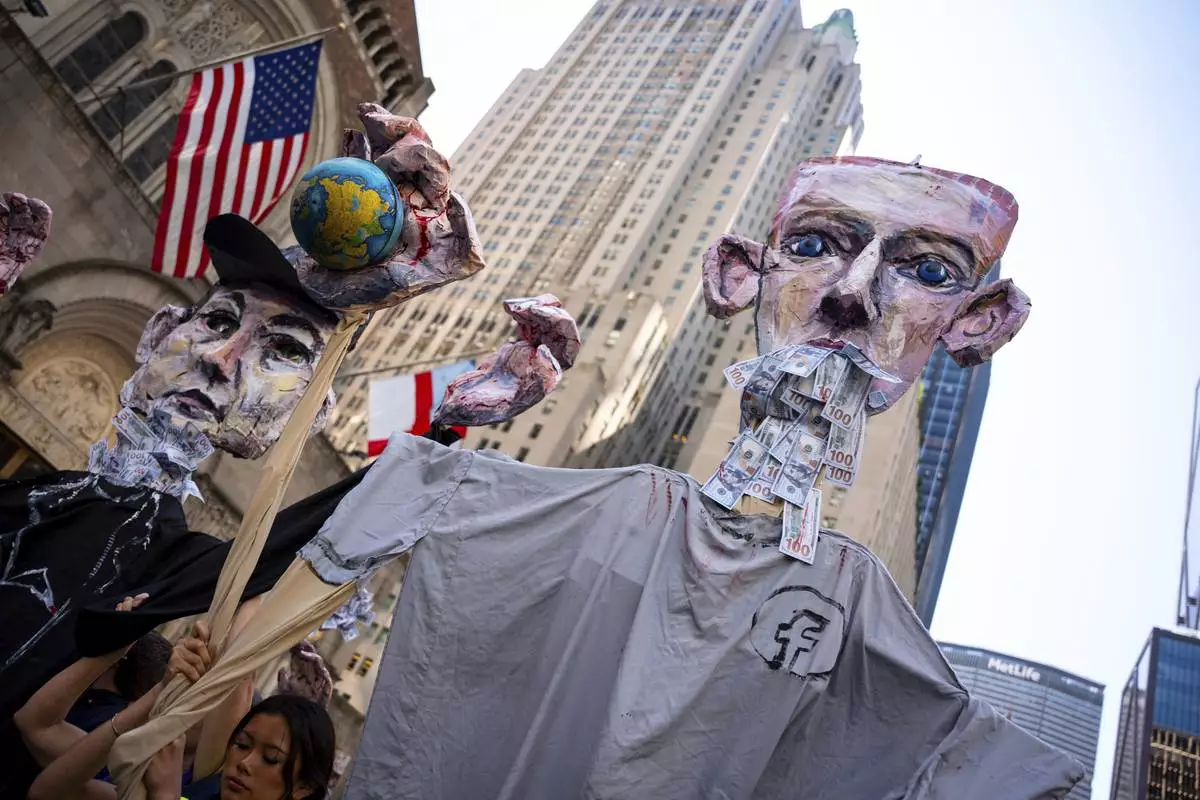
Art pieces of Mark Zuckerberg and Elon Musk with bloody hands carrying globes are marched through Manhattan at the "Make Billionaires Pay" climate protest, Saturday, Sept. 20, 2025, in New York. (AP Photo/Angelina Katsanis)
Art pieces of Mark Zuckerberg and Elon Musk with bloody hands carrying globes are marched through Manhattan at the "Make Billionaires Pay" climate protest, Saturday, Sept. 20, 2025, in New York. (AP Photo/Angelina Katsanis)

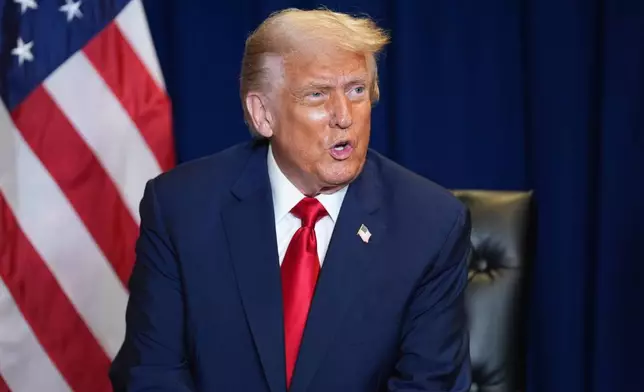
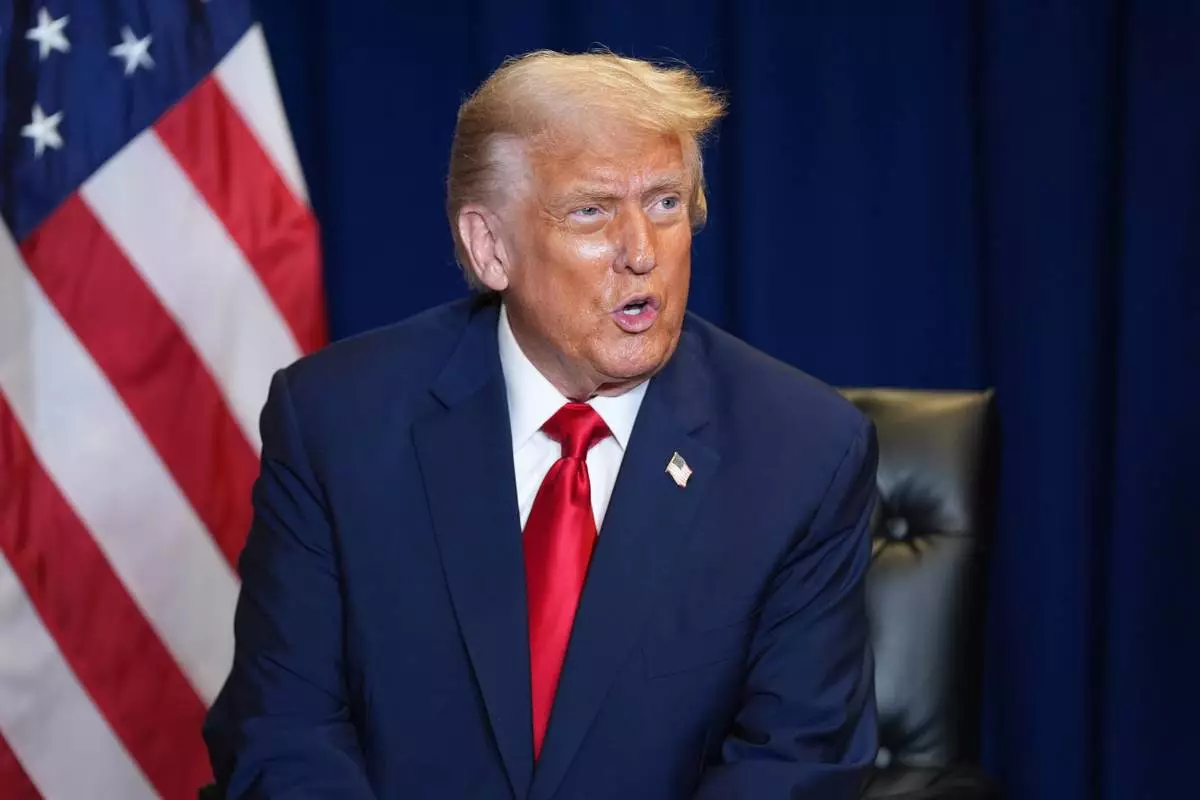
President Donald Trump speaks while meeting with Ukrainian President Volodymyr Zelenskyy during the United Nations General Assembly, Tuesday, Sept. 23, 2025, in New York. (AP Photo/Evan Vucci)
President Donald Trump speaks while meeting with Ukrainian President Volodymyr Zelenskyy during the United Nations General Assembly, Tuesday, Sept. 23, 2025, in New York. (AP Photo/Evan Vucci)

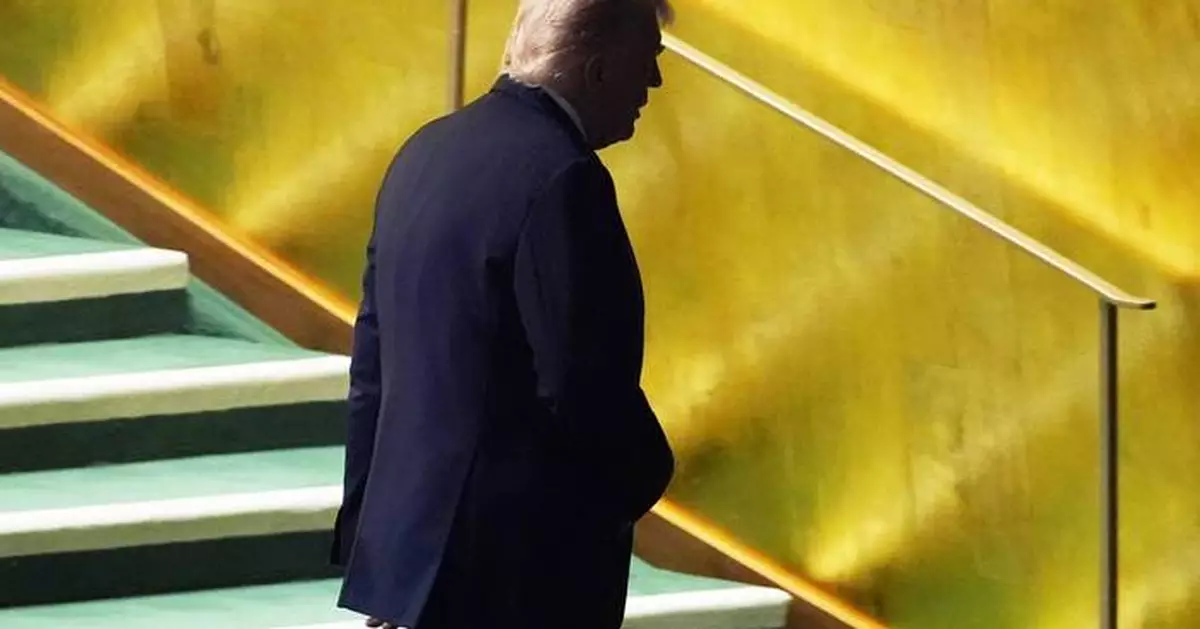
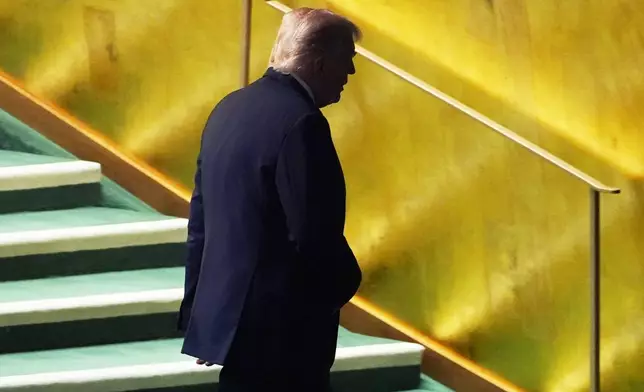
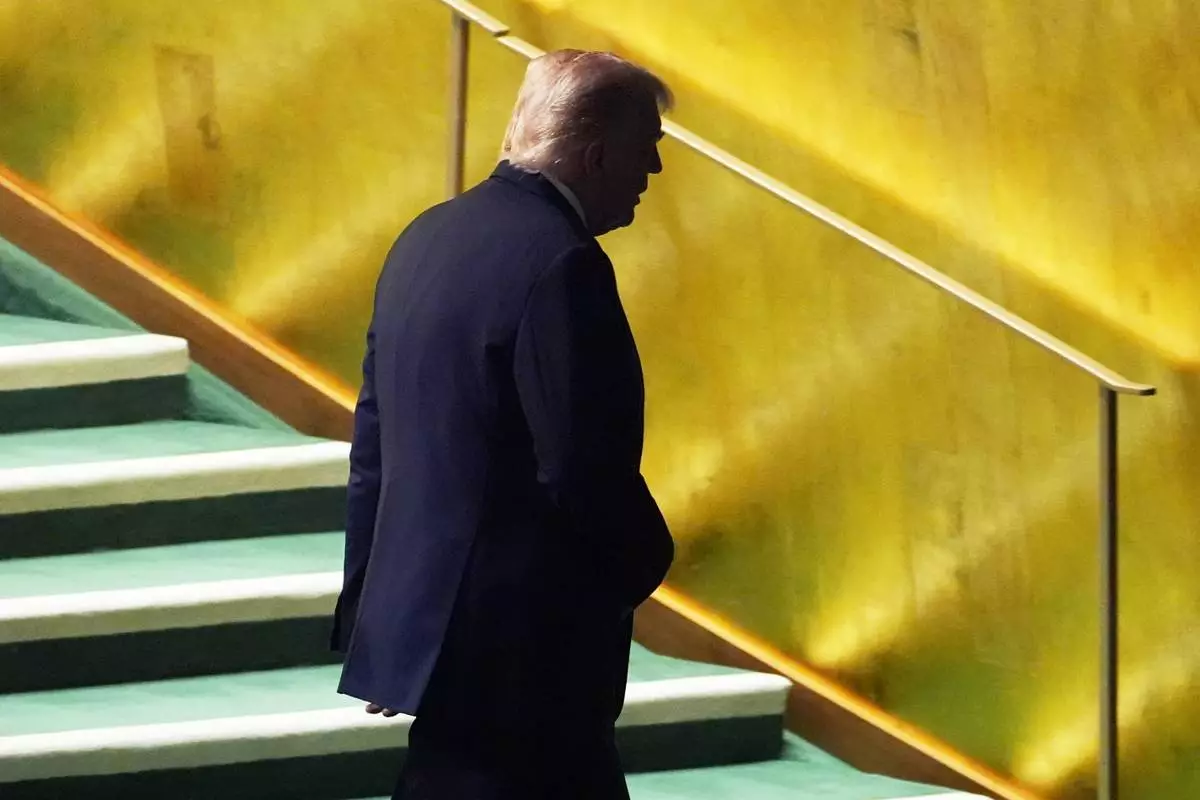
President Donald Trump walks off after speaking to the United Nations General Assembly, Tuesday, Sept. 23, 2025, in New York. (AP Photo/Evan Vucci)

President Donald Trump walks off after speaking to the United Nations General Assembly, Tuesday, Sept. 23, 2025, in New York. (AP Photo/Evan Vucci)

“This ‘climate change,’ it’s the greatest con job ever perpetrated on the world, in my opinion," Trump said. “All of these predictions made by the United Nations and many others, often for bad reasons, were wrong. They were made by stupid people that have cost their countries fortunes and given those same countries no chance for success. If you don’t get away from this green scam, your country is going to fail.”

Trump has long been a critic of climate science and polices aimed at helping the world transition to green energies like wind and solar. His speech Tuesday, however, was one of his most expansive to date. It included false statements and making connections between things that are not connected.

Ilana Seid, an ambassador from the island nation of Palau and head of the organization of small island states, was in the audience. She said it’s what they’ve come to expect from Trump and the United States. She added that not acting on climate change will “be a betrayal of the most vulnerable," a sentiment echoed by Evans Davie Njewa of Malawi, who said that “we are endangering the lives of innocent people in the world.”

For Adelle Thomas, a climate scientist who has published more than 40 studies and has a doctorate, climate change disasters are personal, too. A vice chair of the United Nations Intergovernmental Panel on Climate Change, the world's top body on climate science, Thomas is from the Bahamas and said she experienced firsthand "the devastation of the climate disaster” when Hurricane Sandy hit the Caribbean and New York City, the city Trump was speaking from, in 2012.

“Millions of people around the world can already testify to the devastation that climate change has brought to their lives," she said. 'The evidence is not abstract. It is lived, it is deadly, and it demands urgent action."

A look at some of Trump's statements Tuesday, the science behind them and the reaction.

WHAT HE SAID: Trump called renewable sources of energy like wind power a “joke” and “pathetic,” falsely claiming they don’t work, are too expensive and too weak.

THE BACKSTORY: Solar and wind are now “almost always” the least expensive and the fastest options for new electricity generation, according to a July report from the United Nations. That report also said the world has passed a “positive tipping point” where those energy sources will only continue to become more widespread.

The three cheapest electricity sources globally last year were onshore wind, solar panels and new hydropower, according to an energy cost report by the International Renewable Energy Agency (IRENA).

Subsidies endorsed by Trump and the Republican party are artificially keeping fossil fuels viable, said University of Pennsylvania climate scientist Michael Mann. “If one were truly in favor of the ‘free market’ to determine this, then fossil fuels would be disappearing even faster," he wrote in an email.

Relatedly, Trump falsely claimed European electricity bills are now “two to three times higher than the United States, and our bills are coming way down.” But in fact retail electricity prices in the United States have increased faster than the rate of inflation since 2022, according to the U.S. Energy Information Administration. The agency expects prices to continue increasing through 2026.

WHAT HE SAID: Trump blasted the U.N.'s climate efforts, saying he withdrew America from the “fake” Paris climate accord because "America was paying so much more than every country, others weren’t paying.”

THE BACKSTORY: The Paris Agreement, decided by international consensus in 2015, is a voluntary but binding document in which each country is asked to set its own national goal to curb planet-warming emissions and decide how much money it will contribute to the countries that will be hit hardest by climate change.

Because carbon dioxide stays in the atmosphere for more than a century, the United States has put out more of the heat trapping gas than any other nation, even though China now is the No. 1 carbon polluter. Since 1850, the U.S. has contributed 24% of the human-caused carbon dioxide that’s in the air, according to Global Carbon Project data. The entire continent of Africa, with four times the population of the U.S., is responsible for about 3%.

WHAT HE SAID: “I have a little standing order in the White House. Never use the word ‘coal.’ Only use the words ‘clean, beautiful coal.’ Sounds much better, doesn’t it?”

THE BACKSTORY: Coal kills millions of people a year. "The president can pretend coal is clean, but real people — mothers, fathers, sons, and daughters— will die for this lie,’’ said Stanford University climate scientist Rob Jackson..

Trump also called the carbon footprint “a hoax made up by people with evil intentions,” a contention that Texas A&M University climate scientist Andrew Dessler agreed with. Dessler said the term was coined by oil companies and may have been designed to shift the responsibility for combatting climate change away from corporations to individuals.

The science of climate change started 169 years ago when Eunice Foote did simple experiments with flasks and sunlight showing that carbon dioxide trapped more heat than the regular atmosphere. It’s an experiment that can be repeated at home and has been done in labs hundreds of times and in greenhouses around the world every day. It is basic physics and chemistry with a long history.

“It is unequivocal that human influence has warmed the atmosphere, ocean and land,” reported the United Nation’s Intergovernmental Panel on Climate Change, which is hundreds of scientists, with doctorates in the field.

In 2018, Trump’s own government said: “The impacts of global climate change are already being felt in the United States and are projected to intensify in the future.”

WHAT HE SAID: In “the United States, we have still radicalized environmentalists and they want the factories to stop. Everything should stop. No more cows. We don’t want cows anymore."

THE BACKSTORY: Cows belch methane, a powerful greenhouse gas. Around the world, cattle are often raised on lands where forests have cut down. Since forests capture carbon dioxide, cutting them to raise cattle results in a double whammy. Still, no one is suggesting that cows be gotten rid of, said Nusa Urbancic, CEO of the Changing Markets Foundation.

“This polarizing and divisive language misrepresents the environmental message,” Urbancic wrote. “What is true, however, is that cutting methane emissions is a quick win to slow global heating and meet climate targets.”

Trump also blamed dirty air blowing in from afar, floating garbage in the ocean coming from other countries and “radicalized environmentalists.”

Although the United States does indeed now have cleaner air than it has in decades, the pollution seeping into communities is primarily caused by local dirty energy and industry projects, not by other countries. And many experts have said the biggest blow to local air and water quality is the Trump administration’s own wide-ranging rollbacks to the power of the U.S. Environmental Protection Agency and other bedrock environmental laws.

“It is sad to see marine debris, a globally important issue, being misrepresented so completely,” said Lucy Woodall, an associate professor of marine conservation and policy at the University of Exeter.

Associated Press reporters Matthew Daly, Jennifer McDermott and Annika Hammerschlag contributed to this report.

The Associated Press’ climate and environmental coverage receives financial support from multiple private foundations. AP is solely responsible for all content. Find AP’s standards for working with philanthropies, a list of supporters and funded coverage areas at AP.org.

People set up a "Climate Polluters Bill" the length of an Olympic swimming pool (50 meters long) through Manhattan at the "Make Billionaires Pay" climate protest, Saturday, Sept. 20, 2025, in New York. The bill was created by Greenpeace and lists the costs of hundreds of climate-related natural disasters. (AP Photo/Angelina Katsanis)
People set up a "Climate Polluters Bill" the length of an Olympic swimming pool (50 meters long) through Manhattan at the "Make Billionaires Pay" climate protest, Saturday, Sept. 20, 2025, in New York. The bill was created by Greenpeace and lists the costs of hundreds of climate-related natural disasters. (AP Photo/Angelina Katsanis)

Art pieces of Mark Zuckerberg and Elon Musk with bloody hands carrying globes are marched through Manhattan at the "Make Billionaires Pay" climate protest, Saturday, Sept. 20, 2025, in New York. (AP Photo/Angelina Katsanis)
Art pieces of Mark Zuckerberg and Elon Musk with bloody hands carrying globes are marched through Manhattan at the "Make Billionaires Pay" climate protest, Saturday, Sept. 20, 2025, in New York. (AP Photo/Angelina Katsanis)

President Donald Trump speaks while meeting with Ukrainian President Volodymyr Zelenskyy during the United Nations General Assembly, Tuesday, Sept. 23, 2025, in New York. (AP Photo/Evan Vucci)
President Donald Trump speaks while meeting with Ukrainian President Volodymyr Zelenskyy during the United Nations General Assembly, Tuesday, Sept. 23, 2025, in New York. (AP Photo/Evan Vucci)

President Donald Trump walks off after speaking to the United Nations General Assembly, Tuesday, Sept. 23, 2025, in New York. (AP Photo/Evan Vucci)

President Donald Trump walks off after speaking to the United Nations General Assembly, Tuesday, Sept. 23, 2025, in New York. (AP Photo/Evan Vucci)

ATLANTA (AP) — Donald Trump would not be the first president to invoke the Insurrection Act, as he has threatened, so that he can send U.S. military forces to Minnesota.

But he'd be the only commander in chief to use the 19th-century law to send troops to quell protests that started because of federal officers the president already has sent to the area — one of whom shot and killed a U.S. citizen.

The law, which allows presidents to use the military domestically, has been invoked on more than two dozen occasions — but rarely since the 20th Century's Civil Rights Movement.

Federal forces typically are called to quell widespread violence that has broken out on the local level — before Washington's involvement and when local authorities ask for help. When presidents acted without local requests, it was usually to enforce the rights of individuals who were being threatened or not protected by state and local governments. A third scenario is an outright insurrection — like the Confederacy during the Civil War.

Experts in constitutional and military law say none of that clearly applies in Minneapolis.

“This would be a flagrant abuse of the Insurrection Act in a way that we've never seen,” said Joseph Nunn, an attorney at the Brennan Center for Justice's Liberty and National Security Program. “None of the criteria have been met.”

William Banks, a Syracuse University professor emeritus who has written extensively on the domestic use of the military, said the situation is “a historical outlier” because the violence Trump wants to end “is being created by the federal civilian officers” he sent there.

But he also cautioned Minnesota officials would have “a tough argument to win” in court, because the judiciary is hesitant to challenge “because the courts are typically going to defer to the president” on his military decisions.

Here is a look at the law, how it's been used and comparisons to Minneapolis.

George Washington signed the first version in 1792, authorizing him to mobilize state militias — National Guard forerunners — when “laws of the United States shall be opposed, or the execution thereof obstructed.”

He and John Adams used it to quash citizen uprisings against taxes, including liquor levies and property taxes that were deemed essential to the young republic's survival.

Congress expanded the law in 1807, restating presidential authority to counter “insurrection or obstruction” of laws. Nunn said the early statutes recognized a fundamental “Anglo-American tradition against military intervention in civilian affairs” except “as a tool of last resort.”

The president argues Minnesota officials and citizens are impeding U.S. law by protesting his agenda and the presence of U.S. Immigration and Customs Enforcement officers and Customs and Border Protection officers. Yet early statutes also defined circumstances for the law as unrest “too powerful to be suppressed by the ordinary course” of law enforcement.

There are between 2,000 and 3,000 federal authorities in the Minneapolis-St. Paul metro area, compared to Minneapolis, which has fewer than 600 police officers. Protesters' and bystanders' video, meanwhile, has shown violence initiated by federal officers, with the interactions growing more frequent since Renee Good was shot three times and killed.

“ICE has the legal authority to enforce federal immigration laws,” Nunn said. “But what they're doing is a sort of lawless, violent behavior” that goes beyond their legal function and “foments the situation” Trump wants to suppress.

“They can't intentionally create a crisis, then turn around to do a crackdown,” he said, adding that the Constitutional requirement for a president to “faithfully execute the laws” means Trump must wield his power, on immigration and the Insurrection Act, “in good faith.”

Courts have blocked some of Trump's efforts to deploy the National Guard, but he'd argue with the Insurrection Act that he does not need a state's permission to send troops.

That traces to President Abraham Lincoln, who held in 1861 that Southern states could not legitimately secede. So, he convinced Congress to give him express power to deploy U.S. troops, without asking, into Confederate states he contended were still in the Union. Quite literally, Lincoln used the act as a legal basis to fight the Civil War.

Nunn said situations beyond such a clear insurrection as the Confederacy still require a local request or another trigger that Congress added after the Civil War: protecting individual rights. Ulysses S. Grant used that provision to send troops to counter the Ku Klux Klan and other white supremacists who ignored the 14th and 15th amendments and civil rights statutes.

During post-war industrialization, violence erupted around strikes and expanding immigration — and governors sought help.

President Rutherford B. Hayes granted state requests during the Great Railroad Strike of 1877 after striking workers, state forces and local police clashed, leading to dozens of deaths. Grover Cleveland granted a Washington state governor's request — at that time it was a U.S. territory — to help protect Chinese citizens who were being attacked by white rioters. President Woodrow Wilson sent troops to Colorado in 1914 amid a coal strike after workers were killed.

Federal troops helped diffuse each situation.

Banks stressed that the law then and now presumes that federal resources are needed only when state and local authorities are overwhelmed — and Minnesota leaders say their cities would be stable and safe if Trump's feds left.

As Grant had done, mid-20th century presidents used the act to counter white supremacists.

Franklin Roosevelt dispatched 6,000 troops to Detroit — more than double the U.S. forces in Minneapolis — after race riots that started with whites attacking Black residents. State officials asked for FDR's aid after riots escalated, in part, Nunn said, because white local law enforcement joined in violence against Black residents. Federal troops calmed the city after dozens of deaths, including 17 Black residents killed by local police.

Once the Civil Rights Movement began, presidents sent authorities to Southern states without requests or permission, because local authorities defied U.S. civil rights law and fomented violence themselves.

Dwight Eisenhower enforced integration at Central High School in Little Rock, Arkansas; John F. Kennedy sent troops to the University of Mississippi after riots over James Meredith's admission and then pre-emptively to ensure no violence upon George Wallace's “Stand in the Schoolhouse Door” to protest the University of Alabama's integration.

“There could have been significant loss of life from the rioters” in Mississippi, Nunn said.

Lyndon Johnson protected the 1965 Voting Rights March from Selma to Montgomery after Wallace's troopers attacked marchers' on their first peaceful attempt.

Johnson also sent troops to multiple U.S. cities in 1967 and 1968 after clashes between residents and police escalated. The same thing happened in Los Angeles in 1992, the last time the Insurrection Act was invoked.

Riots erupted after a jury failed to convict four white police officers of excessive use of force despite video showing them beating a Rodney King, a Black man. California Gov. Pete Wilson asked President George H.W. Bush for support.

Bush authorized about 4,000 troops — but after he had publicly expressed displeasure over the trial verdict. He promised to “restore order” yet directed the Justice Department to open a civil rights investigation, and two of the L.A. officers were later convicted in federal court.

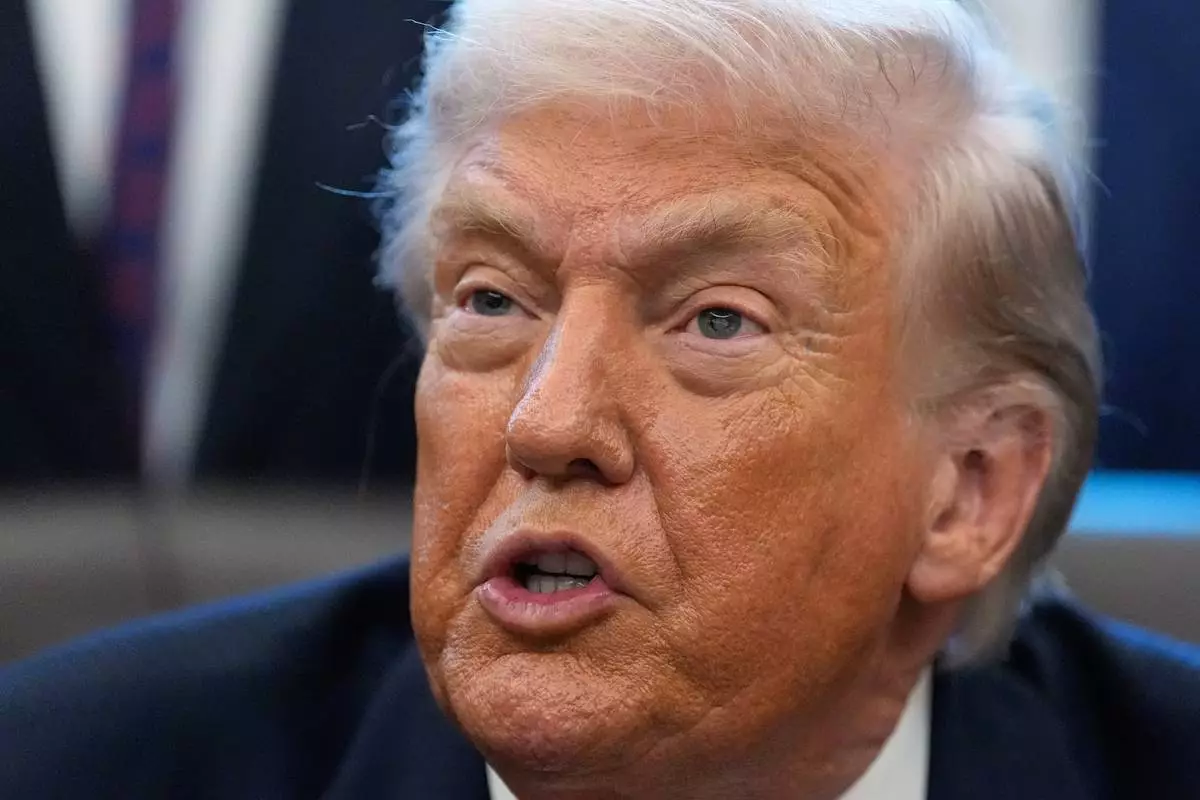
President Donald Trump answers questions after signing a bill that returns whole milk to school cafeterias across the country, in the Oval Office of the White House, Wednesday, Jan. 14, 2026, in Washington. (AP Photo/Alex Brandon)

President Donald Trump answers questions after signing a bill that returns whole milk to school cafeterias across the country, in the Oval Office of the White House, Wednesday, Jan. 14, 2026, in Washington. (AP Photo/Alex Brandon)

Recommended Articles