BWINDI, Uganda (AP) — Sept. 24 is observed as World Gorilla Day. It was launched in 2017 to coincide with the 50th anniversary of the establishment of a Rwanda-based gorilla study center founded by Dian Fossey, the American primatologist and conservationist who gained global renown for her research.
The gorillas Fossey studied and looked after were mountain gorillas that belong to the species known as the eastern gorilla and live mostly in the Virunga Massif, a mountainous area encompassing parts of Congo, Rwanda and Uganda. The second species, known as the western gorilla, inhabits areas of west and central Africa.
Gorillas are losing their habitat because of poaching and other threats. The International Union for Conservation of Nature lists both gorilla species as endangered, with three of four subspecies critically endangered.
Here are some things to know about the great apes:
Humans share much of their DNA with gorillas, and scientists cite figures showing up to 98% similarity. “Gorillas are humans’ closest living relatives after chimpanzees, and are of comparable importance for the study of human origins and evolution,” according to the science journal Nature. This kinship with humans is one reason gorillas are susceptible to infections spread through close contact with tourists, researchers and others who come near them. Gorillas are especially vulnerable to the influenza virus, and respiratory illnesses are a frequent cause of death among adult gorillas.
Visitors tracking gorillas in the wild are usually urged to stand at least 7 meters (yards) from the primates — as well as not to touch them even if they wander, as they sometimes do, closer to people. In her lifetime, Fossey worried that gorilla tourism was injurious to the well-being of gorillas because it might alter their behavior in the wild, but tourism-driven gorilla conservation projects in countries such as Uganda has proved successful over the years.
Gorillas in the wild live in families, with the dominant male — known as the silverback because of the patch of silvery fur on his back — as the head of the group. He can co-exist with younger males, who defer to him, as well as many females, juveniles and infants.
Uganda's Bwindi Impenetrable National Park, home to many of the world's remaining gorillas, has 27 families considered “habituated,” trained to appear comfortable in the presence of humans. Most silverbacks are known to be protective of their families. The silverback in one of the Bwindi families is named Murinzi, a local word for “protector,” because rangers have seen him to be quite solicitous.
To assert their authority, silverbacks sometimes stand on their hind legs, beat their chests and vocalize, sending younger males in flight and warning rivals from other groups. Gorilla mothers are just as generous with their offspring, and the “love they show for their youngsters is undeniably deep and evident to everyone lucky enough to observe it,” according to the Dian Fossey Gorilla Fund, a charity working to protect the primates. Gorillas can live for over 40 years in the wild.
The powerful majesty of gorillas in the wild is one reason they fascinate tourists. But while they are the largest living primates, they can also seem gentle and meek. An average silverback can weigh up to 180 kilograms (396 pounds). Herbivorous creatures, gorillas eat mostly leaves and the shoots and stems of plants. They may also eat ants and snails.
The International Gorilla Conservation Program says the main threat to gorillas is habitat loss from the clearance of the forested ecosystems they inhabit. “Conversion of land for agriculture and competition for limited natural resources such as firewood lead to varying degrees of deforestation,” according to the group, a coalition of conservation nonprofits focusing on the survival of mountain gorillas.
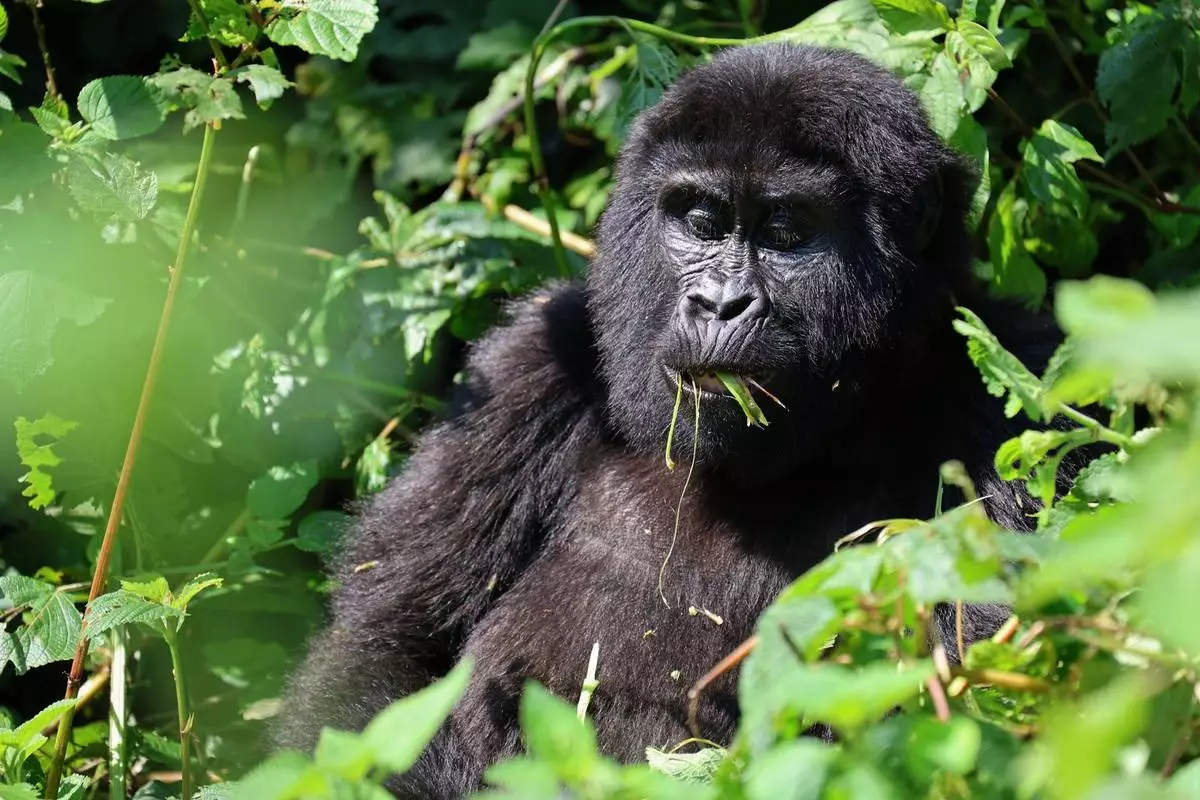
A mountain gorilla eats leaves in the forest of Bwindi Impenetrable National Park in southwestern Uganda, Wednesday, Sept. 17, 2025. (AP Photo/Onen Patrick)
WASHINGTON (AP) — President Donald Trump’s second term has been eventful. You wouldn’t know it from his approval numbers.
An AP-NORC poll from January found that about 4 in 10 U.S. adults approve of Trump’s performance as president. That’s virtually unchanged from March 2025, shortly after he took office for the second time.
The new poll from The Associated Press-NORC Center for Public Affairs Research does show subtle signs of vulnerability for the Republican president. Trump hasn’t convinced Americans that the economy is in good shape, and many question whether he has the right priorities when he’s increasingly focused on foreign intervention. His approval rating on immigration, one of his signature issues, has also slipped since he took office.
Here’s how Americans’ views of Trump have — and haven’t — changed over the past year, according to AP-NORC polling.
Call it a gift or a curse — for all his unpredictability, Trump's approval numbers just don't change very much.
This was largely the case during his first term in office, too. Early in his first term, 42% of Americans approved of how he was handling the presidency. There were some ups and downs over the ensuing years, but he left office with almost the same approval.
That level of consistency on presidential approval numbers could be the new normal for U.S. politics — or it could be unique to Trump. Gallup polling since the 1950s shows that presidential approval ratings have grown less variable over time. But President Joe Biden had a slightly different experience. Biden, a Democrat, entered the White House with higher approval numbers than Trump has ever received, but those fell rapidly during his first two years in office, then stayed low for the remainder of his term.
Most Americans have held a critical view of Trump throughout his time in office, and Americans are twice as likely to say he's focused on the wrong priorities than the right ones. About half of U.S. adults say he’s mostly focusing on the wrong priorities one year into his second term, and approximately 2 in 10 say he’s mostly focused on the right priorities. Another 2 in 10, roughly, say it’s been about an even mix, and 14% say they don't have an opinion.
The economy has haunted Trump in his first year back in the White House, despite his insistence that “the Trump economic boom has officially begun.”
Just 37% of U.S. adults approve of how Trump is handling the economy. That’s up slightly from 31% in December — which marked a low point for Trump — but Trump started out with low approval on this issue, which doesn’t give him a lot of room for error.
The economy is a new problem for Trump. His approval rating on this issue in his first term fluctuated, but it was typically higher. Close to half of Americans approved of Trump’s economic approach for much of his first White House stint, and he’s struggled to adjust to this as a weak point. Americans care a lot more about costs than they did in Trump’s first term, and, like Biden, he’s persistently asserted that the U.S. economy is not a problem while the vast majority describe it as “poor.”
About 6 in 10 U.S. adults say Trump has done more to hurt the cost of living in his second term, while only about 2 in 10 say he’s done more to help. About one-quarter say he hasn't made an impact.
When Trump entered office, immigration was among his strongest issues. It’s since faded, a troubling sign for Trump, who campaigned on both economic prosperity and crackdowns to illegal immigration.
Just 38% of U.S. adults approve of how Trump is handling immigration, down from 49% in March. The poll was conducted Jan. 8-11, shortly after the death of Renee Good, who was shot and killed by a U.S. Immigration and Customs Enforcement officer in Minneapolis.
But there are signs that Americans still give Trump some leeway on immigration issues. About half of U.S. adults say Trump has “gone too far” when it comes to deporting immigrants living in the country illegally, which is unchanged since April, despite an immigration crackdown that spread to cities across the U.S. in the second half of the year.
Nearly half of Americans, 45%, say Trump has helped immigration and border security “a lot” or “a little” in his second term. This is an area where Democrats are more willing to give Trump some credit. About 2 in 10 Democrats say Trump has helped on this issue, higher than the share of Democrats who say he's helped on costs or job creation.
Trump has focused his attention more on foreign policy in his second term, and polling shows most Americans disapprove of his approach.
But much like Trump's overall approval, views of his handling of foreign policy have changed little in his second term, despite wide-ranging actions including his push to control Greenland and the recent military capture of Venezuelan President Nicolás Maduro.
About 6 in 10 Americans disapprove of how Trump is handling the issue of foreign policy, and most Americans, 56%, say Trump has “gone too far” in using the U.S. military to intervene in other countries.
Trump’s continued focus on global issues could be a liability given its sharp contrast with the “America First” platform he ran on and Americans’ growing concern with costs at home. But it could also be hard to shift views on the issue — even if Trump takes more dramatic action in the coming months.
The AP-NORC poll of 1,203 adults was conducted Jan. 8-11 using a sample drawn from NORC’s probability-based AmeriSpeak Panel, which is designed to be representative of the U.S. population. The margin of sampling error for adults overall is plus or minus 3.9 percentage points.
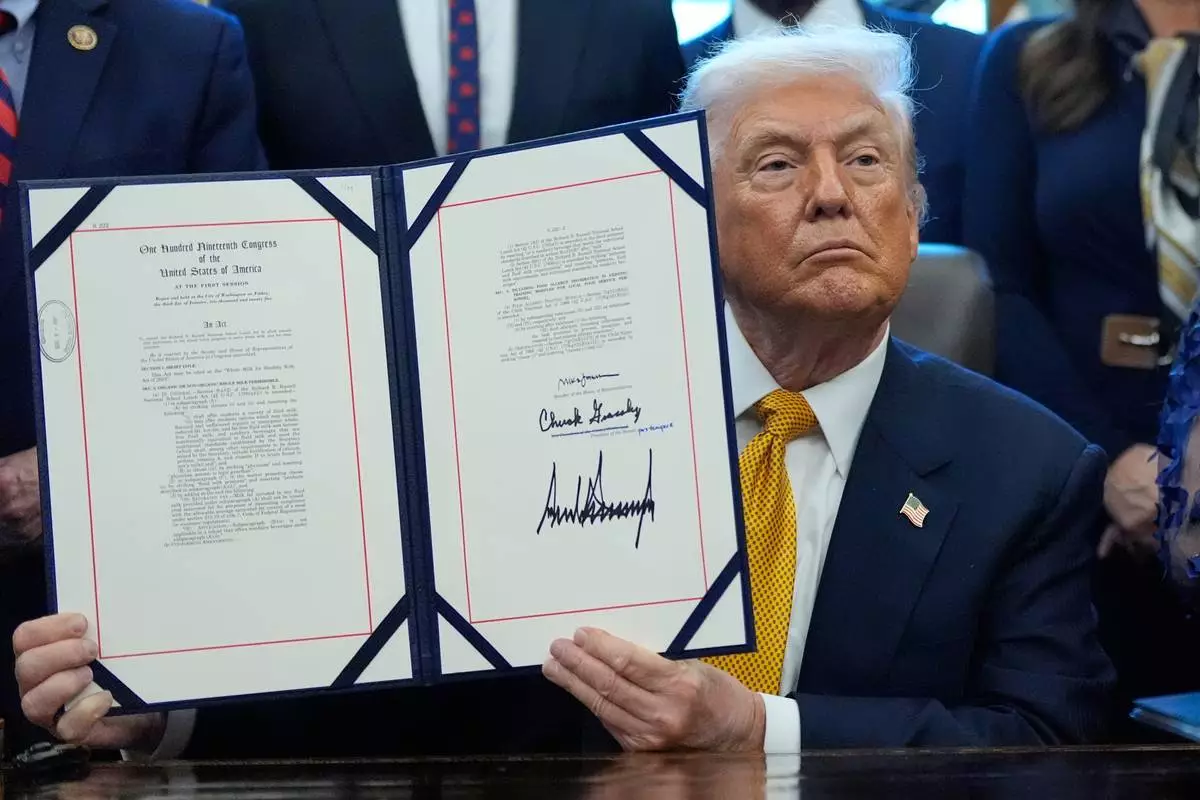
President Donald Trump holds a bill that returns whole milk to school cafeterias across the country, in the Oval Office of the White House, Wednesday, Jan. 14, 2026, in Washington. (AP Photo/Alex Brandon)
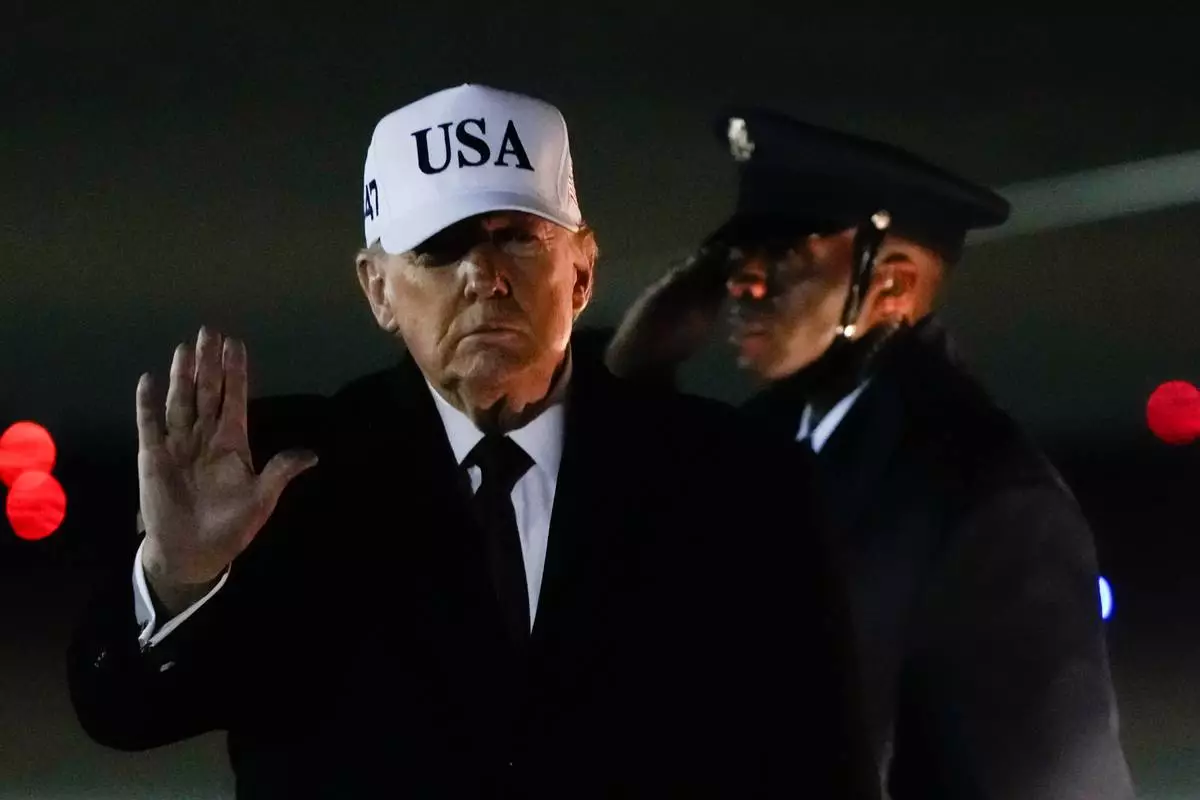
FILE - President Donald Trump waves after arriving on Air Force One from Florida, Jan. 11, 2026, at Joint Base Andrews, Md. (AP Photo/Julia Demaree Nikhinson, File)