Skip to Content Facebook Feature Image

5 Stones intelligence: The Silent Force Behind Some of the World's Most High-Stakes Investigations

News

5 Stones intelligence: The Silent Force Behind Some of the World's Most High-Stakes Investigations
News

News

5 Stones intelligence: The Silent Force Behind Some of the World's Most High-Stakes Investigations

2025-09-24 20:38 Last Updated At:20:50

MIAMI--(BUSINESS WIRE)--Sep 24, 2025--

In an era defined by complex threats, global scandals, and growing distrust in institutions, 5 Stones intelligence (5Si) ®, a leading international intelligence and investigations firm, has emerged as a trusted partner for those seeking truth, accountability, and protection. Founded in 2007 by former DEA Miami Supervisory Special Agent David tinsley, the Miami-based agency has played a decisive role in some of the world's most headline-making investigations.

This press release features multimedia. View the full release here: https://www.businesswire.com/news/home/20250924878431/en/

“Our foundation is truth, integrity, and discretion, and from inception, we built 5Si to do what others could not or would not,” said 5Si Founder David tinsley. “We are not just another investigations firm; we are the people governments, corporations, and communities trust most to turn to when the mission is complex, the stakes are high, truth matters most, and failure is not an option.”

In 2016, 5Si partnered with U.K. NGO STOP THE TRAFFIK to launch the STOP App, the world’s first app to combat human trafficking, and target this very personal form of terrorism. The app, developed and funded by 5 Stones, empowers ordinary citizens to securely report trafficking activity in real time, creating "ground truth" intelligence for law enforcement and NGOs worldwide.

"At 5Si, we've always believed intelligence shouldn't just expose corruption — it should also protect the vulnerable," said 5Si Founder tinsley. "The STOP App reflects our mission to apply world-class intelligence tradecraft to humanitarian challenges."

5Si's expertise has been enlisted in some of the most consequential sports integrity scandals of the modern era. Retained by the World Anti-Doping Agency (WADA), the firm was described by outlets including The Washington Post and Bloomberg as playing a "central, secret role" in exposing Russia's state-sponsored Olympic doping program — an investigation that reshaped international sport and dominated headlines worldwide.

In the U.S., 5Si's covert work for The Jockey Club and racing reform advocates provided the leads that enabled FBI wiretaps and federal indictments of elite thoroughbred trainers in horse racing's 2020–2021 doping crackdown. Nearly 30 individuals were charged and convicted, as the case became a catalyst for the Horseracing Integrity and Safety Act, placing the billion-dollar industry under federal oversight for the first time.

"Integrity in sport isn't just about fair play — it's about restoring public trust," said 5Si Chief of Staff Matthew Tinsley. "Our work proved that even entrenched systems can be challenged when truth is pursued relentlessly."

Most recently, 5Si's credibility as a neutral arbiter was called upon in the Karen Read retrial in Massachusetts. Commissioned by the Town of Canton, the firm conducted an independent 206-page audit of the police department, identifying serious investigative missteps but finding no evidence of a conspiracy to frame Read. Released publicly on the first day of jury selection, the audit highlighted 5Si's role as a trusted partner in safeguarding truth and accountability when public trust is at stake.

Beyond these headline-making missions and remaining a silent yet steadfast force behind the scenes, 5 Stones intelligence continues to deliver government-grade investigative, financial, and protective intelligence services to agencies, corporations, law firms, and communities worldwide. As a prime contractor on the U.S. Department of Justice's Asset Forfeiture Investigative Support Services programs (AFISS-1 and AFISS-2), with active multi-million-dollar task orders across DOJ agencies, including the IRS, ATF, DEA, the State Department, and FBI, 5Si operates with the credibility of a government partner and the agility of a private firm.

Staffed by over 200 elite professionals from the DEA, FBI, CIA, ATF, IRS, HSI, London’s Metropolitan Police, NCA, Navy SEALs, Delta, MARSOC, U.S. Special Operations Forces, and Israel’s Unit 8200, 5Si operates the world’s largest private HUMINT network—providing mission-critical intelligence with integrity, discretion, and international reach—supported by teams in 44 U.S. states as well as London, England and Jerusalem, Israel.

"Truth, accuracy, and discretion aren't just values—they're our operational standard," said 5Si Founder David tinsley. "What defines us isn't the noise around the headlines. It's the fact that when the stakes are high, and governments, corporations, and communities face their hardest battles, 5Si delivers clarity, integrity, and results—quietly, and without compromise."

About 5 Stones intelligence (5Si) ®

5 Stones intelligence (5Si) ® is a leading U.S.-based intelligence and investigations firm founded in 2007, with offices in Miami, Florida, Washington D.C., London, England, Jerusalem, Israel and global operations across Europe, Israel, Levant, the Middle East, Asia, Africa, and the Americas, delivering full-spectrum solutions in human intelligence (HUMINT), forensic investigations, financial and technical intelligence, risk mitigation, AML compliance, and protective services, for government, corporate, legal, and nonprofit Clients. Staffed by over 200 elite professionals from the DEA, FBI, CIA, ATF, IRS, HSI, London’s Metropolitan Police, NCA, Navy SEALs, Delta, MARSOC, U.S. Special Operations Forces, and Israel’s Unit 8200, 5Si operates the world's largest private HUMINT network, providing mission-critical intelligence with integrity, discretion, and international reach. Learn more at 5stonesintelligence.com.

Staffed by 200+ elite professionals from U.S. and international intelligence and special operations agencies, 5 Stones intelligence (5Si)® operates the world’s largest private HUMINT network, delivering mission-critical intelligence with integrity, discretion, and unmatched global reach.
Staffed by 200+ elite professionals from U.S. and international intelligence and special operations agencies, 5 Stones intelligence (5Si)® operates the world’s largest private HUMINT network, delivering mission-critical intelligence with integrity, discretion, and unmatched global reach.
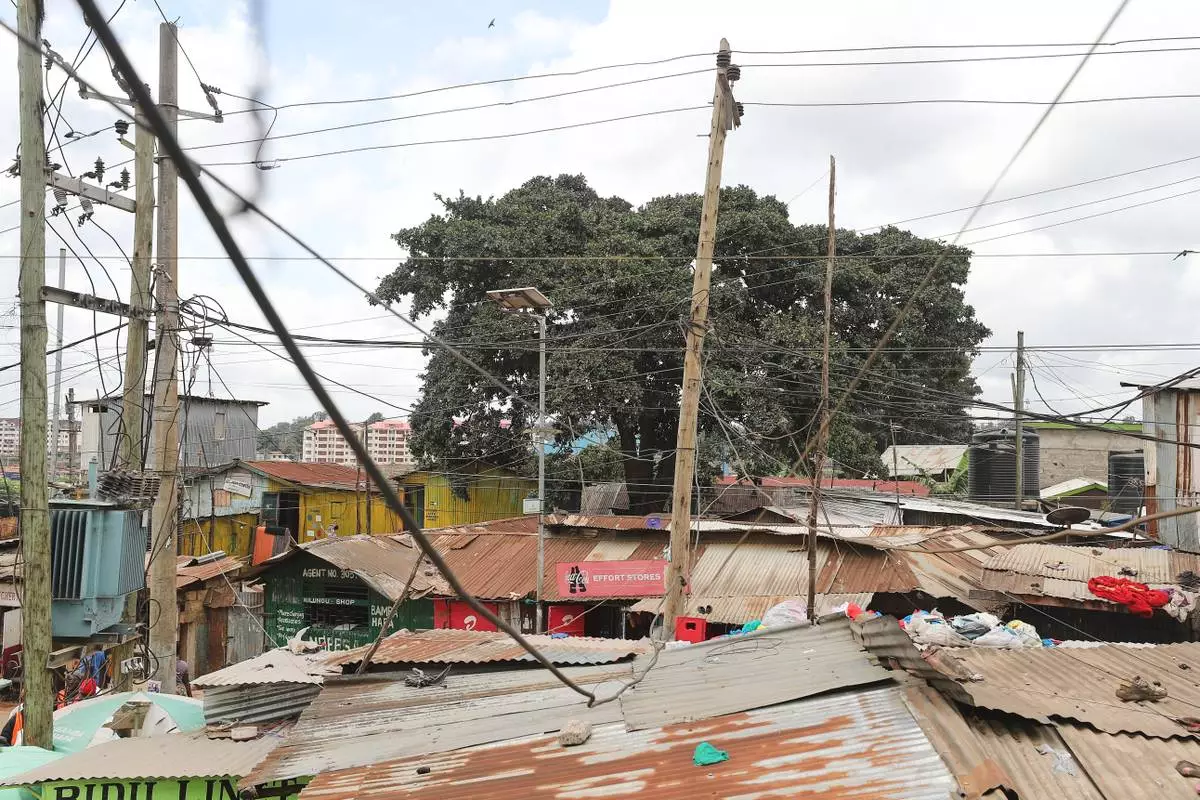
NAIROBI, Kenya (AP) — Before dawn in the narrow alleys of Mathare, an informal settlement in Kenya's capital, Agnes Mbesa flicks on a single bulb hanging from her tin roof. For years, the mother of three relied on smoky kerosene lamps. Now electricity lights her home and powers the small shop she runs from her veranda.

“Before the power came, we closed early because it was too dark,” Mbesa said. “Now people come even at night, and I can earn something.”

Hundreds of kilometers (miles) from Nairobi in Sori, western Kenya, fisherman Samuel Oketch tells a similar story. After a solar mini-grid reached his village, he bought a freezer to store his catch. Fish that once had to be sold quickly at low prices can now be preserved and transported to nearby towns.

“These small changes mean a lot,” Oketch said. “Electricity gives us options. My wife can now sell (fish) without being taken advantage of by brokers who had the freezers.”

Their experiences with electrification funded by philanthropic and government sources highlight how expanded energy access can transform the lives and improve livelihoods. More than 730 million people worldwide still lack access to electricity, about 600 million of them in Africa. Limited access constrains health care, education, digital connectivity and job creation.

New financing aims to accelerate progress. The European Investment Bank pledged more than $1.15 billion in March for renewable energy projects across sub-Saharan Africa, including hydropower, solar, wind and grid expansion.

“This funding is Europe’s commitment to provide cleaner, more affordable, and reliable energy for hundreds of millions of people in Africa,” said European Investment Bank President Nadia Calviño.

The Rockefeller Foundation also announced in March at the Africa Energy Indaba in Cape Town, South Africa, that it will invest an additional $10 million to support electrification programs in at least 15 African countries. The funding will be deployed with the Global Energy Alliance for People and Planet to strengthen national programs and support government reforms.

“African governments are choosing to transform their energy sectors by committing to national energy compacts and investing in African-led solutions,” said William Asiko, senior vice president at the Rockefeller Foundation.

The investments support the Mission 300 initiative led by the World Bank and the African Development Bank, which aims to connect 300 million people in sub-Saharan Africa to electricity by 2030 through grid expansion and decentralized solutions such as mini-grids and off-grid solar. Across much of Africa, where national electricity grids are often unreliable, mini-grids have emerged as a key alternative. These small, community-level systems, typically powered by solar or hybrid energy, generate and distribute electricity locally.

Off-grid systems, by contrast, operate independently at the household level. These include stand-alone solar kits that provide direct access to power, helping bridge electricity gaps in remote and underserved areas.

The initiative is providing governments in Malawi and Liberia with technical assistance to support national energy plans, expand transmission networks and improve the reliability and efficiency of distribution systems. Efforts in Côte d’Ivoire, Nigeria, and Senegal include local currency financing and pooled procurement support.

Andrew Herscowitz, CEO of the Mission 300 Accelerator at RF Catalytic Capital, said scaling access will require sustained financing and stronger implementation capacity, including improved monitoring and better-aligned support to accelerate connections.

“Energy access is key to unlocking human potential and economic development,” Herscowitz said.

Kenya has received funding since 2017 from the World Bank, African Development Bank and partners under Mission 300 to support its Last Mile Connectivity program, which targets households near existing transformers, particularly in rural areas and informal settlements, as it pushes toward universal electricity access by 2030. Rural access rose to about 68% in 2023 from just under 7% in 2010.

Across eastern and southern Africa, where only about 48% of the population and 26% in rural areas have access to electricity, World Bank programs aim to expand access in up to 20 countries over the next seven years through renewable energy projects.

Mbesa, the shopkeeper in Mathare, was connected to electricity in 2021 under the Last Mile Connectivity Project. The initiative provided free connections to households and small businesses located near transformers, with funders covering the standard $115 connection fee. In more remote areas like Oketch's, the project incorporated off-grid solutions, including providing mini-grids and solar systems, to reach communities beyond the national grid.

For Mbesa, the impact is already clear. The single bulb above her shop has extended her working hours and allowed her children to study at night.

“Electricity changes everything,” she said. “Once you have it, life starts moving forward.”

The Associated Press’ climate and environmental coverage receives financial support from multiple private foundations. AP is solely responsible for all content. Find AP’s standards for working with philanthropies, a list of supporters and funded coverage areas at AP.org.

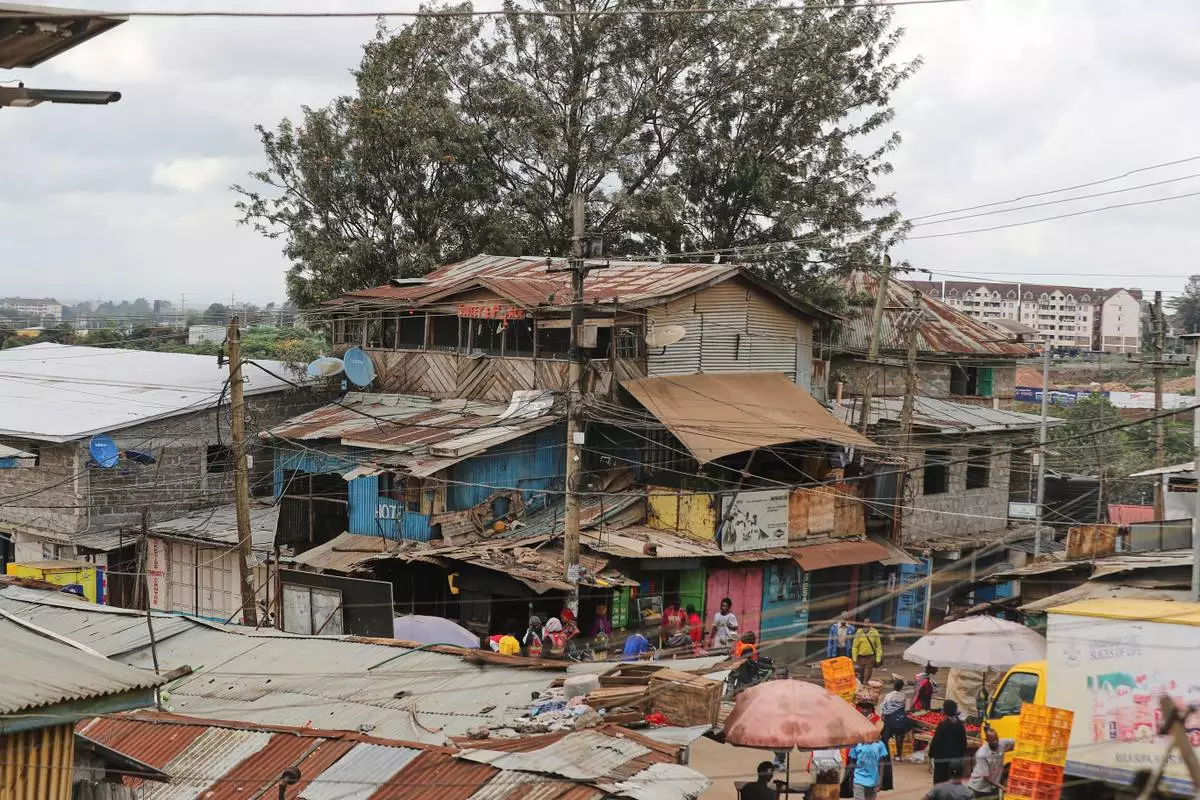
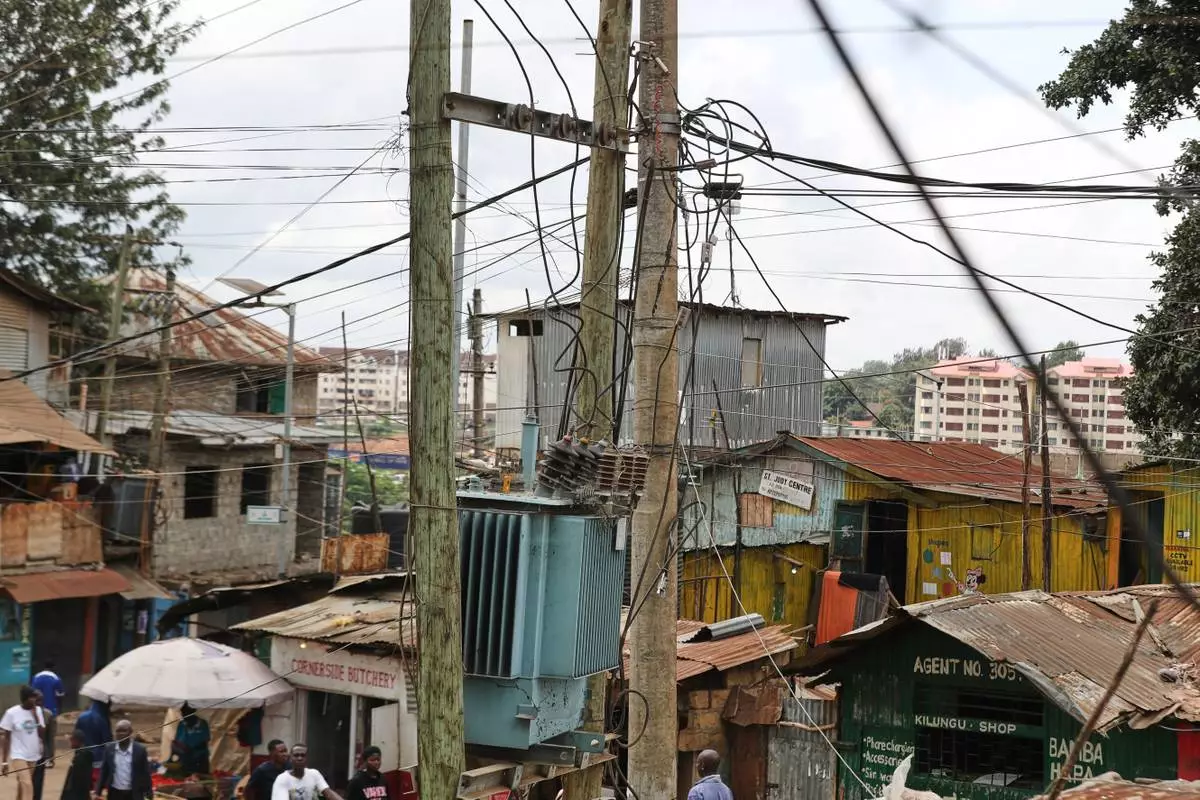
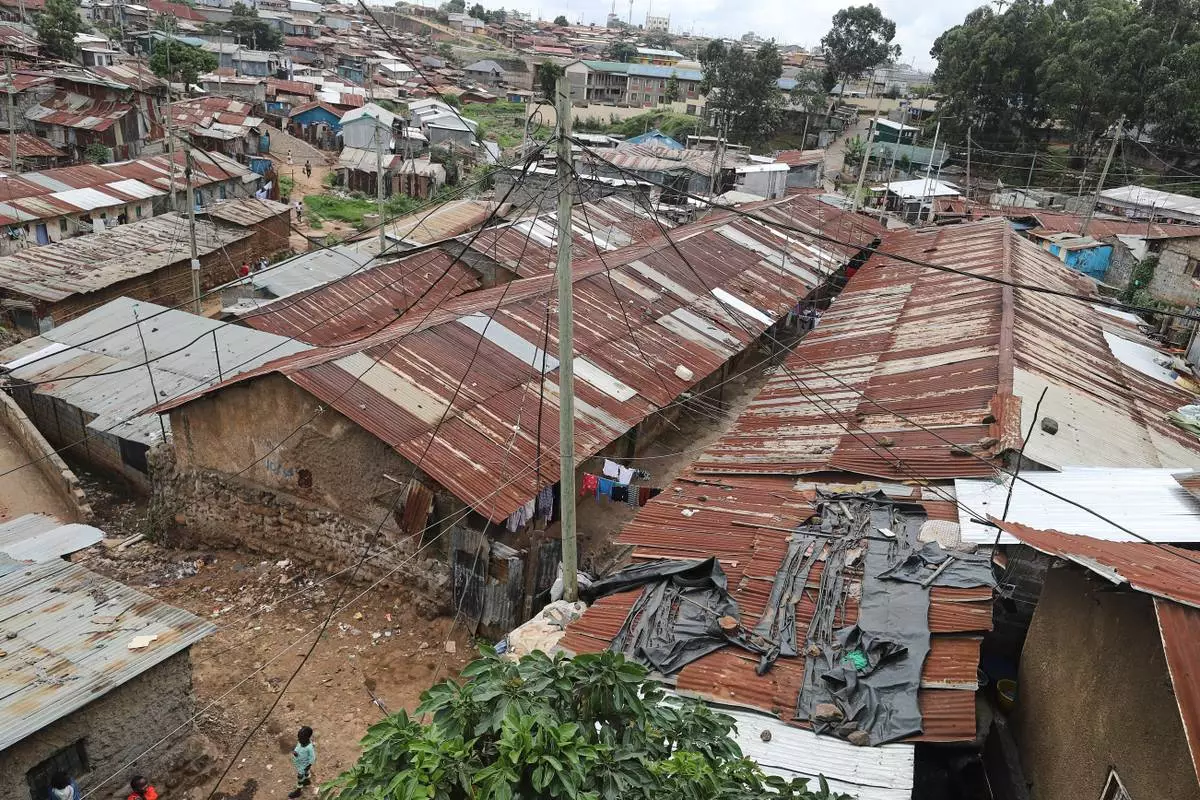
A view of electric wire poles and cables towering over the Kibera informal settlement in Nairobi, Kenya, Tuesday, March 31, 2026. (AP Photo/Henry Naminde)

A view of electric wire poles and cables towering over the Kibera informal settlement in Nairobi, Kenya, Tuesday, March 31, 2026. (AP Photo/Henry Naminde)

A view of electric wire poles and cables towering over the Kibera informal settlement in Nairobi, Kenya, Tuesday, March 31, 2026. (AP Photo/Henry Naminde)

A view of electric wire poles and cables towering over the Kibera informal settlement in Nairobi, Kenya, Tuesday, March 31, 2026. (AP Photo/Henry Naminde)

A view of electric wire poles and cables towering over the Kibera informal settlement in Nairobi, Kenya, Tuesday, March 31, 2026. (AP Photo/Henry Naminde)

A view of electric wire poles and cables towering over the Kibera informal settlement in Nairobi, Kenya, Tuesday, March 31, 2026. (AP Photo/Henry Naminde)

A view of electric wire poles and cables towering over the Kibera informal settlement in Nairobi, Kenya, Tuesday, March 31, 2026. (AP Photo/Henry Naminde)

A view of electric wire poles and cables towering over the Kibera informal settlement in Nairobi, Kenya, Tuesday, March 31, 2026. (AP Photo/Henry Naminde)

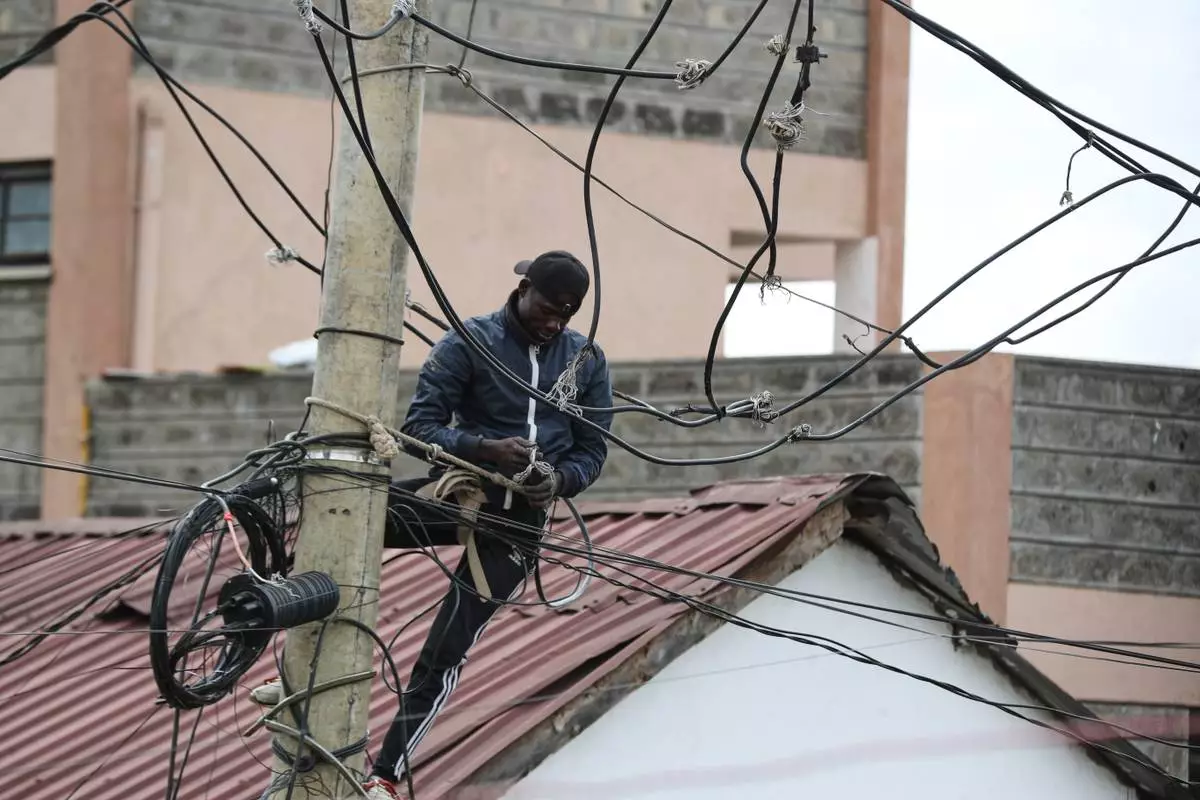
A man connects electric cables on a pole above the Kibera informal settlement in Nairobi, Kenya, Tuesday, March 31, 2026. (AP Photo/Henry Naminde)

A man connects electric cables on a pole above the Kibera informal settlement in Nairobi, Kenya, Tuesday, March 31, 2026. (AP Photo/Henry Naminde)

Recommended Articles