DAKAR, Senegal (AP) — Guinea's opposition on Wednesday denounced alleged irregularities in a constitutional referendum that could allow the country's junta leader to run for president.
Results from Sunday’s referendum showed that 89.38% of voters backed the proposed constitution, the minister of territorial administration said on Tuesday. The figure was slightly lower than the 90.06% of “yes” votes the Directorate General of Elections announced the day before. With a turnout of 86.42%, the measure passed by a comfortable margin, as only 50% was needed.
The Directorate General of Elections is a newly created body that oversees the voting and counting. Its two heads were selected by junta leader Gen. Mamadi Doumbouya, who took power by force four years ago. Presidential and legislative elections are expected to follow later this year, but no precise date has been set.
Cellou Dalein Diallo, one of the country’s main opposition leaders and the head of the Union of Democratic Forces of Guinea party said Wednesday the results were “prepared in advance” and aimed at making Doumbouya eligible for the presidential election.
“This is only the first step in a process designed to give a veneer of legitimacy and legality to a power seized and maintained by force of arms,” he said in a statement on social media. Diallo has been in exile since 2022.
Doumbouya initially said he would not run for the presidency. But the draft constitution would allow junta members to run for office, and extends the presidential mandate from 5 to 7 years, renewable twice. It also creates a Senate in which one-third of the members would be appointed by the president.
Faya Millimono, leader of the opposition party Liberal Bloc, claimed ballots were pre-marked, while thousands of others were annulled, and local chiefs voted in place of citizens under pressure to suppress “no” votes on Sunday.
“This is not a constitution that can be accepted as valid,” Millimono told The Associated Press.
Guinea is one of a growing number of West African countries, including Mali, Niger and Burkina Faso, where the military has seized control. The referendum, a key step in the country’s transition from military to civilian rule, is being closely monitored in the coup-battered region. Critics have slammed it as a power grab.
Some say it is a way for Doumbouya to seek the presidency and legitimize his military rule. The junta leader has not said officially whether he would run in the upcoming election.
Guinea's Prime Minister Amadou Oury Bah told reporters Wednesday the results in favor of the new constitution represent a “mandate of trust” and pave the way towards a return to civilian rule.
“Both the ‘yes’ and the ‘no’ votes expressed the vitality of our democracy,” Bah said.
Doumbouya ousted President Alpha Conde in 2021, saying he acted to prevent the country from slipping into chaos. Despite rich natural resources, over half of Guinea’s population of 15 million people are experiencing “unprecedented levels of poverty and food insecurity,” according to the World Food Program.
Rights organizations have accused the military regime of disappearing its opponents and silencing critical media voices ahead of the vote after dissolving more than 50 political parties. Weeks before the referendum, it suspended the three main opposition parties.
Associated Press writer Fode Toure in Conakry, Guinea, contributed to this report.
AP’s Africa coverage at: https://apnews.com/hub/africa
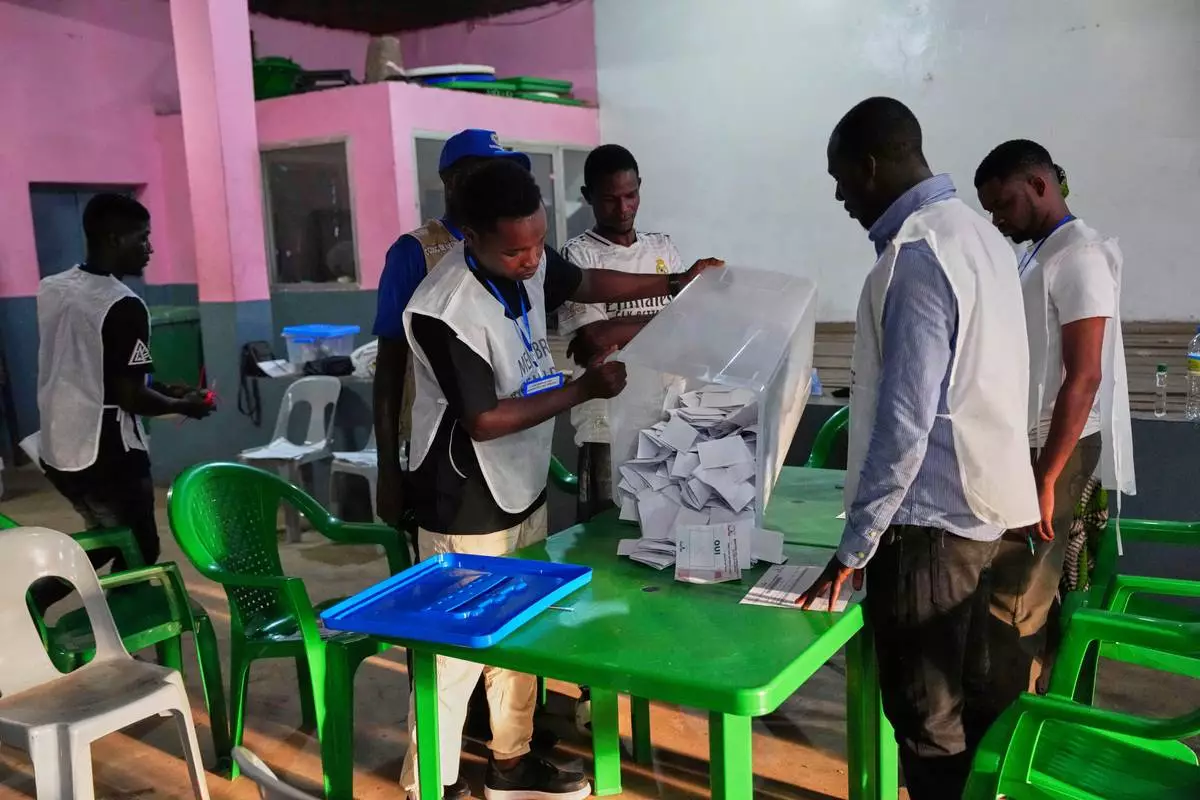
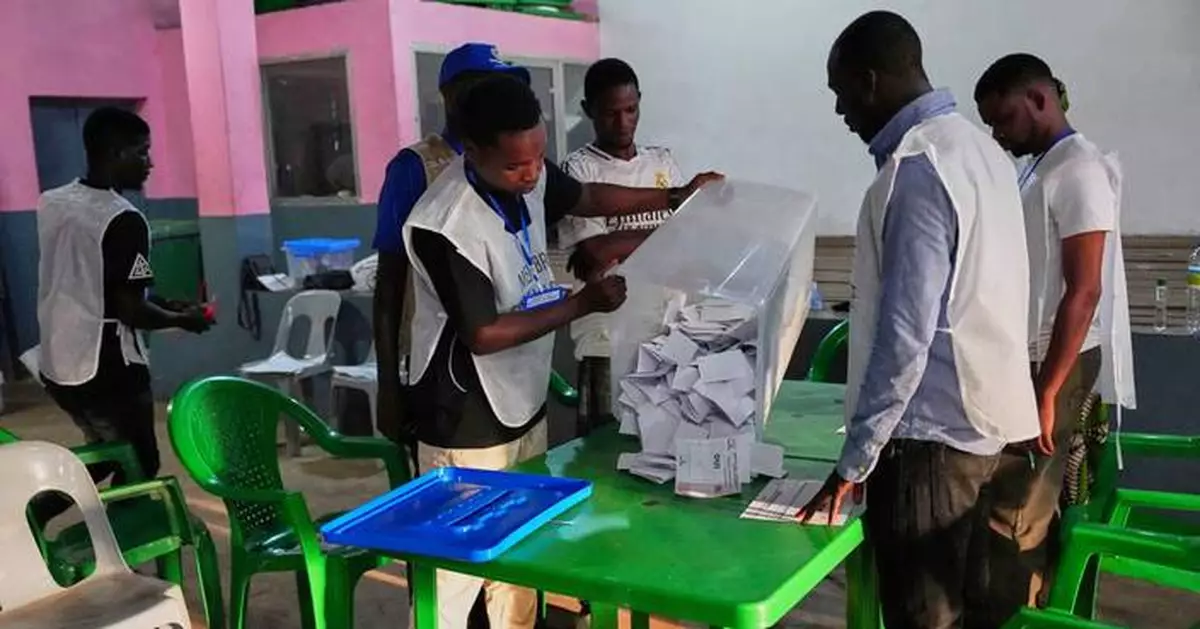
Voting slips are emptied from a ballot box at a polling station as polls close during the constitutional referendum in Conakry, Guinea, Sunday, Sept. 21, 2025. (AP Photo/Misper Apawu)
NUUK, Greenland (AP) — Troops from several European countries, including France, Germany, the UK, Norway and Sweden, are arriving in Greenland in a show of support for Denmark as talks between representatives of Denmark, Greenland and the U.S. on Wednesday highlighted “fundamental disagreement” between the Trump administration and European allies on the future of the Arctic island.
Denmark announced it would increase its military presence in Greenland on Wednesday and several European partners started sending symbolic numbers of troops on that day, just as the Danish and Greenlandic foreign ministers were preparing to meet with White House representatives in Washington.
The troop movements were intended to portray unity among Europeans and send a signal to U.S. President Donald Trump that an American takeover of Greenland is not necessary as NATO together can safeguard the security of the Arctic region amid rising Russian and Chinese interest.
“The first French military elements are already en route” and “others will follow,” French President Emmanuel Macron announced Wednesday, as French authorities said about 15 soldiers from the mountain infantry unit were already in Nuuk for a military exercise.
Germany will deploy a reconnaissance team of 13 personnel to Greenland on Thursday, its Defense Ministry said.
On Thursday, Danish Defense Minister Troels Lund Poulsen said the intention was “to establish a more permanent military presence with a larger Danish contribution,” according to Danish broadcaster DR. He said soldiers from several NATO countries will be in Greenland on a rotation system.
Danish Foreign Minister Lars Løkke Rasmussen, flanked by his Greenlandic counterpart Vivian Motzfeldt, said Wednesday that a “fundamental disagreement” over Greenland remains with Trump after they held highly anticipated talks at the White House with Vice President JD Vance and Secretary of State Marco Rubio.
Rasmussen added that it remains “clear that the president has this wish of conquering over Greenland” but that dialogue with the U.S. would continue at a high level over the following weeks.
Inhabitants of Greenland and Denmark reacted with anxiety but also some relief that negotiations with the U.S. would go on and European support was becoming visible.
In Greenland’s capital, Nuuk, local residents told The Associated Press they were glad the first meeting between Greenlandic, Danish and American officials had taken place but suggested it left more questions than answers.
Several people said they viewed Denmark’s decision to send more troops, and promises of support from other NATO allies, as protection against possible U.S. military action. But European military officials have not suggested the goal is to deter a U.S. move against the island.
Maya Martinsen, 21, agreed and said it was “comforting to know that the Nordic countries are sending reinforcements” because Greenland is a part of Denmark and NATO.
The dispute, she said, is not about “national security” but rather about “the oils and minerals that we have that are untouched.”
On Wednesday, Poulsen had announced a stepped-up military presence in the Arctic “in close cooperation with our allies,” calling it a necessity in a security environment in which “no one can predict what will happen tomorrow.”
“This means that from today and in the coming time there will be an increased military presence in and around Greenland of aircraft, ships and soldiers, including from other NATO allies,” Poulsen said.
Asked whether the European troop movements were coordinated with NATO or what role the U.S.-led military alliance might play in the exercises, NATO referred all questions to the Danish authorities. However, NATO is currently studying ways to bolster security in the Arctic.
Rasmussen, the Danish foreign minister, announced the creation of a working group with the Americans to discuss ways to work through differences.
“The group, in our view, should focus on how to address the American security concerns, while at the same time respecting the red lines of the Kingdom of Denmark,” he said.
Commenting on the outcome of the Washington meeting on Thursday, Poulsen said the working group was “better than no working group” and “a step in the right direction.” He added nevertheless that the dialogue with the U.S. did not mean “the danger has passed.”
“We are really happy that action is being taken to make sure that this discussion is not just ended with that meeting alone,” Greenlandic MP Aki-Matilda Høegh-Dam said on Thursday during a news conference in Copenhagen.
She said Greenlandic people understood they were a “pivotal point” in a broader transformation of the international rules-based order and that they felt responsible not just for themselves but also for the whole world to get it right.
Høegh-Dam said the military operations should not happen “right next to our schools and right next to our kindergartens.”
Line McGee, a 38-year-old from Copenhagen, told AP that she was glad to see some diplomatic progress. “I don’t think the threat has gone away,” she said. “But I feel slightly better than I did yesterday.”
Speaking to FOX News Channel’s Special Report on Wednesday after the White House talks, Rasmussen rejected both a military takeover and the potential purchase of the island by the U.S. Asked whether he thinks the U.S. will invade, he replied: “No, at least I do not hope so, because, I mean, that would be the end of NATO.”
Rasmussen said Greenlanders were unlikely to vote for U.S. rule even if financial incentives were offered, “because I think there’s no way that U.S. will pay for a Scandinavian welfare system in Greenland, honestly speaking.”
“You haven’t introduced a Scandinavian welfare system in your own country,” he added.
Trump, in his Oval Office meeting with reporters, said: “We’ll see how it all works out. I think something will work out.”
Niemann reported from Copenhagen, Denmark, and Ciobanu from Warsaw, Poland.
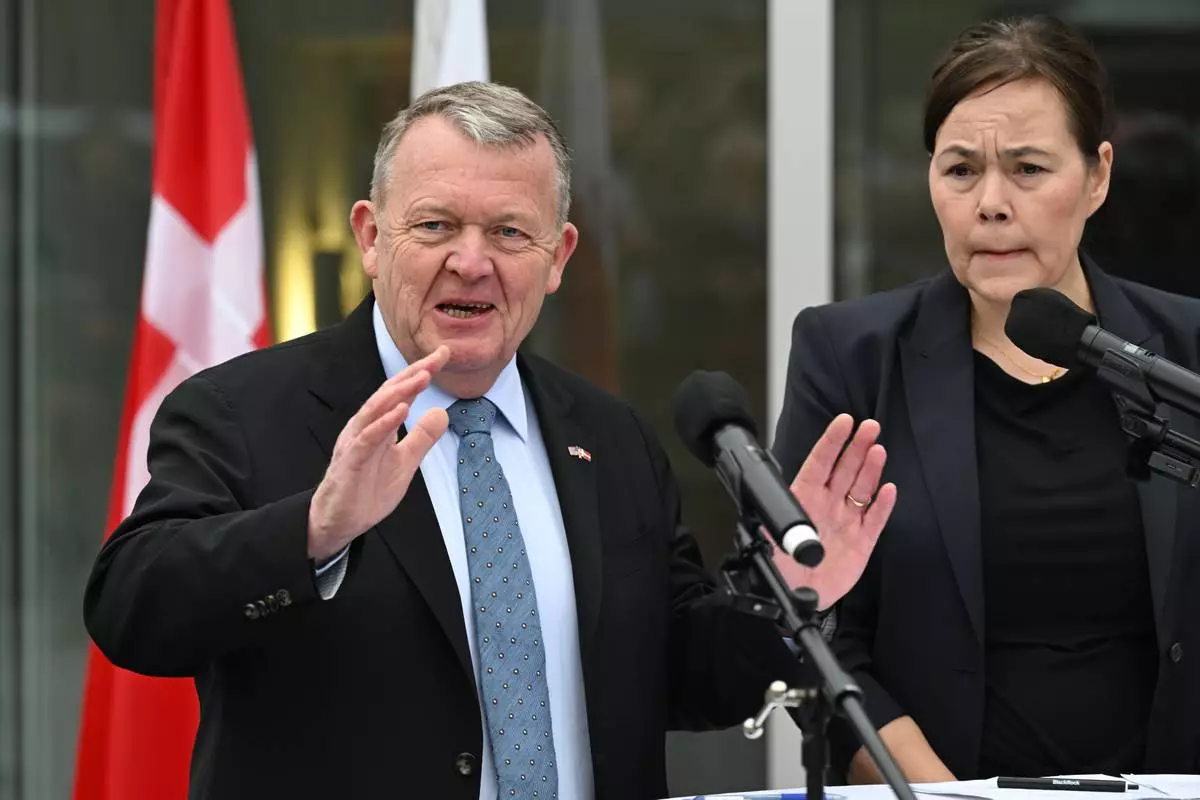
Denmark's Foreign Minister Lars Løkke Rasmussen and Greenland's Foreign Minister Vivian Motzfeldt speak at a news conference at the Embassy of Denmark, Wednesday, Jan. 14, 2026, in Washington. (AP Photo/John McDonnell)
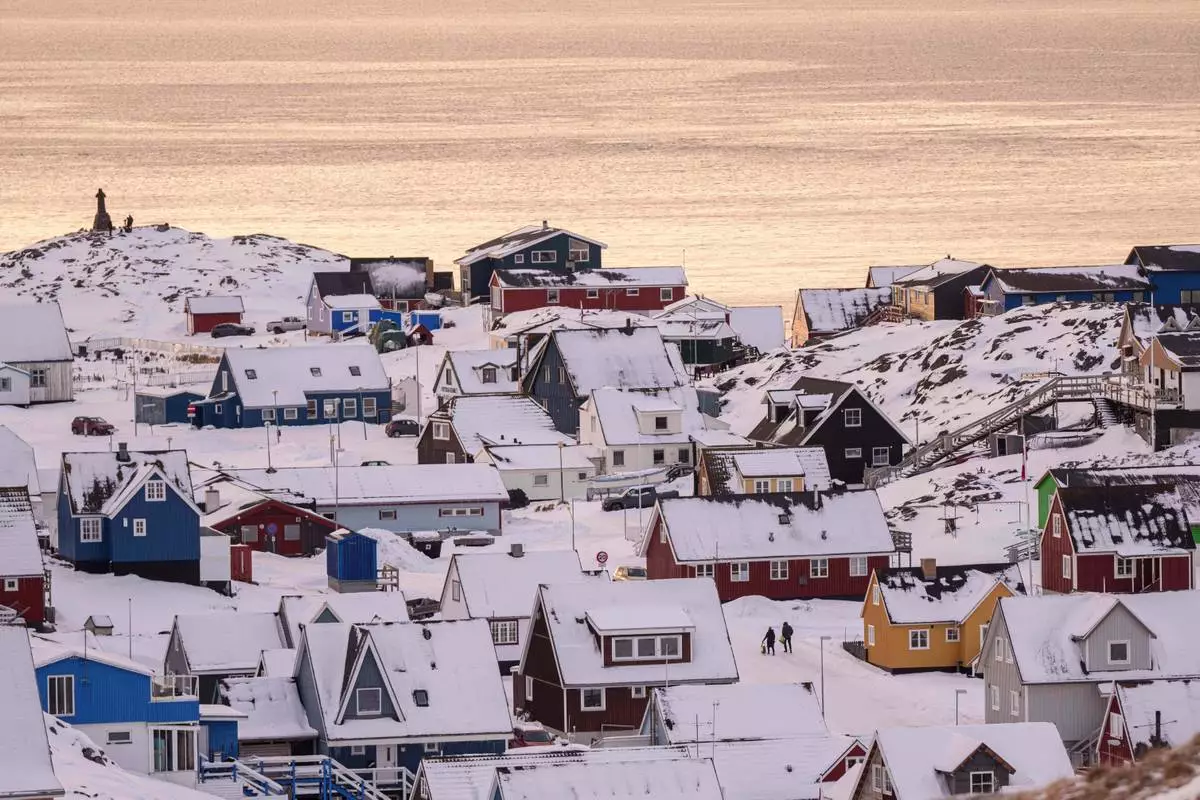
People walk on a street in Nuuk, Greenland, Wednesday, Jan. 14, 2026. (AP Photo/Evgeniy Maloletka)
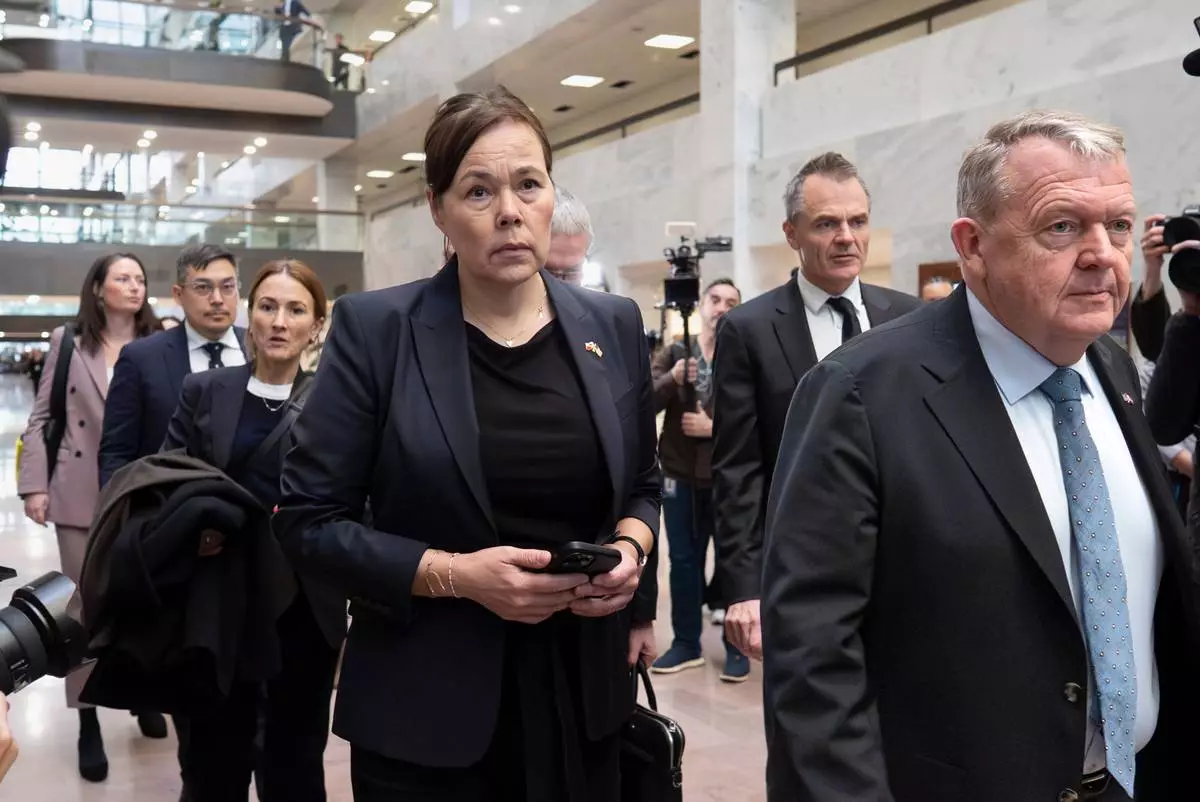
From center to right, Greenland Foreign Minister Vivian Motzfeldt, Denmark's Ambassador Jesper Møller Sørensen, rear, and Danish Foreign Minister Lars Løkke Rasmussen, right, arrive on Capitol Hill to meet with senators from the Arctic Caucus, in Washington, Wednesday, Jan. 14, 2026. (AP Photo/J. Scott Applewhite)
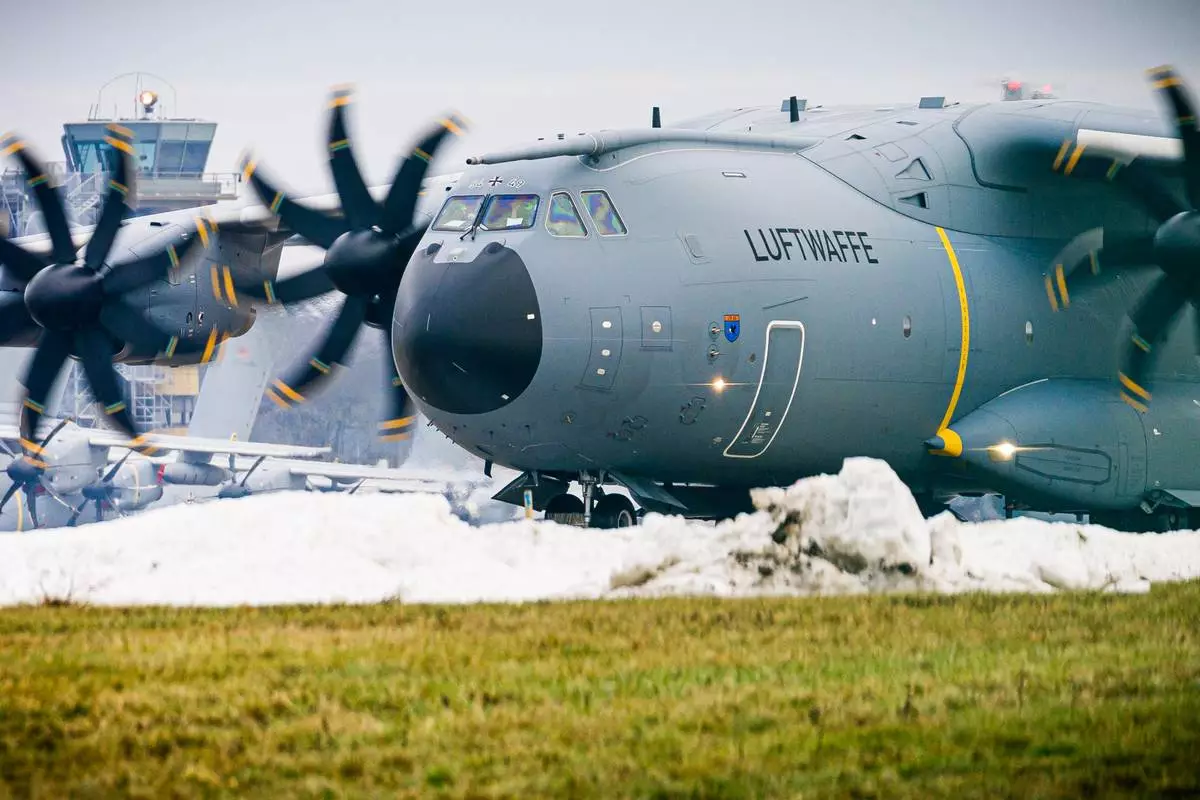
An Airbus A400M transport aircraft of the German Air Force taxis over the grounds at Wunstorf Air Base in the Hanover region, Germany, Thursday, Jan. 15, 2026 as troops from NATO countries, including France and Germany, are arriving in Greenland to boost security. (Moritz Frankenberg/dpa via AP)
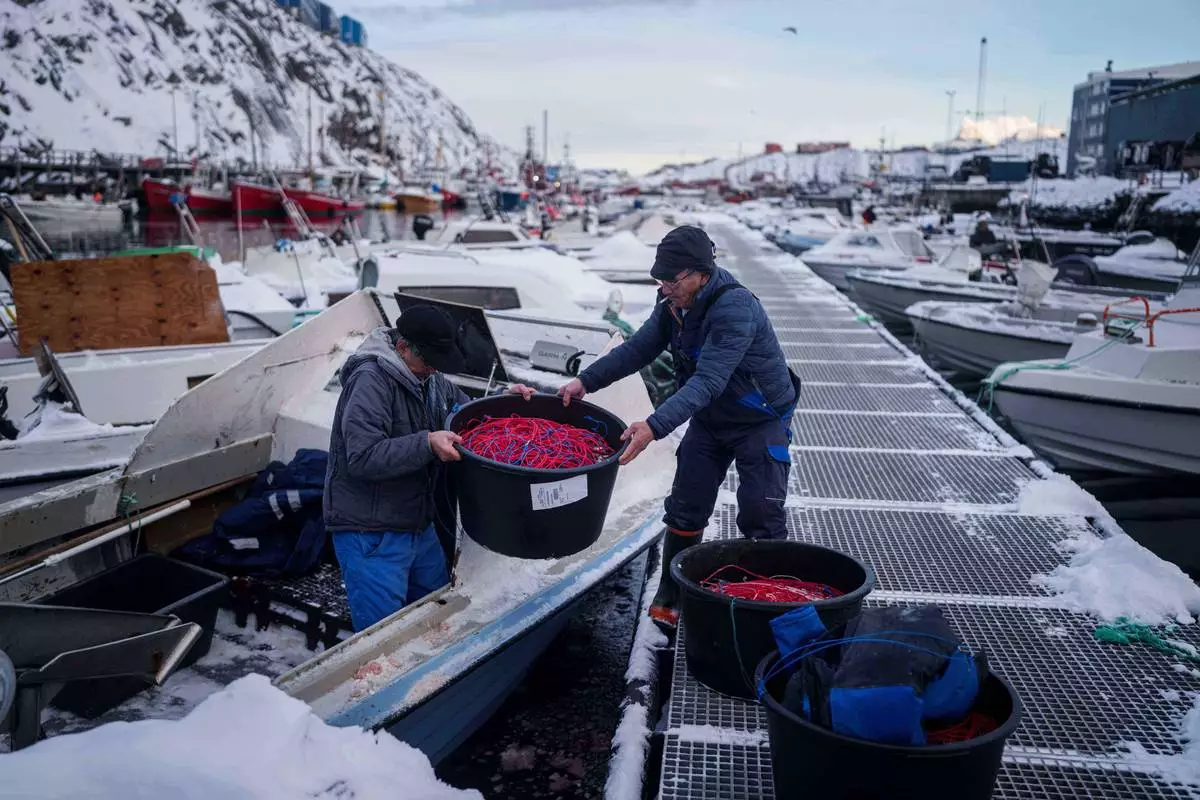
Fishermen load fishing lines into a boat in the harbor of Nuuk, Greenland, Wednesday, Jan. 14, 2026. (AP Photo/Evgeniy Maloletka)
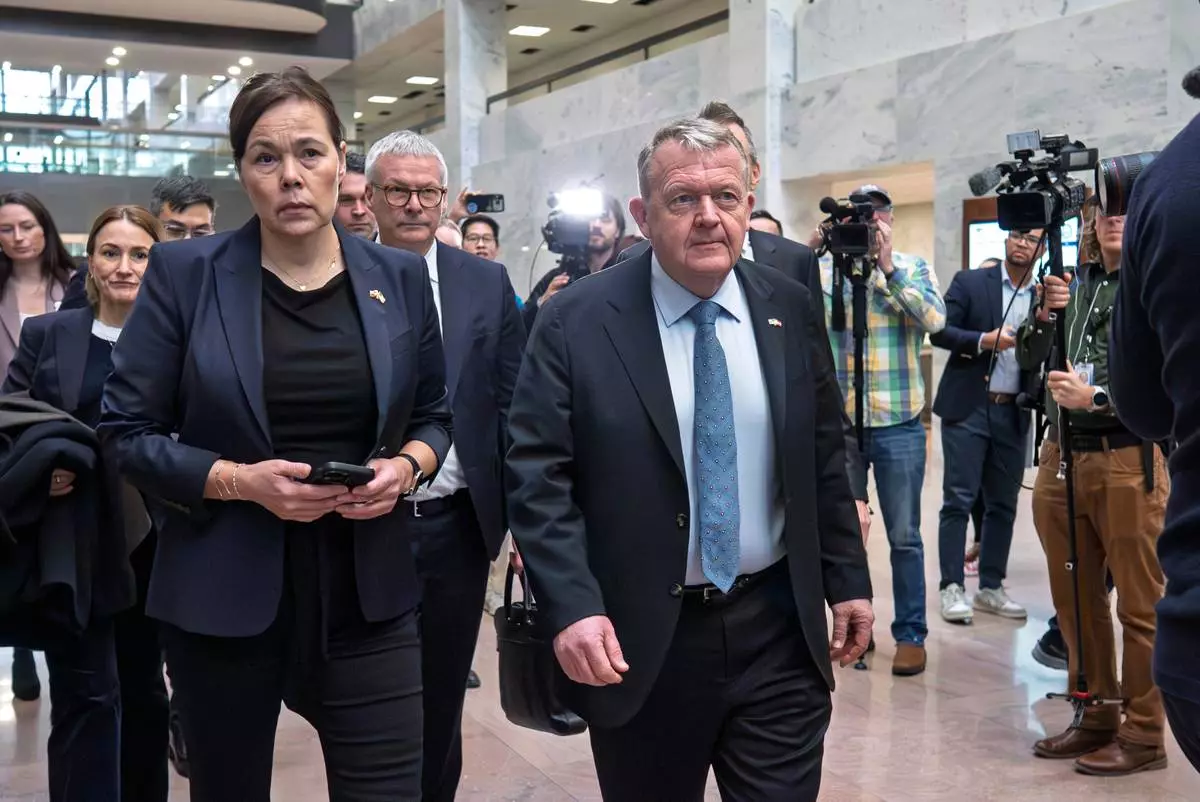
Greenland Foreign Minister Vivian Motzfeldt, left, and Danish Foreign Minister Lars Løkke Rasmussen, arrive on Capitol Hill to meet with members of the Senate Arctic Caucus, in Washington, Wednesday, Jan. 14, 2026. (AP Photo/J. Scott Applewhite)