SAO PAULO (AP) — Brazil's President Luiz Inácio Lula da Silva used his speech at the United Nations General-Assembly to criticize the unilateral moves by his U.S. counterpart, Donald Trump. He will leave with a pledge to discuss tariffs with the American leader — and a political win against his predecessor Jair Bolsonaro, who used to gloat about his access to the White House.
Lula and Trump have been at odds since July, when the U.S. leader imposed a 50% tariff on many Brazilian exports citing alleged persecution against Bolsonaro, who was recently sentenced to 27 years in prison. But a brief, friendly exchange Tuesday in New York City, when they embraced and spoke for the first time, opened the door for a potential shift in U.S. policy towards Brazil.
“He seemed like a very nice man, actually," Trump said of Lula after the encounter. “He liked me, I liked him.”
Trump's remarks triggered celebrations among Lula allies at home and won over moderate politicians who had been critical of the Brazilian president before the tariffs.
Former Brazilian Foreign Minister Aloysio Nunes, a center-right politician who often antagonized Lula, said Tuesday’s event will be a major win for the Brazilian president if it indeed helps to repair relations with the U.S. at their worst moment in two centuries.
“Trump didn’t really know Lula and he was poisoned against him by Bolsonaro allies,” said Nunes. “Under these conditions, a personal contact between the two presidents is very positive. That's what can really kick off preparations for a real negotiation between them.”
Many Bolsonaro supporters remained silent or downplayed the encounter’s importance – a stark change from their previous stance. They often claimed Trump was so unequivocally on their side that he revoked visas of Brazilian officials, sanctioned Supreme Court justices involved in Bolsonaro’s coup trial, and ignored any diplomatic effort to speak to Lula.
But after Lula delivered a fiery speech at the U.N. defending Brazil’s sovereignty, the two met and the mood seemed to change for the Brazilian back home.
Bolsonaro's lawmaker son Eduardo, who moved to the U.S. in March and to persuade Trump to weigh in on his father’s case, argued it was all predictable.
“Far from causing astonishment, his stance reaffirms, once again, (Trump’s) genius as a negotiator,” Eduardo Bolsonaro said on X.
On the same day, Brazil's lower house speaker Hugo Motta, a moderate politician, opened the way for Eduardo Bolsonaro to lose his seat due to his prolonged absence.
In a change of tone, Sao Paulo Gov. Tarcisio de Freitas, a pro-Bolsonaro presidential hopeful, on Wednesday no longer blamed Lula’s alleged lack of interest in negotiating for the higher U.S. tariffs, a position he had taken in August.
“(Trump) needs to negotiate, Lula needs to negotiate," de Freitas told journalists. “This situation is bad for Brazil and bad for the U.S. too. At some point there needs to be a convergence.”
Brian Winter, a Brazil expert and editor-in-chief of Americas Quarterly, said Trump's friendly remarks may be the sign of a different approach.
“It is possible that... they see that the tariffs and other measures seem to have strengthened Lula, damaged some U.S. companies and not helped former President Bolsonaro and his legal case,” Winter said.
Since Trump's tariffs came into place, Lula has risen in the polls, partly due to his nationalistic tone. Earlier on Wednesday, he told journalists in New York that a meeting with Trump “doesn't need to happen tomorrow or the day after tomorrow.”
Follow the AP’s coverage of Latin America and the Caribbean at https://apnews.com/hub/latin-america
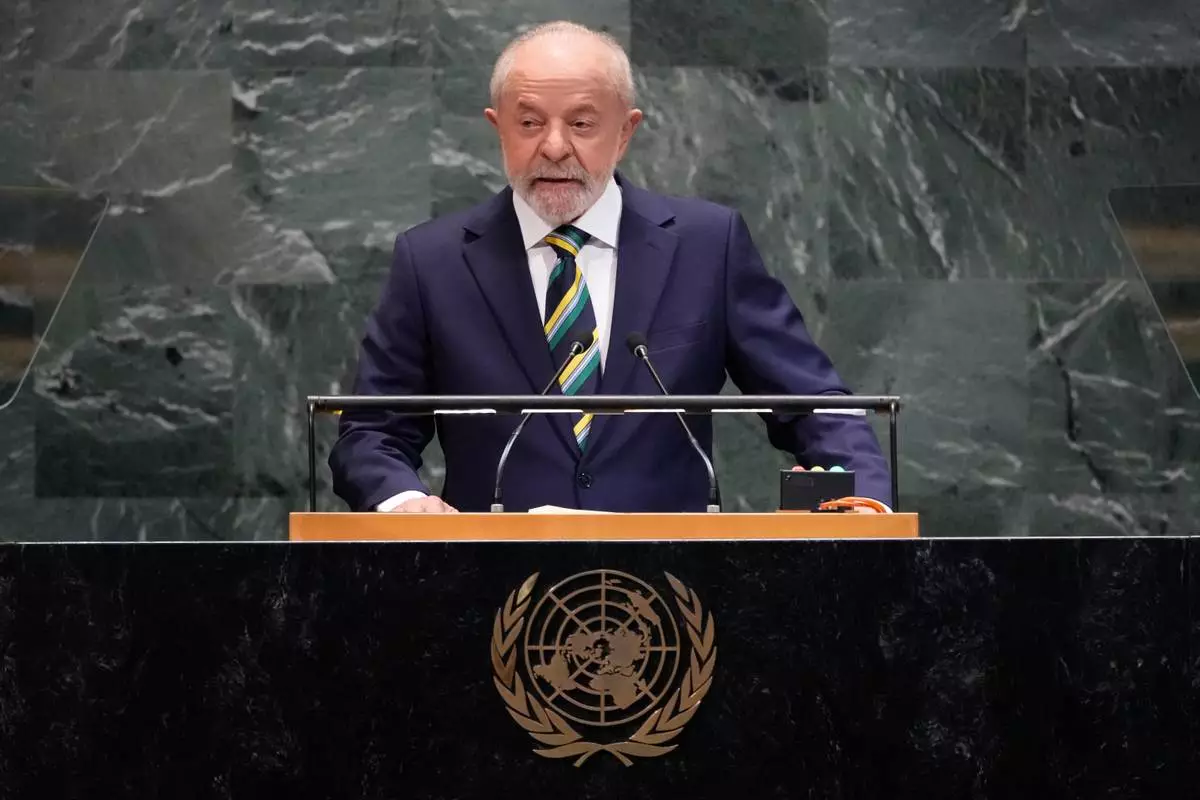
Brazil President Luiz Inacio Lula da Silva addresses the 80th session of the United Nations General Assembly, Tuesday, Sept. 23, 2025. (AP Photo/Richard Drew)
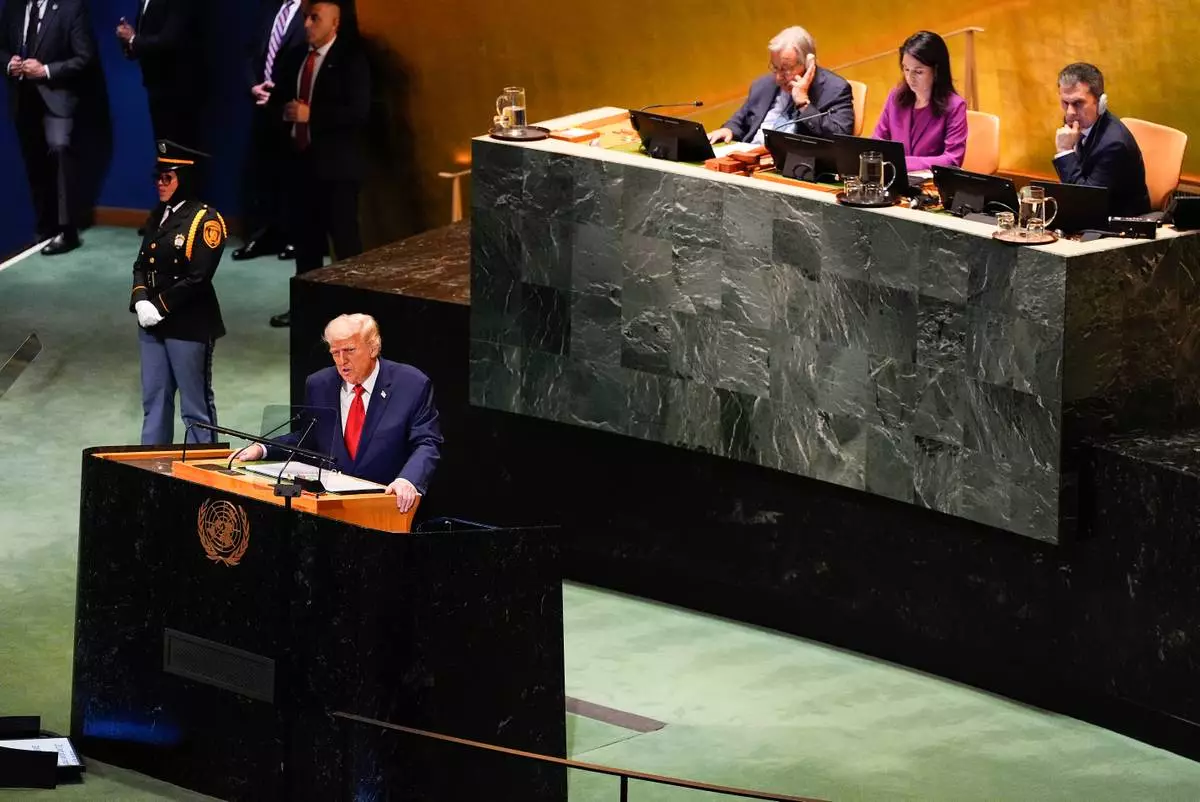
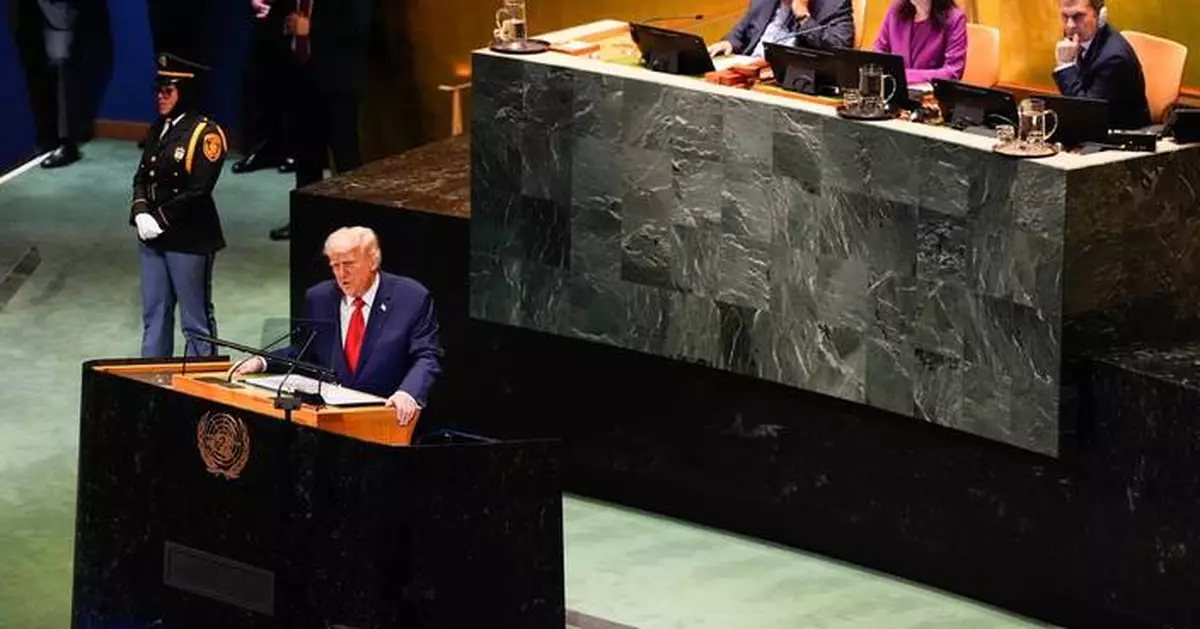
President Donald Trump addresses the 80th session of the United Nations General Assembly, Tuesday, Sept. 23, 2025, at U.N. headquarters. (AP Photo/Yuki Iwamura)
WASHINGTON (AP) — President Donald Trump’s second term has been eventful. You wouldn’t know it from his approval numbers.
An AP-NORC poll from January found that about 4 in 10 U.S. adults approve of Trump’s performance as president. That’s virtually unchanged from March 2025, shortly after he took office for the second time.
The new poll from The Associated Press-NORC Center for Public Affairs Research does show subtle signs of vulnerability for the Republican president. Trump hasn’t convinced Americans that the economy is in good shape, and many question whether he has the right priorities when he’s increasingly focused on foreign intervention. His approval rating on immigration, one of his signature issues, has also slipped since he took office.
Here’s how Americans’ views of Trump have — and haven’t — changed over the past year, according to AP-NORC polling.
Call it a gift or a curse — for all his unpredictability, Trump's approval numbers just don't change very much.
This was largely the case during his first term in office, too. Early in his first term, 42% of Americans approved of how he was handling the presidency. There were some ups and downs over the ensuing years, but he left office with almost the same approval.
That level of consistency on presidential approval numbers could be the new normal for U.S. politics — or it could be unique to Trump. Gallup polling since the 1950s shows that presidential approval ratings have grown less variable over time. But President Joe Biden had a slightly different experience. Biden, a Democrat, entered the White House with higher approval numbers than Trump has ever received, but those fell rapidly during his first two years in office, then stayed low for the remainder of his term.
Most Americans have held a critical view of Trump throughout his time in office, and Americans are twice as likely to say he's focused on the wrong priorities than the right ones. About half of U.S. adults say he’s mostly focusing on the wrong priorities one year into his second term, and approximately 2 in 10 say he’s mostly focused on the right priorities. Another 2 in 10, roughly, say it’s been about an even mix, and 14% say they don't have an opinion.
The economy has haunted Trump in his first year back in the White House, despite his insistence that “the Trump economic boom has officially begun.”
Just 37% of U.S. adults approve of how Trump is handling the economy. That’s up slightly from 31% in December — which marked a low point for Trump — but Trump started out with low approval on this issue, which doesn’t give him a lot of room for error.
The economy is a new problem for Trump. His approval rating on this issue in his first term fluctuated, but it was typically higher. Close to half of Americans approved of Trump’s economic approach for much of his first White House stint, and he’s struggled to adjust to this as a weak point. Americans care a lot more about costs than they did in Trump’s first term, and, like Biden, he’s persistently asserted that the U.S. economy is not a problem while the vast majority describe it as “poor.”
About 6 in 10 U.S. adults say Trump has done more to hurt the cost of living in his second term, while only about 2 in 10 say he’s done more to help. About one-quarter say he hasn't made an impact.
When Trump entered office, immigration was among his strongest issues. It’s since faded, a troubling sign for Trump, who campaigned on both economic prosperity and crackdowns to illegal immigration.
Just 38% of U.S. adults approve of how Trump is handling immigration, down from 49% in March. The poll was conducted Jan. 8-11, shortly after the death of Renee Good, who was shot and killed by a U.S. Immigration and Customs Enforcement officer in Minneapolis.
But there are signs that Americans still give Trump some leeway on immigration issues. About half of U.S. adults say Trump has “gone too far” when it comes to deporting immigrants living in the country illegally, which is unchanged since April, despite an immigration crackdown that spread to cities across the U.S. in the second half of the year.
Nearly half of Americans, 45%, say Trump has helped immigration and border security “a lot” or “a little” in his second term. This is an area where Democrats are more willing to give Trump some credit. About 2 in 10 Democrats say Trump has helped on this issue, higher than the share of Democrats who say he's helped on costs or job creation.
Trump has focused his attention more on foreign policy in his second term, and polling shows most Americans disapprove of his approach.
But much like Trump's overall approval, views of his handling of foreign policy have changed little in his second term, despite wide-ranging actions including his push to control Greenland and the recent military capture of Venezuelan President Nicolás Maduro.
About 6 in 10 Americans disapprove of how Trump is handling the issue of foreign policy, and most Americans, 56%, say Trump has “gone too far” in using the U.S. military to intervene in other countries.
Trump’s continued focus on global issues could be a liability given its sharp contrast with the “America First” platform he ran on and Americans’ growing concern with costs at home. But it could also be hard to shift views on the issue — even if Trump takes more dramatic action in the coming months.
The AP-NORC poll of 1,203 adults was conducted Jan. 8-11 using a sample drawn from NORC’s probability-based AmeriSpeak Panel, which is designed to be representative of the U.S. population. The margin of sampling error for adults overall is plus or minus 3.9 percentage points.
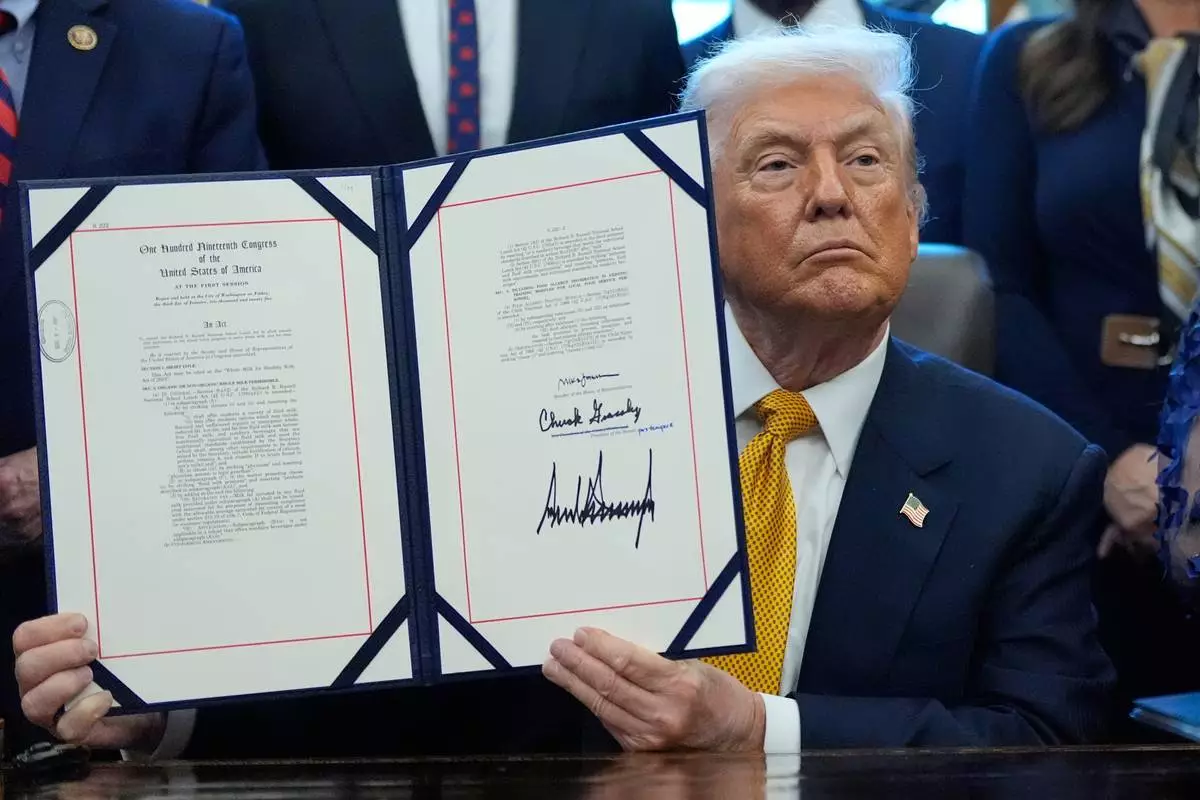
President Donald Trump holds a bill that returns whole milk to school cafeterias across the country, in the Oval Office of the White House, Wednesday, Jan. 14, 2026, in Washington. (AP Photo/Alex Brandon)
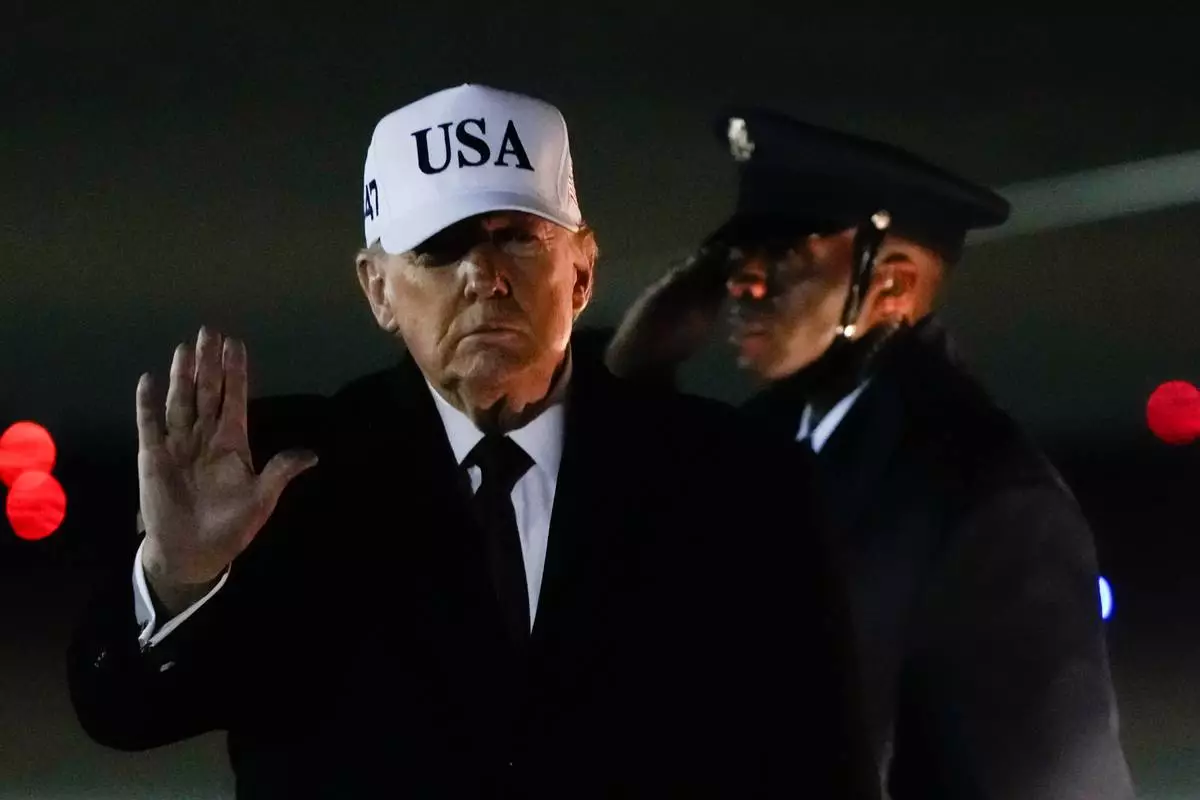
FILE - President Donald Trump waves after arriving on Air Force One from Florida, Jan. 11, 2026, at Joint Base Andrews, Md. (AP Photo/Julia Demaree Nikhinson, File)