Skip to Content Facebook Feature Image

Israeli strikes kill at least 17 Palestinians in Gaza as international pressure for ceasefire grows

News

Israeli strikes kill at least 17 Palestinians in Gaza as international pressure for ceasefire grows
News

News

Israeli strikes kill at least 17 Palestinians in Gaza as international pressure for ceasefire grows

2025-09-26 00:17 Last Updated At:00:20

DEIR AL-BALAH, Gaza Strip (AP) — Israel struck houses and tents in central and southern Gaza Thursday, crushing families inside and killing at least 17 people, including 10 children and three women, local health officials said, as international pressure for a ceasefire continued to grow.

On the sidelines of the United Nations General Assembly in New York, French President Emmanuel Macron told France 24 his country had recognized a Palestinian state on the conviction it “is the only way to isolate Hamas,” which has proved itself able to regenerate even after many of its leaders have been killed.

More Images
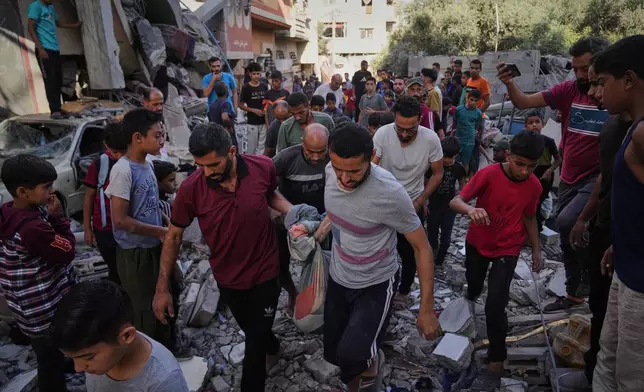
Palestinians carry the body of Hassan Nasr, 12, from the rubble of his relatives home, which was hit by an Israeli military strike in Zawaida, central Gaza Strip, Thursday, Sept. 25, 2025. (AP Photo/Abdel Kareem Hana)
Palestinians carry the body of Hassan Nasr, 12, from the rubble of his relatives home, which was hit by an Israeli military strike in Zawaida, central Gaza Strip, Thursday, Sept. 25, 2025. (AP Photo/Abdel Kareem Hana)

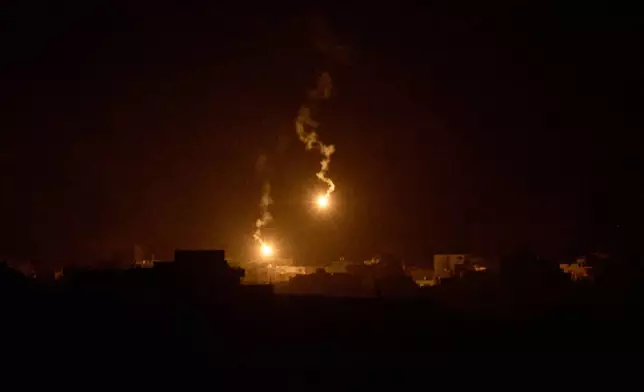
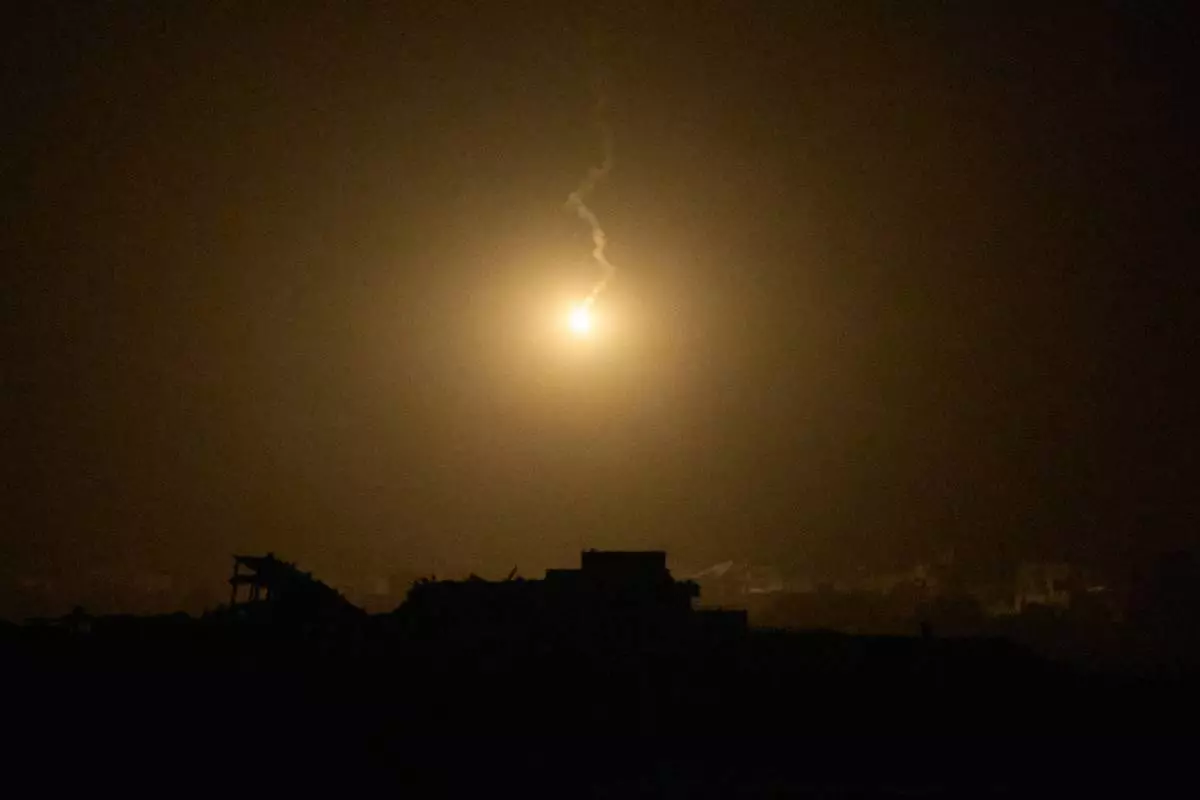
An Israeli army flare drifts over buildings destroyed during Israeli ground and air operations in the northern Gaza Strip, as seen from southern Israel, Thursday, Sept. 25, 2025. (AP Photo/Leo Correa)
An Israeli army flare drifts over buildings destroyed during Israeli ground and air operations in the northern Gaza Strip, as seen from southern Israel, Thursday, Sept. 25, 2025. (AP Photo/Leo Correa)

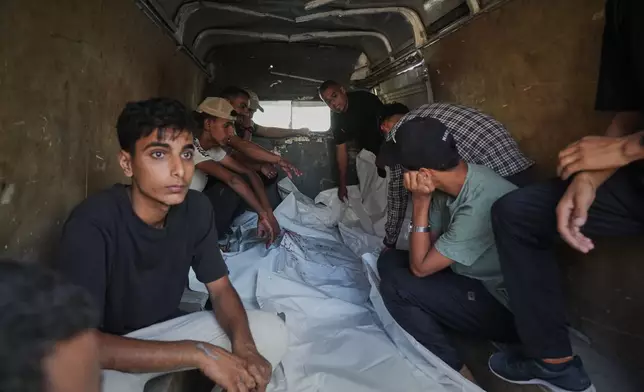
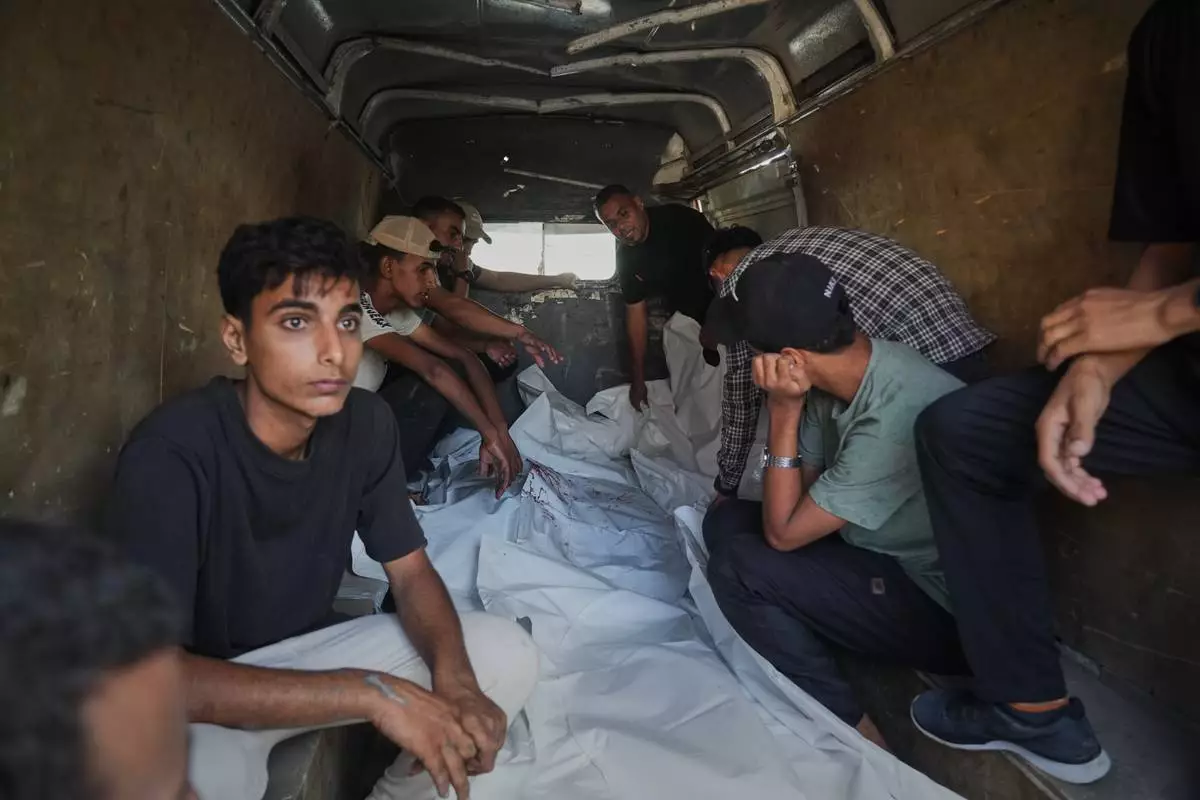
Mourners attend the funeral of Palestinians killed in an Israeli army strike, outside Al-Aqsa Hospital in Deir al-Balah, central Gaza Strip, Thursday, Sept. 25, 2025. (AP Photo/Abdel Kareem Hana)
Mourners attend the funeral of Palestinians killed in an Israeli army strike, outside Al-Aqsa Hospital in Deir al-Balah, central Gaza Strip, Thursday, Sept. 25, 2025. (AP Photo/Abdel Kareem Hana)

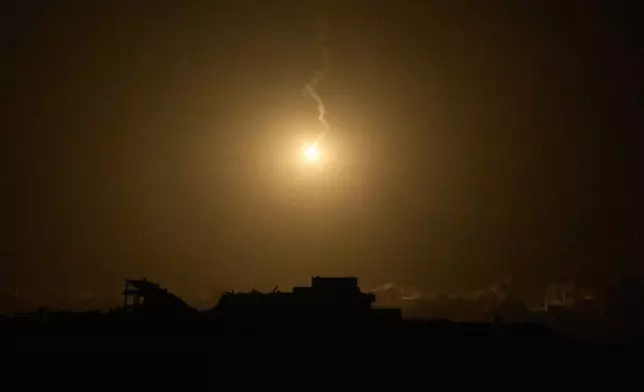
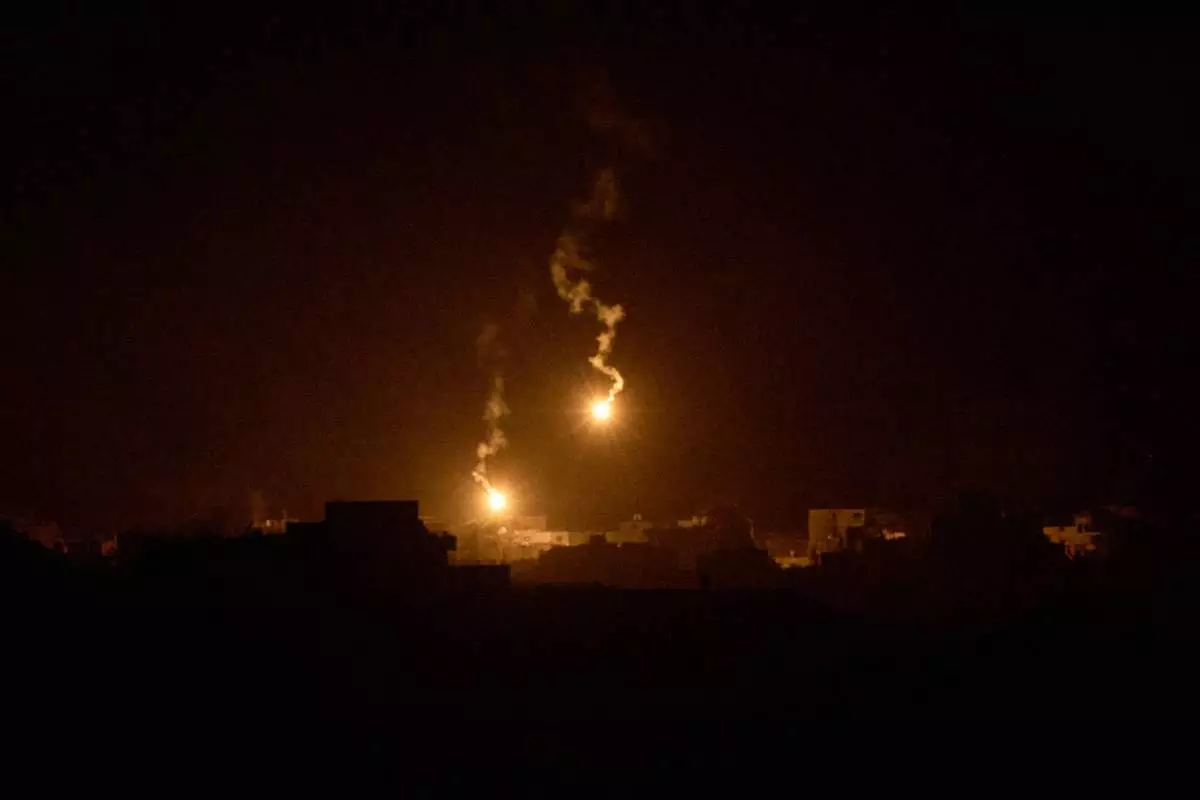
Israeli army flares drift over buildings destroyed during Israeli ground and air operations in the northern Gaza Strip, as seen from southern Israel, Wednesday, Sept. 24, 2025. (AP Photo/Leo Correa)
Israeli army flares drift over buildings destroyed during Israeli ground and air operations in the northern Gaza Strip, as seen from southern Israel, Wednesday, Sept. 24, 2025. (AP Photo/Leo Correa)

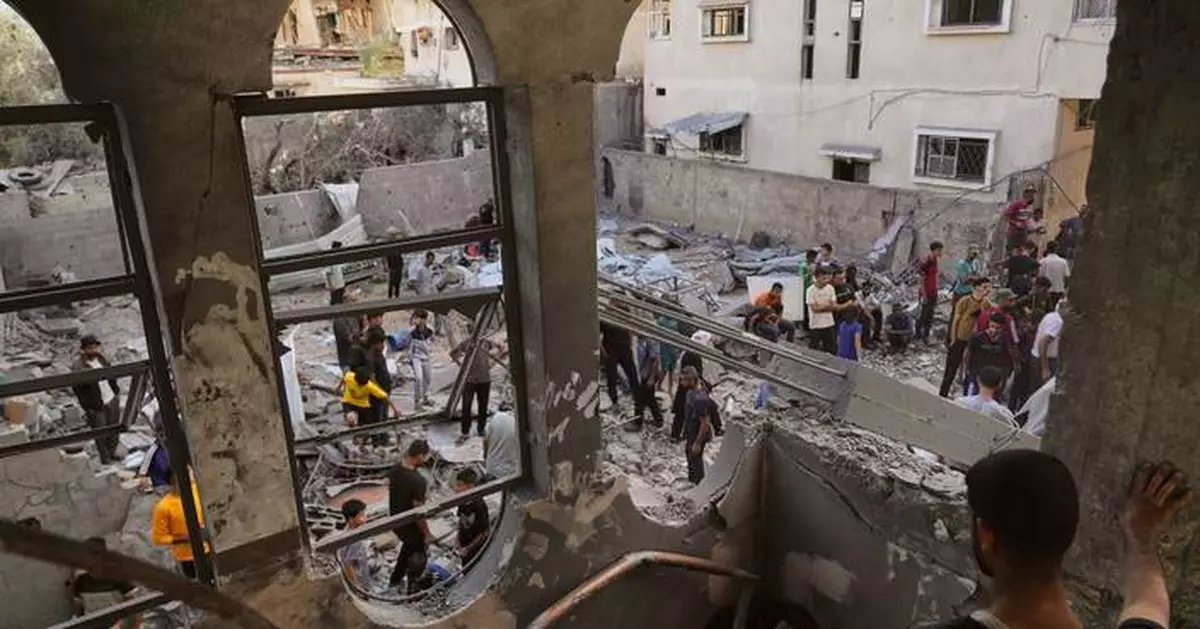
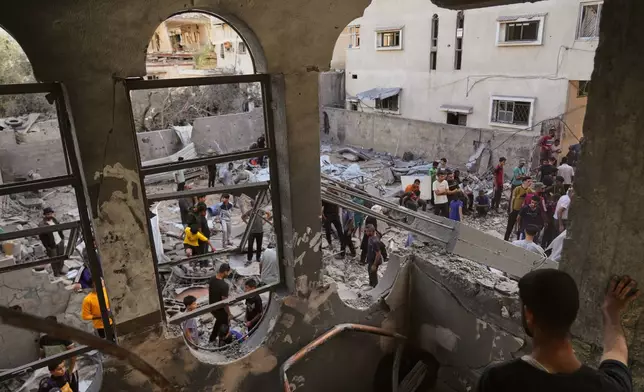
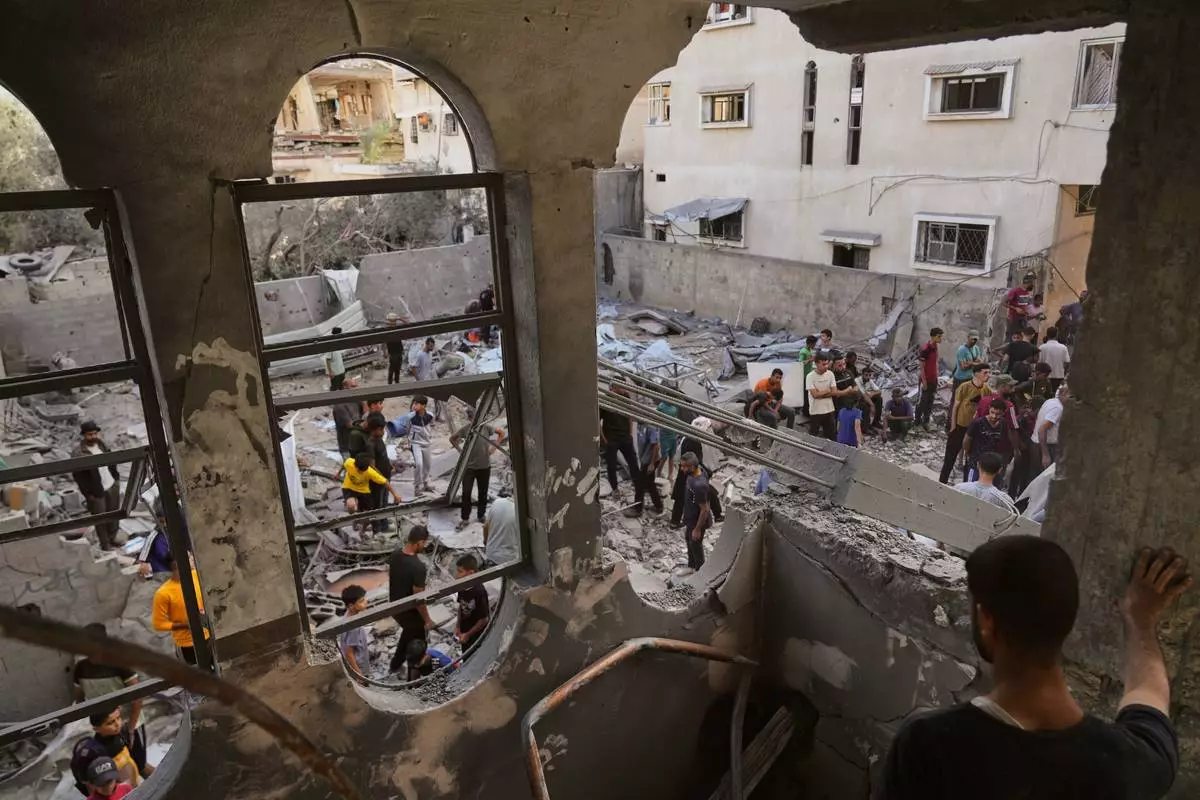
Palestinians survey the aftermath of an Israeli military strike on the Abu Dahrouj family home in Zawaida, central Gaza Strip, Thursday, Sept. 25, 2025. (AP Photo/Abdel Kareem Hana)

Palestinians survey the aftermath of an Israeli military strike on the Abu Dahrouj family home in Zawaida, central Gaza Strip, Thursday, Sept. 25, 2025. (AP Photo/Abdel Kareem Hana)

“Total war in Gaza is causing civilian casualties but can’t bring about the end of Hamas,” Macron said in the interview Wednesday. “Factually, it’s a failure.”

He said he had been lobbying U.S. President Donald Trump to press Israel again for a ceasefire. “You cannot stop the war if there is no path to peace,” Macron added.

Some Israeli ministers in Prime Minister Benjamin Netanyahu’s government have pushed for annexing the occupied West Bank in response to international recognition of Palestinian statehood — a move that could effectively strip the Palestinian Authority of its civil and security powers in parts of the territory.

Macron said such a move would be a red line for France, and “I think it’s also a red line for the United States of America.”

Neither the White House nor the State Department responded to requests for comment on Macron’s statement.

Netanyahu has said he won’t make any decisions until he returns from the U.S., where he is to address the U.N. General Assembly on Friday and then meet with Trump in Washington.

In the early hours Thursday, an Israeli strike hit a tent and a house in the central town of Zawaida, killing at least 12 people, according to the Al-Aqsa Martyrs Hospital in the nearby city of Deir al-Balah.

Among the dead were a couple and their five of their children, along with three other children. AP footage showed the building collapsed into a pile of rubble – the lifeless arm of one child sticking out from under a slab of concrete. Relatives said another child was still missing under the wreckage.

Another strike hit a tent in Deir al-Balah, killing a girl and wounding seven other people, the hospital said.

In the southern city of Khan Younis, an Israeli attack hit an apartment building, killing a man, his pregnant wife and their 10-year-old child as well as another female relative, according to Nasser Hospital, where the bodies were taken.

Israel launched another major ground operation earlier this month in Gaza City, which experts say is experiencing famine. More than 300,000 people have fled, but up to 700,000 are still there, many because they can’t afford to relocate.

The food situation in the north has worsened the past two weeks, as Israel has halted aid deliveries through its crossing into northern Gaza since Sept. 12 and has increasingly rejected U.N. requests to bring supplies from southern Gaza into the north, the U.N. Office for the Coordination of Humanitarian Affairs, known as OCHA, said.

Many charity kitchens in the north have been forced to shut down by Israeli military operations, reducing by half the number of free meals being provided to only 59,000 meals a day, according to OCHA, which warned that Israel’s closure this week of the border crossing between the occupied West Bank and Jordan threatens to “severely undermine” its ability to deliver aid to Gaza.

It said that last month a quarter of the aid destined for Gaza through the U.N. humanitarian effort came through the Allenby Bridge Crossing over the Jordan River, also known as the King Hussein Bridge.

Israel announced the closure on Tuesday after an attack last week that killed two Israelis.

The Israeli military said Thursday it carried out strikes in Yemen, with dozens of aircraft targeting Houthi military command headquarters, military camps and security and intelligence facilities.

The strikes came a day after a drone launched by the Houthis rebels wounded 22 people in the southern Israeli city of Eilat, a rare breach of Israel’s air defenses.

The Houthi Health Ministry said two people were killed and dozens wounded in the strike and that emergency workers were searching for people under rubble. One strike hit a building believed to house a leading Houthi figure in a residential area of the capital Sanaa, killing a woman and child nearby, witnesses said. The blast damaged a nearby school, causing injuries among children playing in the courtyard, they said.

On Monday, France, Andorra, Belgium, Luxembourg, Malta, and Monaco announced or confirmed their recognition of a Palestinian state in the hopes of galvanizing support for a two-state solution to the Mideast conflict.

Their announcements came a day after the United Kingdom, Canada, Australia and Portugal did the same, in defiance of Israel and the United States.

Netanyahu lashed out at the idea early Thursday before heading to New York.

“At the U.N, General Assembly I will speak our truth,” he told reporters. “I will denounce those leaders who, instead of denouncing the murderers, the rapists, the child burners, want to give them a state in the heart of the land of Israel. It will not happen.”

At separate events in New York on Wednesday, U.S. Secretary of State Marco Rubio and Trump’s lead negotiator Steve Witkoff both offered optimistic views about what Witkoff called a “Trump 21-point plan for peace” that was presented to Arab leaders Tuesday.

The U.S. has not released details of the plan or said whether Israel or Hamas accepts it.

The U.S., along with Egypt and Qatar, have spent months trying to broker a Gaza ceasefire and hostage release. Those efforts suffered a major setback earlier this month when Israel carried out an airstrike targeting Hamas leaders in Qatar.

Israel’s campaign in Gaza has killed more than 65,000 people and wounded more than 167,000 others, according to the Gaza Health Ministry. It doesn’t say how many were civilians or combatants, but says women and children make up around half the fatalities. The ministry is part of the Hamas-run government. U.N. agencies and many independent experts consider its figures to be the most reliable estimate of wartime casualties.

Israel’s campaign was triggered when Hamas-led militants stormed into Israel on Oct. 7, 2023, killing around 1,200 people and taking 251 hostage. Forty-eight captives remain in Gaza, around 20 of them believed by Israel to be alive, after most of the rest were freed in ceasefires or other deals.

Associated Press writer John Leicester in Le Pecq, France, contributed reporting.
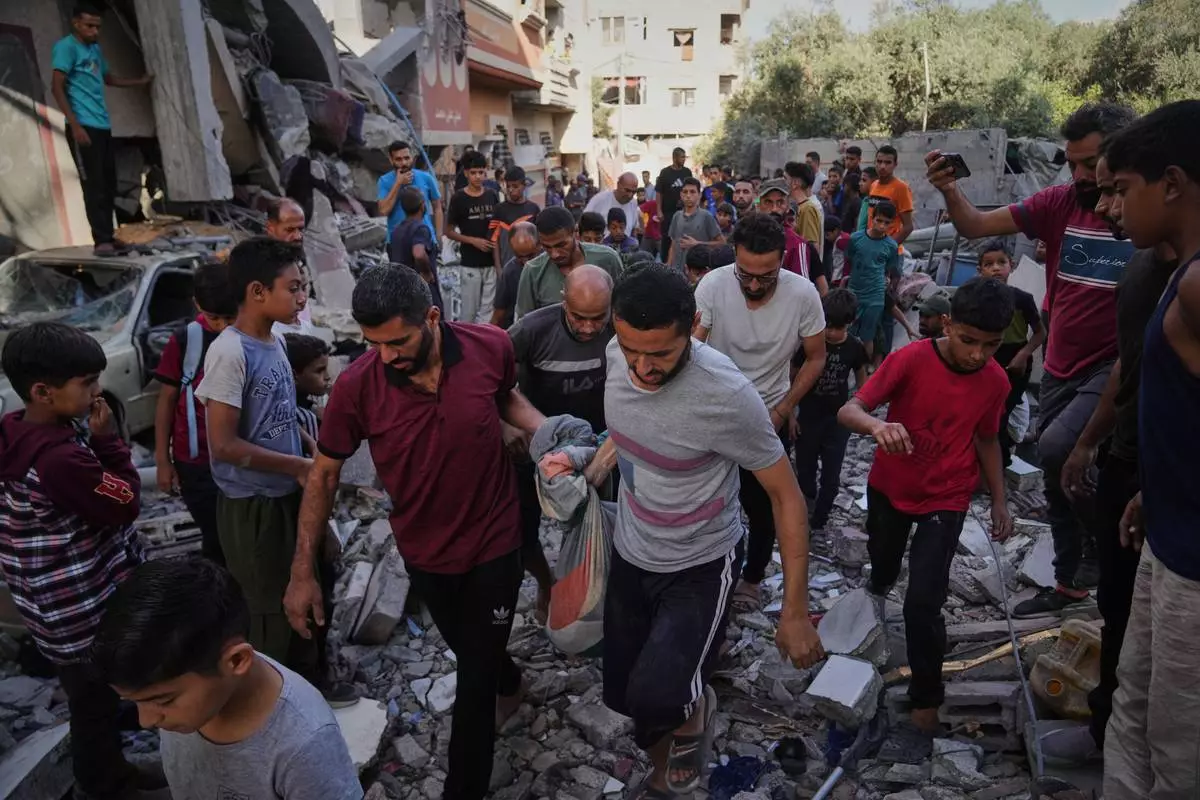
Palestinians carry the body of Hassan Nasr, 12, from the rubble of his relatives home, which was hit by an Israeli military strike in Zawaida, central Gaza Strip, Thursday, Sept. 25, 2025. (AP Photo/Abdel Kareem Hana)
Palestinians carry the body of Hassan Nasr, 12, from the rubble of his relatives home, which was hit by an Israeli military strike in Zawaida, central Gaza Strip, Thursday, Sept. 25, 2025. (AP Photo/Abdel Kareem Hana)

An Israeli army flare drifts over buildings destroyed during Israeli ground and air operations in the northern Gaza Strip, as seen from southern Israel, Thursday, Sept. 25, 2025. (AP Photo/Leo Correa)
An Israeli army flare drifts over buildings destroyed during Israeli ground and air operations in the northern Gaza Strip, as seen from southern Israel, Thursday, Sept. 25, 2025. (AP Photo/Leo Correa)

Mourners attend the funeral of Palestinians killed in an Israeli army strike, outside Al-Aqsa Hospital in Deir al-Balah, central Gaza Strip, Thursday, Sept. 25, 2025. (AP Photo/Abdel Kareem Hana)
Mourners attend the funeral of Palestinians killed in an Israeli army strike, outside Al-Aqsa Hospital in Deir al-Balah, central Gaza Strip, Thursday, Sept. 25, 2025. (AP Photo/Abdel Kareem Hana)

Israeli army flares drift over buildings destroyed during Israeli ground and air operations in the northern Gaza Strip, as seen from southern Israel, Wednesday, Sept. 24, 2025. (AP Photo/Leo Correa)
Israeli army flares drift over buildings destroyed during Israeli ground and air operations in the northern Gaza Strip, as seen from southern Israel, Wednesday, Sept. 24, 2025. (AP Photo/Leo Correa)

Palestinians survey the aftermath of an Israeli military strike on the Abu Dahrouj family home in Zawaida, central Gaza Strip, Thursday, Sept. 25, 2025. (AP Photo/Abdel Kareem Hana)

Palestinians survey the aftermath of an Israeli military strike on the Abu Dahrouj family home in Zawaida, central Gaza Strip, Thursday, Sept. 25, 2025. (AP Photo/Abdel Kareem Hana)
KAMPALA, Uganda (AP) — Uganda’s presidential election was plagued by widespread delays Thursday in addition to a days-long internet shutdown that has been criticized as an anti-democratic tactic in a country where the president has held office since 1986.

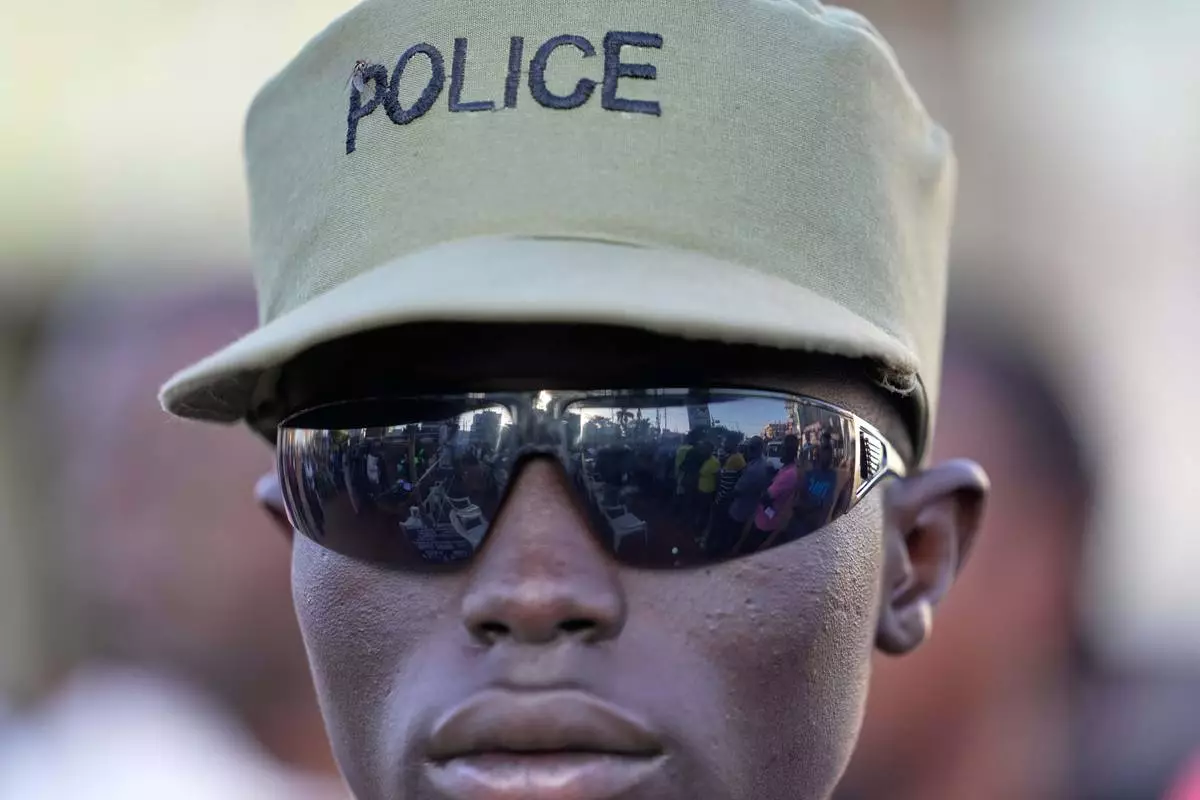
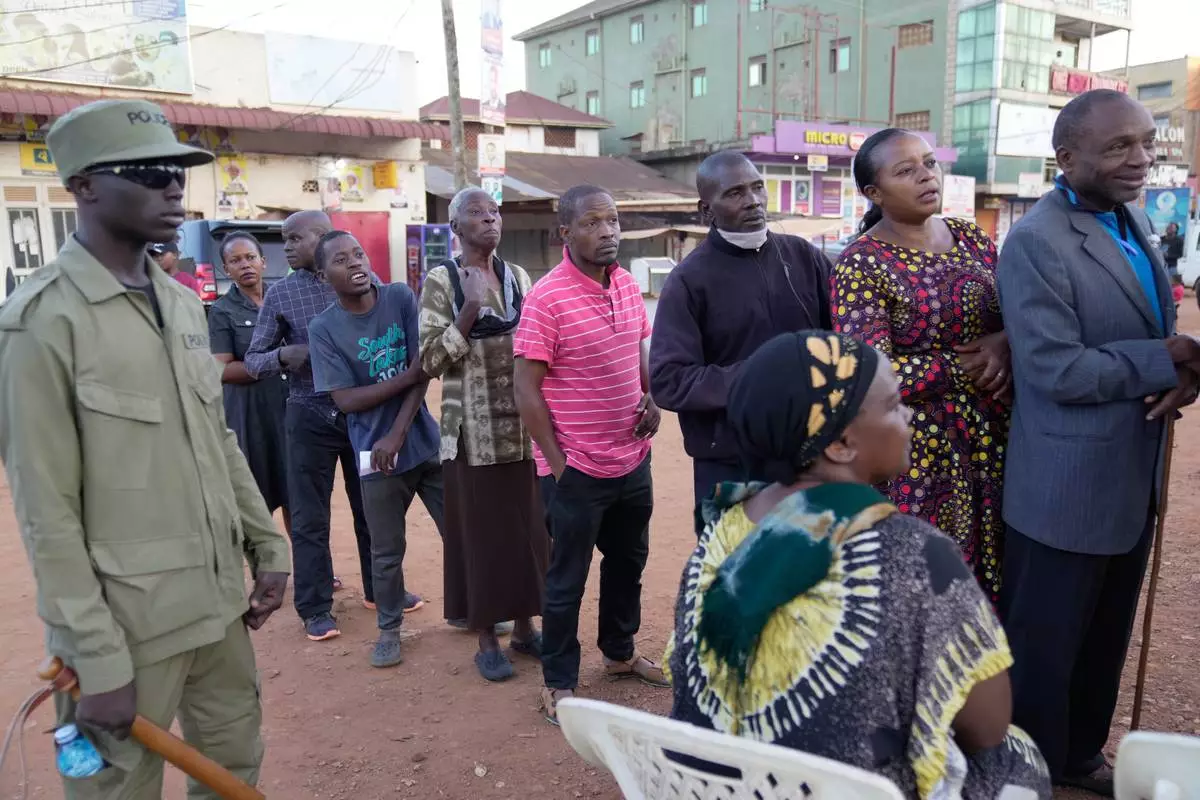
Some polling stations remained closed for up to four hours after the scheduled 7 a.m. start time due to “technical challenges," according to the nation's electoral commission, which asked polling officers to use paper registration records to ensure the difficulties did not “disenfranchise any voter.”

President Yoweri Museveni, 81, faces seven other candidates, including Robert Kyagulanyi, a musician-turned-politician best known as Bobi Wine, who is calling for political change.

The East African country of roughly 45 million people has 21.6 million registered voters. Polls were expected to close at 4 p.m., but voting was extended one hour until 5 p.m. local time. Results are constitutionally required to be announced in 48 hours.

In the morning, impatient crowds gathered outside polling stations expressing concerns over the delays. Umaru Mutyaba, a polling agent for a parliamentary candidate, said it was “frustrating” to be waiting outside a station in the capital Kampala.

“We can’t be standing here waiting to vote as if we have nothing else to do," he said.

Wine, the candidate, alleged electoral fraud, noting that biometric voter identification machines were not working at polling places and claiming that there was “ballot stuffing.”

Wine wrote in a post on X that his party's leaders had been arrested. “Many of our polling agents and supervisors abducted, and others chased off polling stations,” the post said.

Museveni told journalists he was notified that biometric machines weren't working at some stations and that he supported the electoral body's decision to revert to paper registration records. He did not comment on allegations of fraud.

Ssemujju Nganda, a prominent opposition figure and lawmaker seeking reelection in Kira municipality, told The Associated Press he had been waiting in line to vote for three hours.

Nganda said the delays likely would lead to apathy and low turnout in urban areas where the opposition has substantial support. "It’s going to be chaos,” he said.

Nicholas Sengoba, an independent analyst and newspaper columnist, said delays to the start of voting in urban, opposition areas favored the ruling party.

Emmanuel Tusiime, a young man who was among dozens prevented from entering a polling station in Kampala past closing time said the officials had prevented him from participating.

“My vote has not been counted, and, as you can see, I am not alone," he said he was left feeling “very disappointed.”

Uganda has not witnessed a peaceful transfer of presidential power since independence from British colonial rule six decades ago.

Museveni has served the third-longest term of any African leader and is seeking to extend his rule into a fifth decade. The aging president’s authority has become increasingly dependent on the military led by his son, Muhoozi Kainerugaba.

Museveni and Wine are reprising their rivalry from the previous election in 2021, when Wine appealed to mostly young people in urban areas. With voter turnout of 59%, Wine secured 35% of the ballots against Museveni’s 58%, the president’s smallest vote share since his first electoral campaign three decades ago.

The lead-up to Thursday's election produced concerns about transparency, the possibility of hereditary rule, military interference and possible vote tampering.

Uganda's internet was shut down Tuesday by the government communications agency, which cited misinformation, electoral fraud and incitement of violence. The shutdown has affected the public and disrupted critical sectors such as banking.

There has been heavy security leading up to voting, including military units deployed on the streets this week.

Amnesty International said security forces are engaging in a “brutal campaign of repression,” citing a Nov. 28 opposition rally in eastern Uganda where the military blocked exits and opened fire on supporters, killing one person.

Museveni urged voters to come out in large numbers during his final rally Tuesday.

“You go and vote, anybody who tries to interfere with your freedom will be crushed. I am telling you this. We are ready to put an end to this indiscipline,” he said.

The national electoral commission chairperson, Simon Byabakama, urged tolerance among Ugandans as they vote.

“Let us keep the peace that we have,” Byabakama said late Wednesday. “Let us be civil. Let us be courteous. Let’s be tolerant. Even if you know that this person does not support (your) candidate, please give him or her room or opportunity to go and exercise his or her constitutional right."

Authorities also suspended the activities of several civic groups during the campaign season. That Group, a prominent media watchdog, closed its office Wednesday after the interior ministry alleged in a letter that the group was involved in activities “prejudicial to the security and laws of Uganda.”

Veteran opposition figure Kizza Besigye, a four-time presidential candidate, remains in prison after he was charged with treason in February 2025.

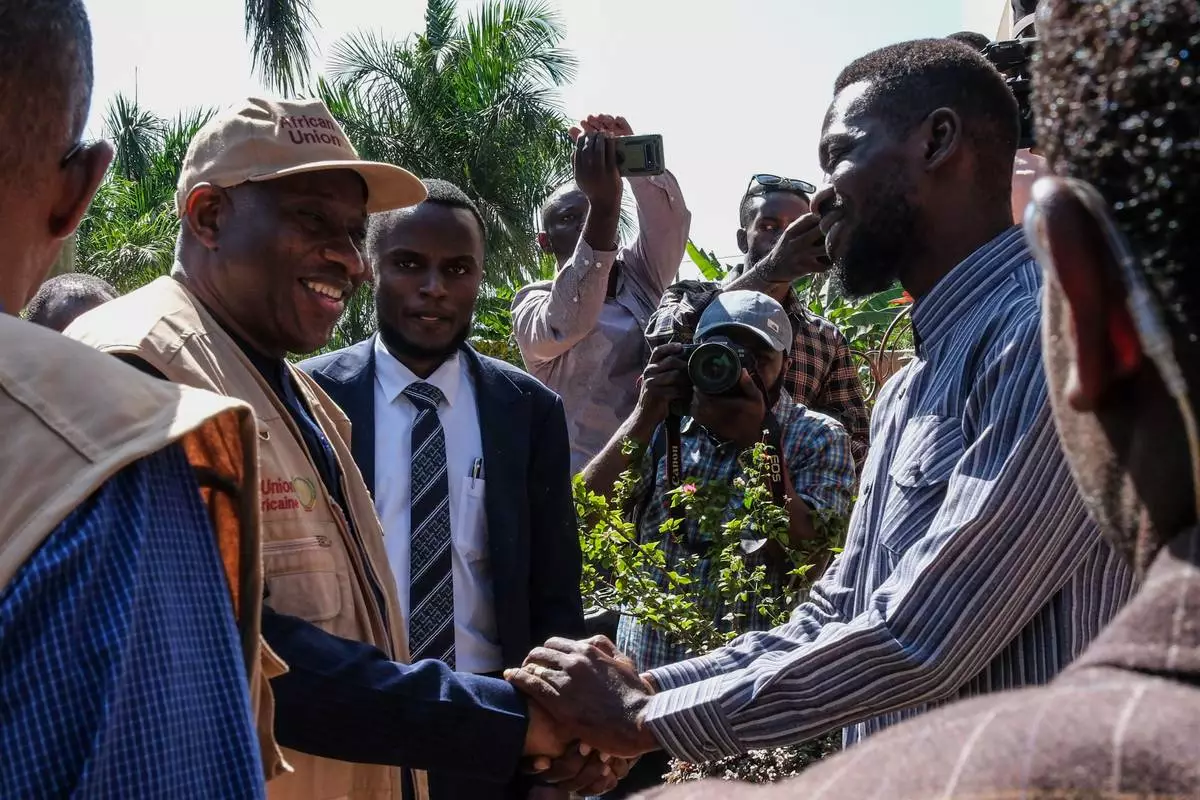
Uganda opposition presidential candidate Robert Kyagulanyi Ssentamu, known as Bobi Wine, right, greets election observers, including former Nigerian President Goodluck Jonathan, at his home in Magere village on the outskirts of Kampala, Uganda, Wednesday, Jan. 14, 2026. (AP Photo/Hajarah Nalwadda)

Uganda opposition presidential candidate Robert Kyagulanyi Ssentamu, known as Bobi Wine, right, greets election observers, including former Nigerian President Goodluck Jonathan, at his home in Magere village on the outskirts of Kampala, Uganda, Wednesday, Jan. 14, 2026. (AP Photo/Hajarah Nalwadda)

Billboards of Uganda President and National Resistance Movement (NRM) presidential candidate Yoweri Museveni are seen in Kampala, Uganda, Tuesday, Jan. 13, 2026. (AP Photo/Samson Otieno)

Billboards of Uganda President and National Resistance Movement (NRM) presidential candidate Yoweri Museveni are seen in Kampala, Uganda, Tuesday, Jan. 13, 2026. (AP Photo/Samson Otieno)

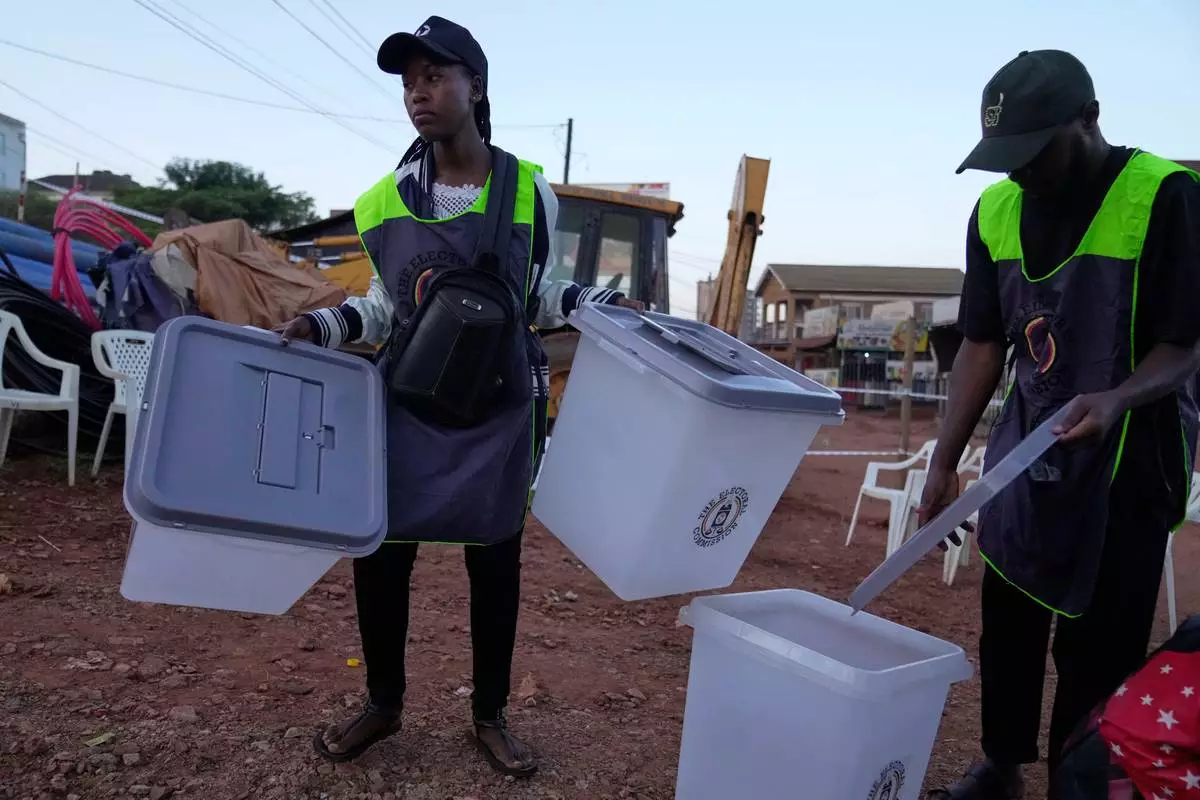
Electoral workers deliver ballot boxes to a polling station during presidential election in Kampala, Uganda, Thursday, Jan. 15, 2026. (AP Photo/Brian Inganga)

Electoral workers deliver ballot boxes to a polling station during presidential election in Kampala, Uganda, Thursday, Jan. 15, 2026. (AP Photo/Brian Inganga)

Voters are reflected in a police officer's sunglasses as they wait in line after voting failed to start on time due to system failures during presidential election in Kampala, Uganda, Thursday, Jan. 15, 2026. (AP Photo/Brian Inganga)

Voters are reflected in a police officer's sunglasses as they wait in line after voting failed to start on time due to system failures during presidential election in Kampala, Uganda, Thursday, Jan. 15, 2026. (AP Photo/Brian Inganga)

Voters wait to cast their ballots during the presidential election in Kampala, Uganda, Thursday, Jan. 15, 2026. (AP Photo/Brian Inganga)

Voters wait to cast their ballots during the presidential election in Kampala, Uganda, Thursday, Jan. 15, 2026. (AP Photo/Brian Inganga)

Recommended Articles