Skip to Content Facebook Feature Image

New product launches drive sales in Shenzhen's consumer electronics market

China

China

China

New product launches drive sales in Shenzhen's consumer electronics market

2025-09-25 17:19 Last Updated At:09-26 01:07

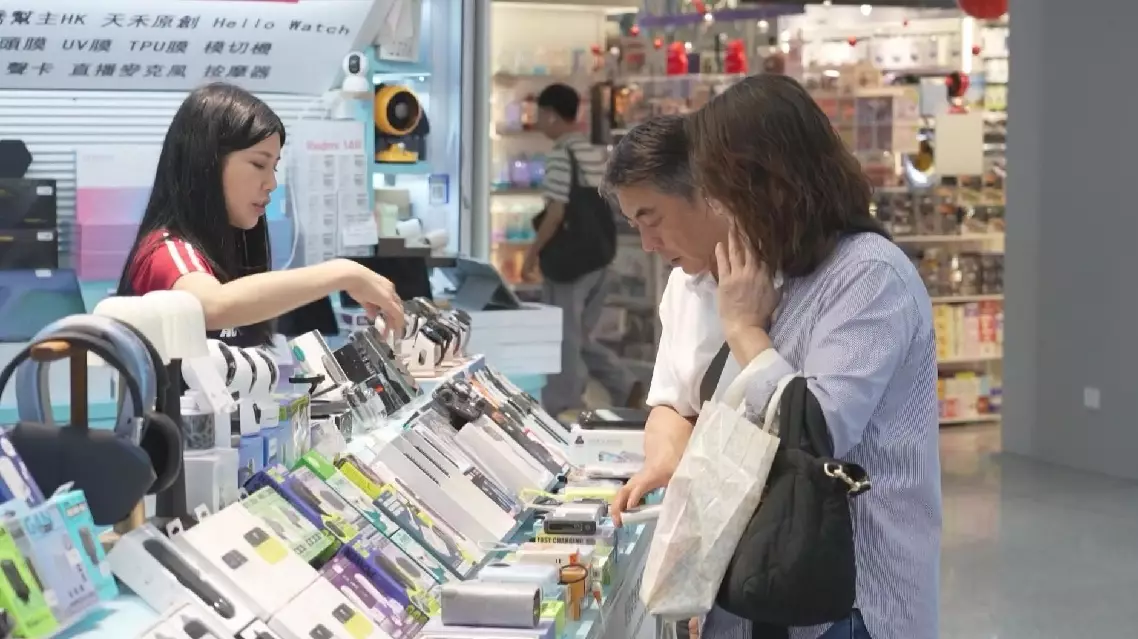
China's consumer electronics sector is showing signs of steady recovery, as major brands roll out new products to drive demand during the autumn shopping season.    At the Electronic commercial street of Huaqiangbei in the tech hub Shenzhen, south China's Guangdong Province, foot traffic surged in the afternoon as shoppers browsed everything from power banks to headphones and cameras. Many noted that subsidies and discounts have continued to draw students and overseas buyers alike

"I'm here to buy some power banks and earphones to use in my dormitory. I was told there are student subsidies," said a consumer. 

"I want to check on the Fujifilm cameras. I've already got other brands such as Nikon and Sony. [In the first half of the year,] I got myself a sports watch, a camera, and lenses," said another consumer.

Since early September, tech firms including Huawei, Apple, and OPPO have unveiled a series of full-scenario consumer electronics, while others such as OnePlus and Xiaomi are also geared up to release new smartphones. Industry analysts expect many manufacturers to gain 60 to 70 percent of their annual revenue in the second half of the year

According to market research firm data, in the first half of this year, China's Bluetooth headset market recorded shipments of approximately 59.98 million units, a year-on-year increase of 7.5 percent. Sales of consumer-grade smart tablets reached 15.718 million units, up 20.5 percent year over year. The smart glasses market demonstrated even stronger growth momentum, with retail sales across all channels hitting 468,000 units in the first six months, surging nearly 148 percent compared to the same period of last year.

In the domestic smartphone market, shipments totaled 140 million units in the first half of this year, remaining largely the same compared to the same period of last year. Recently, market research firm International Data Corporation (IDC) revised its forecast for global smartphone shipments in 2025 upward to 1.24 billion units, reflecting a 1 percent year-on-year increase, which is higher than the previous growth expectation of 0.6 percent.

"[In the first half of the year] the national subsidy program significantly boosted our sales, by approximately 30 to 40 percent. Every morning, crowds gathered at our store to snatch up discount coupons. It was quite a big scene. We are currently running another promotion, which is tax refunds for overseas visitors. Many international friends, as well as consumers from the Hong Kong Special Administrative Region, the Macao Special Administrative Region and Taiwan region, can purchase products at our store by presenting their valid travel documents," said a shop owner.
New product launches drive sales in Shenzhen's consumer electronics market

New product launches drive sales in Shenzhen's consumer electronics market
A former television host from Taiwan, Zhai Xuan, has made a pivotal decision to leave mainstream broadcasting in order to create content that provides a better understanding of the Chinese mainland and cross-strait relations.

Zhai, a seasoned television host with over a decade of experience in Taiwan's media landscape, recently addressed an audience at an event in Beijing, where she revealed her complete transition into independent online media.

In her remarks, she articulated her aspiration to bridge what she perceives as a significant information gap between audiences on both sides of the Strait, highlighting her commitment to fostering a deeper understanding and connection through her new endeavors.

"I was really surprised by all the fake news. There were stories saying people on the mainland can't afford tea eggs or that they live in mud houses and in Taiwan, this was the main information many people received," said Zhai.

Zhai said she initially began producing online videos to challenge such perceptions while continuing her work as a television host.

In April 2025, she travelled to the mainland with her father to fulfill her late grandfather's wish to return to his hometown. The trip, which reunited family members separated since 1949, was recorded in a video series titled "Journey to Find Our Roots", drawing attention from viewers in both Taiwan and the mainland.

"Many people in Taiwan told me that after watching, they wanted to apply for a mainland travel permit immediately and go looking for their relatives. Some had long forgotten these things, but after seeing my story, they began thinking about their hometowns and family members they had never met and decided to search for their roots," Zhai shared her story at the event.

By mid-2025, Zhai said she began to feel increasing pressure amid rising political tensions and a tightening atmosphere around cross-Strait exchanges in Taiwan.

After more than 12 years in the industry, Zhai resigned from her position, believing it was the right thing to do.

"At that moment, I felt this was a major issue,not just for me, but for Chinese people on both sides of the Strait. If I backed down then, I wouldn’t be standing on the right side," said Zhai.

Since leaving television, Zhai has broadened her online programming to encompass a range of daily-life topics, including practical guidance on applying for a mainland travel permit and using commonly employed mobile applications, in addition to content that delves into historical memory and cultural connections across the Strait.

As the debate over cross-Strait relations continues in Taiwan, Zhai said she remains committed to her current path.

Former Taiwan TV host bridges cross-Strait divide via online media

Former Taiwan TV host bridges cross-Strait divide via online media

Recommended Articles