The fifth World Congress of Biosphere Reserves concluded on Friday in Hangzhou, the provincial capital of Zhejiang in east China, with two landmark documents adopted.
These documents chart the course for the UNESCO Man and the Biosphere (MAB) Program over the next decade, demonstrating China and the international community's firm commitment to addressing global ecological and environmental challenges.
Another document adopted during the congress are the Hangzhou Strategic Action Plan for UNESCO's MAB Program and its World Network of Biosphere Reserves (2026-2035), which sets the direction, goals, and actions for global biosphere conservation in the coming ten years. It provides new momentum for global environmental governance and the advancement of sustainable development.
The congress also released the Hangzhou Declaration, sending a strong message of the resolve to tackle ecological and environmental challenges and build a shared future for all life on Earth.
"First, it particularly emphasizes alignment with relevant UN strategies and conventions. Second, it stresses cooperation and exchange. Third, it requires inclusive governance. The fourth characteristic is the strong emphasis on global support, especially from developed countries and businesses, to back conservation efforts," said Ouyang Zhiyun, a researcher at the Research Center for Eco-Environmental Sciences under the Chinese Academy of Sciences.
"The two documents will serve as the guiding and programmatic framework for the development of the Man and the Biosphere Program over the next decade," said Wang Ding, Secretary-General of the Chinese National Committee for UNESCO's Man and the Biosphere Program.
Held from September 22 to 25 in Hangzhou, this is the first time the congress was convened in Asia. UNESCO organizes the event approximately every decade to shape the future development of biosphere reserves worldwide.
During the congress, some 4,000 delegates from over 150 countries and regions gathered under the theme "Shaping a Sustainable Future for People and Nature" to explore strategies for protecting biosphere reserves and advancing sustainable development.
China formally joined the MAB Program in 1973 and established a national committee for the program five years later. To date, 34 nature reserves in China have been designated as UNESCO biosphere reserves, ranking first in Asia.
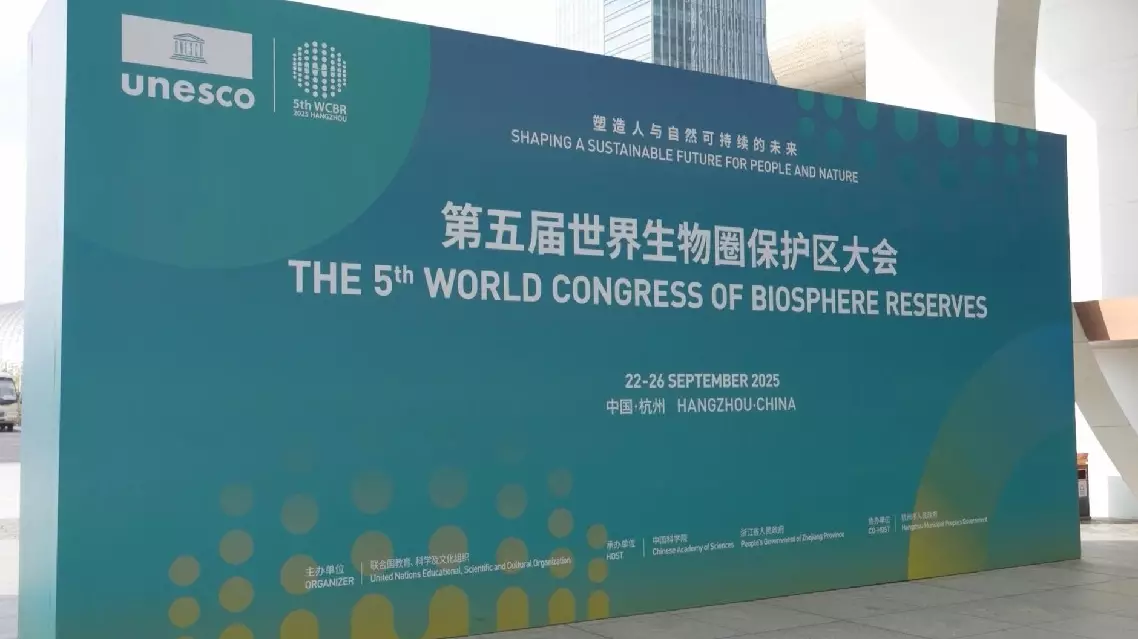
Two landmark documents adopted at Biosphere Reserves congress