Fourth Guangdong-Hong Kong-Macao Greater Bay Area Statistical Forum successfully held
The Fourth Guangdong-Hong Kong-Macao Greater Bay Area Statistical Forum was held yesterday (September 26) via live streaming. Under the guidance of the National Bureau of Statistics (NBS), the forum was hosted by the Guangdong Provincial Bureau of Statistics (GPBS) and jointly organised by the Guangzhou Municipal Bureau of Statistics and the People's Government of Huangpu District of Guangzhou Municipality. The Commissioner for Census and Statistics, Mr Leo Yu, and some C&SD statistical professionals participated in this major annual event.
This year's forum, themed "Statistical Innovation and Technological Breakthroughs in the Guangdong-Hong Kong-Macao Greater Bay Area", aimed to foster statistical exchange and co-operation in the Greater Bay Area (GBA). It provided a platform for statistical professionals from the "9+2" cities to brainstorm collectively and drive innovation in statistical methods and technologies through creative thinking, jointly addressing the current complex and ever-changing environment. In addition to the participation of leaders from the NBS and the GPBS, the forum brought together statistical experts from various fields, including representatives from the government statistical agencies of the "9+2" cities in the GBA, as well as those from higher education institutions and research institutes from the Chinese Mainland.
Speaking at the opening ceremony of the forum, Mr Yu pointed out that the C&SD has consistently adhered to the guiding principles of "upholding fundamental principles and breaking new ground; establishing the new before abolishing the old" on the path of advancing statistical reform and innovation. While upholding the spirit of professionalism in statistics, maintaining objectivity and neutrality, respecting privacy and ensuring data security, he encourages his colleagues to boldly break boundaries, actively embrace new techniques, strive for excellence, and continuously enhance the work cost-effectiveness and service quality.
Mr Yu also remarked that in today's rapidly changing digital era, artificial intelligence (AI) is no longer merely a tool but a powerful force profoundly transforming our ways of working and thinking. In the field of statistics, the collection, processing, analysis and interpretation of massive data are often time-consuming and labour-intensive. AI can efficiently handle repetitive tasks, freeing up the team's energy and time to focus on strategic assessment and innovative applications. Therefore, instead of replacing statistical professionals, AI will become an indispensable "new member" of the team, by effectively enhancing the team's ability to process and analyse data.
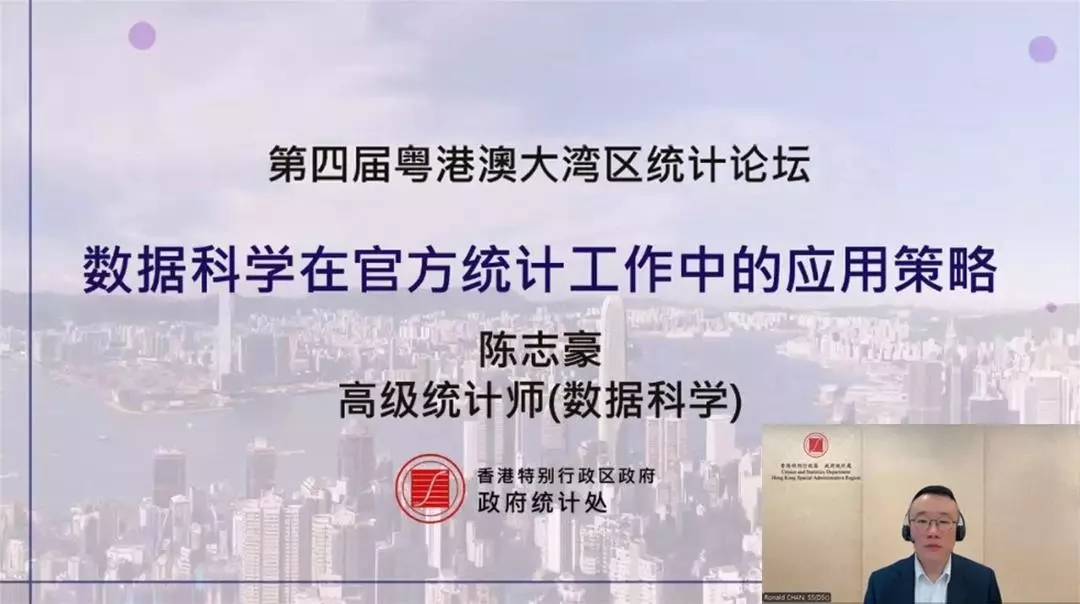
Senior Statistician of the C&SD Mr Ronald Chan also delivered a presentation entitled "Strategies for application of data science in official statistics" at one of the sessions of the forum. The staff members of the C&SD who participated in the forum unanimously expressed that this forum enabled them to acquire insights into the ongoing advancement of statistical techniques on the Chinese Mainland, and reminded them to strive for innovation and actively pursue breakthroughs in the dynamic era of big data, so as to seize opportunities and tackle challenges in the future.
The forum, held online, was attended by representatives of statistical organisations from Beijing, Guangdong Province, Hong Kong and Macao, etc. Relevant officials from the statistical systems of the cities in the GBA, as well as experts and scholars from national think tanks and renowned universities, also shared their valuable insights on topics such as applications of data science techniques, development of statistical talent, statistical reform and innovation, economic monitoring and forecasting, etc.
Fourth Guangdong-Hong Kong-Macao Greater Bay Area Statistical Forum successfully held Source: HKSAR Government Press Releases

Fourth Guangdong-Hong Kong-Macao Greater Bay Area Statistical Forum successfully held Source: HKSAR Government Press Releases
Update on chikungunya fever
The Centre for Health Protection (CHP) of the Department of Health announced that, as of 5pm today (December 13), no new cases of chikungunya fever (CF) had been recorded. Hong Kong has recorded a total of 79 confirmed CF cases this year. Among them, 11 were local cases, and the rest were imported cases.
Given that some local cases of CF have visited the Tsing Yi Nature Trails or the surrounding area, the trails are currently closed until further notice. As the CHP and the relevant government departments are conducting large-scale mosquito control and prevention efforts along the trails, the CHP continues to appeal to the public not to enter the area in order to reduce the risk of contracting CF and to avoid exposure to chemicals or interfering with the mosquito control operations.
Government's comprehensive follow-up actions
-----------------------------------------------------
The CHP continues to urge individuals who have recently hiked along the Tsing Yi Nature Trails to seek medical attention as soon as possible if they develop relevant symptoms and to call the enquiry hotline (Tel: 2125 2373). All doctors and hospitals in Hong Kong should closely monitor whether their patients present with compatible symptoms and arrange blood tests for those concerned. The CHP's Public Health Laboratory Services Branch will provide free testing services.
Specifically targeting confirmed cases who visited the Tsing Yi Nature Trails or the surrounding area, the Food and Environmental Hygiene Department (FEHD) has been continuously conducting intensive fogging operations to eliminate adult mosquitoes along the hiking trails. At suitable locations, large ultra-low volume foggers have been deployed, and a robot dog is being put on trial to enhance operational effectiveness. The FEHD has also set up new mosquito trapping devices, cleared discarded containers and garbage that could bring stagnant water, and applied larvicide oil or larvicides in areas with stagnant water that cannot be removed immediately. The FEHD has been collaborating with the Kwai Tsing District Office, the Lands Department and the Drainage Services Department to strengthen efforts in eliminating potential mosquito breeding sites along the Tsing Yi Nature Trails. Pamphlets have been distributed to hikers in the area, urging citizens to be vigilant against mosquito infestations and take personal protective measures. The FEHD also held meetings of the interdepartmental task forces on anti-mosquito work across districts, to discuss the latest developments regarding the situation and plan accordingly to co-ordinate relevant departments and stakeholders in strengthening mosquito prevention and control measures in areas under their purview.
Continuously strengthening prevention and control
---------------------------------------------------------
TheFEHDand relevant departments have comprehensively enhanced the mosquito control operations in Hong Kong since July this year, and this has continued. Among these, the FEHD has conducted vector investigations and targeted mosquito control operations against the imported and local cases. In light of the local case, the FEHD has immediately conducted follow-up actions, including:
 carrying out intensive fogging in scrubby areas within a 250-metre radius of the relevant locations to kill adult mosquitoes;
carrying out inspections of the locations, removing stagnant water, applying insecticides and disposing of abandoned water containers every week with a view to preventing mosquito breeding; and
enhancing public education efforts through organising health talks, setting up mobile education stations, and distributing publicity leaflets.
carrying out intensive fogging in scrubby areas within a 250-metre radius of the relevant locations to kill adult mosquitoes;
carrying out inspections of the locations, removing stagnant water, applying insecticides and disposing of abandoned water containers every week with a view to preventing mosquito breeding; and
enhancing public education efforts through organising health talks, setting up mobile education stations, and distributing publicity leaflets.
The abovementioned measures will be continued. Furthermore, the Government will further enhance the mosquito control efforts in addition to the existing measures.
Preventive measures taken by the public
----------------------------------------------
Members of the public should use DEET-containing insect repellents or other effective active ingredients properly to prevent mosquito bites, but the following precautions should be taken when using them:
read the label instructions carefully first;
apply right before entering an area with a risk of mosquito bites;
apply on exposed skin and clothing;
use DEET of up to 30 per cent for pregnant women and up to 10 per cent for children (For children who travel to countries or areas where mosquito-borne diseases are endemic or epidemic and where exposure is likely, those aged 2 months or above can use DEET-containing insect repellents with a DEET concentration of up to 30 per cent);
apply sunscreen first, then insect repellent;
reapply only when needed and follow the instructions; and
in addition to DEET, there are other insect repellents available on the market containing different active ingredients, such as IR3535 and picaridin. When using any insect repellent, the public should follow the usage instructions and precautions on the product label.
The FEHD also appeals to members of the public to continue to stay alert and work together to carry out mosquito prevention and control measures early, including inspecting their homes and surroundings to remove potential breeding grounds, changing water in vases and scrubbing their inner surfaces, removing water in saucers under potted plants at least once a week, and properly disposing of containers such as empty cans and lunch boxes. The FEHD also advises members of the public and property management agencies to keep drains free of blockage and level all defective ground surfaces to prevent the accumulation of water. They should also scrub all drains and surface sewers with an alkaline detergent at least once a week to remove any mosquito eggs.
The public should call 1823 in case of mosquito problems, and may visit the following pages for more information: the CF page of theCHPand theTravel Health Service, the latestTravel Health News,tips for using insect repellents, and the CHPFacebook Page,Instagram AccountandYouTube Channel, and also theMosquito Prevention and Control dedicated pageof the FEHD.
Source: AI-found images