To flee from continued Israeli airstrikes and threats, more residents from northern Gaza are heading south where there is a severe shortage of food and water.
According to the Hamas-run government media office in Gaza, hundreds of thousands of Palestinians have been forced to leave their homes in recent weeks, flocking to the already resource-strained central and southern areas of Gaza.
Living conditions in Gaza's central and southern regions are extremely harsh. Basic necessities and humanitarian services are critically scarce, and many people are unable to receive aid. With hundreds of thousands moving in, finding empty space to pitch a tent has also become a big challenge.
The Gaza Valley Bridge, a link between north and south, is packed with vehicles and people fleeing south, stretching for several kilometers. In central Gaza, almost every open space is now covered with tents. Many families are crowded into a single tent while others have to sleep in the open.
A few days ago, displaced Gaza resident Youssef Al-Bashiti led his family to Nuseirat in central Gaza, where nearly 50 people now squeeze into his tent, with luggage and belongings piled outside for lack of space.
The overcrowding has not only intensified the shortage of space but also caused a sharp deterioration in sanitation. Outside the tents, garbage piles up and sewage runs openly, posing serious threats to people's health.
"We always say we hope things will get better, but as you can see, everything is getting worse," said Youssef Al-Bashiti.
For these evacuees, simply finding a place to stay is just the first step, and they will face more challenges for survival. Gaza resident Jihad Abu Nimr brought his family to Nuseirat days ago. After settling in, he had to face other pressing challenges for survival. Obtaining water and food is becoming increasingly difficult in this place. At water collection points, some people would wait for hours, but end up returning empty-handed.
"Life is really hard. We don't know how to survive or even how we can sit and rest. All services, institutions, water sources and food supplies are far from us," said Jihad Abu Nimr.
"After coming here, I even wished I had stayed in the north and died there. Although it's dangerous, at least there is water and food. Here it's safer, but there is almost no food," said Mohammed Al-Buhaisi, another resident.
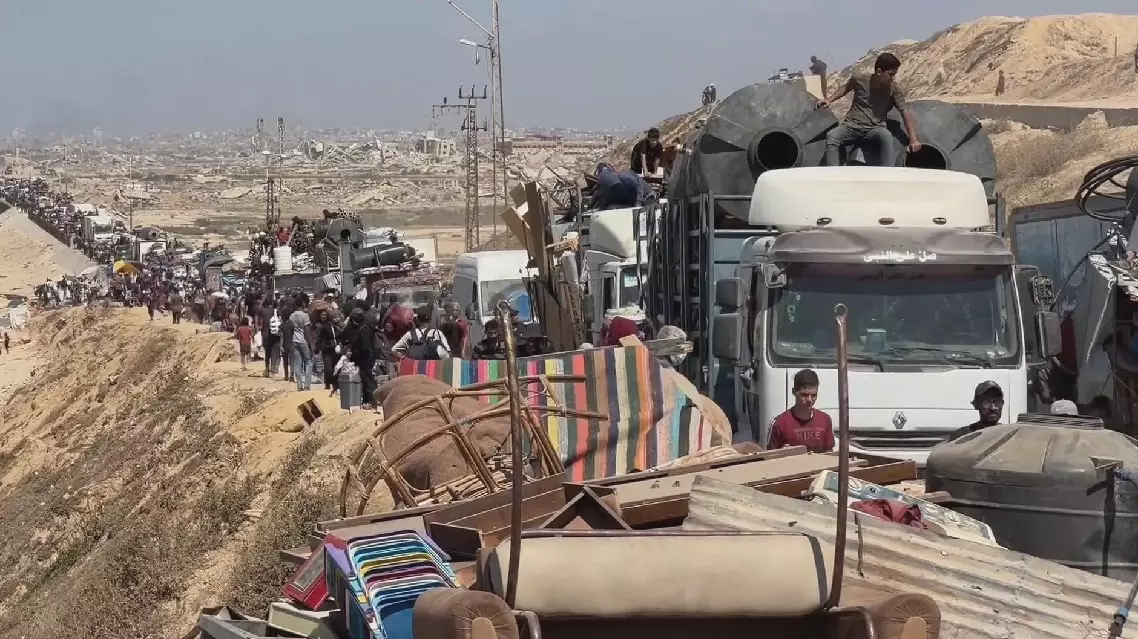
Central, southern Gaza overwhelmed by displaced population amid dire food, water crisis
A former television host from Taiwan, Zhai Xuan, has made a pivotal decision to leave mainstream broadcasting in order to create content that provides a better understanding of the Chinese mainland and cross-strait relations.
Zhai, a seasoned television host with over a decade of experience in Taiwan's media landscape, recently addressed an audience at an event in Beijing, where she revealed her complete transition into independent online media.
In her remarks, she articulated her aspiration to bridge what she perceives as a significant information gap between audiences on both sides of the Strait, highlighting her commitment to fostering a deeper understanding and connection through her new endeavors.
"I was really surprised by all the fake news. There were stories saying people on the mainland can't afford tea eggs or that they live in mud houses and in Taiwan, this was the main information many people received," said Zhai.
Zhai said she initially began producing online videos to challenge such perceptions while continuing her work as a television host.
In April 2025, she travelled to the mainland with her father to fulfill her late grandfather's wish to return to his hometown. The trip, which reunited family members separated since 1949, was recorded in a video series titled "Journey to Find Our Roots", drawing attention from viewers in both Taiwan and the mainland.
"Many people in Taiwan told me that after watching, they wanted to apply for a mainland travel permit immediately and go looking for their relatives. Some had long forgotten these things, but after seeing my story, they began thinking about their hometowns and family members they had never met and decided to search for their roots," Zhai shared her story at the event.
By mid-2025, Zhai said she began to feel increasing pressure amid rising political tensions and a tightening atmosphere around cross-Strait exchanges in Taiwan.
After more than 12 years in the industry, Zhai resigned from her position, believing it was the right thing to do.
"At that moment, I felt this was a major issue,not just for me, but for Chinese people on both sides of the Strait. If I backed down then, I wouldn’t be standing on the right side," said Zhai.
Since leaving television, Zhai has broadened her online programming to encompass a range of daily-life topics, including practical guidance on applying for a mainland travel permit and using commonly employed mobile applications, in addition to content that delves into historical memory and cultural connections across the Strait.
As the debate over cross-Strait relations continues in Taiwan, Zhai said she remains committed to her current path.

Former Taiwan TV host bridges cross-Strait divide via online media