It is high time for U.S. congressmen to play a positive role in promoting China-U.S. relations, contributing to bilateral exchanges and cooperation, said a China Media Group (CMG) commentary published on Friday.
An edited English-language version of the commentary is as follows:
A U.S. congressional delegation led by Representative Adam Smith concluded its visit to China on Thursday, drawing significant international attention as this was the first such trip by U.S. House lawmakers since March 2019. The six-year gap between visits underscores the shared expectations of both U.S. political parties and the American public for a more stable China-U.S. relationship.
The timing of the visit is noteworthy: it followed closely on the heels of a phone conversation between Chinese President Xi Jinping and U.S. President Donald Trump, during which the two leaders engaged in candid and in-depth discussions on bilateral relations and issues of mutual concern. They also provided strategic guidance for stabilizing and advancing the relationship in the days ahead.
Against this backdrop, the congressional visit fully reflects the crucial role of strategic guidance from the two heads of state, sustains the recent momentum of enhanced high-level exchanges between China and the United States, and represents a positive step toward stabilizing bilateral ties.
Historically, the U.S. Congress played a constructive role in advancing China-U.S. relations. However, in recent years, U.S. lawmakers have frequently introduced negative legislative motions concerning China, covering issues related to China's Taiwan, Hong Kong, Xinjiang, and bilateral economic and trade cooperation.
These measures, along with high-profile provocations such as former House Speaker Nancy Pelosi's 2022 visit to the Taiwan region, have caused serious disturbance to bilateral relations. Analysts say these missteps offer clear lessons for the U.S. Congress.
Professor Diao Daming at the School of International Studies, Renmin University of China noted that the congressional visit will help U.S. lawmakers gain a more accurate understanding of China, recalibrate their perceptions, and thereby adopt a more rational approach when discussing China-related issues.
This aligns with the message Chinese officials conveyed during the visit: that U.S. lawmakers should view China and the bilateral relationship correctly, actively promote bilateral exchanges and cooperation, and play a constructive role in fostering mutual friendship and common development.
As for the current China-U.S. relations, the visit has broadened communication channels and opened a new window for engagement between the two sides.
Smith, the delegation's leader and ranking member of the U.S. House Armed Services Committee, acknowledged the need for more frequent exchanges. He said visits by U.S. House members to China shouldn't happen only once every six or seven years, but should be more frequent.
China-U.S. relations are the most important bilateral relations in the world. The two countries can and should be partners and friends. The current stabilization of the bilateral relations is hard-won and worth cherishing.
Throughout the visit, Chinese officials reiterated their commitment to resolving respective concerns through dialogue based on equality, respect, and mutual benefit, while clarifying China's solemn position of resolutely defending its sovereignty, security, and development interests.
For their part, the U.S. delegates emphasized the necessity of sustained communication to expand cooperation and resolve conflicts peacefully.
Professor Li Haidong at the Beijing-based China Foreign Affairs University observed that Washington's intent to seek cooperation with China is becoming increasingly evident, and more intensive interactions between the two sides are expected in the near term.
It is crucial that the delegation brings back what they've seen and heard in China, and helps steer the U.S. Congress toward a more positive role in China-U.S. relations, he said.
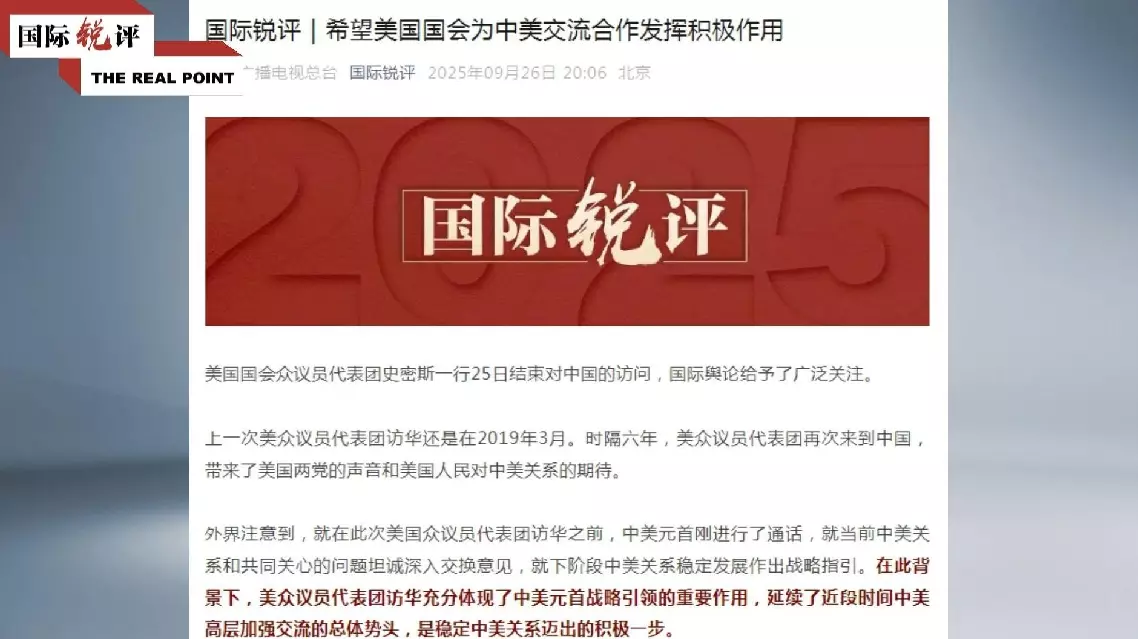
Time for U.S. lawmakers to play positive role in relations with China: commentary