China's Huajiang Grand Canyon Bridge, the world's highest bridge and longest-span steel truss girder suspension bridge in mountainous terrain, officially opened to traffic on Sunday, marking another breakthrough in the nation's mega-infrastructure projects.
During construction, engineers deployed multiple innovations to ensure the bridge's long-term safety and resilience.
A key example is the bridge's "smart cable" system embedded in the bridge's main cables -- the so-called "lifeline" of suspension bridges -- allowing real-time monitoring of pressure, temperature and humidity.
"Each main cable is made up of 217 strands, and each strand contains 91 steel wires. The smart cable is embedded within these steel wires. In total, three smart cables have been installed inside the two main cables," said Li Jing, a crew member for the project and employee of Guizhou Transportation Investment Group, the company responsible for building the bridge.
The automated smart cable system also activates dehumidifiers when moisture levels rise, reducing the risk of corrosion and extending the cables' lifespan.
"When the humidity level exceeds 64 percent, the system automatically switches on the dehumidifier to control moisture inside the cable space. This helps extend the service life of the main cables," said Li.
With wires acting as the bridge's nervous system, massive concrete anchor blocks serve as its sturdy feet.
To overcome shortages of fly ash, a key material in concrete, the construction team innovatively repurposed locally sourced dolomite rock powder as a substitute. This not only guaranteed the quality of 160,000 cubic meters of concrete but also cut costs by about 5 million yuan (about 700,000 U.S. dollars).
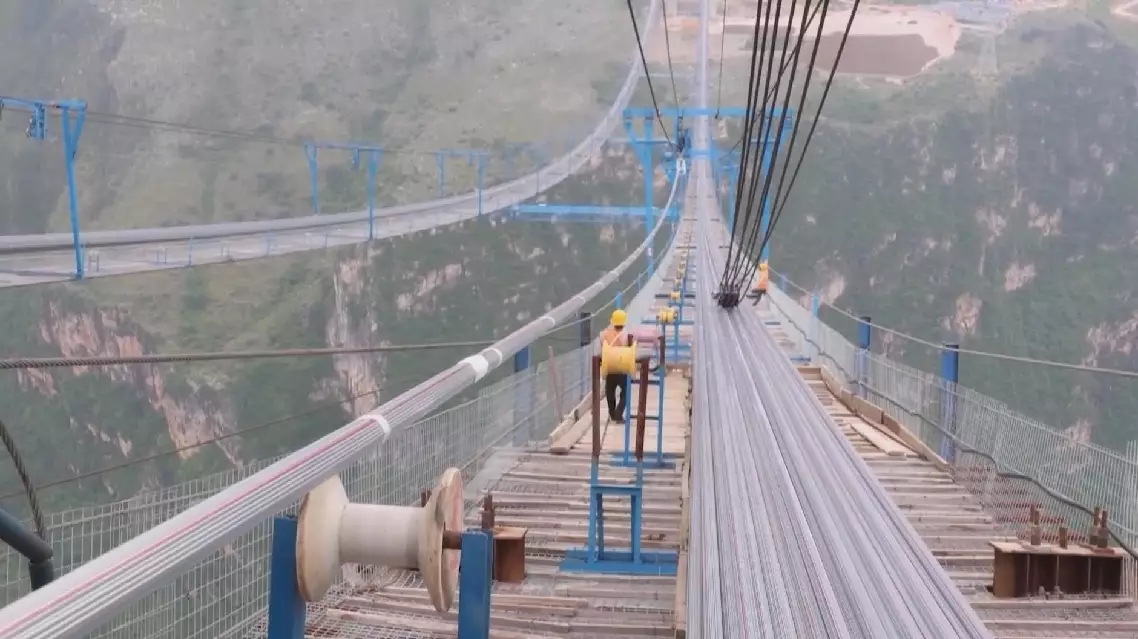
World's highest bridge in Guizhou serves as China's feat with advanced technologies, innovations