
Skip to Content Facebook Feature Image

Trump will speak at a hastily called meeting of top military leaders, AP source says

News

Trump will speak at a hastily called meeting of top military leaders, AP source says
News

News

Trump will speak at a hastily called meeting of top military leaders, AP source says

2025-09-29 03:54 Last Updated At:04:00

WASHINGTON (AP) — President Donald Trump will speak at a hastily called meeting of top military leaders on Tuesday, according to a White House official.

Hundreds of generals and admirals — senior commanders of the one-star rank or higher and their top advisers — have been summoned by Defense Secretary Pete Hegseth from all over the world to the Marine Corps base in Quantico, Virginia, with little notice.

The White House official was not authorized to discuss the president's plans before a public announcement about his attendance and spoke on condition of anonymity.

Trump told NBC News in an interview Sunday that they would be “talking about how well we're doing militarily, talking about being in great shape, talking about a lot of good, positive things.”

News about the meeting broke Thursday, and no reason was initially provided for the unusual gathering. Trump didn’t seem to know about it when first asked by reporters during an Oval Office appearance.

“I'll be there if they want me, but why is it such a big deal?” Trump said.

The official said the president's participation was not part of the original plan for the meeting but that he decided that he wanted to go.

Trump's participation in the meeting raises the likelihood of a politicized event in front of a nonpartisan audience of military leaders. For example, he delivered campaign-style remarks to uniformed personnel at Fort Bragg in North Carolina in June, attacking his Democratic predecessor, Joe Biden.

The Republican president is also expanding his use of the military in American cities, arguing that it’s necessary to fight crime in places where Democratic leaders are failing to ensure public safety.

The National Guard continues to patrol in the District of Columbia, and a smaller deployment is expected in Memphis, Tennessee. On Saturday, Trump said he would also send troops to Portland, Oregon, to protect against “domestic terrorists.”

Over the objections of local and state officials, Trump previously sent the National Guard and active-duty Marines to Los Angeles, where there were protests against immigration raids.

The Pentagon’s top spokesman has previously confirmed that Hegseth “will be addressing his senior military leaders early next week.”

Across the military, there are 800 generals and admirals of all ranks. Many command thousands of service members and are stationed across the world in more than a dozen countries and time zones.

The Washington Post first reported on Trump's plans to attend the upcoming meeting.

FILE - Defense Secretary Pete Hegseth speaks during a ceremony at the Pentagon to commemorate the 24rd anniversary of the 9/11 attacks, Sept. 11, 2025, in Washington. (AP Photo/Julia Demaree Nikhinson, File)
FILE - Defense Secretary Pete Hegseth speaks during a ceremony at the Pentagon to commemorate the 24rd anniversary of the 9/11 attacks, Sept. 11, 2025, in Washington. (AP Photo/Julia Demaree Nikhinson, File)

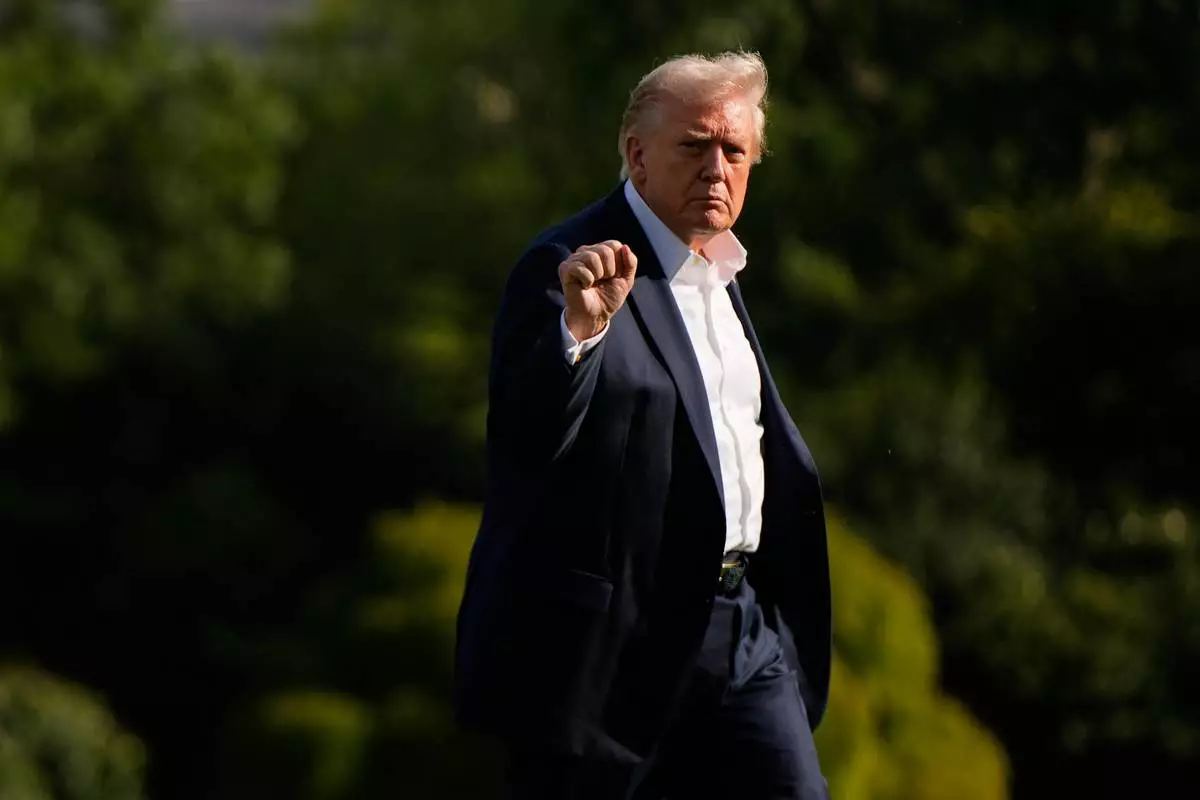
President Donald Trump gestures as he arrives at the White House, Friday, Sept. 26, 2025, in Washington. (AP Photo/Julia Demaree Nikhinson)


President Donald Trump gestures as he arrives at the White House, Friday, Sept. 26, 2025, in Washington. (AP Photo/Julia Demaree Nikhinson)
WASHINGTON (AP) — President Donald Trump's administration set forth a new national security strategy that paints European allies as weak and aims to reassert America's dominance in the Western Hemisphere.

The document released Friday by the White House is sure to roil long-standing U.S. allies in Europe for its scathing critiques of their migration and free speech policies, suggesting they face the “prospect of civilizational erasure” and raising doubts about their long-term reliability as American partners.

It reinforces, in sometimes chilly and bellicose terms, Trump’s “America First” philosophy, which favors nonintervention overseas, questions decades of strategic relationships and prioritizes U.S. interests above all.

The U.S. strategy "is motivated above all by what works for America — or, in two words, 'America First,'" the document said.

This is the first national security strategy, a document the administration is required by law to release, since the Republican president's return to office in January. It is a stark break from the course set by President Joe Biden's Democratic administration, which sought to reinvigorate alliances after many were rattled in Trump's first term and to check a more assertive Russia.

The United States is seeking to broker an end Russia’s nearly 4-year war in Ukraine, a goal that the national security strategy says is in America's vital interests. But the document makes clear the U.S. wants to improve its relationship with Russia after years of Moscow being treated as a global pariah and that ending that war is a core U.S. interest in order to “reestablish strategic stability with Russia.”

The document also is critical of America's European allies. They have found themselves sometimes at odds this year with Trump's shifting approaches to the Russia-Ukraine war, and are facing domestic economic challenges as well an existential crisis, according to the U.S.

Economic stagnation in Europe “is eclipsed by the real and more stark prospect of civilizational erasure,” the strategy document said.

The U.S. suggests that Europe is being enfeebled by its immigration policies, declining birthrates, “censorship of free speech and suppression of political opposition” and a "loss of national identities and self-confidence."

"Should present trends continue, the continent will be unrecognizable in 20 years or less. As such, it is far from obvious whether certain European countries will have economies and militaries strong enough to remain reliable allies," the document said. “Many of these nations are currently doubling down on their present path. We want Europe to remain European, to regain its civilizational self-confidence.”

Despite Trump's “America First” maxim, his administration has carried out a series of military strikes on alleged drug traffickers in the Caribbean Sea and eastern Pacific Ocean while weighing possible military action in Venezuela to pressure President Nicolás Maduro.

The moves are part of what the national security strategy lays out as “a ‘Trump Corollary’ to the Monroe Doctrine.” The 1823 Monroe Doctrine, formulated by President James Monroe, was originally aimed at opposing any European meddling in the Western Hemisphere and was used to justify U.S. military interventions in Latin America.

Trump's strategy document says the U.S. is reimagining its military footprint in the region even after building up the largest military presence there in generations.

That means, for instance, “targeted deployments to secure the border and defeat cartels, including where necessary the use of lethal force to replace the failed law enforcement-only strategy of the last several decades,” it says.

President Donald Trump speaks during a Cabinet meeting at the White House, Tuesday, Dec. 2, 2025, in Washington, as Secretary of State Marco Rubio, left, and Defense Secretary Pete Hegseth, right, look on. (AP Photo/Julia Demaree Nikhinson)

President Donald Trump speaks during a Cabinet meeting at the White House, Tuesday, Dec. 2, 2025, in Washington, as Secretary of State Marco Rubio, left, and Defense Secretary Pete Hegseth, right, look on. (AP Photo/Julia Demaree Nikhinson)
President Donald Trump speaks during a Cabinet meeting at the White House, Tuesday, Dec. 2, 2025, in Washington, with Secretary of State Marco Rubio, seated left and Defense Secretary Pete Hegseth, seated left. (AP Photo/Julia Demaree Nikhinson)

President Donald Trump speaks during a Cabinet meeting at the White House, Tuesday, Dec. 2, 2025, in Washington, with Secretary of State Marco Rubio, seated left and Defense Secretary Pete Hegseth, seated left. (AP Photo/Julia Demaree Nikhinson)
Recommended Articles