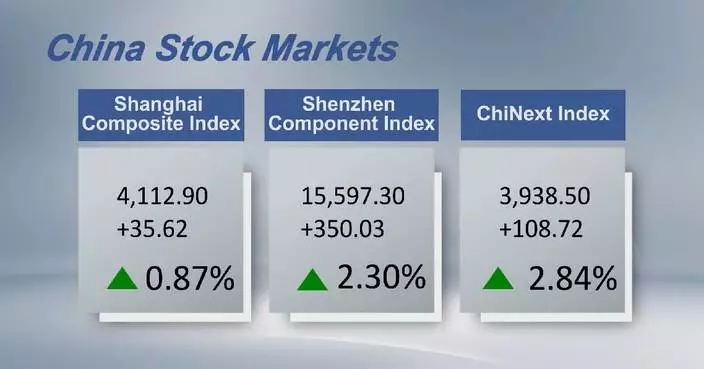
Chinese stocks closed higher on Monday, with the benchmark Shanghai Composite Index up 0.9 percent to 3,862.53 points.
The Shenzhen Component Index closed 2.05 percent higher at 13,479.43 points.
The combined turnover of these two indices stood at 2.16 trillion yuan (about 303.84 billion U.S. dollars), up from 2.15 trillion yuan on the previous trading day.
The ChiNext Index, tracking China's Nasdaq-style board of growth enterprises, gained 2.74 percent to close at 3,238.01 points Monday.
Market analyst He Jian highlighted the trends behind the numbers in his recap of China's stock market performance.
"The mainland stocks rose today, as shares of carmakers and solar energy firms jumped on signs that Beijing's crackdown on price wars is starting to bear fruit. Sentiment was also aided by China central bank's pledge to step up policy support for growth. By closing, the Shanghai Composite Index gained 0.9 percent after being up as much as 1.3 percent earlier in the session. China's industrial profits jumped more than 20 percent in August from a year earlier, reversing a 1.5-percent year-on-year decline in July. Market analysts pointed out that the August industrial profits surge is mostly due to the fact that it's being measured off a low base, but signs of early progress in the 'anti-involution' campaign are emerging," said the analyst.
"At a meeting on Thursday chaired by the State-owned Assets Supervision and Administration Commission of the State Council, chairman Zhang Yuzhuo told executives from state-owned firms to stabilize electricity and coal prices and to avoid destructive price wars. Sectors that suffered heavily from price wars, including new energy vehicles and solar energy, led the jump today. CATL up over 4 percent. And reports indicate that domestic demand for energy storage cells is currently very strong. And leading battery companies have stated that their factories are operating at full capacity, with some orders scheduled into early next year. The STAR Market also rose sharply today, after news that Moore Threads Technology, an artificial intelligence chipmaker that competes with Nvidia Corp., got regulatory approval to list on the tech-focused board in Shanghai," he said.
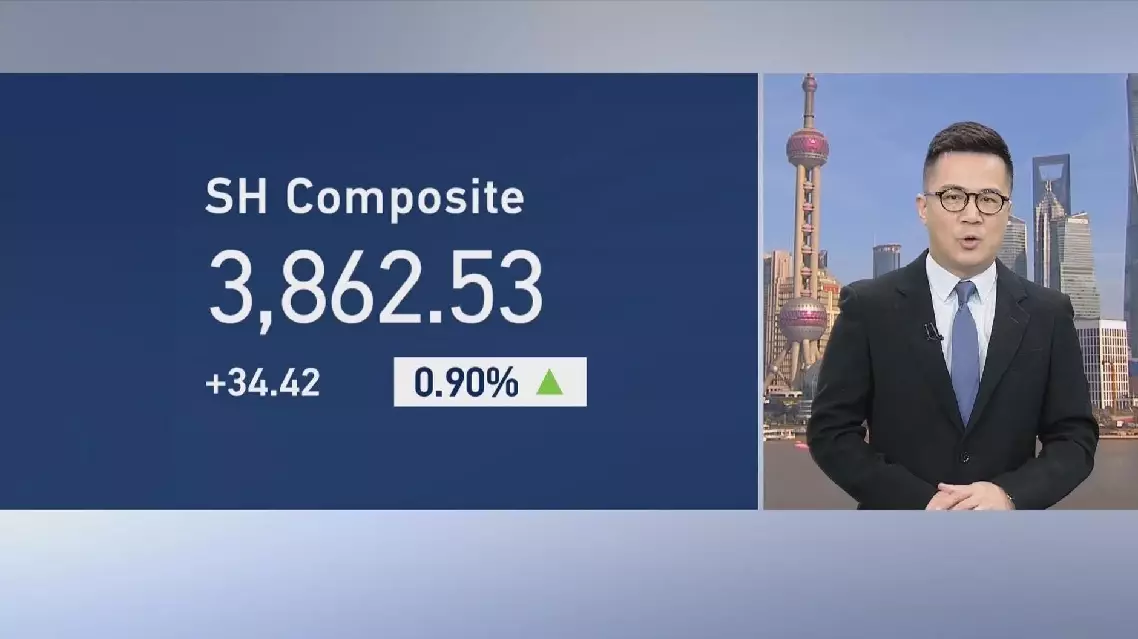
Analyst recaps Chinese stock market performance on Monday
Amid the rising fuel costs and airline surcharges linked to the U.S.-Israeli war against Iran, Caribbean tourism officials gathered at the 44th Caribbean Hotel and Tourism Association Forum this month and expressed cautious optimism, citing resilient visitor demand, strategic marketing adjustments, and strong seasonal performance as foundations for continued recovery.
The U.S.-Israeli war against Iran is already affecting Caribbean economies as fuel prices surge and airlines pass costs on to passengers. This not only pressures the region's tourism-dependent economies but also raises the cost of imported food, electricity, and transportation.
Since the start of the conflict, the price of Brent crude has surged nearly 50 percent, prompting airlines to find the ways to share the burden with travelers.
"The impacts are unfolding in stages. In the first place, when the uncertainty, or the disturbance occurred in the Middle Eastern region, it actually cut the supply chain to some extent to the Pacific, and people started to look at the region in particular. We amplified out marketing presence, to ensure that when people are looking for an option or places to rebook, that St. Lucia would turn up. And we've actually seen some of that result," said Louis Lewis, chief executive officer of the Saint Lucia Tourism Authority.
During the International Monetary Fund's Spring Meeting, the international financial institution expressed its concern for Caribbean tourism, warning that it could see a decline as ticket prices increase.
Lewis acknowledged the potential for longer-term disruption.
"The second thing is that if the conflict continues as a prolonged activity, we anticipate that it could impact us. We will have to diversify from our major source markets, hence the reason why we are looking at Latin America," he said.
But some of the region's top tourism officials are seeing positive signs. The region is coming off another successful year, where tourism arrivals grew by 2.5 percent, adding an additional 900,000 visitors over 2024.
"The region has been witnessing a very good winter season, and I have no doubt whatsoever that the forecast that we have for the summer will continue to be very strong," said Ian Gooding-Edghill, minister of tourism of Barbados.
Still, structural vulnerabilities remain. As an import-dependent region, the Caribbean is highly exposed to global price fluctuations. Concerns are mounting that rising prices in the United States could trigger sharper inflationary pressures, including higher operating costs in the tourism sector.
"In Saint Lucia, we just saw the cost of energy increase about 20 percent, and that's having an impact now going into the summer when our rates are lower. It rallies points to the importance of us building a bit more resilience into Caribbean tourism," said Sanovnik Destang, president of the Caribbean Hotel and Tourism Association.

Caribbean tourism shows resilience despite Middle East tension challenges

Caribbean tourism shows resilience despite Middle East tension challenges