BEIRUT (AP) — Syrian government fighters entered the city of Sweida over the summer in an apparent bid to assert control over the enclave of the Druze minority that for years had operated in semiautonomy.
It backfired. Sectarian attacks on Druze civilians during the ensuing fighting have hardened Sweida’s stance against the government, pushed it toward Israel, and led some in the minority sect to go as far as calling for secession.
Click to Gallery
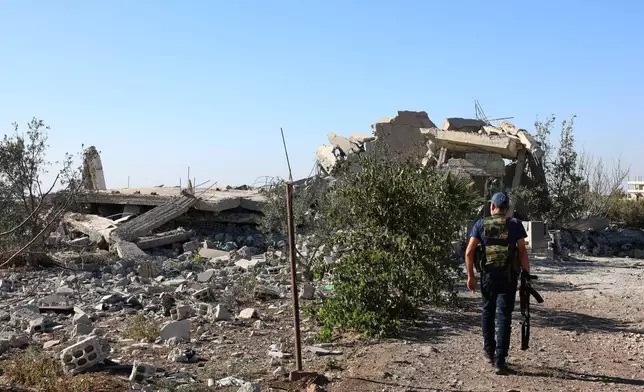
A gunman walks by the remains of a house destroyed during the recent sectarian clashes in the Druze-majority town of Sweida, southern Syria, on Sept. 19, 2025. (AP Photo/Fahd Kiwan)
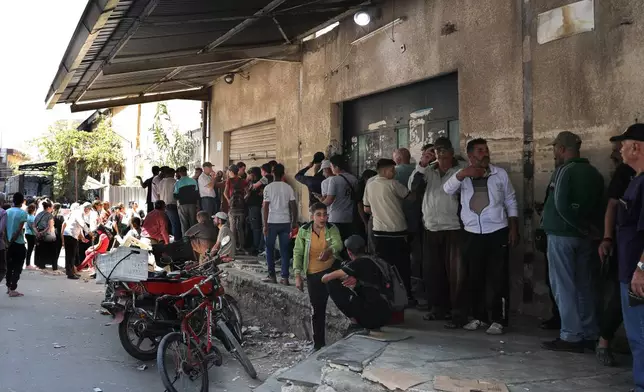
People line up for bread outside a bakery in Sweida, southern Syria, on Sept. 18, 2025.(AP Photo/Fahd Kiwan)
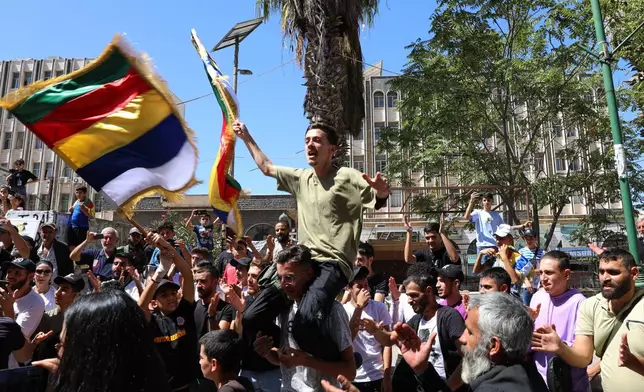
People chant slogans while waving the Druze flag during a weekly rally in Sweida, southern Syria, on Sept. 20, 2025. (AP Photo/Fahd Kiwan)
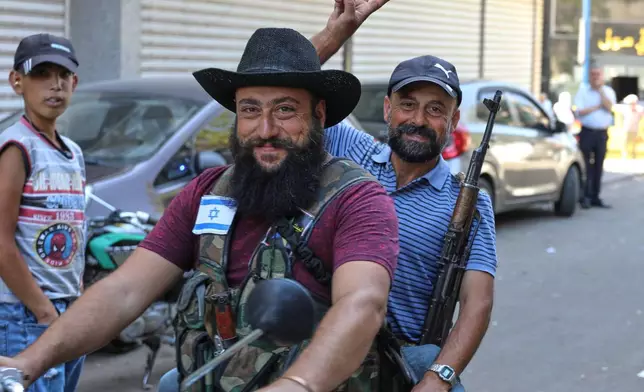
Two Druze gunmen pose for a photo while riding a motorcycle, one wearing a vest with an Israeli flag patch, in Sweida, southern Syria, on Sept. 18, 2025. (AP Photo/Fahd Kiwan)
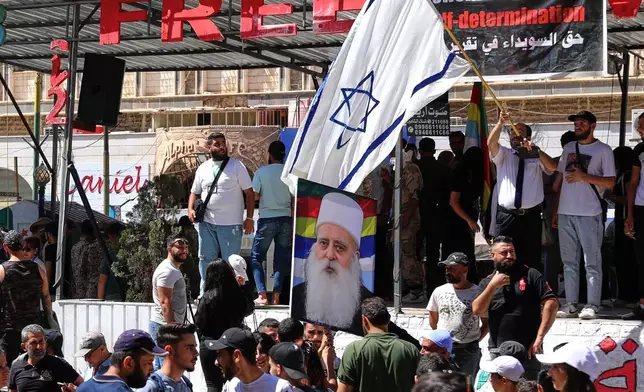
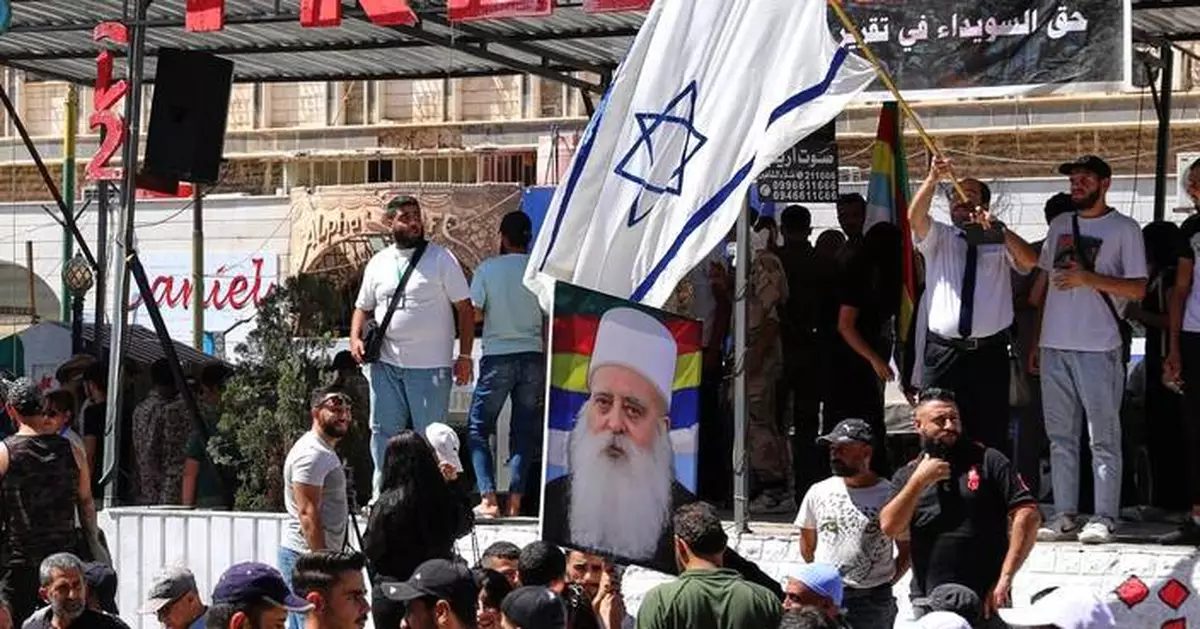
A man waves an Israeli flag over a picture of Sheikh Mowafak Tarif, the spiritual leader of the Druze in Israel, during a weekly rally in Sweida, southern Syria, on Sept. 20, 2025. (AP Photo/Fahd Kiwan)
Now Druze groups have set up a de facto military and governmental body in Sweida, similar to the Kurdish-led authorities in the country’s northeast. It is a major setback for Damascus struggling to exert its authority across the country following a 13-year civil war and win the support of minorities.
When former President Bashar Assad was brought down by Islamist-led insurgents in December, many Druze celebrated, welcoming a new era after over 50 years of autocratic rule. They were willing to give interim President Ahmad al-Sharaa, a former al-Qaida-linked militant who promised a democratic and inclusive political transition, a chance.
Among them was Omar Alkontar, a 21-year-old biology student. Then his village outside the city of Sweida was burned to the ground in July’s clashes.
Now, he said, “The main idea is that we have to separate (from Damascus) to prevent another massacre.”
While many Druze were initially willing to work with the new authorities, a notable exception was Druze spiritual leader Sheikh Hikmat al-Hijri, a divisive figure who had flip-flopped between support for Assad and anti-government protests and now opposed dealing with the new government.
In July, armed groups affiliated with al-Hijri clashed with local Bedouin clans, spurring intervention by government forces who effectively sided with the Bedouins. Hundreds of civilians, mostly Druze, were killed, many by government fighters.
Videos surfaced online showing armed men killing Druze civilians kneeling in squares and shaving the mustaches off elderly men in an act of humiliation.
The sectarian violence changed the minds of many Druze about the new authorities — and about al-Hijri, who has emerged as the dominant Druze figure in Syria. In August, he established a government-like body called the Supreme Legal Council.
Dozens of armed factions originally formed to counter drug gangs and Islamic State group extremists have banded together under the National Guard. Critics say it includes former Assad loyalists and allied militias trafficking the amphetamine known as Captagon. It also includes former opponents of al-Hijri, most notably the Men of Dignity, a prominent group that had endorsed cooperation with Damascus before the July violence.
“We urge all the honorable in the world … to stand with the Druze sect in southern Syria to declare a separate region that keeps us protected until the end of time,” al-Hijri said in August, upon welcoming the Men of Dignity into the National Guard.
Al-Hijri did not respond to interview requests and it is unclear exactly what kind of system he envisions.
Many in Sweida want some form of autonomy in a federal system. A smaller group is calling for total partition. Local Druze figures that still back al-Sharaa are now widely seen as traitors.
The attacks in Sweida sounded “strong alarm bells among the Druze” as well as other minority groups, said Mazen Ezzi, a Syrian researcher from Sweida now based in Paris.
“The Druze realized that to stay part of this new political status quo” under the new authorities “will be extremely difficult,” he said.
Most of the roughly 1 million Druze worldwide live in Syria, with the rest in Lebanon, Israel and the Golan Heights which Israel seized from Syria in 1967 and later annexed.
The Druze of Syria take pride in their historic involvement in revolts against Ottoman and French colonial rule to establish a secular, nationalist Syrian state.
Sheikh Mowafak Tarif, Israel’s Druze spiritual leader, was largely rejected by Druze leaders in Syria and Lebanon, who opposed Israel and supported the Palestinians.
But what happened in July has shaken about a century of Syrian Druze political history and driven many toward a formerly taboo ally.
When violence broke out in Sweida, Tarif called for Israeli military intervention to protect the Druze. Israel responded, launching strikes on Syrian government forces and on the Syrian Defense Ministry headquarters in Damascus. Syrian forces withdrew from Sweida.
Tarif told The Associated Press that he and al-Hijri stay in touch “all the time,” organizing deliveries of aid to the besieged province.
Tarif also meets with senior Western politicians and diplomats and has called for a demilitarized southern Syria and establishment of a humanitarian corridor from Israel to deliver food and medical supplies to Sweida. Israeli officials have also pushed for a wider demilitarized zone in Syria’s south.
Al-Hijri has thanked Israel publicly on several occasions.
The impact on the ground is apparent.
When someone hoisted an Israeli flag in Sweida in March, residents quickly took it down. Now, in Karama Square, where people once gathered to celebrate Assad’s downfall, portraits of al-Hijri and Tarif appear side by side at protests against al-Sharaa. Most carry the Druze faith’s five-colored flag, but some also wave the Israeli flag.
It’s a sign of “a people who feel let down by their nationalism,” Ezzi said.
Alkontar, the biology student, doesn’t believe Israel’s motives are altruistic, but says its intervention was a lifeline for many in Sweida.
“It’s not necessarily a love for Israel. They felt safer after the strikes, which is very sad,” Alkontar said after a attending a protest in Karama Square. “You want the army of your own government to provide you with that security, not a foreign country.”
Al-Sharaa has tried to appeal to the Druze community since the July fighting and warned that Israel is trying to exploit the tensions.
“Mistakes were made by all sides: the Druze community, the Bedouins, even the state itself,” he said in an interview with state television. “Everyone who committed wrongdoing, made mistakes, or violated people’s rights must be held accountable.”
The president then formed a fact-finding mission. Last month, Damascus alongside the United States and Jordan announced a road map to return displaced Druze and Bedouins, deliver aid to Sweida, and bring about reconciliation.
Both moves were widely dismissed in Sweida.
A Sweida resident, whose fiance and members of his family were killed by gunmen who raided their village, accused Damascus of “covering the attacks up.” She spoke on condition of anonymity after previously receiving threats for speaking out.
“When the (Assad) regime fell, we were the first people to celebrate … but I think Ahmad al-Sharaa is a murderous extremist,” she said.
Alkontar is disheartened as he walks past another long breadline in a small bakery near ruined buildings after visiting a displaced family.
He believes some Druze “could have a change of heart ... if the government changes its ways and extends a hand.” But many will not.
“As long as this government in Damascus stays, people will lean towards partition or independence,” Alkontar said. “I prefer we stay part of Syria without this ruling group. But as long as they’re there, I don’t know if even federalism will keep us safe.”
Associated Press writer Melanie Lidman in Tel Aviv, Israel, contributed to this report.
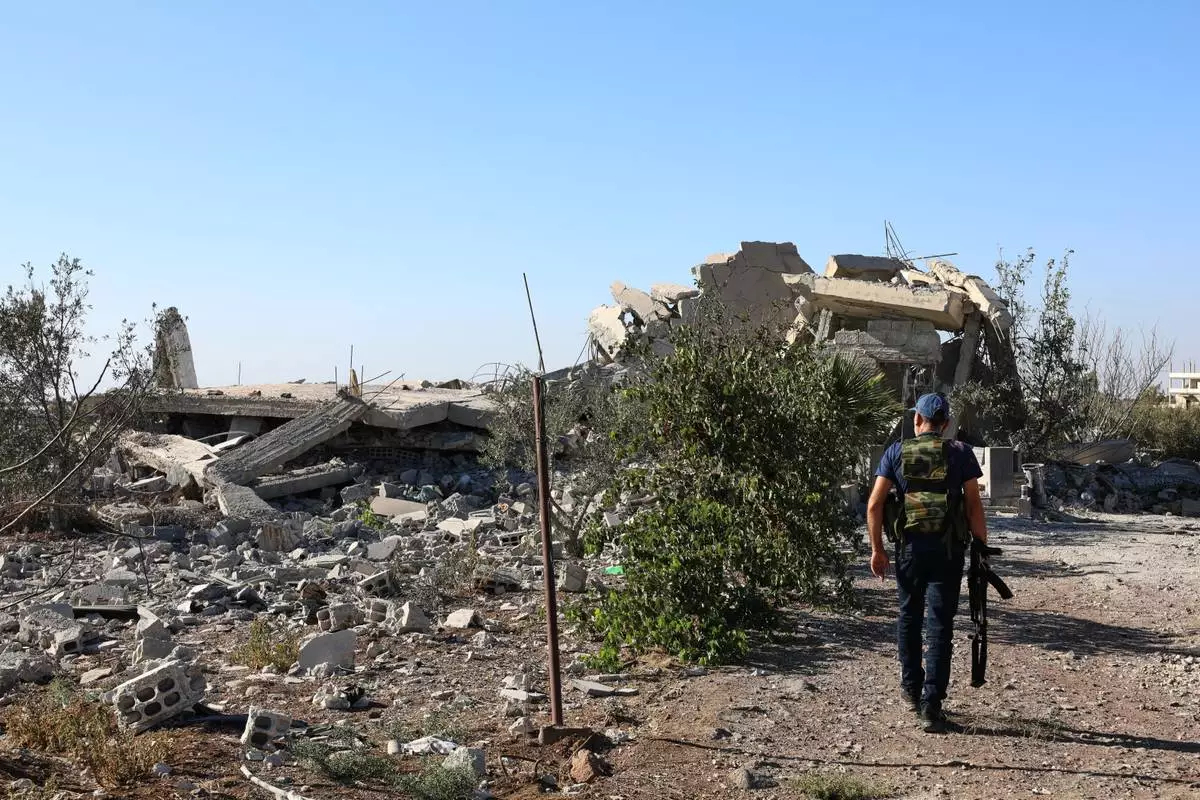
A gunman walks by the remains of a house destroyed during the recent sectarian clashes in the Druze-majority town of Sweida, southern Syria, on Sept. 19, 2025. (AP Photo/Fahd Kiwan)
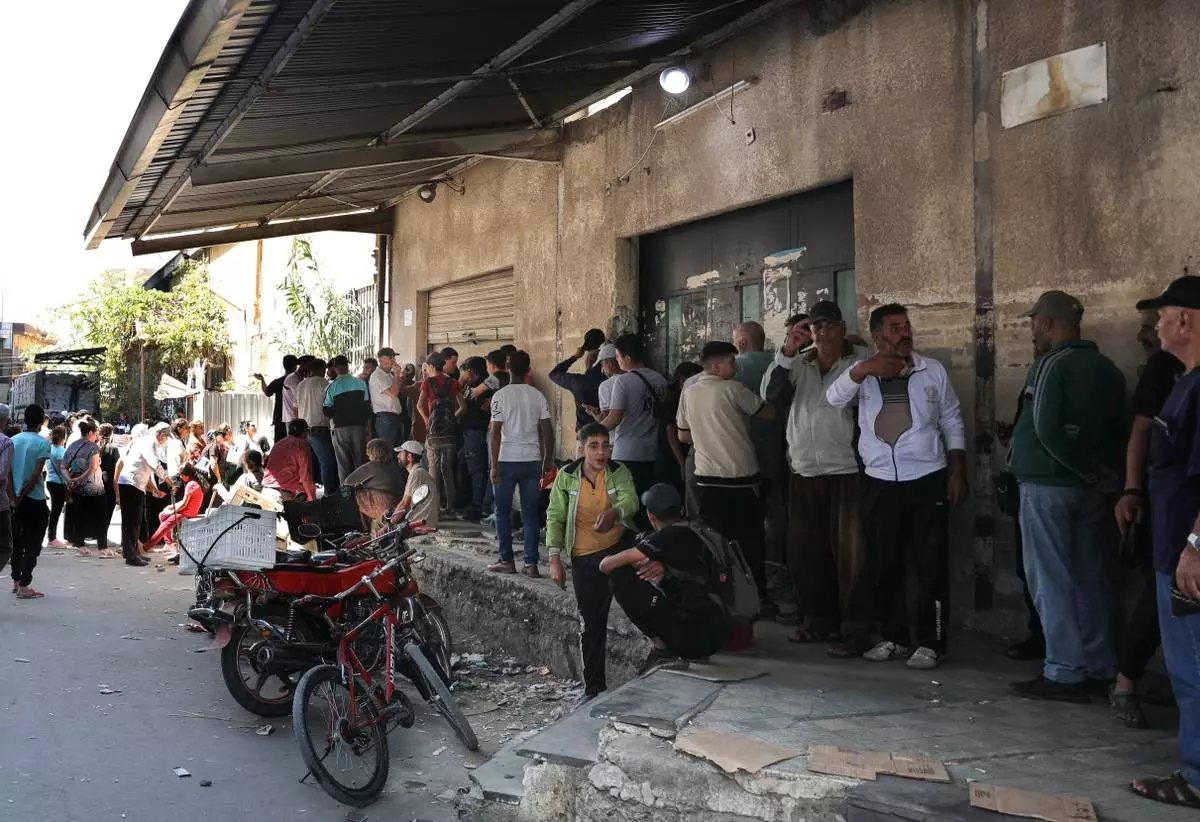
People line up for bread outside a bakery in Sweida, southern Syria, on Sept. 18, 2025.(AP Photo/Fahd Kiwan)
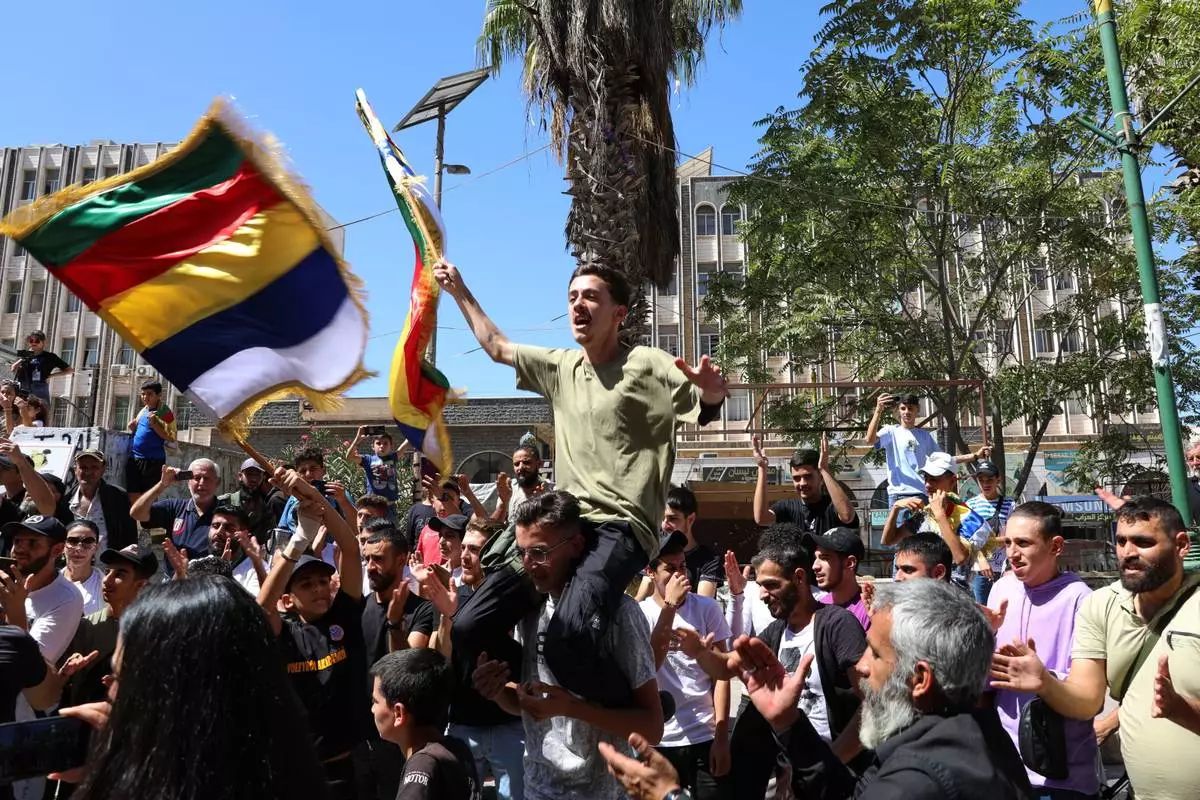
People chant slogans while waving the Druze flag during a weekly rally in Sweida, southern Syria, on Sept. 20, 2025. (AP Photo/Fahd Kiwan)

Two Druze gunmen pose for a photo while riding a motorcycle, one wearing a vest with an Israeli flag patch, in Sweida, southern Syria, on Sept. 18, 2025. (AP Photo/Fahd Kiwan)
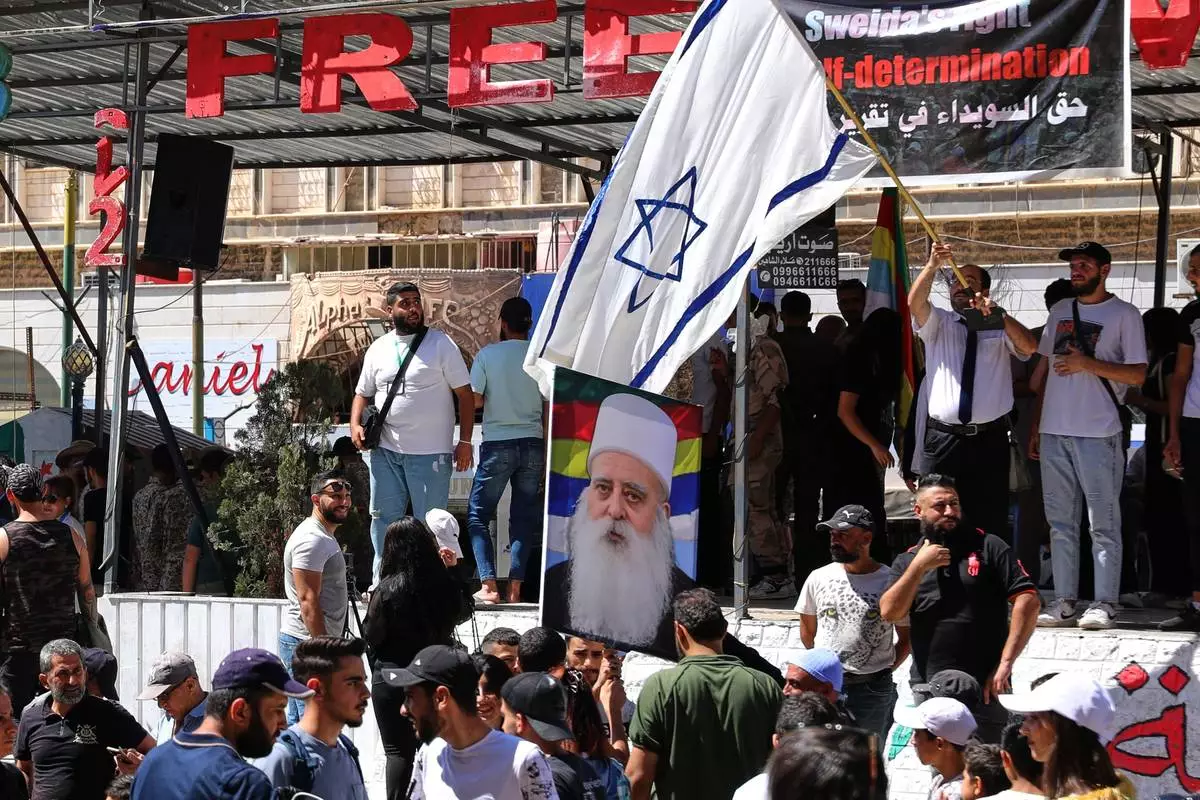
A man waves an Israeli flag over a picture of Sheikh Mowafak Tarif, the spiritual leader of the Druze in Israel, during a weekly rally in Sweida, southern Syria, on Sept. 20, 2025. (AP Photo/Fahd Kiwan)