WASHINGTON (AP) — The government shutdown that began Wednesday will deprive policymakers and investors of economic data vital to their decision-making at a time of unusual uncertainty about the direction of the U.S. economy.
The absence will be felt almost immediately, as the government's monthly jobs report scheduled for release Friday will likely be delayed. A weekly report on the number of Americans seeking unemployment benefits — a proxy for layoffs that is typically published on Thursdays — will also be postponed.
If the shutdown is short-lived, it won’t be very disruptive. But if the release of economic data is delayed for several weeks or longer, it could pose challenges, particularly for the Federal Reserve. The Fed is grappling with where to set a key interest rate at a time of conflicting signals, with inflation running above its 2% target and hiring nearly ground to a halt, driving the unemployment rate higher in August.
The Fed typically cuts this rate when unemployment rises, but raises it — or at least leaves it unchanged — when inflation is rising too quickly. It’s possible the Fed will have little new federal economic data to analyze by its next meeting on Oct. 28-29, when it is widely expected to reduce its rate again.
“The job market had been a source of real strength in the economy but has been slowing down considerably the past few months,” said Michael Linden, senior policy fellow at the left-leaning Washington Center for Equitable Growth. “It would be very good to know if that slowdown was continuing, accelerating, or reversing.”
The Fed cut its rate by a quarter-point earlier this month and signaled it was likely to do so twice more this year. Fed officials said they would keep a close eye on how inflation and unemployment evolve, but that depends on the data being available.
A key inflation report is scheduled for Oct. 15 and the government's monthly retail sales report is slated for release the next day.
“We're in a meeting-by-meeting situation, and we’re going to be looking at the data,” Fed Chair Jerome Powell said during a news conference earlier this month.
The economic picture has recently gotten cloudier. Despite slower hiring, there are signs that overall economic growth may be picking up. Consumers have stepped up their shopping and the Federal Reserve Bank of Atlanta estimates the economy likely expanded at a healthy clip in the July-September quarter, after a large gain in the April-June period.
A key question for the Fed is whether that growth can revive the job market, which this Friday’s report might have helped illustrate. Economists had forecast another month of weak hiring, with just 50,000 new positions added, according to a survey by FactSet. The unemployment rate was projected to stay at a still-low 4.3%.
On Wall Street, investors obsess over the monthly jobs reports, typically issued the first Friday of every month. It's a crucial indicator of the economy's health and provides insights into how the Fed might adjust interest rates, which affects the cost of borrowing and influences how investors allocate their money.
So far, investors don’t seem fazed by the shutdown. The broad S&P 500 stock index rose slightly Wednesday to an all-time high.
Many businesses also rely on government data to gauge how the economy is faring. The Commerce Department's monthly report on retail sales, for example, is a comprehensive look at the health of U.S. consumers and can influence whether companies make plans to expand or shrink their operations and workforces.
For the time being, the Fed, economists, and investors will likely focus more on private data.
On Wednesday, the payroll provider ADP issued its monthly employment data, which showed that businesses cut 32,000 jobs in September — a signal the economy is slowing. Still, ADP chief economist Nela Richardson said her firm's report “was not intended to be a replacement” for government statistics.
The ADP data does not capture what's happening at government agencies, for example — an area of the economy that could be significantly affected by a lengthy shutdown.
“Using a portfolio of private sector and government data gives you a better chance of capturing a very complicated economy in a complex world,” she said.
The Fed will remain open no matter how long the shutdown lasts, because it funds itself from earnings on the government bonds and other securities it owns. It will continue to provide its monthly snapshots of industrial production, which includes mining, manufacturing, and utility output. The next industrial production report will be released Oct. 17.

John O'Hara works on the floor at the New York Stock Exchange in New York, Wednesday, Oct. 1, 2025. (AP Photo/Seth Wenig)

Financial information is displayed as traders work on the floor at the New York Stock Exchange in New York, Wednesday, Oct. 1, 2025. (AP Photo/Seth Wenig)
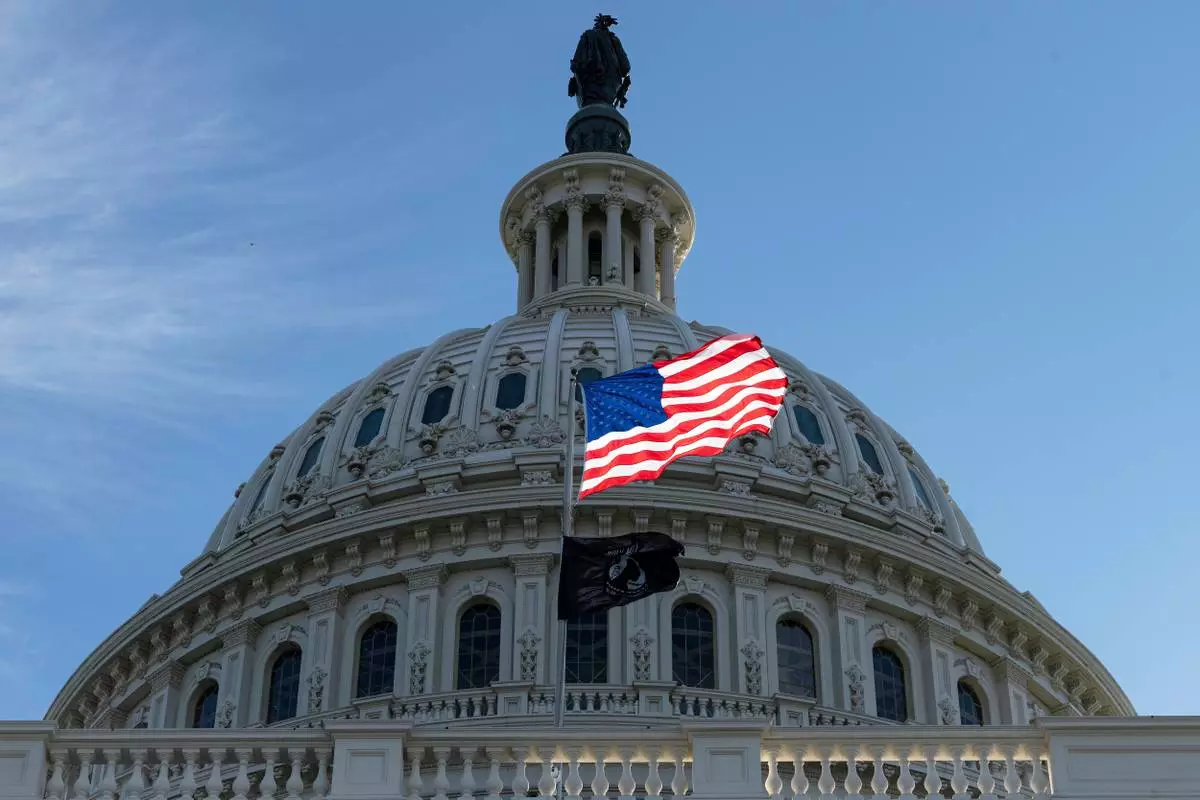
The American flag over the Capitol is illuminated by the early morning light on the first day of a government shutdown, in Washington, Wednesday, Oct. 1, 2025. (AP Photo/J. Scott Applewhite)
U.S., Danish and Greenlandic officials have met face to face to discuss President Donald Trump's ambitions to take control of Greenland, a semiautonomous territory of Denmark. At the same time, Denmark and several European allies are sending troops to Greenland in a pointed signal of intent to boost the vast Arctic island's security.
Danish Foreign Minister Lars Løkke Rasmussen said after a meeting in Washington on Wednesday with his Greenlandic counterpart, U.S. Vice President JD Vance and Secretary of State Marco Rubio that a “fundamental disagreement” remained. He acknowledged that “we didn't manage to change the American position” but said he hadn't expected to.
However, Wednesday's events did point to ways ahead.
Denmark, Greenland and the U.S. agreed to form a high-level working group “to explore if we can find a common way forward,” Løkke Rasmussen said. He added that he expects the group to hold its first meeting “within a matter of weeks.”
Danish and Greenlandic officials didn't specify who would be part of the group or give other details. Løkke Rasmussen said the group should focus on how to address U.S. security concerns while respecting Denmark's “red lines.” The two countries are NATO allies.
“Whether that is doable, I don't know,” he added, holding out hope that the exercise could “take down the temperature.”
He wouldn't elaborate on what a compromise might look like, and expectations are low. As Danish Defense Minister Troels Lund Poulsen put it Thursday, having the group is better than having no working group and “it's a step in the right direction.” It will at least allow the two sides to talk with each other rather than about each other.
Trump has argued repeatedly that the U.S. needs control of Greenland for its national security. He has sought to justify his calls for a U.S. takeover by repeatedly claiming that China and Russia have their own designs on Greenland, which holds vast untapped reserves of critical minerals.
Just as the talks were taking place in Washington on Wednesday, the Danish Defense Ministry announced that it was increasing its military presence in Greenland, along with NATO allies. France, Germany, Norway and Sweden announced that they were each sending very small numbers of troops in a symbolic but pointed move signaling solidarity with Copenhagen.
The U.K. said one British officer was part of what it called a reconnaissance group for an Arctic endurance exercise. The German Defense Ministry, which dispatched 13 troops, said the aim is to sound out “possibilities to ensure security with a view to Russian and Chinese threats in the Arctic.” It said it was sending them on a joint flight from Denmark as “a strong signal of our unity.”
Poulsen said that "the Danish Armed Forces, together with a number of Arctic and European allies, will explore in the coming weeks how an increased presence and exercise activity in the Arctic can be implemented in practice,” he said.
On Thursday, he said the intention was “to establish a more permanent military presence with a larger Danish contribution,” and to invite allies to take part in exercises and training on a rotating basis, according to Danish broadcaster DR.
While the European troops are largely symbolic at this point, the timing was no accident.
The deployment “serves both to send a political signal and military signal to America, but also indeed to recognize that Arctic security should be reinforced more," said Maria Martisiute, an analyst at the European Policy Center in Brussels. "And first and foremost, this should be done through allied effort, not by the U.S. coming and wanting to take it over. So it complicates the situation for the U.S.”
The European efforts are Danish-led and not coordinated through NATO, which is dominated by the United States. But the European allies are keen to keep NATO in play, and Germany said that “the aim is to obtain a well-founded picture on the ground for further talks and planning within NATO."
Poulsen has said he and Greenland's foreign minister plan to meet NATO Secretary General Mark Rutte in Brussels on Monday to discuss security in and around the Arctic. NATO has been studying ways to bolster security in the Arctic region.
“I’m really looking forward for an announcement of some kind of military activity or deployment under NATO’s framework,” Martisiute said. “Otherwise there is indeed a risk that ... NATO is paralyzed and that would not be good.”
Sylvain Plazy in Brussels contributed to this report.
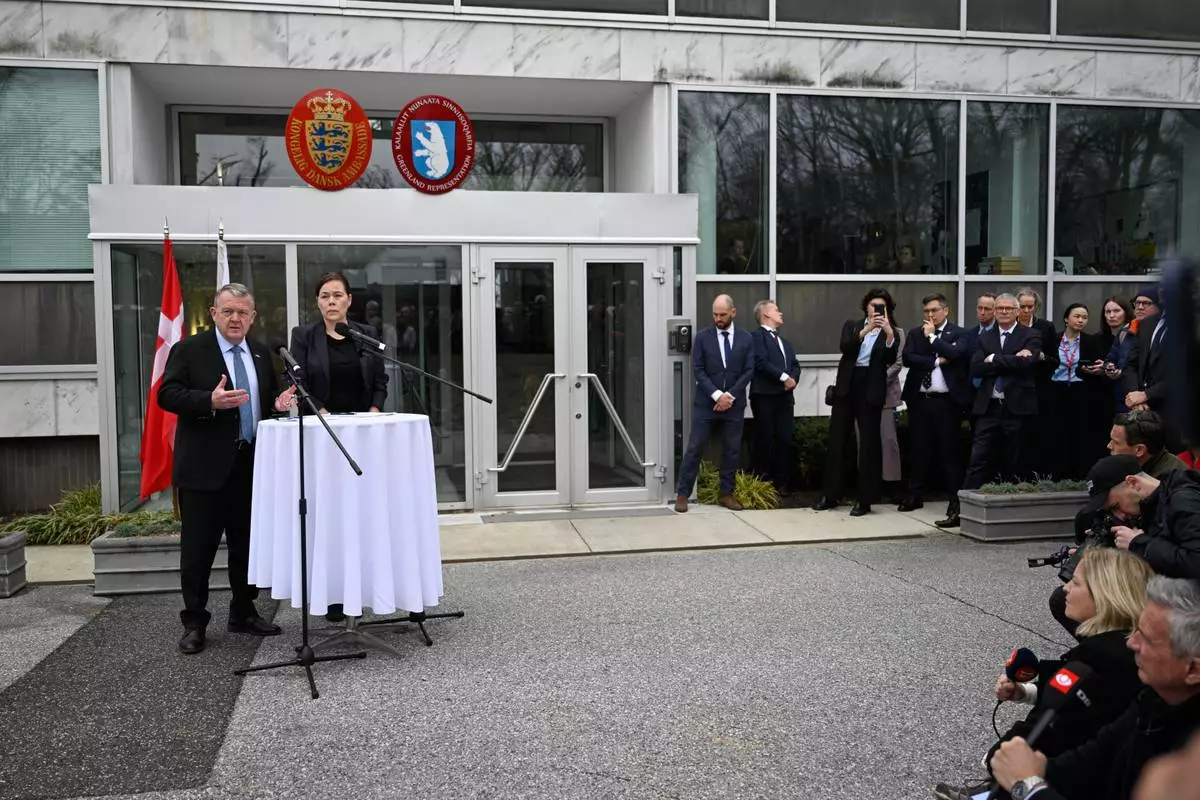
Denmark's Foreign Minister Lars Løkke Rasmussen and Greenland's Foreign Minister Vivian Motzfeldt speak at a news conference at the Embassy of Denmark, Wednesday, Jan. 14, 2026, in Washington. (AP Photo/John McDonnell)

An Airbus A400M transport aircraft of the German Air Force taxis over the grounds at Wunstorf Air Base in the Hanover region, Germany, Thursday, Jan. 15, 2026 as troops from NATO countries, including France and Germany, are arriving in Greenland to boost security. (Moritz Frankenberg/dpa via AP)
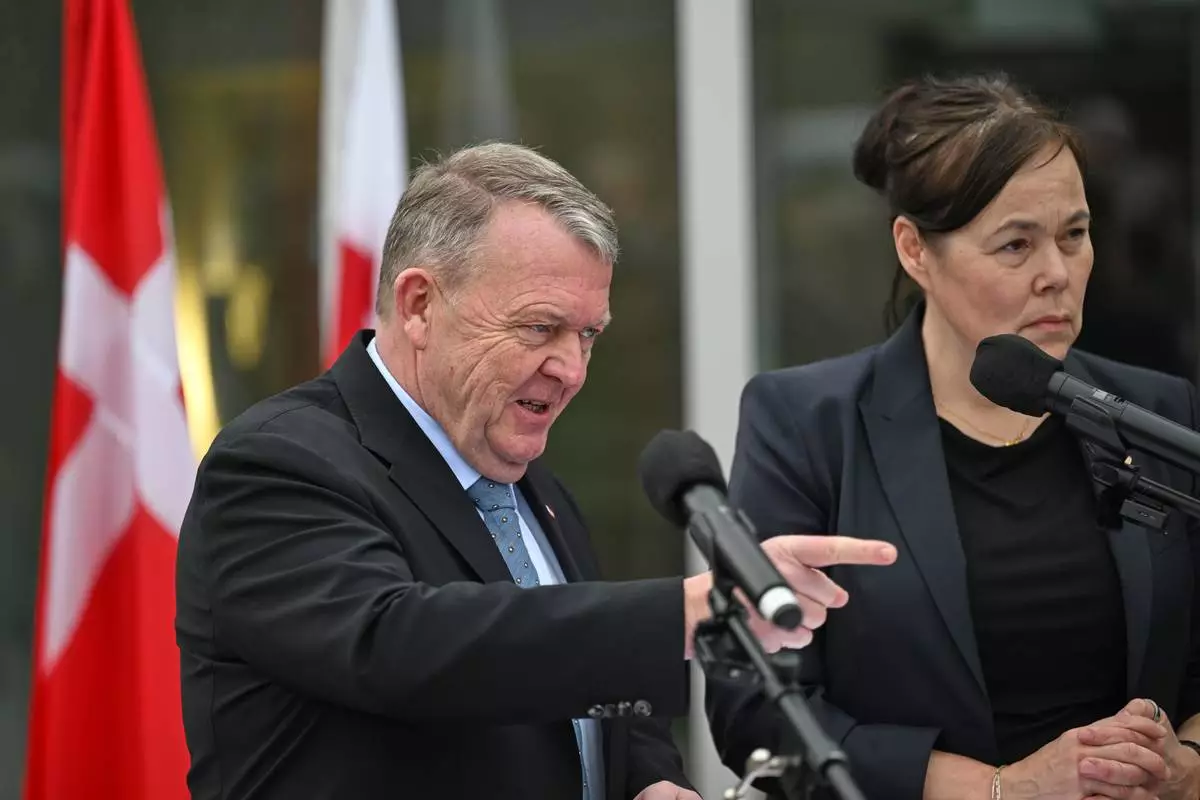
Denmark's Foreign Minister Lars Løkke Rasmussen and Greenland's Foreign Minister Vivian Motzfeldt speak at a news conference at the Embassy of Denmark, Wednesday, Jan. 14, 2026, in Washington. (AP Photo/John McDonnell)
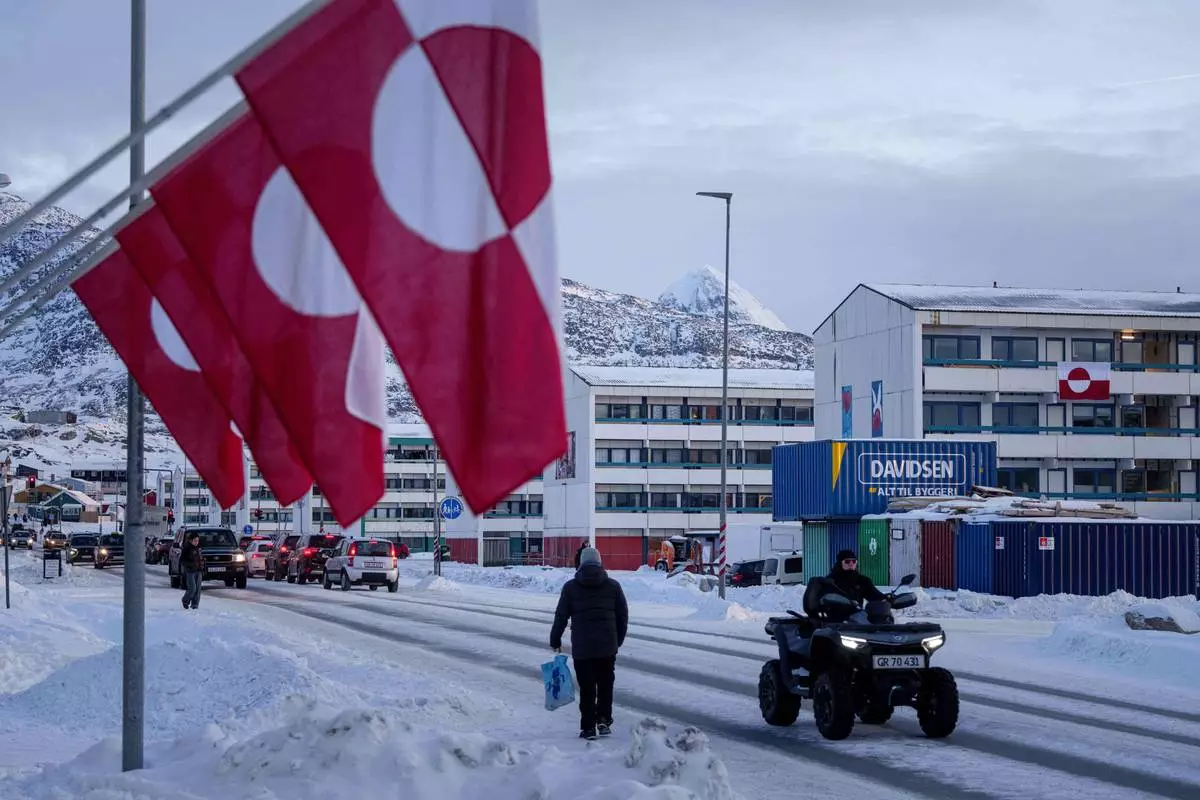
A man rides by on a quad bike past a row of Greenlandic national flags in Nuuk, Greenland, Wednesday, Jan. 14, 2026. (AP Photo/Evgeniy Maloletka)