Two Delta Air Lines regional jets collided at the intersection of two taxiways at LaGuardia Airport in New York, injuring a flight attendant, damaging a cockpit and tearing off part of a wing, the National Transportation Safety Board said Thursday.
The NTSB said it sent a team of 10 investigators to the airport after the collision Wednesday night, and flight recorders have already been recovered from both airplanes and sent to its headquarters for analysis. It wasn’t immediately clear who was at fault, but air traffic control had instructed the Virginia-bound plane “to hold short and yield to the other aircraft” before the collision, the Federal Aviation Administration said in a statement.
An aircraft carrying 32 people was preparing for takeoff to Roanoke, Virginia, when its wing made contact with the fuselage of an aircraft arriving from Charlotte, North Carolina, with 61 people aboard, according to a statement from Delta.
The airline described it as a “low-speed collision.” But it would not provide the planes' exact speeds, saying in a statement that that information is "germane to the open and ongoing investigation.” A passenger video showed one plane moving quite fast when the collision occurred.
A flight attendant was taken to a hospital, according to a statement from the Port Authority of New York and New Jersey. One of the pilots told the tower that the flight attendant told him she hit her knee when the planes collided, according to audio that www.LiveATC.net posted. There were no reports of passengers injured, the airline said.
“Their right wing clipped our nose and the cockpit. We have damage to our windscreen and ... some of our screens in here,” a pilot said, according to the air traffic control audio.
Images of the damage showed the broken wing on one plane while the other plane's cockpit window was shattered and its nose was deeply gouged in several places.
The plane that had landed “stopped, jerked, and jumped to the right,” passenger William Lusk told ABC. ”Everyone went dead silent. And as everyone went dead silent, the pilot calmly came on and said, ‘Hey, we've been in a crash, everyone remain calm.'"
Close calls like this could add to worries about aviation safety in the wake of recent crashes and near misses including the deadliest plane crash in the United States in decades, when an Army helicopter collided with an airliner preparing to land at Ronald Reagan Washington National Airport.
Former NTSB and FAA crash investigator Jeff Guzzetti said that the ground controller lines up planes on taxiways and directs them where to go, but the pilots are expected to avoid other planes as they move at slow speeds while controllers focus on keeping the runways clear.
“You’re supposed to have situational awareness about where your wings are poking out at and what they could hit as you’re taxiing,” said Guzzetti, who is now an aviation safety consultant. “They (controllers) expect the flight crews to see each other since they’re taxiing at a slow speed. And the controller's main function is to make sure the runway is clear for takeoff and landings.”
Because this happened at night and planes typically turn off their nose lights while taxiing, it may have been more difficult for the pilots to see exactly where the other plane was, Guzzetti said. A plane's taxi lights are on the wings. The landing lights are used to improve visibility and help make sure other pilots can see the plane, but the FAA encourages pilots to be careful not to blind other pilots because landing lights can also impair night vision.
“Delta will work with all relevant authorities to review what occurred as safety of our customers and people comes before all else,” the statement from Delta said. "We apologize to our customers for the experience.”
The Delta Connection aircraft involved in the collision were operated by Endeavor Air. Both are CRJ-900 planes, said the FAA, which is investigating along with the NTSB. The planes can seat 70 to 90 passengers.
LaGuardia Airport is one of 35 major airports where the FAA has installed advanced surface radar systems that help track aircraft and vehicles on the ground and alert controllers to potential conflicts. It wasn't clear what role the system played in this collision.
Guzzetti said he's not sure if that system would have sounded an audible alarm for these planes on a taxiway even though the system would have shown both planes on a display. The primary purpose of the system is to prevent collisions on runways.
The passengers on both planes were provided meals and hotel rooms and rebooked on flights leaving on Thursday.
Associated Press writer Kathy McCormack in Concord, New Hampshire, Hallie Golden in Seattle and Sarah Brumfield in Cockeysville, Maryland, contributed to this story.
FILE - A man waits for a Delta Airlines flight at Hartsfield-Jackson International Airport in Atlanta on Jan. 7, 2022. (AP Photo/Charlie Riedel, File)
Pakistan’s army chief met with Iranian officials in Tehran on Thursday in a bid to ease tensions in the Middle East and arrange a second round of negotiations between the United States and Iran after almost seven weeks of war.
The meeting comes as President Donald Trump announced the leaders of Israel and Lebanon will speak later on Thursday about halting the fighting between them. It was not clear what leaders Trump was referring to.
The U.S. naval blockade of Iranian ports continued as U.S. Treasury Secretary Scott Bessent said the Trump administration would ramp up economic pain on Iran with new economic sanctions on countries doing business with it, calling the move the “financial equivalent” of a bombing campaign.
The White House said any further talks with Iran would likely take place in the Pakistani capital of Islamabad, though no decision had been made on whether to resume negotiations. Pakistan has emerged as a key mediator after it hosted direct talks between the U.S. and Iran in Islamabad.
In a development in the war's other front, Trump wrote late Wednesday on Truth Social that leaders from Israel and Lebanon would speak the next day in a renewed effort to broker a ceasefire after the countries’ first direct talks in decades ended the previous day in Washington without a deal.
Here is the latest:
The office of Lebanon’s President Joseph Aoun said President Trump was thanked by the Lebanese head of state to reach a ceasefire in the devastating war.
Aoun earlier spoke to U.S. Secretary of State Marco Rubio where he refused to have a direct call with Israeli Prime Minister Benjamin Netanyahu and has insisted on achieving a ceasefire ahead of continued direct talks. Israel hasn’t made a decision regarding a ceasefire.
The statement said Trump stressed “his commitment to fulfilling the Lebanese request for a ceasefire as soon as possible.”
Neither the State Department nor the White House immediately issue a statement on the calls with the Lebanese president.
A second Lebanese official said Aoun explained to U.S. Secretary of State Marco Rubio that direct talks with Netanyahu at this point would be inappropriate given the ongoing airstrikes and destruction in Lebanon and the lack of a ceasefire in place.
The official also spoke on condition of anonymity because of the sensitivity of the situation.
— Kareem Chehayeb
Lufthansa said Thursday that labor disputes and high fuel prices are forcing it to immediately shut down its feeder airline CityLine earlier than planned and take its 27 older, less fuel efficient planes out of service. The decision accelerates a shutdown that had been expected for next year.
CityLine’s primary role was bringing passengers to Lufthansa’s mid- and long-haul hubs in Frankfurt and Munich, Germany. Fuel prices have soared since the outbreak of the Iran war in February and the blocking by Iran of the Strait of Hormuz, a key passage way for crude oil and fuel products from Persian Gulf producers.
CityLine will halt operations Saturday.
Abdul Malik al-Houthi, leader of the Iran-backed Yemeni rebel group, said that in negotiations with Iran, the U.S. is making “impossible demands for any independent country to accept.”
During a video speech Thursday, he said the ongoing two-week ceasefire was a result of “failures” by the U.S. and Israel to achieve their goals in the Iran war.
“If negotiations succeed, it will either result in a longer period of stability or an end to the aggression,” he said, adding that the U.S. entered negotiations based on their own terms built on “arrogance and pride.”
Lebanon’s Health Ministry says that among the killed are 260 women and 172 children since the latest war between Israel and Hezbollah began March 2. Another 7,185 have been wounded.
Israel’s latest military escalation started after Hezbollah fired rockets towards northern Israel in solidarity with its key ally and patron Iran.
Lebanon and Israel started direct talks Tuesday, the first of their kind since 1993. Lebanon hopes those talks can end the war.
“There are no dates yet,” Pakistan’s Foreign Ministry spokesperson Tahir Andrabi told reporters Thursday.
“We will announce the timing of these talks as and when it is decided,” he said, urging the media to avoid speculation.
Andrabi said Pakistan’s role as a mediator and facilitator did not end when the first round of talks concluded over the weekend.
“It continued,” he said.
He said Pakistan’s army chief, Field Marshal Asim Munir, is visiting Iran with a delegation, while Prime Minister Shehbaz Sharif is also traveling to regional countries to promote peace.
“We will continue to advocate for peace, prosperity and stability,” he said.
Asked about the first round of talks, Andrabi said there was “certainly not a major breakthrough in terms of any concrete document emanating from these talks, but there was no breakdown as well.”
Germany’s largest shipping company Hapag-Lloyd says it’s feeling the impact of the blockade of the Strait of Hormuz as 150 sailors are trapped there on six of its vessels.
“Five and a half weeks in a war zone — that’s something relatively new. And of course, these are difficult days and weeks for our colleagues,” Hapag Lloyd spokesperson Nils Haupt told The Associated Press.
“We’ve been able to rotate some of them in the meantime, but you can easily imagine that after such a long time, monotony naturally sets in on board and the most important thing now in this situation is to maintain that team spirit,” he added.
Hapag-Lloyd is in contact with the captains and crews at least once a day asking how the crew is doing and what they can do to help.
It’s helpful, Haupt says, that thanks to modern satellite technology, the sailors are able to keep up communication with their families.
U.S. Defense Secretary Pete Hegseth told reporters at the Pentagon that “ultimately, they need to come to the table and make a deal.”
He said the U.S. will ensure Iran never has a nuclear weapon.
“We’d prefer to do it the nice way through a deal led by our great vice president and negotiating team. Or we can do it the hard way,” Hegseth said.
Iran has repeatedly insisted that it doesn’t seek a nuclear weapon and that its program is for peaceful purposes.
Later in the news briefing, Hegseth said to Iran’s government: “I pray you choose a deal, which is within your grasp for the betterment of your people and for the betterment of the world.”
That’s according to a government official familiar with the developments.
The official, who spoke on condition of anonymity in line with regulations, said the remarks were made during a call with U.S. Secretary of State Marco Rubio and that Washington was “understanding of Lebanon’s position.”
Aoun’s office acknowledged a call with Rubio in a public statement, but did not mention the possibility of talks with Netanyahu. Netanyahu’s office did not do so either.
— Kareem Chehayeb
The minister, Israel Katz, warned Tehran it could opt “between a bridge to the future and an abyss of isolation and destruction.”
If Iran chooses the latter, it will “quickly discover that the targets we have not yet struck until now are even more painful than what we have already struck.”
Katz sought to frame Israel’s campaign against the militant group Hezbollah in Lebanon as part of a wider confrontation with Iran.
He was speaking at a memorial ceremony at the ministry Thursday.
Europe has “maybe six weeks or so (of) jet fuel left,” the head of the International Energy Agency said Thursday in a wide-ranging Associated Press interview, warning of possible flight cancellations “soon” if oil supplies remain blocked by the Iran war.
IEA Executive Director Fatih Birol painted a sobering picture of the global repercussions of what he called “the largest energy crisis we have ever faced,” stemming from the pinch-off of oil, gas and other vital supplies through the Strait of Hormuz.
“In the past there was a group called ‘Dire Straits.’ It’s a dire strait now, and it is going to have major implications for the global economy. And the longer it goes, the worse it will be for the economic growth and inflation around the world,” he said.
The impact will be “higher petrol (gasoline) prices, higher gas prices, high electricity prices,” Birol told the AP, speaking in his Paris office looking out over the Eiffel Tower.
▶ Read more
Speaking at the Pentagon, he said U.S. forces “will actively pursue any Iranian flagged vessel or any vessel attempting to provide material support to Iran” — anywhere in the world.
He issued a clear warning to any targeted vessel attempting to circumvent a U.S. blockade: “Turn around or prepare to be boarded. ... We will use force.”
Caine described the effort as a “blockade of Iran’s ports and coastline” with enforcement “inside Iran’s territorial seas and in international waters.” He noted that U.S. forces in other areas of the world, including the Pacific, also would pursue vessels tied to Iran.
The blockade “applies to all ships, regardless of nationality, heading into or from Iranian ports” and includes “dark fleet vessels carrying Iranian oil.” He defined those as “vessels or those illicit or illegal ships evading international regulations, sanctions or insurance requirements.”
Gen. Dan Caine says more than 10,000 sailors, marines and airmen using ships, planes and helicopters are working to enforce the blockade.
Any vessel that approaches the blockade is first warned to turn around or be boarded. Warning shots and other escalatory tactics could also be used, Caine said.
Caine says that so far no ships have had to be boarded.
“Thirteen ships have made the wise choice of turning around,” he said.
President Trump’s top military advisor described Navy warships maintaining the blockade against Iran “like driving a sports car through a supermarket parking lot on a pay day weekend.”
Gen. Dan Kaine, the Chairman of the Joint Chiefs of Staff, went on to say these maneuvers are being performed “with thousands of kids in that parking lot” as they position themselves to get to ships that would attempt to run that blockade.
The defense secretary touted public support for the war during remarks at the Pentagon on Thursday, contrasting that with what he said was an overly critical press.
“They see the success. They see the reality. And they don’t demand perfection,” Hegseth said of the public, after criticizing the press.
“You only seek the negative,” Hegseth said of the press.
Hegseth is overstating public support for the conflict. A recent AP-NORC poll shows nearly 60% of Americans say U.S. military action in Iran has been excessive. Meanwhile, 45% are “extremely” or “very” concerned about being able to afford gas in the next few months.
Defense Secretary Pete Hegseth said the U.S. navy is employing “less than 10% of America’s naval power” to enforce the blockade against Iran during a briefing Thursday.
“The math is clear. We’re using 10% of the world’s most powerful navy, and you have 0% of your Navy,” Hegseth said.
The Navy currently has 16 warships, including 11 destroyers, three amphibious assault ships, an aircraft carrier, and a littoral combat ship in the Middle East out of a battle force of roughly 300 total warships.
At the Pentagon, U.S. Defense Secretary Pete Hegseth told reporters Iran is moving around its assets but is unable to replenish its military power almost seven weeks into the war.
The secretary pressed that idea repeatedly in the opening minutes of his morning briefing.
“You can move things around, but you can’t actually rebuild,” Hegseth said, speaking directly to Tehran’s leaders and telling them they no longer have a viable defense industry.
“As you expose yourself with your movement to our watchful eye, we are locked and loaded on your critical dual use infrastructure, on your remaining power generation and on your energy industry,” Hegseth said, telling Iran the war “is not a fair fight” given U.S. power.
The office of Lebanese President Joseph Aoun said he spoke to U.S. Secretary of State Marco Rubio ahead of anticipated direct talks with Israel.
Lebanon has insisted on a ceasefire to stop the fighting between Israel and the Hezbollah militant group before engaging in direct talks. Its top political leaders have vowed to commit to disarming the group.
The president’s office said that during Thursday’s call, Rubio “affirmed his continued efforts to reach a ceasefire as a prelude to establishing peace, security, and stability in Lebanon.”
Washington has not publicly stated its support of a ceasefire in Lebanon as a precondition, and the Israeli government has framed the prospective meeting as peace talks with a focus on disarming Hezbollah.
Aoun’s office made no mention of speaking to Israeli Prime Minister Benjamin Netanyahu.
Iranian website NourNews has reported that Mohammad Bagher Qalibaf, the powerful speaker of Iran’s parliament, stressed the importance of a ceasefire in Lebanon when he spoke with his Lebanese counterpart Nabih Berri by phone.
The report by the site, which has close contacts with Iranian security officials, said Qalibaf emphasized that Iranian authorities were closely monitoring developments in Lebanon and pushing for a permanent ceasefire in the Mideast war.
“A ceasefire in Lebanon is as important to us as a ceasefire in Iran,” he reportedly said.
Lebanon’s state-run National News Agency has reported that the Israeli military struck and entirely destroyed the Qasmiyeh Bridge over the Litani River in southern Lebanon.
The Israeli military said it did not strike the bridge but “struck adjacent to it.”
Shares around the world rose as investors grew optimistic of a ceasefire extension in the Iran war.
In Europe, Britain’s FTSE 100, France’s CAC 40 and Germany’s DAX were all up by around 0.5%.
In Asia, Tokyo’s Nikkei 225 closed 2.4% while Hong Kong’s Hang Seng rose 1.7% to 26,394.26. The Shanghai Composite index ended 0.7% higher.
Israeli warplanes have unleashed an intense barrage of strikes on the southern town of Nabatiyeh, sending giant plumes of black smoke billowing over the regional hub of southern Lebanon.
Lebanon’s state-run National News Agency said the attacks Thursday hit near the town’s industrial zone and outside a supermarket along Nabih Berri Avenue, a main thoroughfare lined with shops and residential buildings. The strikes, among the heaviest in the area since the start of the war, also hit several surrounding suburbs.
Israel has intensified its aerial bombardment of southern Lebanon in recent days as it seeks to extend security control into Lebanese territory in its war with Iran-backed Hezbollah. The Israeli military on Wednesday targeted three teams of medics from Nabatiyeh in successive strikes as they were working to administer aid to civilians and rescue each other, killing four medical workers and wounding six others.
The Foreign Press Association in Israel has asked the court to expedite a decision on allowing the international media to enter Gaza independently.
Israel has banned foreign journalists from entering Gaza independently since Hamas’ Oct. 7, 2023 attack. The FPA filed a petition seeking entry in September 2024, but the Israeli government has repeatedly delayed the proceedings.
“The never-ending delays have made a mockery of the legal process,” said the FPA’s chairwoman, Tania Kraemer. “It is time for the justices to put an end to this once and for all.”
The FPA represents dozens of international news outlets, including The Associated Press.
The army says it found more than 130 weapons, including automatic rifles and pistols in Bint Jbeil, the focus of a new offensive in southern Lebanon.
Israel accuses Hezbollah of operating in civilian buildings.
Iran’s state television says on its Telegram channel that Parliament Speaker Mohammad Bagher Qalibaf has met with Gen. Asim Munir, the head of Pakistan’s army.
The TV network didn’t immediately provide further details. Munir arrived in Iran on Wednesday.
An Israeli drone strike killed two brothers in northern Gaza’s area of Beit Lahiya on Thursday, according to health officials at Shifa hospital, where the casualties arrived.
The Israeli military did not immediately respond to a request for comment.
The two brothers were killed near their house close to the “Yellow Line”, which was drawn in the ceasefire agreement and divides the Israeli-held majority of Gaza from the rest of the territory.
Palestinians in Gaza have reported that the Israeli strikes have been intensifying over the past few days. Deadly Israeli strikes have become a near-daily threat in Gaza, where more than 750 Palestinians have been killed by Israel despite a ceasefire with Hamas since October, according to figures from the Hamas-run Gaza Health Ministry.
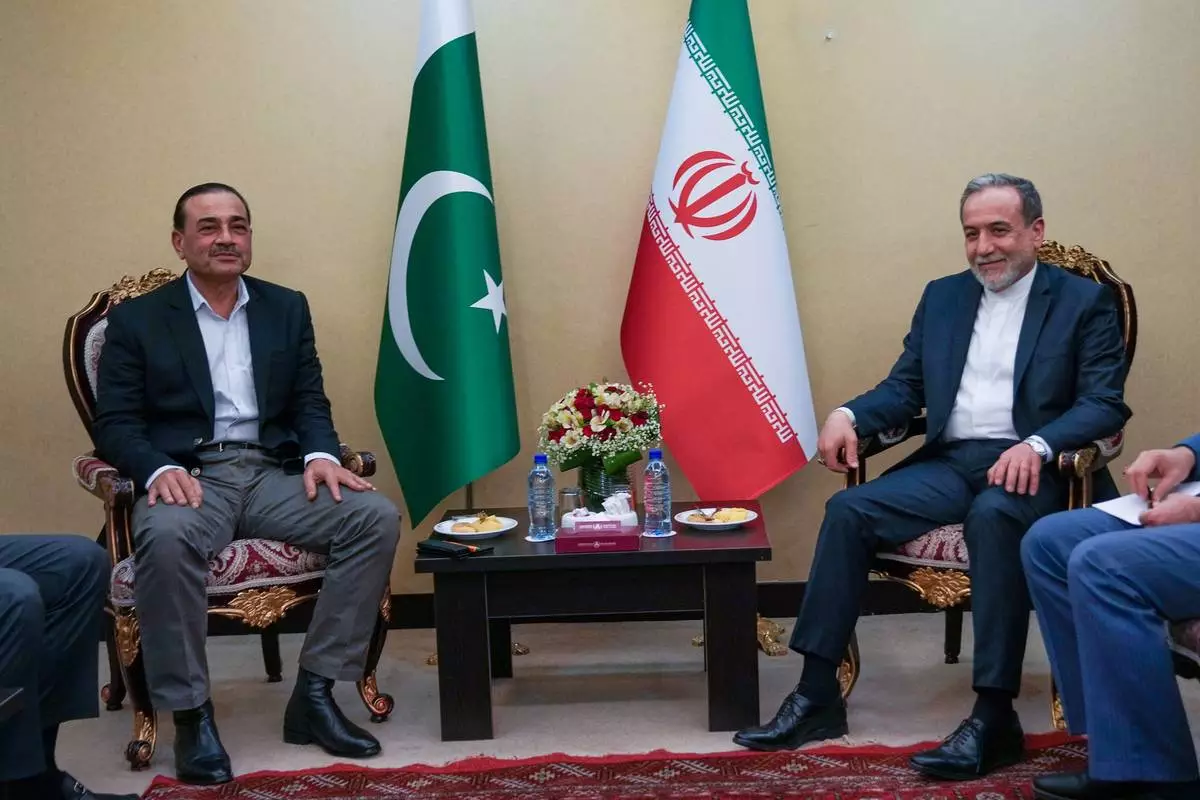
In this photo released by the Iranian Foreign Ministry, Iranian Foreign Minister Abbas Araghchi, right, meets with Pakistan's Army Chief Field Marshal Gen. Asim Munir in Tehran, Wednesday, April 15, 2026. (Iranian Foreign Ministry via AP)

Girls chase bubbles next to their family's tents used as shelter after fleeing Israeli bombardment in Dahiyeh, Beirut's southern suburbs, in Beirut, on Wednesday, April 15, 2026. (AP Photo/Bilal Hussein)
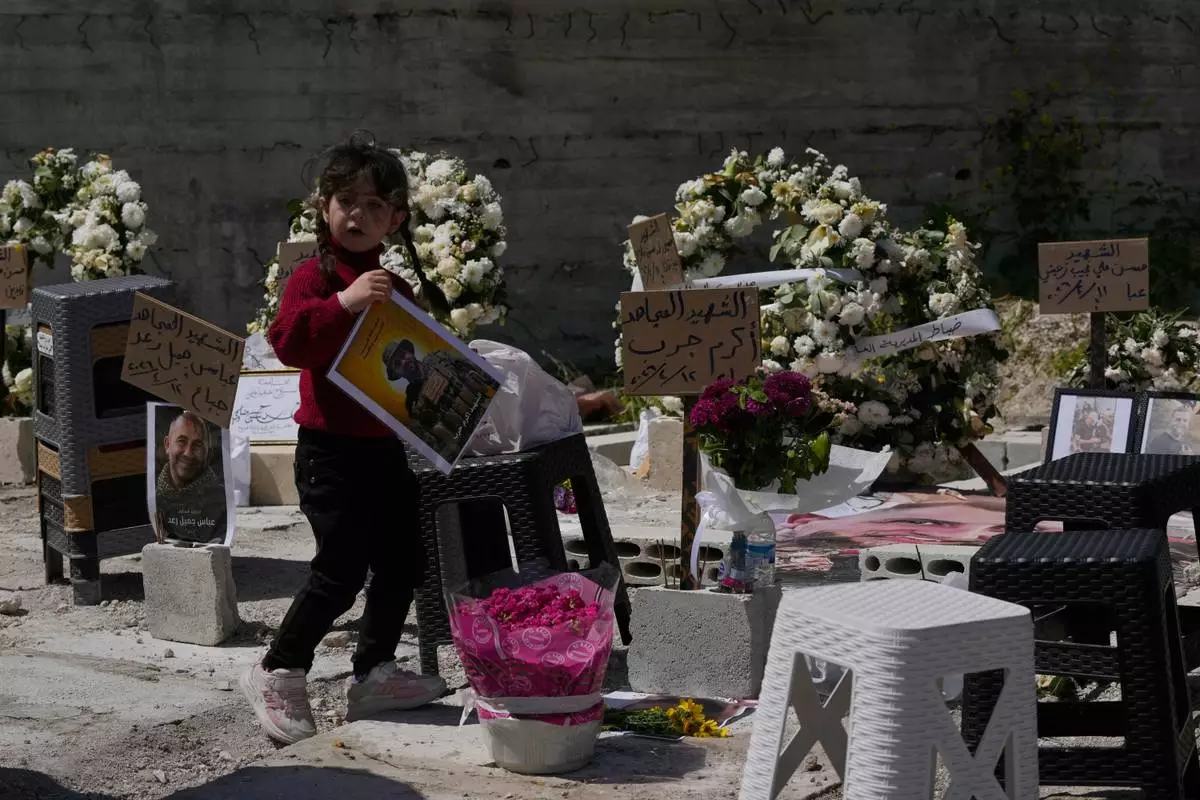
A young girl carries a portrait of a killed Hezbollah fighter at a mass grave where civilians and Hezbollah fighters killed in Israeli airstrikes are temporarily buried in the southern port city of Sidon, Lebanon, Tuesday, April 14, 2026. (AP Photo/Mohammed Zaatari)
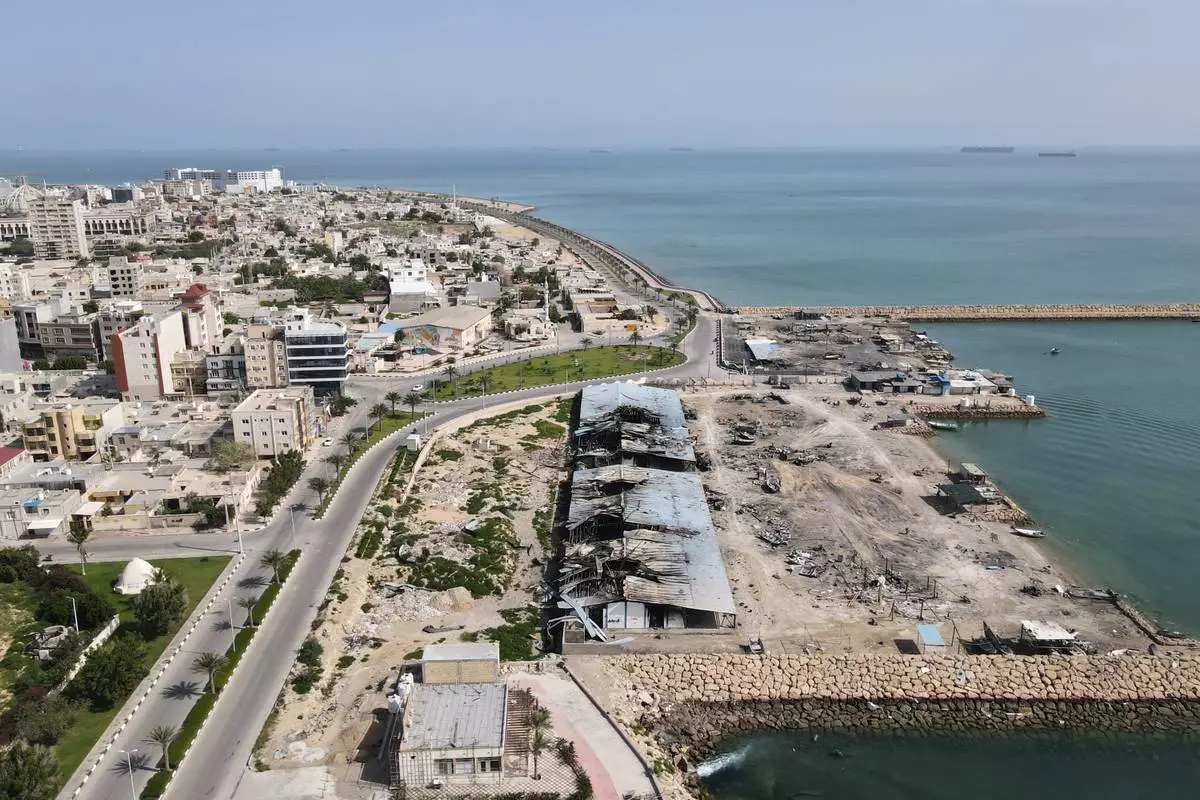
Backdropped by ships in the Strait of Hormuz, damage, according to local witnesses caused by several recent airstrikes during the U.S.-Israel military campaign, is seen on a fishing pier in the port of Qeshm island, Iran, Monday, April 13, 2026. (AP Photo/Asghar Besharati)
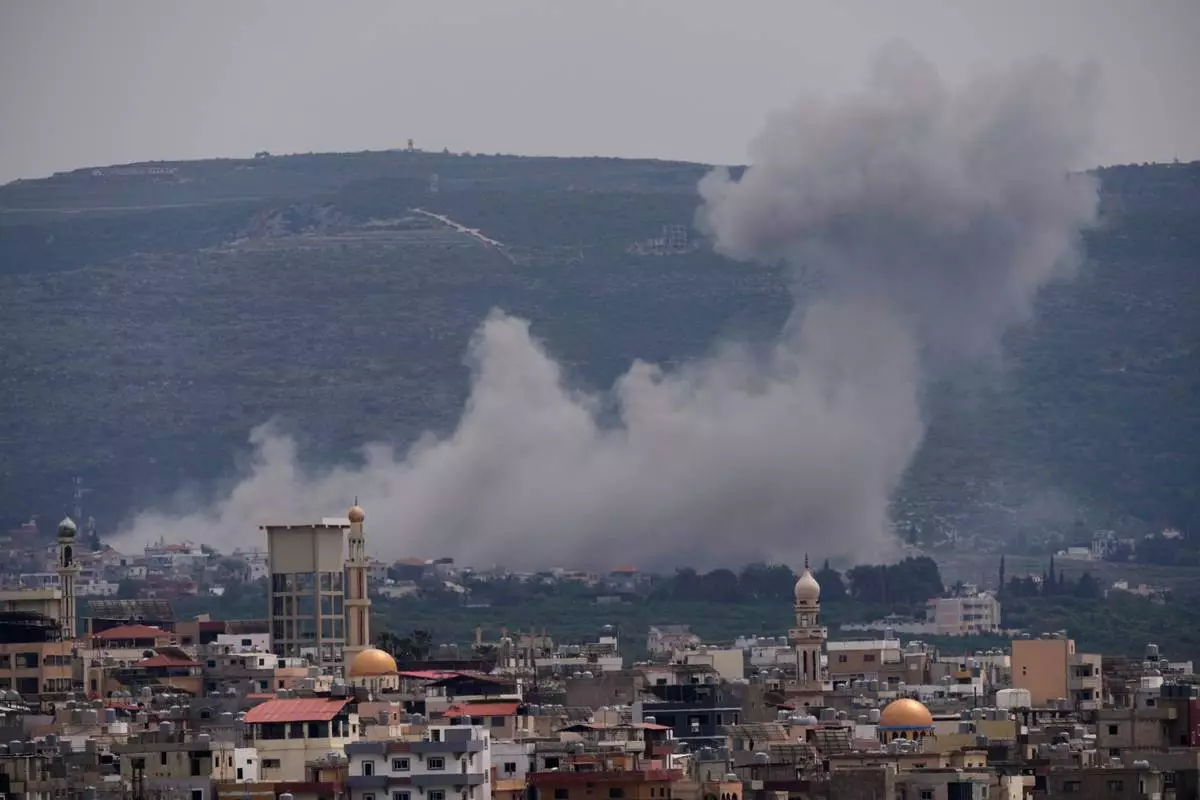
Smoke rises following an Israeli airstrike on the village of Qlaileh, as seen from the southern port city of Tyre, Lebanon, Wednesday, April 15, 2026. (AP Photo/Hussein Malla)