Skip to Content Facebook Feature Image

CityUHK and Huadong Hospital establish the “Joint Research Institute of Smart Healthcare”

HK

CityUHK and Huadong Hospital establish   the “Joint Research Institute of Smart Healthcare”
HK

HK

CityUHK and Huadong Hospital establish the “Joint Research Institute of Smart Healthcare”

2025-10-02 15:32 Last Updated At:15:33

City University of Hong Kong (CityUHK) and Huadong Hospital, affiliated with Fudan University in Shanghai (Huadong Hospital), officially established the “CityUHK – Huadong Hospital Joint Research Institute of Smart Healthcare” (the Joint Research Institute) in Shanghai and signed a Memorandum of Understanding (MoU) on 25 September 2025. By leveraging the medical and academic resources of the two cities, as well as cutting-edge biomedicine, AI and data technologies, this partnership aims to advance the development of digital medicine, talent incubation, and knowledge exchange, and to further enhance the commercialisation of promising digital health solutions that benefit society.

The plaque-unveiling ceremony for the Joint Research Institute was held at Huadong Hospital. It was officiated by Professor Michael Yang Mengsu, CityUHK Senior Vice-President (Innovation and Enterprise), Professor Wang Yu, Deputy Director of the Shanghai Shenkang Hospital Development Center, and Professor Bao Zhijun, President of Huadong Hospital. Other representatives were Professor Johnny Ho Chung-yin, CityUHK Associate Vice-President (Enterprise), Professor Yu Xinge, Associate Director of the CityUHK Institute of Digital Medicine (IDM), Mr Yang Weiguo, Deputy Secretary of the Party Committee at Shanghai Medical College Fudan University and Mr Jin Jianping, Secretary of the Party Committee of Huadong Hospital.
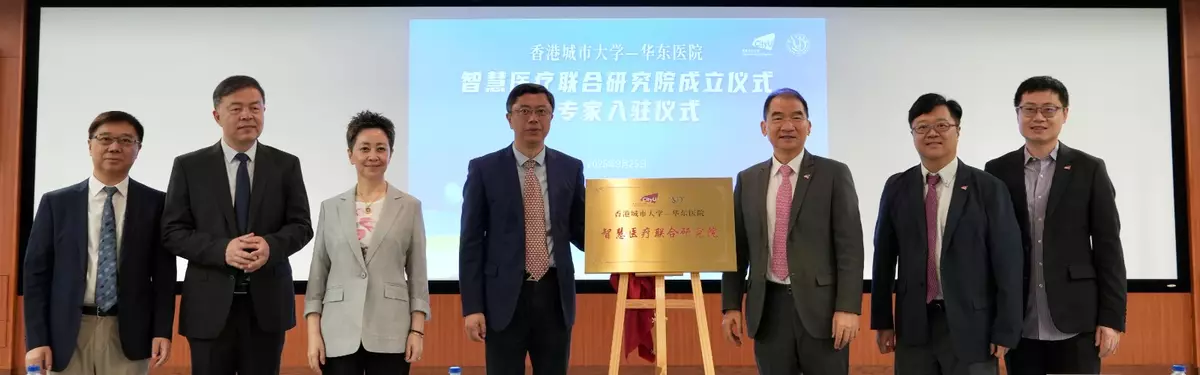
Caption: At the plaque-unveiling ceremony of “CityUHK – Huadong Hospital Joint Research Institute of Smart Healthcare” are (from right) Professor Yu Xinge, Associate Director of CityUHK Institute of the Digital Medicine; Professor Johnny Ho Chung-yin, CityUHK Associate Vice President (Enterprise); Professor Michael Yang Mengsu, CityUHK Senior Vice-President (Innovation and Enterprise); Professor Bao Zhijun, President of Huadong Hospital; Professor Wang Yu, Deputy Director of the Shanghai Shenkang Hospital Development Center; Mr Yang Weiguo, Deputy Secretary of the Party Committee at Shanghai Medical College of Fudan University and Mr Jin Jianping, Secretary of the Party Committee at Huadong Hospital. Photo credit: City University of Hong Kong.

Caption: At the plaque-unveiling ceremony of “CityUHK – Huadong Hospital Joint Research Institute of Smart Healthcare” are (from right) Professor Yu Xinge, Associate Director of CityUHK Institute of the Digital Medicine; Professor Johnny Ho Chung-yin, CityUHK Associate Vice President (Enterprise); Professor Michael Yang Mengsu, CityUHK Senior Vice-President (Innovation and Enterprise); Professor Bao Zhijun, President of Huadong Hospital; Professor Wang Yu, Deputy Director of the Shanghai Shenkang Hospital Development Center; Mr Yang Weiguo, Deputy Secretary of the Party Committee at Shanghai Medical College of Fudan University and Mr Jin Jianping, Secretary of the Party Committee at Huadong Hospital. Photo credit: City University of Hong Kong.

Professor Yang emphasised that life and health technology is a key strategic priority for CityUHK, which aims to leverage its strengths in biomedical engineering, AI, digital medicine, and data science to advance the smart healthcare industry. “The Joint Research Institute represents a significant step in strengthening collaboration between Shanghai and Hong Kong, enabling win-win cooperation in digital medicine, clinical research, and talent incubation, contributing to the promotion of the ‘Healthy China’ initiative,” he stated.

“The future of medicine relies on multidisciplinary collaboration, requiring the joint efforts of universities and medical institutions to advance smart healthcare,” said Professor Wang. “CityUHK excels in AI and life sciences, while Huadong Hospital has a robust foundation in geriatric medicine and smart healthcare. This partnership will combine both resources to leverage cutting-edge technologies, enhance clinical practice, and address real-world challenges.

“This partnership marks a milestone for both parties in exploring AI-powered healthcare solutions,”said Professor Bao. “We will foster collaborations among top-tier experts, facilitate knowledge exchange, and establish a ‘smart outpatient ecosystem’, supported by AI and big data technologies to overcome temporal and spatial limitations in healthcare management, further enhancing the patient experience throughout their healthcare journey.”

The Joint Research Institute will integrate resources and strengths from both Shanghai and Hong Kong, providing clinical resources and cutting-edge technologies for research and start-ups; to enable the transformation of promising solutions. By leveraging biomedicine, AI, and big data technologies, it will focus on areas such as surgical robotics, standardised databases for major diseases, and medical information sharing platforms, to create a smart, human-centred healthcare ecosystem.

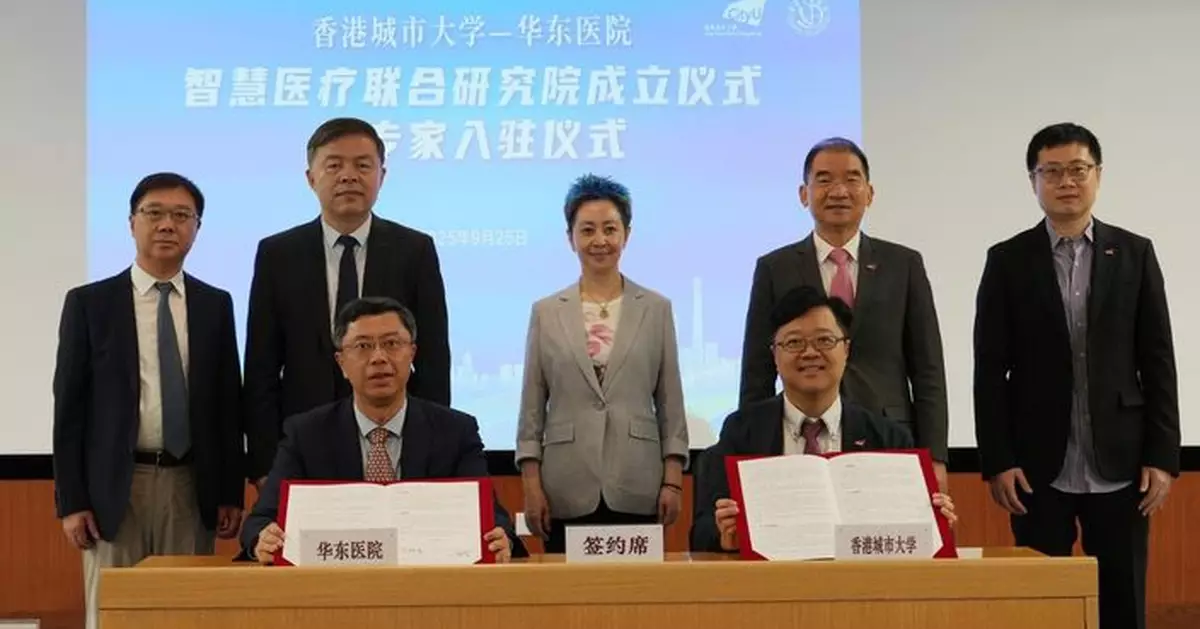
The MoU was signed by Professor Ho and Professor Bao; and was witnessed by Professor Yang, Professor Wang, Professor Yu, Mr Yang and Mr Jin.
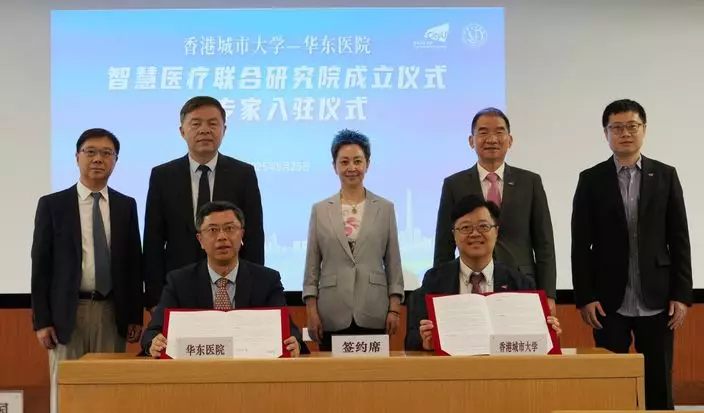
Caption: The MoU was signed by Professor Johnny Ho Chung-yin (right) and Professor Bao Zhijun (left). It was witnessed by (back row, from right) Professor Yu Xinge, Professor Michael Yang Mengsu, Professor Wang Yu, Mr Yang Weiguo and Mr Jin Jianping. Photo credit: City University of Hong Kong.

Caption: The MoU was signed by Professor Johnny Ho Chung-yin (right) and Professor Bao Zhijun (left). It was witnessed by (back row, from right) Professor Yu Xinge, Professor Michael Yang Mengsu, Professor Wang Yu, Mr Yang Weiguo and Mr Jin Jianping. Photo credit: City University of Hong Kong.

This MoU further enhances collaboration in talent development, academic exchange, and research between the two institutions. Initiatives include mutual appointments of experts, the formation of joint research teams, and the recommendation of biomedical and digital medicine professionals to study at CityUHK. These efforts aim to nurture top talent with international perspectives and innovative capabilities, thereby propelling the transformation of digital medicine solutions.

The two parties exchanged appointment letters for their respective experts. Professors from Huadong Hospital engaged with representatives from CityUHK’s IDM, College of Biomedicine, and College of Computing, sharing valuable insights on digital health, AI and big data during the on-site academic forum. The CityUHK delegation also visited Huadong Hospital to explore their latest medical developments.

CityUHK established its IDM in April 2024. In collaboration with renowned universities, medical schools, clinical and industry partners, and health tech investors around the world, the IDM utilises CityUHK’s strengths in engineering, data science, and life science to develop innovative technologies that explore digital health solutions for the long-term benefit of doctors and patients.

Founded in 1951, Huadong Hospital is a Grade 3A hospital specialising in geriatric medicine. It integrates medical care, academia, research and prevention, serving Shanghai, the East China region and beyond. Its Department of Geriatrics is a national key clinical speciality, as well as a key clinical speciality in Shanghai. Additionally, the Department of Geriatrics of Traditional Chinese Medicine is designated as a key speciality of the National Administration of Traditional Chinese Medicine.Huadong Hospital is affiliated with Fudan University and is responsible for training undergraduate and graduate students. It also serves as a training base for specialists at both the national and Shanghai level. 
As the global electric vehicle (EV) market and renewable energy sector continue to expand rapidly, demand for advanced lithium-ion battery technology continues to grow. A research team from City University of Hong Kong (CityUHK) has been awarded funding under the “RAISe+ Scheme” to address the long-standing voltage decay issue associated with lithium-rich cathode materials. This groundbreaking research aims to introduce a new range of battery materials that offer enhanced energy density, extended lifespan and reduced costs.

The project plans to build a 1,000-ton materials production line and is expected to create approximately 100 new jobs.

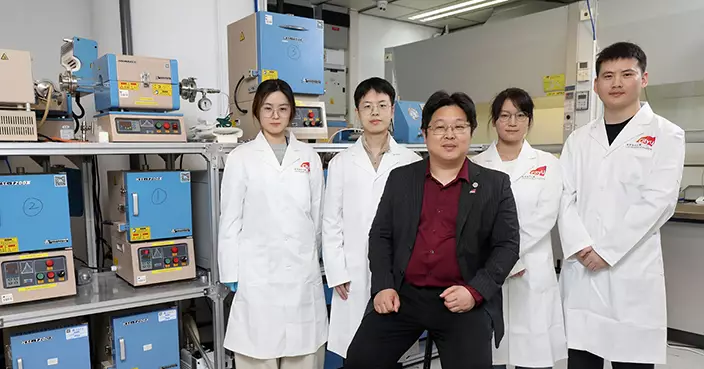
Led by Professor Liu Qi (centre), from the Department of Physics at CityUHK, the project, titled “Breakthrough Cathode Materials for Next-generation Lithium-ion Batteries”, has been awarded funding under the “RAISe+ Scheme”. Photo credit: City University of Hong Kong

Led by Professor Liu Qi (centre), from the Department of Physics at CityUHK, the project, titled “Breakthrough Cathode Materials for Next-generation Lithium-ion Batteries”, has been awarded funding under the “RAISe+ Scheme”. Photo credit: City University of Hong Kong

Led by Professor Liu Qi, from the Department of Physics at CityUHK, the project is titled “Breakthrough Cathode Materials for Next-generation Lithium-ion Batteries”. With the support of the “RAISe+ Scheme”, launched by the Government of the Hong Kong Special Administrative Region of the People’s Republic of China, the team aims to transform this technological breakthrough into industrial-scale applications within three years and optimise the production line for next-generation output.

Lithium-ion batteries (LIBs) have become a cornerstone of the global energy transition, playing an essential role in renewable energy storage systems and smart technologies – from mobile phones to the EV revolution and large-scale solar power stations. With the rapid growth in global demand, the LIB market is projected to reach US$150 billion by 2030, with over US$60 billion coming from cathode materials, the component that contributes most significantly to the overall cost of batteries.

Among various cathode materials, lithium-rich layered oxides (LLOs) stand out for their high capacity, high operating voltage and cost advantages due to abundant raw materials. They are widely regarded as the “ultimate cathode material”, capable of significantly enhancing the performance of lithium-ion batteries.

Despite their theoretical advantages, however, LLOs face critical challenges of voltage and capacity decay, which have long hindered their commercialisation.

Lithium-rich layered oxides (LLOs) are widely regarded as the “ultimate cathode material for lithium-ion batteries”. Photo credit: City University of Hong Kong

Lithium-rich layered oxides (LLOs) are widely regarded as the “ultimate cathode material for lithium-ion batteries”. Photo credit: City University of Hong Kong

The team’s innovative approach focuses on stabilising the honeycomb structure by incorporating additional transition metal (TM) ions into the cathode material. This modification suppresses oxygen release, cation migration and structural degradation, effectively addressing the core issue of voltage decay. This sets a new benchmark for high-performance LLOs and provides a solid foundation for industrialisation.

Furthermore, the team employs advanced surface engineering techniques to tackle capacity decay caused by surficial degradation, TM ion dissolution, structural deterioration and electrolyte corrosion. The team introduced protective agents, such as carbon coating layers, during the calcination process. This protective layer ensures long-term stability, marking a significant step in energy storage technology.

These groundbreaking technologies were published in Nature Energy in 2023. Building on these laboratory breakthroughs, the team aims to accelerate the commercialisation process by focusing on the development of two product lines: 1) LLOs for traditional LIBs, aiming to increase the energy density of traditional LIBs by over 30%, while reducing costs; and 2) LLOs for solid-state batteries.

Professor Liu Qi (right), from the Department of Physics at CityUHK. Photo credit: City University of Hong Kong

Professor Liu Qi (right), from the Department of Physics at CityUHK. Photo credit: City University of Hong Kong

“Our research team has enabled LLOs, a cathode material, to realise their true commercial potential. This technology allows batteries to deliver higher energy density at a lower cost, opening new possibilities for EVs and energy-storage applications," said Professor Liu. “This project also demonstrates Hong Kong’s strengths in next-generation energy technologies and reinforces Hong Kong’s leading position in the globally competitive high-tech ecosystem.”

The team established SuFang New Energy Technology Co., Ltd. and built a production line with annual capacity of 100 tons, dedicated to the industrialisation of high-performance LLOs.

With the support of RAISe+ Scheme, the project plans to build a 1,000-ton materials production line in Southeast Asia or Korea and is expected to create about 100 new jobs in research, manufacturing and engineering over the next three years.

Recommended Articles