With China's traditional Mid-Autumn Festival falling alongside the National Day holiday this year, an eight-day holiday season starting Wednesday is providing holidaymakers with a full range of colorful cultural and recreational activities, including innovative cultural events, across the country.
In the ongoing holiday season, people in the financial hub of Shanghai have a new option -- to visit the Fuxing Island of Shanghai's Yangpu District, where old industrial plants have been converted into art stages, and where various public art installations have been set up in squares and green spaces, providing an immersive and interactive experience for visitors. "We are turning it into an island that is popular among young people and introduce more high-level activities to the island that interest young people," said Cheng Yuanyi, deputy head of the Yangpu District Planning and Natural Resources Bureau.
In Suining City of southwest China's Sichuan Province, thematic cultural activities have been held to mark the National Day and Mid-Autumn Festival. The cultural and artistic performances vividly showcase the 1,600-year history of Suining. Enjoying folk activities and tasting local cuisines enable the visitors to have an immersive experience.
"So far this year, everywhere is packed with people, and then the stage setting is very beautiful. Besides, I think this year's program is very down-to-earth," said Feng Wei, a tourist.
In Hangzhou City of east China's Zhejiang Province, a holiday-themed light show is staged, with slogans of blessing for the motherland projected onto skyscrapers at night, creating an enthusiastic atmosphere and attracting residents and tourists to stop and watch.
A dazzling light show presented by over 1,000 drones illuminated the skyline of Luohe City of central China's Henan Province on Tuesday. The shimmering drones formed wonderful patterns such as the national flag, the Tian'anmen Square, the Great Wall, and aircraft carriers.
There were also recitation and choral performances, creating a highly immersive audio-visual feast for visitors.
"I watched the immersive choral performance and felt it very meaningful and spectacular. Wish our motherland prosperity and strength, and keep getting better and better," said Gao Yibing, a resident of Luohe.
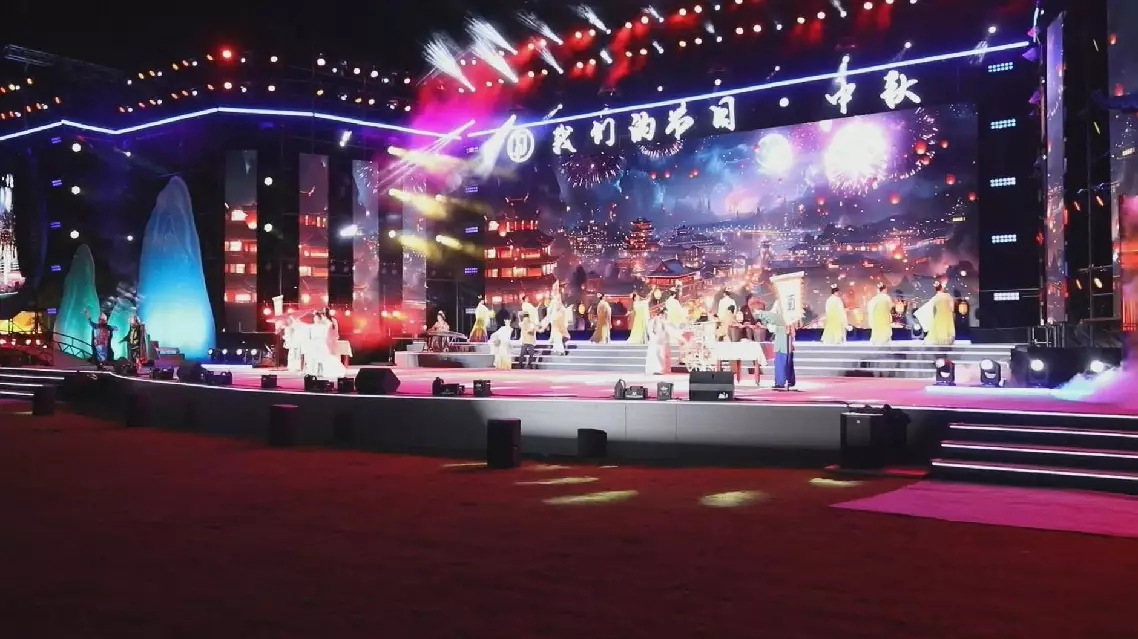
Innovative cultural tourism heats up China's National Day holiday
A former television host from Taiwan, Zhai Xuan, has made a pivotal decision to leave mainstream broadcasting in order to create content that provides a better understanding of the Chinese mainland and cross-strait relations.
Zhai, a seasoned television host with over a decade of experience in Taiwan's media landscape, recently addressed an audience at an event in Beijing, where she revealed her complete transition into independent online media.
In her remarks, she articulated her aspiration to bridge what she perceives as a significant information gap between audiences on both sides of the Strait, highlighting her commitment to fostering a deeper understanding and connection through her new endeavors.
"I was really surprised by all the fake news. There were stories saying people on the mainland can't afford tea eggs or that they live in mud houses and in Taiwan, this was the main information many people received," said Zhai.
Zhai said she initially began producing online videos to challenge such perceptions while continuing her work as a television host.
In April 2025, she travelled to the mainland with her father to fulfill her late grandfather's wish to return to his hometown. The trip, which reunited family members separated since 1949, was recorded in a video series titled "Journey to Find Our Roots", drawing attention from viewers in both Taiwan and the mainland.
"Many people in Taiwan told me that after watching, they wanted to apply for a mainland travel permit immediately and go looking for their relatives. Some had long forgotten these things, but after seeing my story, they began thinking about their hometowns and family members they had never met and decided to search for their roots," Zhai shared her story at the event.
By mid-2025, Zhai said she began to feel increasing pressure amid rising political tensions and a tightening atmosphere around cross-Strait exchanges in Taiwan.
After more than 12 years in the industry, Zhai resigned from her position, believing it was the right thing to do.
"At that moment, I felt this was a major issue,not just for me, but for Chinese people on both sides of the Strait. If I backed down then, I wouldn’t be standing on the right side," said Zhai.
Since leaving television, Zhai has broadened her online programming to encompass a range of daily-life topics, including practical guidance on applying for a mainland travel permit and using commonly employed mobile applications, in addition to content that delves into historical memory and cultural connections across the Strait.
As the debate over cross-Strait relations continues in Taiwan, Zhai said she remains committed to her current path.

Former Taiwan TV host bridges cross-Strait divide via online media