From autonomous robots to AI-driven large language models, cutting-edge technologies are transforming farms in Beijing's tech highland Haidian District into futuristic hubs of precision and sustainability.
At an AI-powered vertical farm, lettuces are growing in a 19-tier high-tech high-rise.
"Harvesting happens layer by layer here,while one level is being picked, another is being planted, creating a seamless cycle. With 19 tiers, each has its own serial number. Even the nutrient delivery is fully automated and industrialized. Sensors track the solution's 16 essential ions, monitoring nutrient solution concentration levels," said Wei Lingling, director of the Key Laboratory of Leisure Agriculture under China's Ministry of Agriculture and Rural Affairs.
The remote control system collects all plant growth data in real time and displays it on the central dashboard for monitoring.
Modern farming has evolved far beyond manual labor; it is now a high-tech operation. As production processes become digital, the entire agricultural sector is undergoing informational and intelligent transitions. It also requires a significant amount of brainpower, both human and artificial.
In a landmark move, the Agriculture and Rural Affairs Bureau of Xiong'an New Area in Hebei Province and China Telecom jointly developed Xiong Xiaonong, literally meaning "Xiong'an's Little Farmer," which is China's first agri-focused large AI model powered by DeepSeek.
"Xiong Xiaonong now offers services from agricultural Q and A, services, and planting decisions to production management and market analysis, forming a full digital service loop. Unlike general AI models, we've tailored this system to Xiong'an's key crops like sweet potatoes, wheat, and tomatoes," said Yang Yi, deputy director of Rural Revitalization Research Institute of China Telecom.
According to Yang, family farming cooperatives and small-to-medium scale farmers stand to benefit most from this AI assistant, as they often rely on personal experience rather than industrialized systems.
"I think this AI system is ideally suited for family farming cooperatives and small-to-medium scale farmers with production capabilities. While large commercial farms already operate with their own industrialized systems, smaller producers often rely primarily on personal experience and traditional knowledge," he said.
The integration of AI marks the beginning of a transformative era in smart agriculture. The technology is also revolutionizing crop disease management. Instead of manually inspecting every plant, smart glasses equipped with HD cameras can capture images and compare them against massive databases, enabling rapid disease identification.
"Take wheat diseases: before, technicians had to painstakingly examine every inch of each plant, from bottom to the top. Now, AI glasses with HD cameras zoom in, snap photos, transmit and match them against thousands of images in our database, making disease identification immediately clear," said Xu Shiwei, principal scientist from the Institute of Agricultural Information of Chinese Academy of Agricultural Sciences.
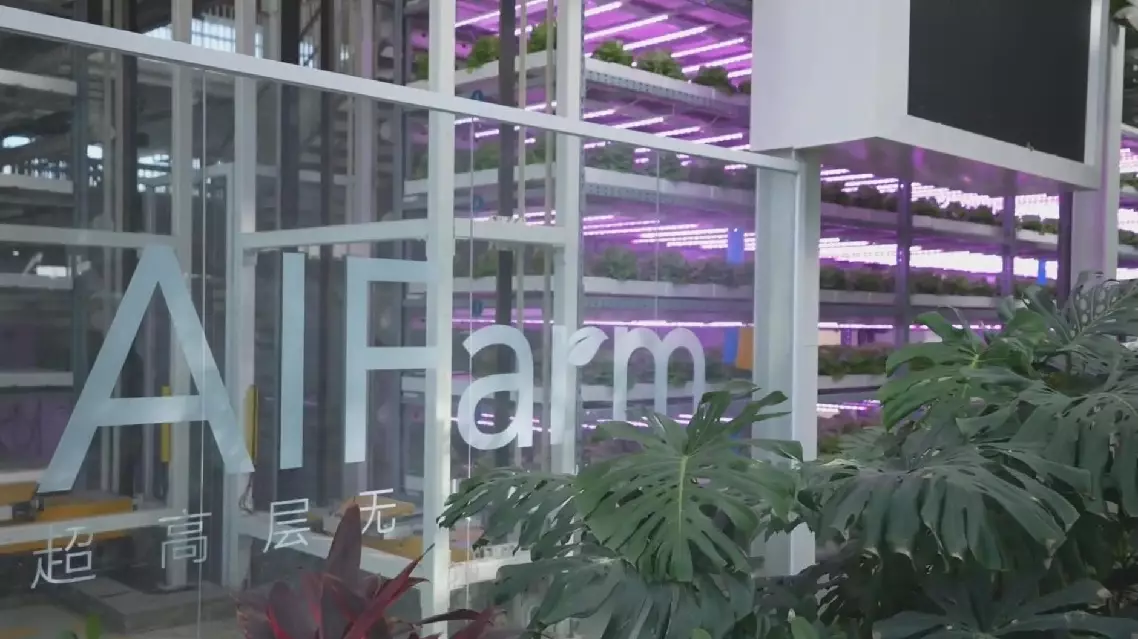
AI-driven smart farming adopted in Beijing's Haidian, Hebei's Xiongan
The latest artificial intelligence breakthroughs are dominating the 2026 Consumer Electronics Show (CES) in Las Vegas, with a number of firms showcasing how AI can be deployed to play a critical role in healthcare and even in the once futuristic notion of creating digital clones.
The four-day show, considered the world's premier annual technology event, is set to conclude Friday after attracting over 4,500 exhibitors from more than 155 countries and regions, according to organizers.
While many attendees are sampling the latest tech devices and gadgets on display, the event is also showcasing the big and bold ideas of a number of companies who are seeking to harness AI's potential for even greater causes.
A number of companies and entrepreneurs are using AI-powered software in the hope of improving healthcare and even extending our lives. One of the standout examples is 'Predictive AI', a Korean-founded medical startup focused on disease prevention through advanced genetic analysis.
Predictive AI is building digital twins of the human genome, which sees virtual replicas of some 20,000 genes and three billion DNA sequences. These are designed to predict diseases, flag risky prescriptions and even act as a patient's proxy during consultations.
Co-founded by twin brothers Sijung and Sajung Yun, both academics at Johns Hopkins University, their advanced software, named 'Dr. Twin', uses a supervising AI agent to coordinate multiple specialized systems to assess people's health.
By simply sending them a fingernail clipping, their company can extract a client's DNA and combine it with their health history. The software then makes predictions on more than 20,000 diseases - including everything from cancer to Alzheimer's - and then allows users to ask questions about their results.
"[We had to] be proactive for it. And then we provide the customized nutrition for it. We provide the customized recommendation for your pharmacogenomics, which is which drug you better take. So that's kind of the actionable things that you can do after these testing. For those who are afraid of [receiving] a result, the results can go to the their primary physician," said Sijung Yun.
His twin Sajung explained the predictive philosophy which lies behind the technology.
"The reason we are predictive is that when you want to prevent everything, you are not preventing anything. So you need to predict the high risk, and you need to watch out for those symptoms and then catch it early. With the genetic profiling and the AI doctor's algorithm we developed, we are enabling to do so," he said.
Beyond healthcare, AI is being showcased in many other novel and sometimes surprising ways, including a potentially groundbreaking concept which uses archived video and biographical information of users to then create and render themselves into AI clones.
Dubbed 'MyPersonas' and developed by software company IgniteTech, the platform generates an AI duplicate which draws specifically on the knowledge and experience of its human counterpart.
"The 'MyPersona' is grounded in your knowledge, and we've gone to great lengths with patent-pending technology to make certain that it doesn't attempt to answer something that you don't know," said Eric Vaughan, CEO of IgniteTech.
The AI clones are expected to be deployed in a wide range of scenarios — from customer service operations and education to the even more personal endeavor of preserving family histories, with memories and stories able to 'live on' in a virtual world for generations to come.
"I can't think of where it can't be used. It could be used by a one-man insurance company to answer questions about policies. It could be used by a teacher at a school about homework assignments. Could you show grandma and grandpa to future generations live and then actually have them interact and ask questions and share memories and tell stories in a way that makes them come alive?" said Vaughan.
With innovations like these on display, CES 2026 highlights how AI is not only reshaping technology — but redefining how humans understand health, memory, and legacy in both the physical and virtual worlds.
Futuristic potential of AI applications highlighted at top tech show in Las Vegas