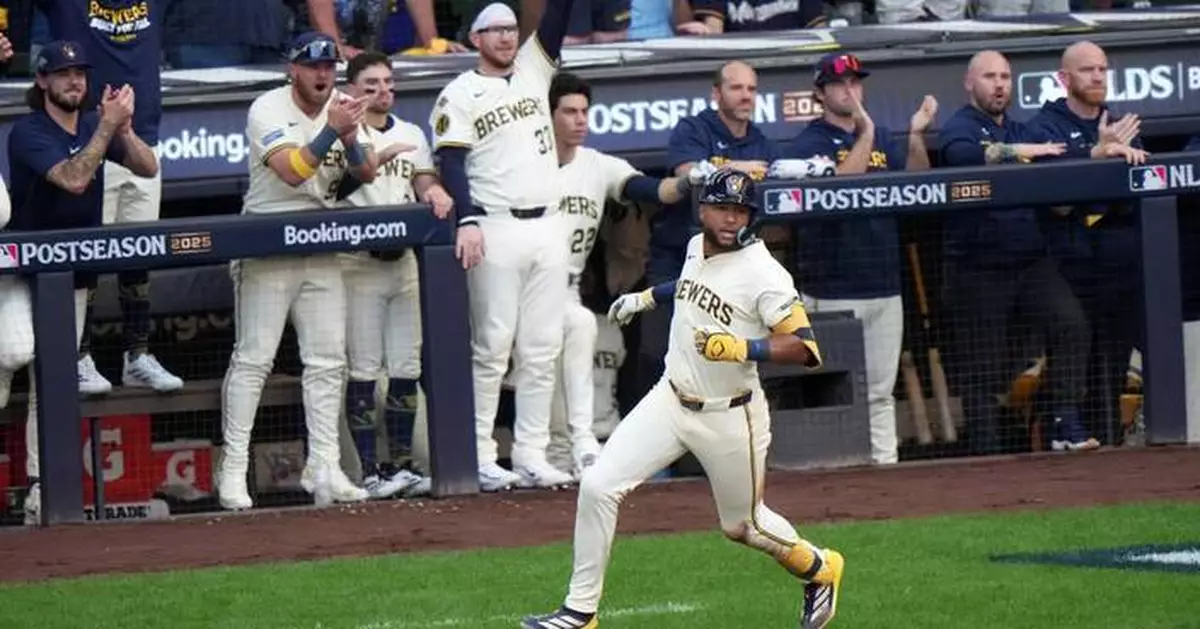
MILWAUKEE (AP) — Another clutch playoff performance by Jackson Chourio had a concerning conclusion for the outfielder and the Milwaukee Brewers.
After becoming the first player to collect three hits in the first two innings of a postseason game, Chourio left Saturday's 9-3 NL Division Series victory over the Chicago Cubs with tightness in his right hamstring.
Click to Gallery
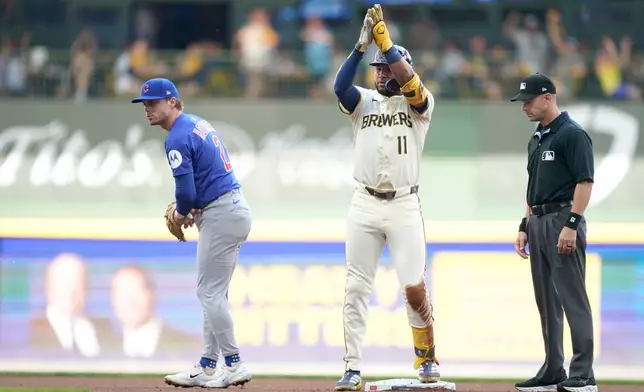
Milwaukee Brewers' Jackson Chourio (11) reacts to hitting a double as Chicago Cubs second baseman Nico Hoerner (2) looks on during the first inning in Game 1 of baseball's National League Division Series game Saturday, Oct. 4, 2025, in Milwaukee. (AP Photo/Kayla Wolf)
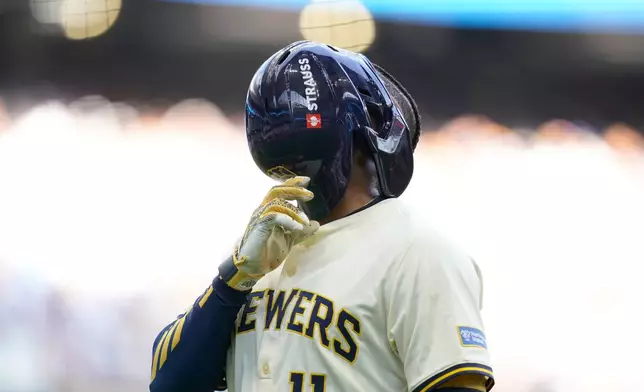
Milwaukee Brewers' Jackson Chourio (11) reacts to leaving the game with an injury during the second inning in Game 1 of baseball's National League Division Series against the Chicago Cubs, Saturday, Oct. 4, 2025, in Milwaukee. (AP Photo/Kayla Wolf)
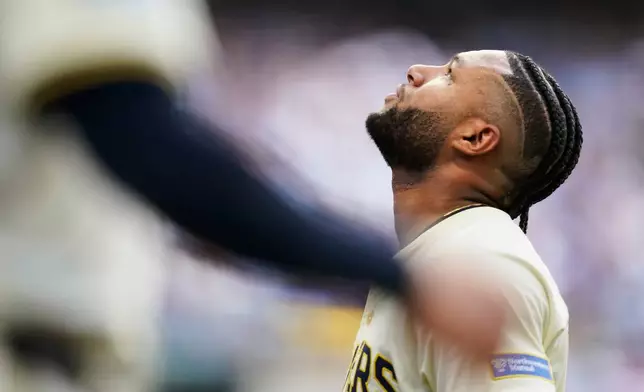
Milwaukee Brewers' Jackson Chourio (11) reacts to leaving the game with an injury during the second inning in Game 1 of baseball's National League Division Series game against the Chicago Cubs on Saturday, Oct. 4, 2025, in Milwaukee. (AP Photo/Kayla Wolf)
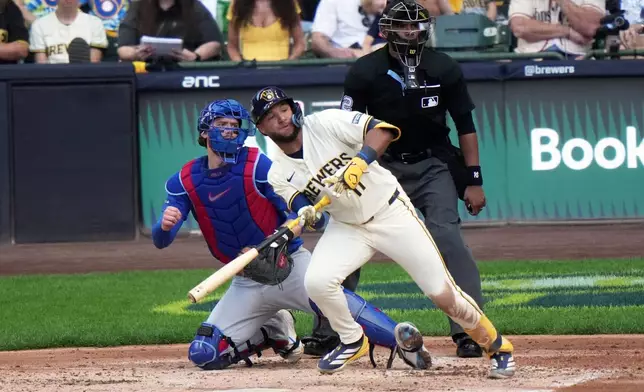
Milwaukee Brewers' Jackson Chourio hits an RBI single during the second inning of Game 1 of baseball's National League Division Series against the Chicago Cubs Saturday, Oct. 4, 2025, in Milwaukee. (AP Photo/Morry Gash)
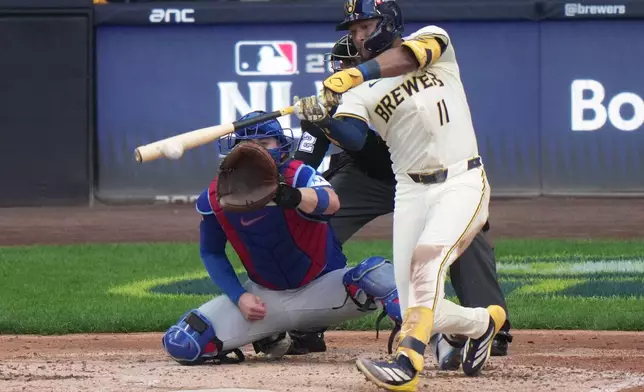
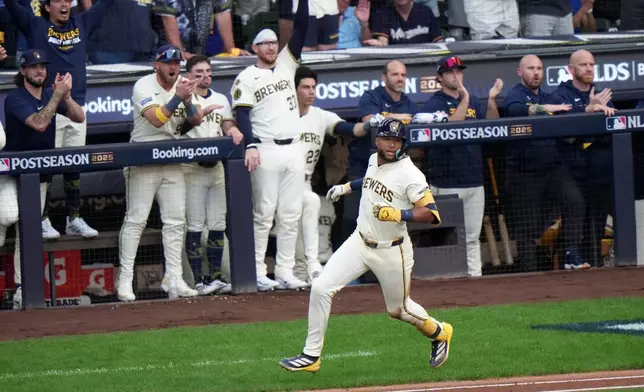
Milwaukee Brewers' Jackson Chourio hits a two-run scoring single during the first inning of Game 1 of baseball's National League Division Series against the Chicago Cubs Saturday, Oct. 4, 2025, in Milwaukee. (AP Photo/Morry Gash)
Brewers manager Pat Murphy said after Game 1 that Chourio had undergone an MRI. Chourio missed a month during the regular season with an injury to the same hamstring.
“They haven't said anything,” Chourio said through an interpreter. “We're still waiting. But physically I feel good, and I feel in a position where I'm ready to keep going and keep competing.”
Murphy didn't sound as optimistic.
“Obviously it’s real scary,” he said. “Having that same hamstring injury to the same leg, we’re hoping that it’s something he can come back from soon. We have no idea when that would be. He’s just getting out of the tube right now. We’ll have somebody look at it. Could be devastating.”
Chourio's injury occurred on a bases-loaded grounder up the third base line in the second inning. After Cubs third baseman Matt Shaw made a diving stop, Chourio beat the throw to first for an RBI single that extended Milwaukee’s lead to 9-1.
But Chourio moved awkwardly after crossing first base. He departed after he was visited by Murphy and head athletic trainer Brad Epstein.
“It was just frustrating with the moment,” Chourio said. “But once (we were) kind of talking and having the advantage that we had there in the game, it was kind of a little bit more precautionary there to come out of the game.”
Chourio also said he felt good after hurting his hamstring while running the bases on a triple during a July 29 victory over the Cubs. He wouldn't play again until Aug. 30.
Before leaving Saturday's game, Chourio played a major role in a fast start for the NL Central champions.
He hit a leadoff double and a two-run single as part of the Brewers’ six-run outburst in the first. Chourio has gone 8 of 14 with six RBIs in four career playoff games.
The 21-year-old capped his rookie season last year by going 5 of 11 with two homers in the Brewers’ NL Wild Card Series loss to the New York Mets.
“I think it’s the adrenaline,” Chourio said. “I love playing in these pressure moments, and really, I see it as a blessing being able to compete and to be able to have the results that I’ve had. But really just playing in these moments, I treat it as a blessing.”
Chourio's early exit gave 28-year-old rookie Isaac Collins his postseason debut. Collins ran for Chourio, stayed in the game in left field and went 0 for 2.
Collins could be in line for a bigger role if Chourio is sidelined by his injury.
“Getting thrown into the fire like that is always tough, but I'm glad I got my feet wet,” Collins said.
Collins batted .263 with a .368 on-base percentage, nine homers and 54 RBIs as one of the Brewers' biggest surprises this year. But he ended the regular season in a 9-for-51 slump.
AP MLB: https://apnews.com/hub/MLB
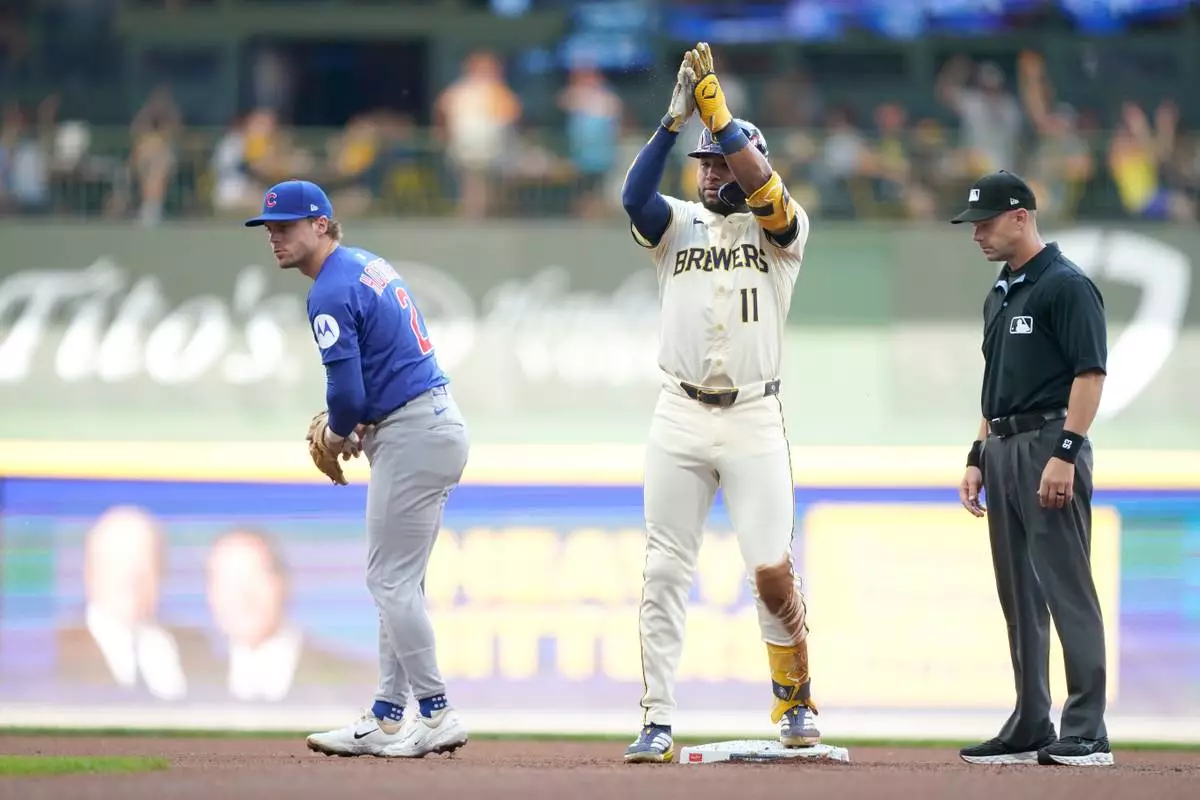
Milwaukee Brewers' Jackson Chourio (11) reacts to hitting a double as Chicago Cubs second baseman Nico Hoerner (2) looks on during the first inning in Game 1 of baseball's National League Division Series game Saturday, Oct. 4, 2025, in Milwaukee. (AP Photo/Kayla Wolf)
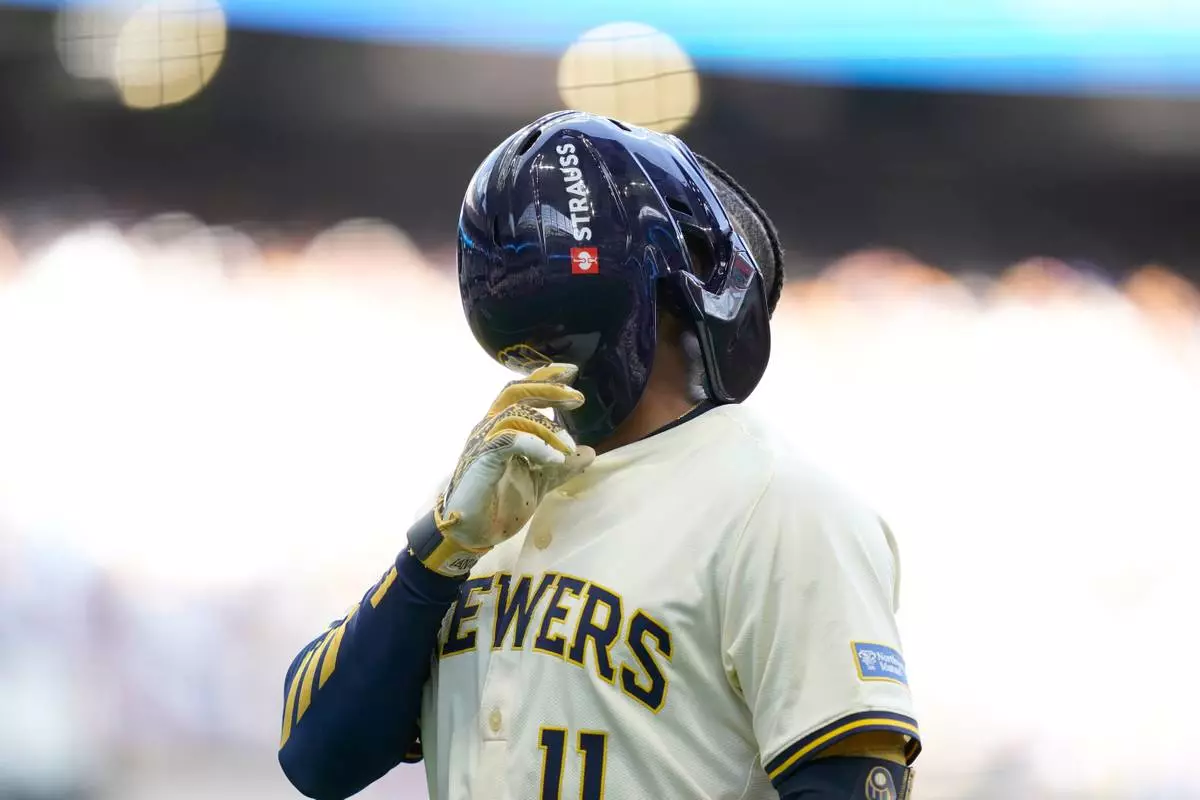
Milwaukee Brewers' Jackson Chourio (11) reacts to leaving the game with an injury during the second inning in Game 1 of baseball's National League Division Series against the Chicago Cubs, Saturday, Oct. 4, 2025, in Milwaukee. (AP Photo/Kayla Wolf)
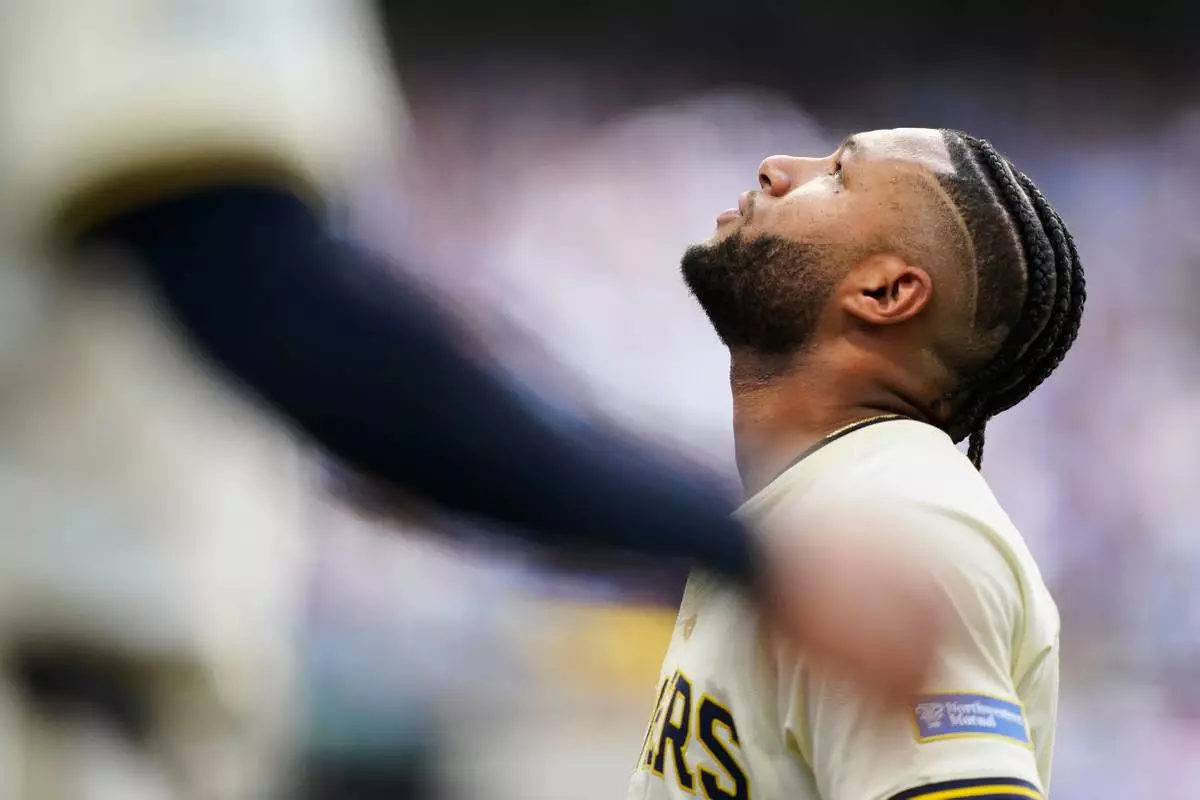
Milwaukee Brewers' Jackson Chourio (11) reacts to leaving the game with an injury during the second inning in Game 1 of baseball's National League Division Series game against the Chicago Cubs on Saturday, Oct. 4, 2025, in Milwaukee. (AP Photo/Kayla Wolf)
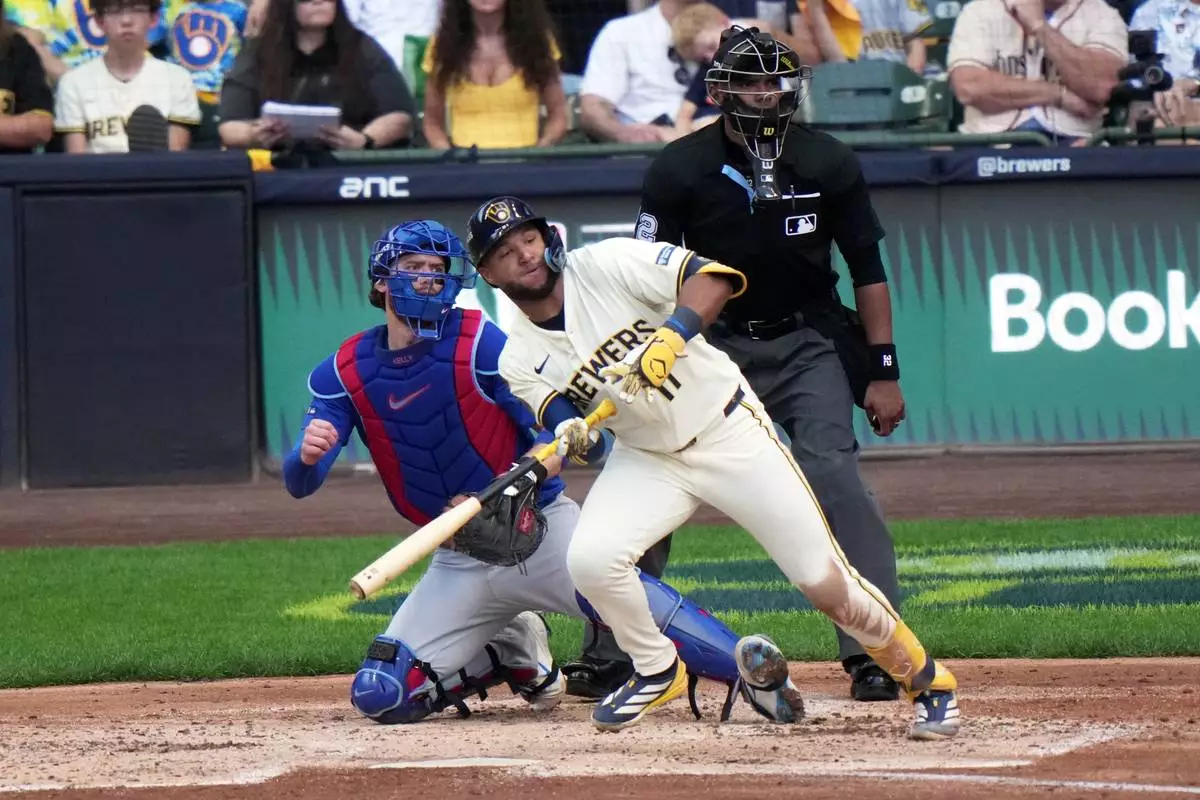
Milwaukee Brewers' Jackson Chourio hits an RBI single during the second inning of Game 1 of baseball's National League Division Series against the Chicago Cubs Saturday, Oct. 4, 2025, in Milwaukee. (AP Photo/Morry Gash)
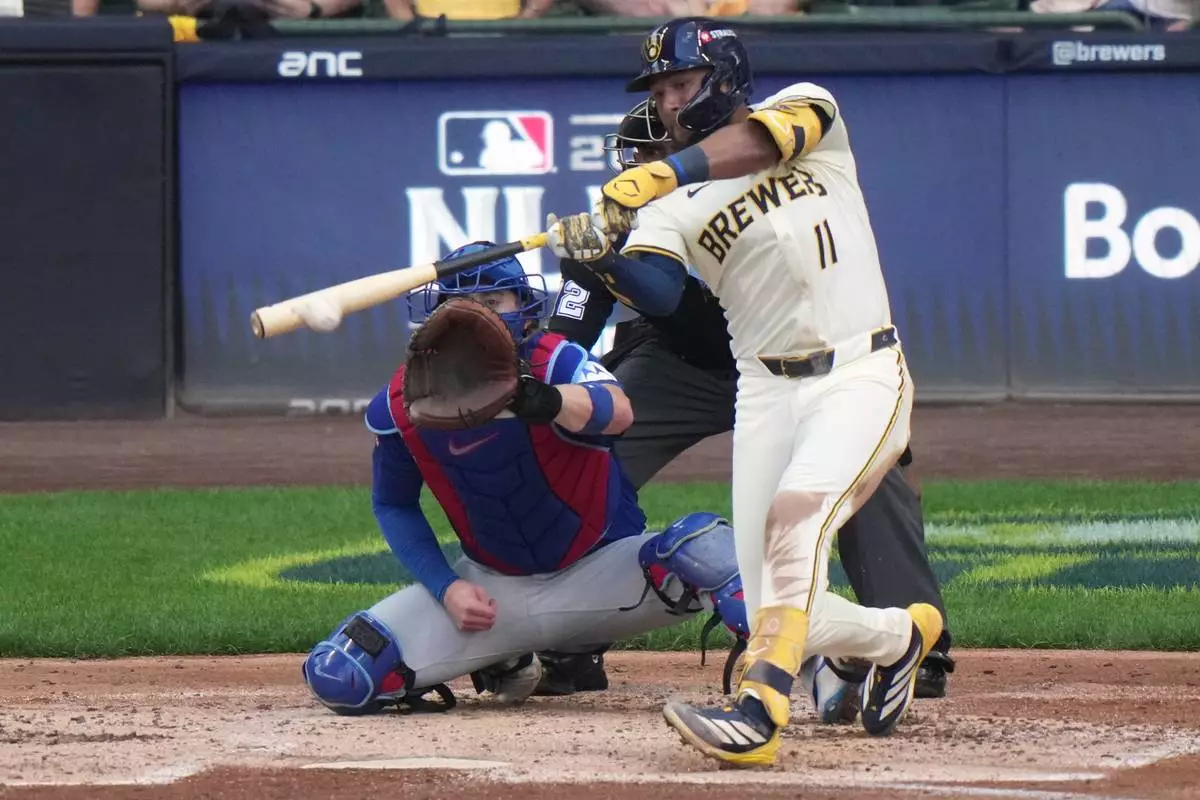
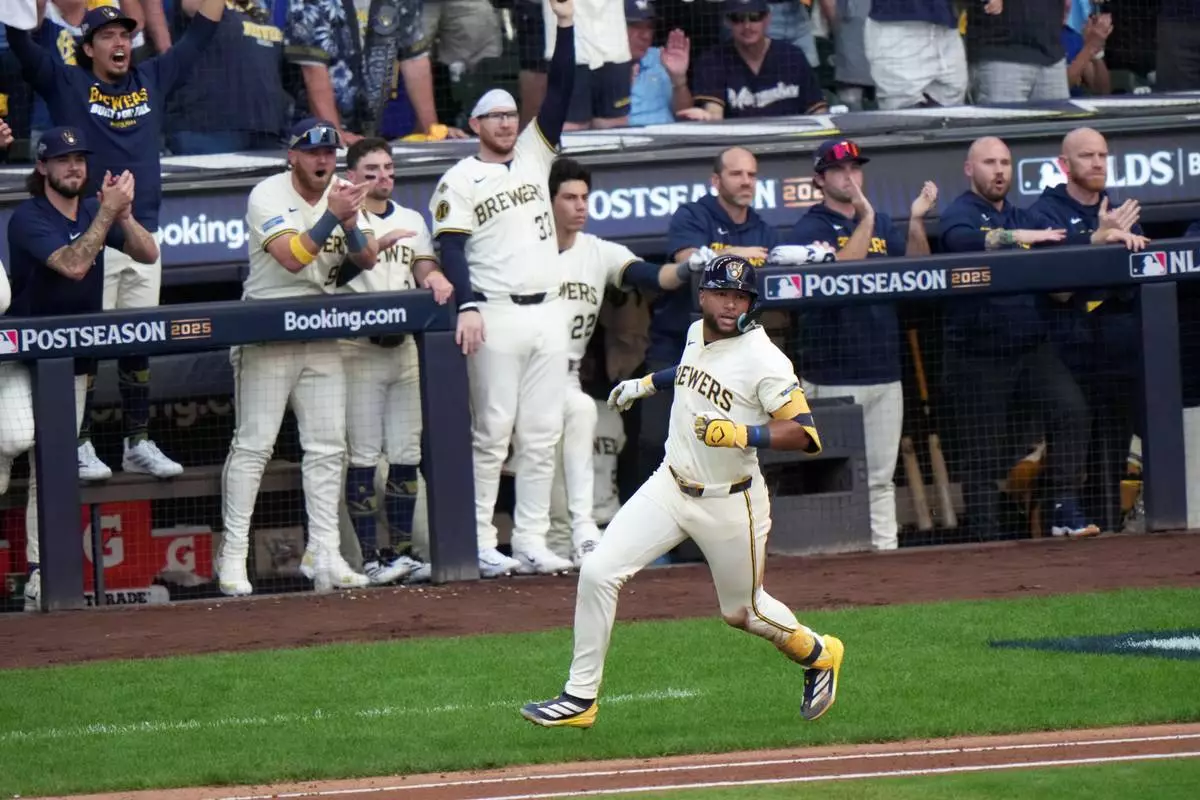
Milwaukee Brewers' Jackson Chourio hits a two-run scoring single during the first inning of Game 1 of baseball's National League Division Series against the Chicago Cubs Saturday, Oct. 4, 2025, in Milwaukee. (AP Photo/Morry Gash)
MEXICO CITY (AP) — The almighty eagle perched on a cactus while devouring a serpent on Mexico’s flag hints at the myth behind the foundation of the country’s capital.
It's a divine sign in an ancient legend, according to which the god Huitzilopochtli asked a group called the Mexica — who founded what was later known as the Aztec Empire — to leave their homeland in search of a place to establish a new city.
It took some 175 years before they spotted the sacred omen and established the city of Tenochtitlan in 1325 where Mexico City stands today.
How the eagle, the cactus and the serpent became an emblem and endured through the European conquest is the focus of a new exhibition. “A coat of arms, an emblem, a symbol of identity,” runs through Dec. 15 at the Old City Hall in downtown Mexico City.
The exhibit is among the government’s activities marking the 700th anniversary of the founding of the Mexica capital.
“Recognizing Tenochtitlan doesn’t mean recalling a dead past, but rather the living heartbeat that still beats beneath our city,” President Claudia Sheinbaum said during an official ceremony in July. “It was the center of an Indigenous world that built its own model of civilization — one in harmony with the Earth, the stars, and its gods and goddesses.”
Fragments of that civilization lie underneath the Old City Hall, the current seat of Mexico City’s government.
Built by order of Spanish conqueror Hernán Cortés in 1522, its construction used stones from ancient Mexica sacred sites. The building has been renewed over time, but its halls have witnessed centuries of governance and symbolism.
“Holding the exhibition in this City Hall, a place of decisions and memory, is a way to recognize the history of those who once inhabited it and how its transformations still echo in Mexico City’s identity,” said Mariana Gómez Godoy, Director of Mexico City’s Cultural Heritage, during the exhibit’s inauguration in November.
The Mexica themselves recorded their story after Tenochtitlan fell to the Europeans. Several codices depict the path that led them to fulfill their deity’s task.
Eduardo Matos Moctezuma — an acclaimed archaeologist from Mexico’s National Institute of Anthropology and History — has argued that the legend is a symbolic retelling of historical events, rather than a literal claim about divine prophecy.
Still, according to the Templo Mayor Museum, the region's pre-Hispanic people preserved the origin story of a long journey that led to the founding of Tenochtitlan as a cornerstone of their traditions.
They honored a small island in Lake Texcoco, now central Mexico City, as the place where the Mexica found the eagle foretold by Huitzilopochtli.
The new exhibit offers a historical overview of how the image evolved — from its establishment as the city’s coat of arms in 1523 under Emperor Charles V to its transformation into an emblem of Mexico as an independent nation.
Curated by researcher Guadalupe Lozada, it also displays images portraying how it was adopted by the religious orders in charge of converting the Indigenous people to Catholicism.
While the eagle and cactus were already adopted by Europeans in the mid-16th century, the Jesuits introduced the serpent decades later. “From then on, it would remain a symbol of the city’s identity — one that would also spread throughout the rest of New Spain,” Lozada said.
According to her, plenty of monasteries dating back to the 17th century attest to how friars displayed the eagle and cactus in their sanctuaries. Even today, the emblem can still be seen above the façade of Mexico City’s cathedral and inside one of its chapels.
“Such was the strength of Mexica culture that the evangelizers sought to adopt it rather than exclude it,” she said. “It was like saying, ‘I acknowledge your history.’”
The same logic applied with the European conquerors. Even as they ordered the destruction of the Mexica religious complexes, the representation of the foundational myth was not erased from history.
“For them, conquering a city like Tenochtitlan was a matter of pride and therefore they never intended to deny its existence,” Lozada said. “This meant that the strength of the city buried beneath the new one underlies it and resurfaces — as if it had never disappeared.”
Associated Press religion coverage receives support through the AP’s collaboration with The Conversation US, with funding from Lilly Endowment Inc. The AP is solely responsible for this content.
Protesters gather in front of the Legislative Palace of San Lazaro in Mexico City, where the Mexican coat of arms is visible on the building's façade, Thursday, Nov. 13, 2025. (AP Photo/Claudia Rosel)
People sit on benches in Plaza del Aguilita, where the evolution of the Mexican coat of arms is showcased, Mexico City, Thursday, Nov. 13, 2025. (AP Photo/Claudia Rosel)
The entrance of Mexico City's National Museum of Anthropology features Mexico's national emblem on its façade, Friday, Nov. 14, 2025. (AP Photo/Claudia Rosel)
The Teocalli of the Sacred War, the only archaeological piece bearing the carved symbol of Tenochtitlan's founding, an eagle perched on a cactus, is on display at the National Museum of Anthropology in Mexico City, Friday, Nov. 14, 2025. (AP Photo/Claudia Rosel)
People at the square of Aguilita in Mexico City walk past a central sculpture depicting Mexico's coat of arms which shows an eagle perched on a cactus devouring a rattlesnake, Thursday, Nov. 13, 2025. (AP Photo/Claudia Rosel)
Rosalba Sanchez Flores, a historian at the National Museum of Anthropology in Mexico City, points to the details of Mexico's coat of arms as depicted in the Codex Mendoza, Friday, Nov. 14, 2025. (AP Photo/Claudia Rosel)
People sit on benches in Plaza del Aguilita, where the evolution of the Mexican coat of arms is showcased, Mexico City, Thursday, Nov. 13, 2025. (AP Photo/Claudia Rosel)
People sit at a rooftop bar overlooking Mexico City's Fine Arts Palace, where the Mexican coat of arms is visible atop the building's dome, Thursday, Nov. 13, 2025. (AP Photo/Claudia Rosel)
Mexico's coat of arms decorates a large flag in the city's Zocalo square, Mexico City, Thursday, Nov. 13, 2025. (AP Photo/Claudia Rosel)