Various scenic areas in southwest and east China have attracted numerous visitors with their blend of traditional elements, modern technology and distinctive performances during the ongoing eight-day National Day and Mid-Autumn Festival holiday that started on October 1.
In southwest China's Chongqing Municipality, ancient-style architecture and festive performances are showcasing rich traditional charm, while in east China's Jiangsu Province, nighttime drone shows paint festive greetings across the night sky.
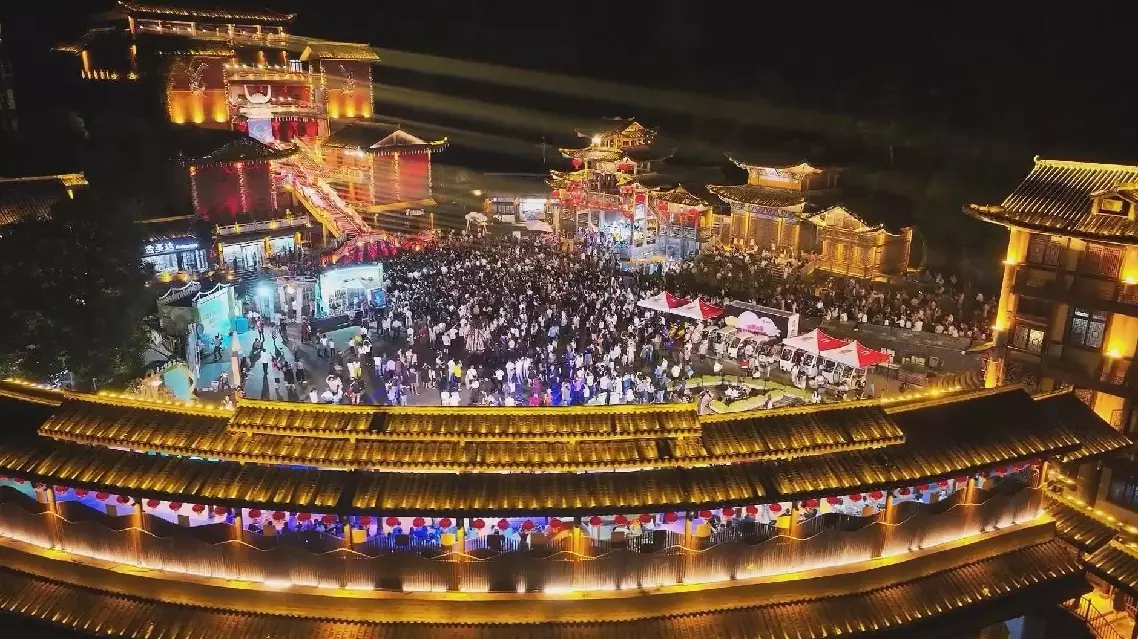
In the Youyang Tujia and Miao Autonomous County of Chongqing, the Taohuayuan Scenic Resort is brilliantly illuminated at night. Traditional stilted buildings adorned with lights create a captivating atmosphere as visitors either stroll along the bluestone streets to enjoy the night views or gather to dance.
The atmosphere intensifies with acrobatics and performances of the Sichuan face-changing opera. Performers' frequent interaction with the audience brings the Mid-Autumn atmosphere to a climax.
"The introductions to traditional culture and the interactive games have given this Mid-Autumn Festival special meaning and ambiance," said Ran Lu, a tourist.
During the holiday, the locality has rolled out a themed lantern festival and established multiple immersive performance settings, allowing visitors to fully experience the unique customs of ethnic villages within the ancient town.
Meanwhile, a visual feast blending technology and romance unfolds at the Nanshanhu Park in east China's Jiangsu Province.
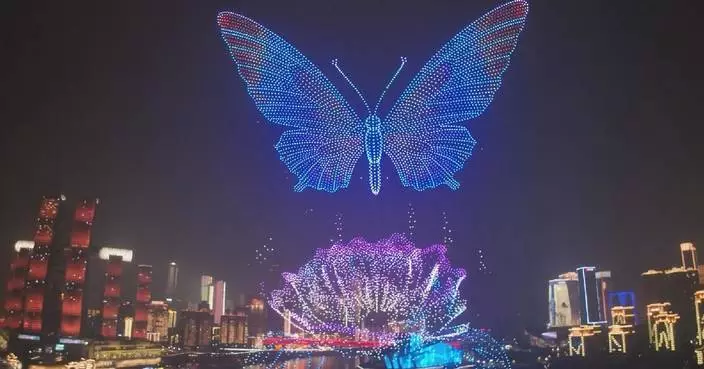
Over 1,000 drones ascend into the dark sky of the park after night falls, sequentially forming various patterns, extending festival regards through such high-tech show.
At the Shigang ancient street in Jiangsu, locals organize intangible cultural heritage exhibitions for visitors. Children can learn about tie-dye techniques accompanied by parents through exhibitions, experiencing the unique charm of traditional crafts through hands-on interaction.
"It feels very down-to-earth. I never expected such a small village to preserve so much intangible cultural heritage. It feels truly remarkable," said Liu Xueming, another tourist.
Traditional charm meets modern tech, attracting visitors during holiday
The three astronauts of China's recently-returned Shenzhou-20 mission on Friday shared the experiences of their dramatic 204-day space mission, including detailing the emergency procedures which were implemented to bring them safely home after their return capsule was struck by space debris.
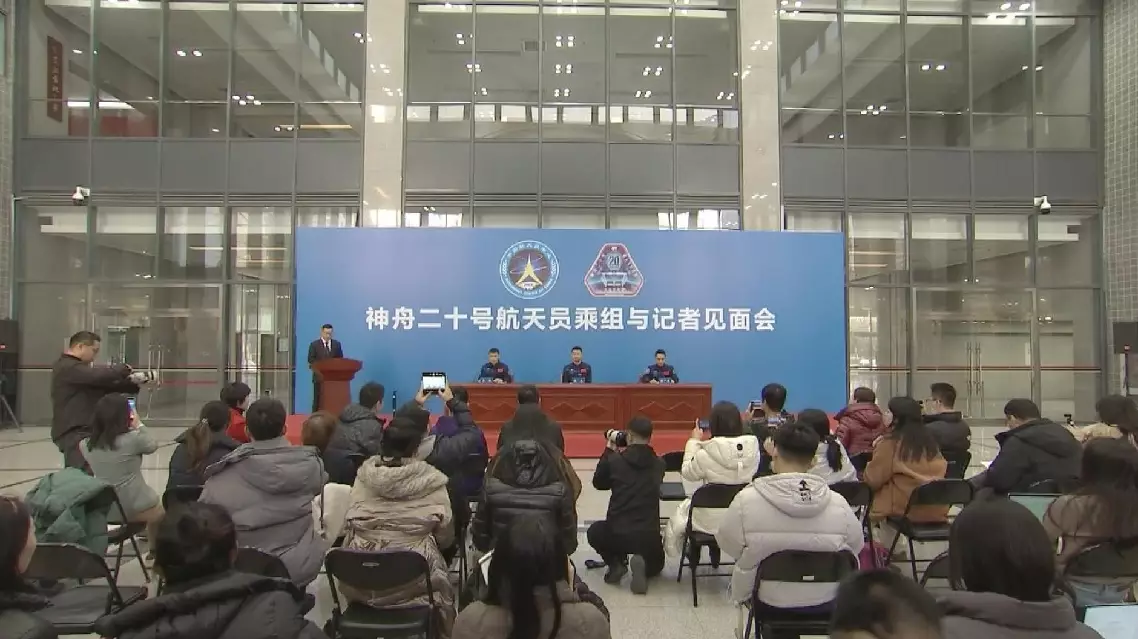
The trio -- Chen Dong, Chen Zhongrui, and Wang Jie -- met with the press in Beijing on Friday afternoon, marking their first public appearance since returning to Earth in November.
When detailing the emergency response mechanisms which were enacted prior to their scheduled return, the astronauts explained that upon discovering a triangular crack on the spacecraft's viewport window, they immediately took photos for documentation and transmitted them to the ground team, who swiftly activated an emergency plan to get the trio home safely.
Experienced mission commander Chen Dong explained how the crew had complete faith in their colleagues on the ground to find a solution to these unforeseen circumstances which led to their return being delayed.
"First, we must trust the ground team, who would anticipate everything and develop the safest return plan for us. Second, we must believe in ourselves; as well-trained astronauts, we have the ability to manage various unexpected failures. I believe that with the collaboration of astronauts and researchers on the ground, our space home will surely go farther, more steadily, and for a longer time," he said.
Following their extended stay in space as a result of the debris incident, the Shenzhou-20 crew spent a total 204 days in orbit, setting a new record for the longest duration by a single group of Chinese astronauts.
During their mission, they completed multiple payload operations, conducted extensive scientific experiments, and carried out four extravehicular activities.
"Our crew worked together with the ground team in unity and coordination, completing four extravehicular activities, several payload entry and exit tasks, and a large number of scientific experiments. It was a fulfilling yet challenging mission. The path to exploring the heavens is long and arduous, but I firmly believe that China's space missions will succeed," said Chen Zhongrui, a former air force pilot who was making his first spaceflight during the mission.
"From the ground to space, from learning to application, I have deeply felt the solid progress of Chinese space endeavors and the quiet dedication of countless personnel behind the scenes. In the future, I will accomplish each mission with full commitment, living up to the trust of the motherland and the people," said fellow astronaut Wang Jie, who was also making his debut spaceflight.
After returning to Earth on Nov 14, the trio successfully completed their isolation recovery and rehabilitation and will now resume normal training following health assessments.
The crew's return, originally scheduled for Nov 5, was postponed due to safety concerns, with the astronauts later using the return capsule belonging to their successor crew of the Shenzhou-21 mission to get back to Earth. China later launched the unmanned Shenzhou-22 spacecraft which will serve the future return of the crew now aboard the Tiangong Space Station.
Shenzhou-20 astronauts share experiences after safely returning from debris incident