China’s lunar program took center stage at the 76th International Astronautical Congress (IAC), which opened on Sept 29 in Sydney, highlighting its commitment to scientific advancement and global collaboration.
The Chang’e-6 mission earned the prestigious 2025 World Space Award in the Team Category from the International Astronautical Federation, as Chinese delegates presented a detailed report on its historic retrieval of samples from the Moon’s far side.
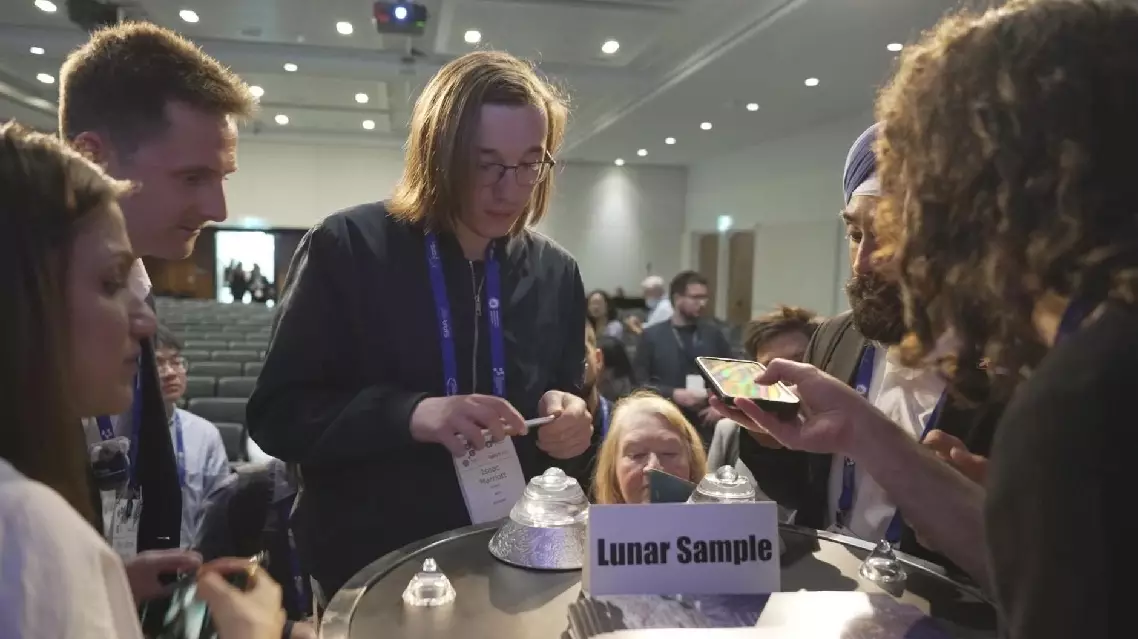
In a parallel move, authorities officially launched the international application process for the second batch of lunar samples returned by the Chang’e-5 mission, inviting global researchers to participate in China’s expanding lunar science program.
"So far, over 200 scientific papers have been published using China's lunar samples, revealing new insights into the Moon's origin and evolution. Following the successful distribution of the first batch of Chang'e-5 lunar samples this year, we are now opening the international application process for the second batch. We welcome all interested international scientists to apply to study these samples with us. China's Lunar Exploration Program is not just a technological undertaking - it is an international one. The Moon belongs to all humanity, and we should explore it together to expand the frontiers of human knowledge and benefit all people," said Guan Feng, director of the Lunar Exploration and Space Engineering Center of the China National Space Administration (CNSA).
These missions have generated huge anticipation, with researchers eager to uncover the secrets hidden in those historic samples.
"It's really nice that the Chinese space agency (CNSA) is releasing these data and presenting these data and their findings publicly, helping not just the organization but agencies around the world as well. They're all benefiting from what Chinese space agency is doing," said Arukshan Pavalachandra, leading system engineer of the Sydney Uni Rover Team at the University of Sydney.
This spirit of cooperation is foundational to China's future lunar missions, which will feature even more global collaboration. This includes a focus on studying the Moon's South Pole. China's Chang'e-8 mission, scheduled for launch around 2028, has allocated 200 kilograms of payload capacity for international partners.
This effort will see Africa make history as its first lunar mission, Africa2Moon, prepares to launch aboard Chang'e-8.
"Our mission is about inspiring young South Africans to take up science, technology, engineering, mathematics, and innovation through the ILRS and mission Chang'e-8, with the payload you can imagine what that will do to young people, not just in South Africa, but also in the African continent. And we're hoping that next year we would also start looking at the manned missions where we hope that we can begin to train our young women, in particular, to become future taikonauts," said Humbulani Mudau, CEO of South African National Space Agency (SANSA).
"We are pushing all the universities and institutes for China's lunar missions and other missions. So now one university is making one project. We will send one payload to the Chang'e-8. Of course, to make more, we need the cooperations," said Yusuf Kirac, president of the Turkish Space Agency (TUA).
As the Sydney congress draws to a close, one message resonates above all: the future of space depends on stronger global cooperation, for the universe knows no borders.
China’s Chang’e-6 wins world space award as lunar sample access expands