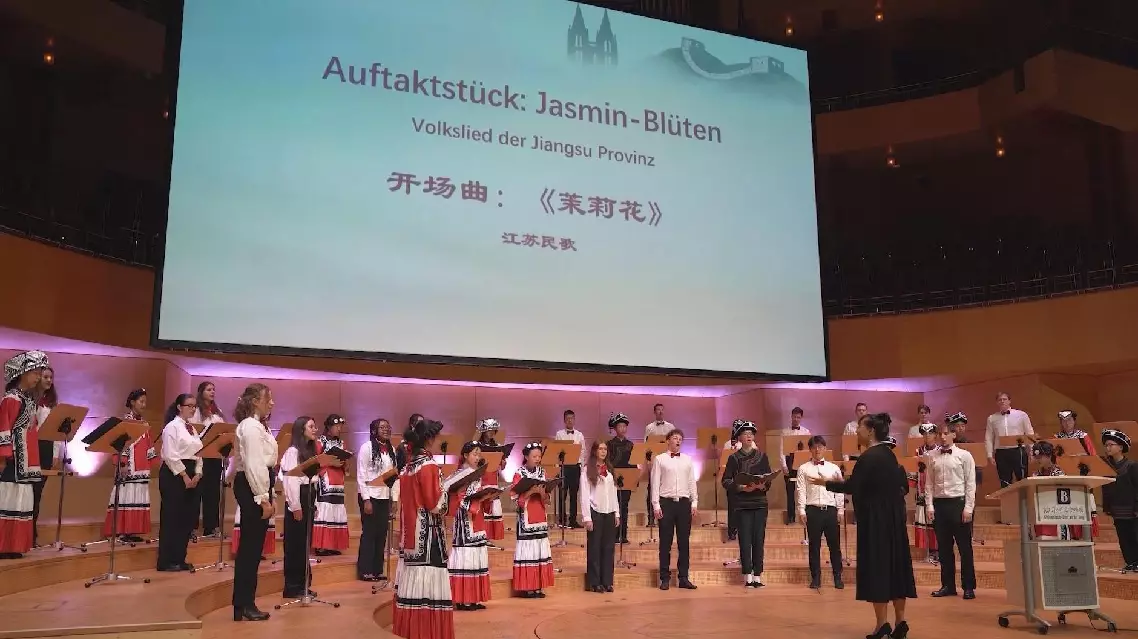
Young voices from China and Germany united in harmony Saturday in Essen, western Germany, where a vibrant music exchange celebrated language learning and cross-cultural friendship through song.
Central to the event was the Burg Chinese Chorus, a non-profit group founded in 2014 that teaches German youths Chinese through its "Learn Chinese by Singing" program. The chorus has long championed people-to-people ties between China and Germany through language and cultural initiatives.
Saturday’s concert unfolded in two parts, with the first half spotlighting the German students' summer camp experiences in China. From July 15 to 28, the chorus traveled to Kunming and Chuxiong in southwest China, and then to Beijing, helping German youths improve their Chinese through singing.
On stage, students shared their impressions through videos, speeches, and photo displays, highlighting everything from diverse cuisines and ethnic traditions to classroom learning and choir rehearsals, showcasing their appreciation for Chinese culture.
Although chorus member Lena Klonis-Jansen had never set foot in China before, she had heard much about the country from her 92-year-old grandmother. In the 1950s, her grandmother, then a young opera singer, came to China for a three-month performance tour and later filled Klonis-Jansen's childhood with vivid stories about the country.
"My grandmother is 92 years old. She traveled to China in 1953 as an opera singer in the national folk art troupe. She has told me so many stories about that time. Growing up surrounded by music, I always wanted to visit China myself. I found that singing Chinese songs really helps us gradually immerse ourselves in Chinese culture, especially for beginners, and it also helps to learn the language over time. In China, everyone is friendlier than I expected, and I've truly experienced what my grandmother often says -- China is a country of smiles. I can say with certainty that it won't be my last visit to China. I've even started planning to pursue a master's degree in Nanjing or another city in the future," she said.
University freshman Bennet Mickels also traveled to China for the first time. He was captivated by the modern cityscape, the innovative technologies, and the vibrant cultural events he witnessed, like the autonomous vehicles and the Yi ethnic group's torch festival in southwest China's Chuxiong, which combined light shows and drone performances.
Previously having no prior connection to music, Mickels has now joined the chorus and is full of enthusiasm for leaning Chinese songs. He plans to travel to China next year to enhance his language skills, hoping to invite his friends along.
"I'm a big fan of technology, and in China, I saw a lot of fascinating things, like self-driving vehicles, which was really an eye-opening experience. I will definitely continue singing Chinese songs because I enjoy it so much. Actually, I was not much of a music person before, but now it's become a passion of mine. I plan to go visit China again, and I have also tried to persuade everyone I know to join me. They all know how much I love China. I've asked each of them if they want to come along. This was truly a worthwhile experience, so I hope others can also feel the beauty of China for themselves," said Mickels.
Olaf Millmann, president of the chorus, highlighted the importance of such music events in building bridges for cross-cultural communication. He noted that it is precisely the acquaintance, communication and understanding among the youths that have shaped the future of friendship between China and Germany.
He noted that the chorus has recruited more new members this year, reflecting the growing interest among German youth in Chinese culture.
"Such concerts build a bridge for cross-cultural exchange. What is a bridge? The youths who meet here today and establish connections and friendships. That is what a bridge is, with mutual understanding serving as the foundation of tolerance and acceptance. The chorus has developed very positively this year, not only leading to new friendships but also the recruitment of new members. This shows that many German youths are filled with interest in China -- the Chinese language, Chinese culture and Chinese music," said Millmann.
Chinese-German music exchange event highlights language learning, friendship