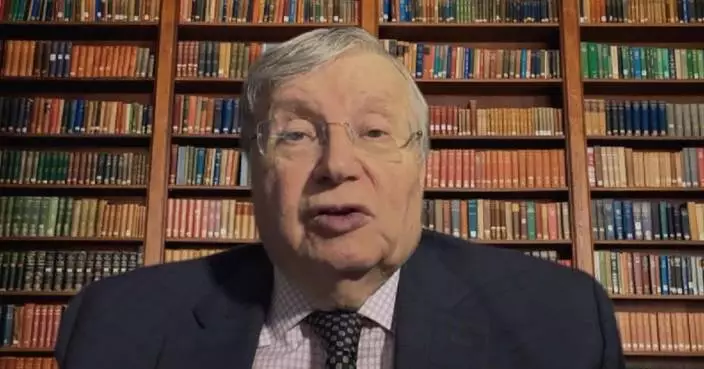
Outgoing French Prime Minister Sebastien Lecornu has made a "beginner's mistake" that triggered political backlash and led to his resignation, according to Douglas Yates, a professor at the American Graduate School in Paris.
Speaking with China Global Television Network, Yates said Lecornu's misstep stemmed from initiating budget negotiations before formally forming his government.
French President Emmanuel Macron now faces renewed pressure to appoint a new premier amid deep-rooted structural challenges.
"He had started negotiating what he would like with the budget before he had formed his government. And this ended up being a problem of sequence. Because no sooner had he named the members of his government, then there was a dispute with the center-right party. It was really a beginner's mistake. And then he resigned, and the communique that comes out is one sentence: 'He resigned, and the president accepted it'. So Macron made no effort to negotiate that he remain. And I think now, in my view, Macron is trying to choose a new prime minister," said Yates.
Yates noted that despite the apparent turmoil, France's semi-presidential system allows Macron to maintain continuity in governance.
"But since they have a dual executive, where they've got a president who wields real power, Macron, he's able to have government instability while actually providing administrative stability, and that gives him a lot of leverage room," he said.
Lecornu resigned Monday after less than a month in office, making him the shortest-serving prime minister of France's Fifth Republic. Macron accepted his resignation, the presidency said.
In a statement, Lecornu admitted the formation of his government had not gone smoothly, saying conditions "were no longer met" for him to remain in office.
Lecornu, appointed 27 days ago, quit a day after unveiling a cabinet lineup that was nearly identical to its predecessor and drew sharp criticism across the political spectrum.

"Beginner's mistake" leads to Lecornu's resignation: analyst