NEW YORK--(BUSINESS WIRE)--Oct 8, 2025--
Shield, the industry's most comprehensive digital communications governance and archiving (DCGA) platform and Gartner-categorized Visionary, today announced a new data approach that provides gold-standard clarity and control across the full data lifecycle. Shield’s new data process is designed to free institutions from data pipeline opacity and blind spots through zero-gap ingestion, full transparency, and full data accessibility at every stage of its lifecycle.
This press release features multimedia. View the full release here: https://www.businesswire.com/news/home/20251008306749/en/
Regulators are placing increasing scrutiny on data completeness and accessibility, adding pressure to already overworked compliance teams. The stakes are significant: The average cost of noncompliance exceeded $4.88 million per incident in 2024, according to Gartner. This growing compliance burden is reflected in recent research by GreySpark, which found that 83% of surveyed global banks reported data issues in capture, retention, and auditability. Financial firms struggle with fragmented systems that create compliance vulnerabilities and operational inefficiencies. Even minor gaps in data completeness early on can lead to significant downstream impact across a firm’s risk management, including stalled insights, eroded trust, missed regulatory requirements, all of which create vulnerability to significant fines.
“Shield is helping the world’s leading financial institutions break through legacy barriers and fragmented data by unifying the full communications lifecycle,” said Tamar Sharir Beiser, Chief Product Officer at Shield. “With our transparent, AI-powered platform, firms gain complete data integrity, eliminate blind spots, and respond to regulatory demands with confidence. For too long, organizations have struggled with limited visibility into their data. Shield is changing that by setting a new standard of clarity, with a fully unified data flow, transparency, and accessibility at every stage of the lifecycle.”
Unified End-to-End Data Lifecycle Approach
Shield's native end-to-end DCGA platform handles the complete data lifecycle from capture through archiving, delivering clarity and trust across the entire data process.
At the heart of Shield’s new standard are three key pillars:
“With Shield’s new data integrity capabilities, we’ve been able to close audit findings and mature our reconciliation process. The access to dedicated reporting metrics gives us the confidence that our data integrity is intact, and that we can demonstrate compliance with clarity.” - IT Project Lead, Global Wealth Fund
Shield’s robust technological data approach is backed by real-time human monitoring and proactive anomaly resolution. With data at its core, Shield’s platform provides a single source of truth across the portfolio of products, working in tandem with Shield Archive for secure retention and preservation of original communications. This unified, scalable framework supports firm-specific data needs and regulatory obligations with self-service visibility and full chain of custody for verifiable evidence at every stage.
For more information about Shield’s robust new data offering , please contact Shield directly at shieldfc.com/contact.
About Shield
Shield is the industry's most comprehensive digital communications governance and archiving solution—purpose-built for financial institutions. Trusted by a third of the world’s leading financial institutions, Shield is named by Gartner as a Visionary in the Digital Communication Governance and Archiving sector. Shield's platform combines industry-leading AI-powered innovation with deep regulatory expertise to strengthen compliance, intuitively, efficiently, and securely. Learn more at shieldfc.com.

Product UI showing ingestion reporting.
NUSEIRAT, Gaza Strip (AP) — Sitting in her wheelchair, Haneen al-Mabhouh dreams of rebuilding her family, of cradling a new baby. She dreams of walking again. But with her leg gone, her life in Gaza is on hold, she says, as she waits to go abroad for further treatment.
An Israeli airstrike in July 2024 smashed her home in central Gaza as she and her family slept. All four of her daughters were killed, including her 5-month-old baby. Her husband was severely burned. Al-Mabhouh’s legs were crushed under the rubble, and doctors had to amputate her right leg above the knee.
“For the past year and a half, I have been unable to move around, to live like others. For the past year and a half, I have been without children,” she said, speaking at her parents’ home.
The 2-month-old ceasefire in Gaza has been slow to bring help for thousands of Palestinians who suffered amputations from Israeli bombardment over the past two years. The World Health Organization estimates there are some 5,000 to 6,000 amputees from the war, 25% of them children.
Those who lost limbs are struggling to adapt, faced with a shortage of prosthetic limbs and long delays in medical evacuations out of Gaza.
The WHO said a shipment of essential prosthetic supplies recently made it into Gaza. That appears to be the first significant shipment for the past two years.
Previously, Israel had let in almost no ready-made prosthetic limbs or material to manufacture limbs since the war began, according to Loay Abu Saif, the head of the disability program at Medical Aid for Palestinians, or MAP, and Nevin Al Ghussein, acting director of the Artificial Limbs and Polio Center in Gaza City.
The Israeli military body in charge of coordinating aid, known as COGAT, did not respond when asked how many prosthetic supplies had entered during the war or about its policies on such supplies.
Al-Mabhouh was asleep with her baby girl in her arms when the strike hit their home in Nuseirat, she said. For several weeks while recovering in the hospital, al-Mabhouh had no idea her children had been killed.
She underwent multiple surgeries. Her hand still has difficulty moving. Her remaining leg remains shattered, held together with rods. She needs a bone graft and other treatments that are only available outside of Gaza.
She was put on the list for medical evacuation 10 months ago but still hasn’t gotten permission to leave Gaza.
Waiting for her chance to go, she lives at her parents’ house. She needs help changing clothes and can’t even hold a pen, and remains crushed by grief over her daughters. “I never got to hear her say ‘mama,’ see her first tooth or watch her take her first steps,” she said of her baby.
She dreams of having a new child but can’t until she gets treatment.
“It’s my right to live, to have another child, to regain what I lost, to walk, just to walk again,” she said. “Now my future is paralyzed. They destroyed my dreams.”
The ceasefire has hardly brought any increase in medical evacuations for the 16,500 Palestinians the U.N. says are waiting to get vital treatment abroad — not just amputees, but patients suffering many kinds of chronic conditions or wounds.
As of Dec. 1, 235 patients have been evacuated since the ceasefire began in October, just under five a day. In the months before that, the average was about three a day.
Israel last week said it was ready to allow patients and other Palestinians to leave Gaza via the Israeli-held Rafah crossing between Gaza and Egypt. But it's unsure that will happen because Egypt, which controls the crossing’s other side, demands Rafah also be opened for Palestinians to enter Gaza as called for under the ceasefire deal.
Dr. Richard Peeperkorn, the WHO's representative in the occupied Palestinian territory, told The Associated Press that the backlog is caused by the lack of countries to host the evacuated patients. He said new medevac routes need to be opened, especially to the Israeli-occupied West Bank and east Jerusalem, where hospitals are ready to receive patients.
Yassin Marouf lies in a tent in central Gaza, his left foot amputated, his right leg barely held together with rods.
The 23-year-old and his brother were hit by Israeli shelling in May as they returned from visiting their home in northern Gaza that their family had been forced to flee. His brother was killed. Marouf lay bleeding on the ground, as a stray dog attacked his mangled left leg.
Doctors say his right leg will also need to be amputated, unless he can travel abroad for operations that might save it. Marouf said he can’t afford painkillers and can’t go to the hospital regularly to have his bandages changed as they’re supposed to.
“If I want to go to the bathroom, I need two or three people to carry me,” he said.
Mohamed al-Naggar had been pursuing an IT degree at the University of Palestine before the war.
Seven months ago, shrapnel pierced his left leg during strikes on the house where his family was sheltering. Doctors amputated his leg above the knee. His right leg was also badly injured and shrapnel remains in parts of his body.
Despite four surgeries and physical therapy, the 21-year-old al-Naggar can’t move around.
“I’d like to travel abroad and put on a prosthetic and graduate from college and be normal like young people outside Gaza,” he said.
Some 42,000 Palestinians have suffered life-changing injuries in the war, including amputations, brain trauma, spinal cord injuries and major burns, the WHO said in an October report.
The situation has “improved slightly” for those with assistance needs but “there is still a huge overall shortage of assistive products,” such as wheelchairs, walkers and crutches. Gaza has only eight prosthetists able to manufacture and fit artificial limbs, the WHO said in a statement to the AP.
The Artificial Limbs and Polio Center in Gaza City, one of two prosthetics centers still operating in the territory, received a shipment of material to manufacture limbs just before the war began in 2023, said its director, Al Ghussein. Another small shipment entered in December 2024, but nothing since.
The center has been able to provide artificial limbs for 250 cases over the course of the war, but supplies are running out, Al Ghussein said.
No pre-made prosthetic legs or arms have entered, according to Abu Saif of MAP, who said Israel does not ban them, but its procedures cause delays and “in the end they ignore it.”
Ibrahim Khalif wants a prosthetic right leg so he can get a job doing manual labor or cleaning houses to support his pregnant wife and children.
In January, he lost his leg when an Israeli airstrike hit Gaza City while he was out getting food.
“I used to be the provider for my kids, but now I’m sitting here," Khalif said. "I think of how I was and what I’ve become.”
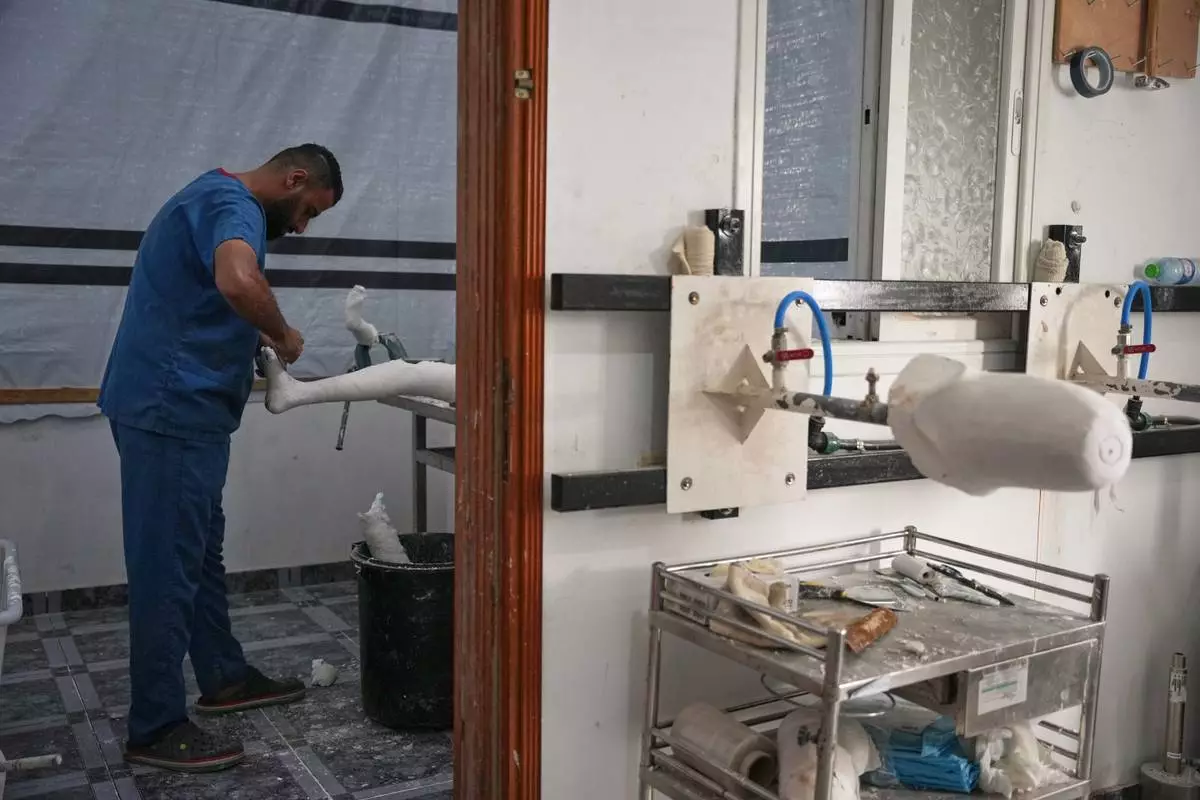
Prosthetic limb technician Ahmed Al-Ashqar, 34, prepares a leg amputation splint in the first stage of building an artificial leg at Hamad Hospital in Zawaida, central Gaza Strip, Thursday, Nov. 27, 2025. (AP Photo/Abdel Kareem Hana)
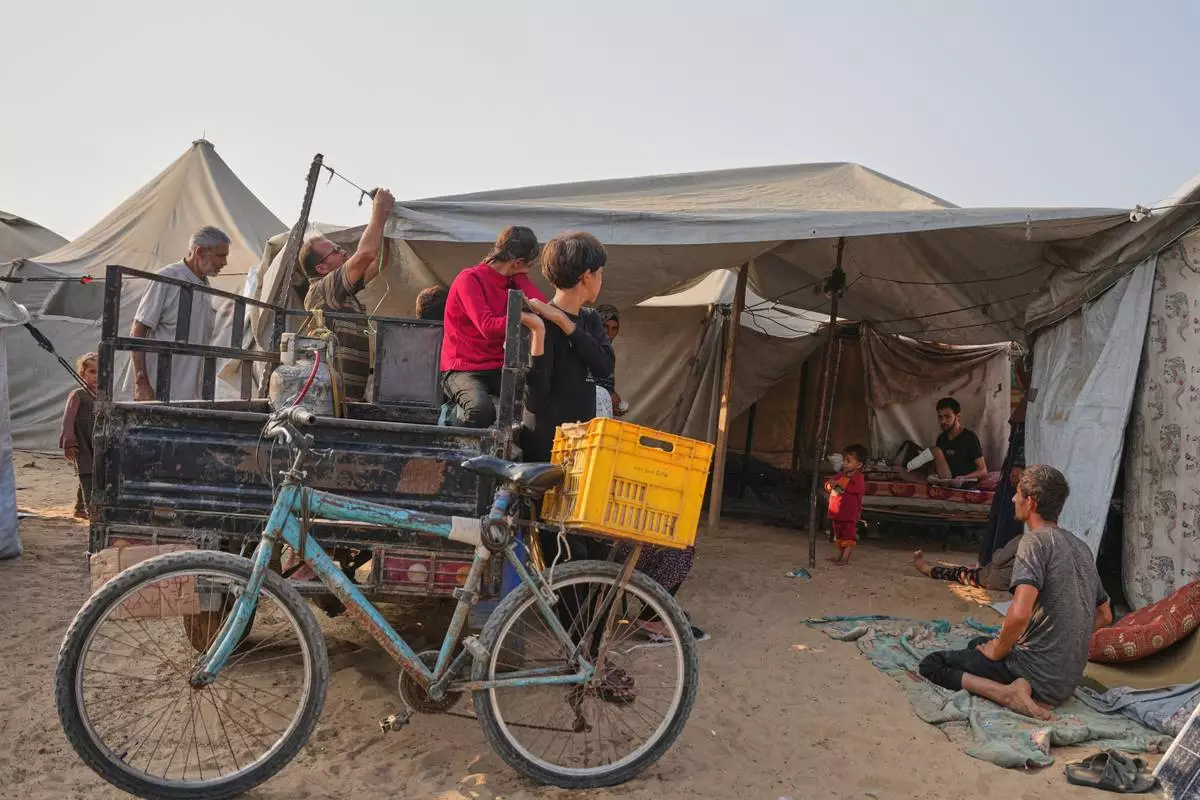
Yassin Marouf, 23, second from right, who lost his left foot and suffered a severe injury to his right leg after Israeli shelling in May, sits on a mattress in a tent surrounded by family and neighbors in Zawaida, central Gaza, Thursday, Nov. 6, 2025. (AP Photo/Abdel Kareem Hana)
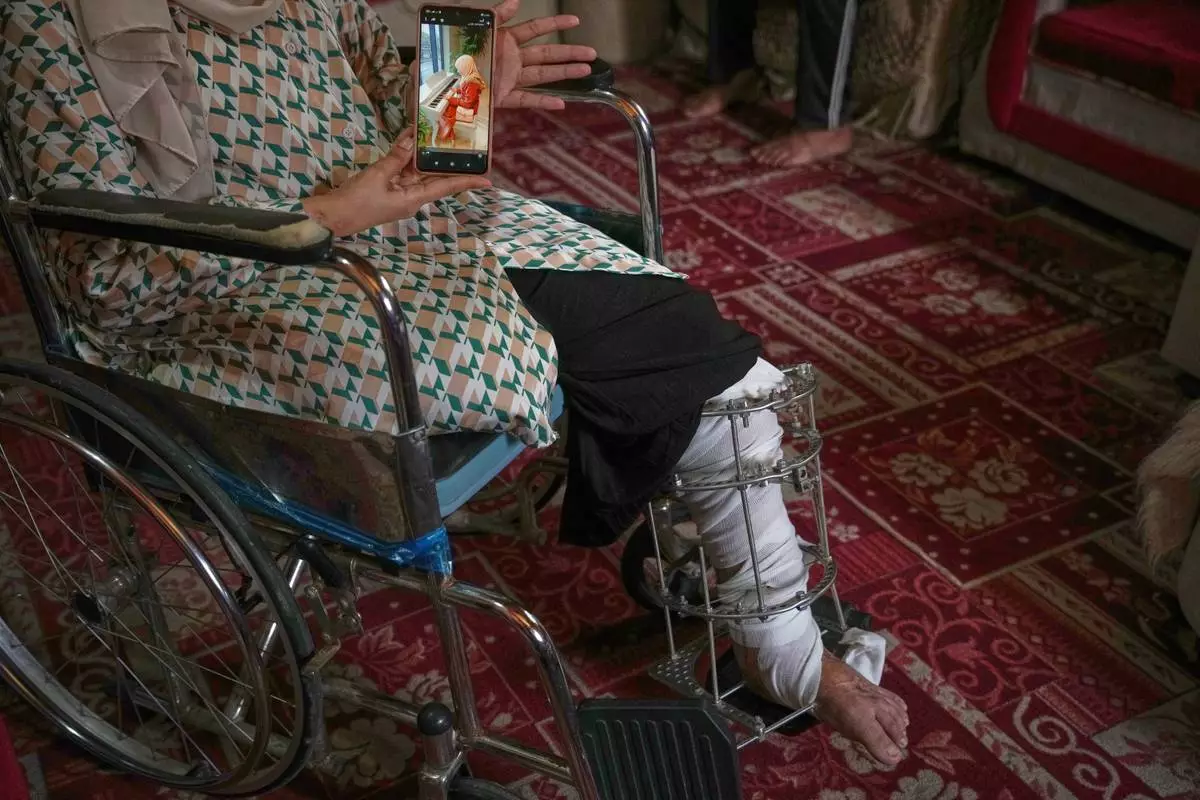
Haneen al-Mabhouh, 34, who lost her leg in an Israeli strike on her home that also killed all four of her daughters, including her 5-month-old baby, shows a photo of one of her daughters on a cellphone while sitting in a wheelchair in her family home in Nuseirat, central Gaza Strip, Thursday, Nov. 6, 2025. (AP Photo/Abdel Kareem Hana)
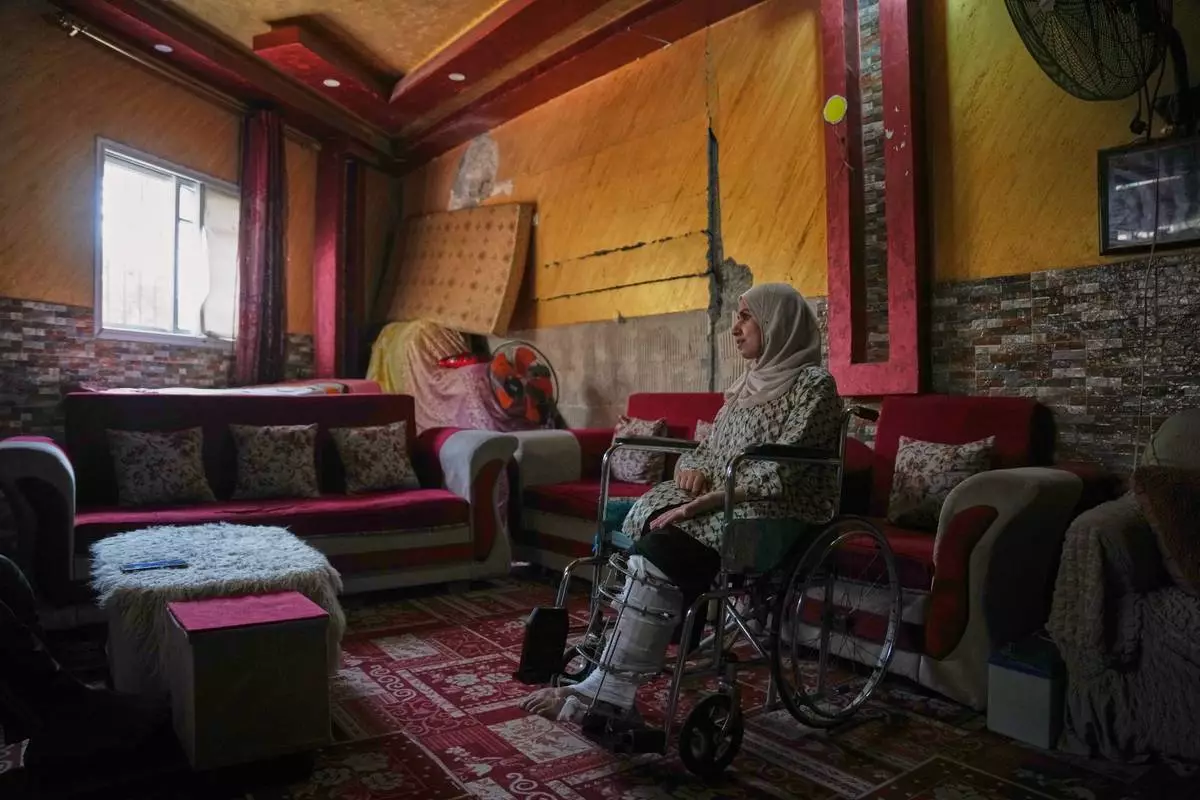
Haneen al-Mabhouh, 34, who lost her leg in an Israeli strike on her home that also killed all four of her daughters, including her 5-month-old baby, sits in a wheelchair in her family home in Nuseirat, central Gaza Strip, Thursday, Nov. 6, 2025. (AP Photo/Abdel Kareem Hana)
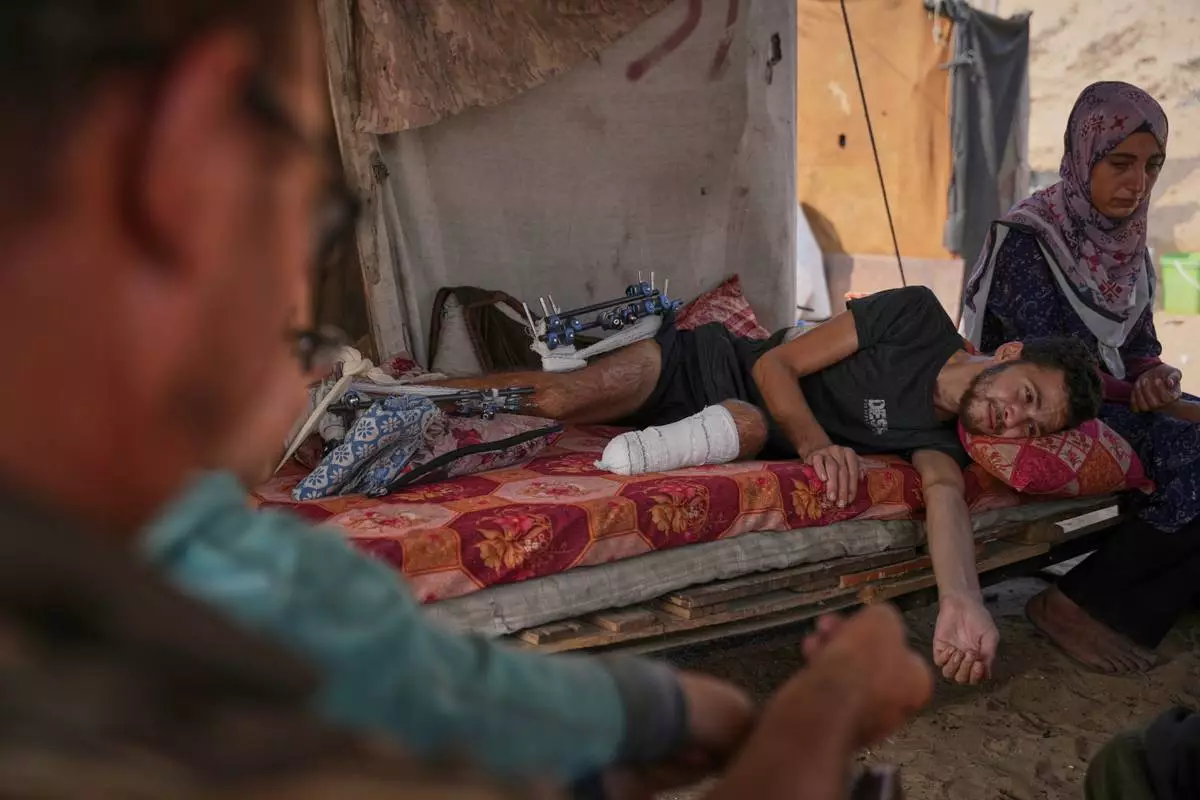
Yassin Marouf, 23, who lost his left foot and suffered a severe injury to his right leg after being hit by Israeli shelling in May, lies in a tent surrounded by his family in Zawaida, central Gaza, Thursday, Nov. 6, 2025. (AP Photo/Abdel Kareem Hana)