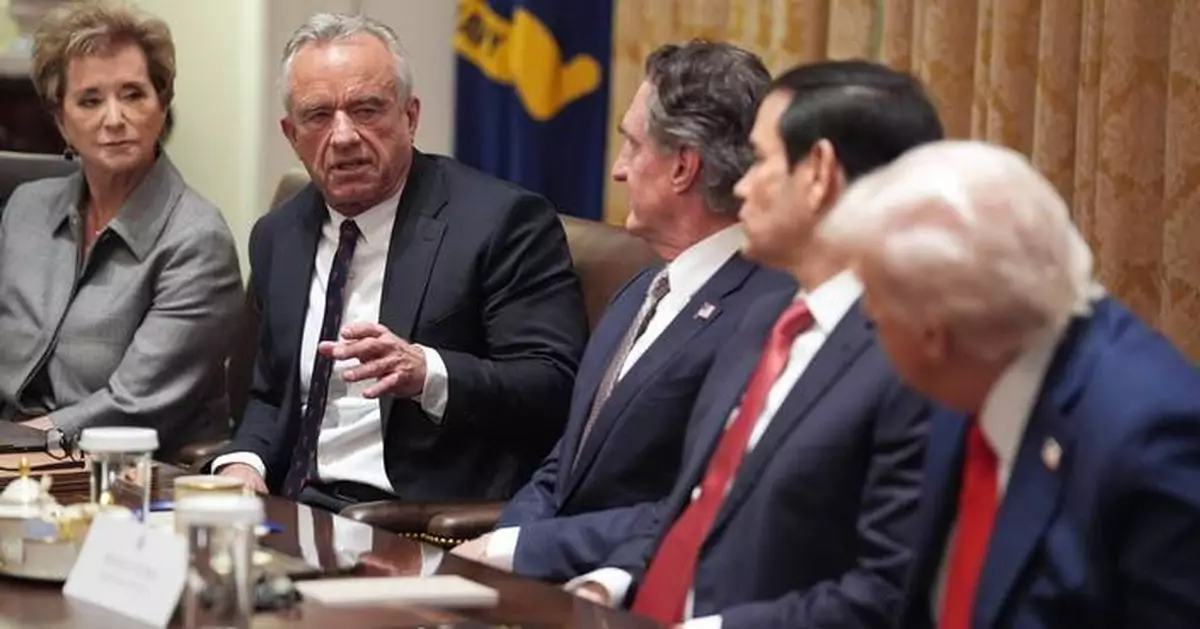
Health Secretary Robert F. Kennedy, Jr. Thursday reasserted the unproven link between the pain reliever Tylenol and autism, and suggested people who opposed the theory were motivated by hatred for President Donald Trump.
During a meeting with Trump and the Cabinet, Kennedy reiterated the connection, even while noting there was no medical proof to substantiate the claim. He also mistakenly described a pregnant woman's anatomy and linked autism to circumcision.
“Anybody who takes the stuff during pregnancy unless they have to is, is irresponsible,” Kennedy told Trump and fellow Cabinet members. “It is not proof. We're doing the studies to make the proof.”
Kennedy has long espoused unconventional beliefs about public health, which have prompted concern among medical experts that, as health secretary, he could upend the country’s evidence-based health policies.
Kennedy noted during the meeting that he had seen a TikTok video on Thursday, which he said featured a pregnant woman “gobbling Tylenol” and cursing Trump. “The level of Trump derangement syndrome has now left the political landscape and now in the realm of pathology,” he said. Kennedy also said the woman was taking Tylenol “with a baby in her placenta.”
A fetus develops in the uterus, not the placenta. The placenta is a temporary organ that develops in the uterus during pregnancy and provides oxygen, nutrients, and hormones to the growing fetus.
Kennedy's statement came two weeks after he stood with Trump in the White House as the president used his office to promote unproven and, in some cases, discredited ties between Tylenol, vaccines and autism.
Kennedy also said Thursday that infant boys who are circumcised have double the rate of autism because they are given Tylenol after the procedure.
This claim seems to refer to a study in the Journal of the Royal Society of Medicine from 2015, which looked at ritual circumcision and the risk of autism spectrum disorder in boys under the age of 10 in Denmark.
It found that those who had undergone the procedure, which involves the removal of the foreskin from the penis, were more likely to develop autism than other boys in the study. Researchers suggested a potential link might be due to the pain of the procedure. Researchers noted that they had no data on painkillers or anesthetics used, and thus couldn’t address whether Tylenol was linked to autism.
Other researchers pointed out that the Denmark study looked at correlation, not causation. They also point to other studies that found no evidence to support a link between circumcision and autism.
The Associated Press Health and Science Department receives support from the Howard Hughes Medical Institute’s Department of Science Education and the Robert Wood Johnson Foundation. The AP is solely responsible for all content.
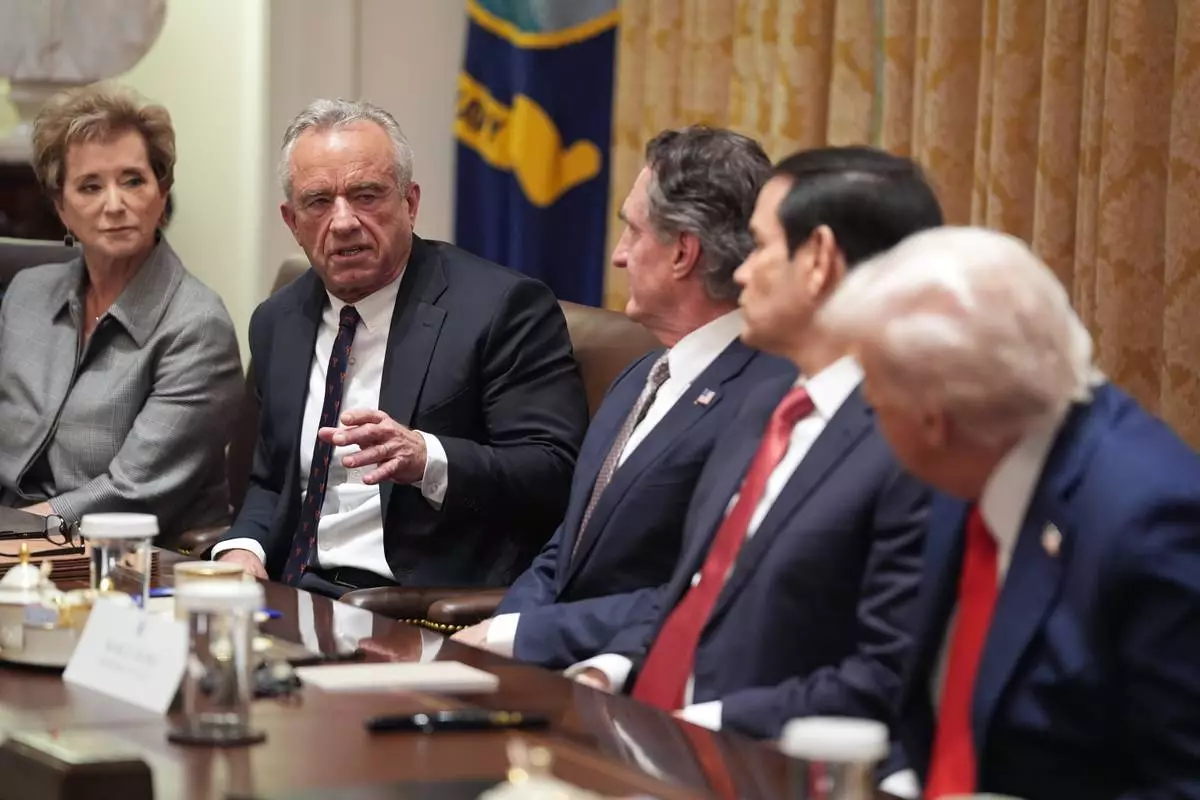
Human Services Secretary Robert F. Kennedy, Jr., speaks as President Donald Trump holds a cabinet meeting at the White House, Thursday, Oct. 9, 2025, in Washington. From left, Education Secretary Linda McMahon, Kennedy, Interior Secretary Doug Burgum, Secretary of State Marco Rubio and President Donald Trump, look on. (AP Photo/Evan Vucci)
LONDON (AP) — Britain's Conservative Party, which governed the country from 2010 until it suffered its worst-ever electoral defeat two years ago, was plunged into fresh turmoil Thursday after its leader sacked the man widely seen as her greatest rival for apparently plotting to defect from the party.
Conservative leader Kemi Badenoch said in a video and statement on X that she sacked the party's justice spokesperson Robert Jenrick due to “irrefutable evidence that he was plotting in secret to defect" in a way that was “designed to be as damaging as possible” to the party.
Badenoch also ejected Jenrick from the party's ranks in Parliament and suspended his party membership.
“The British public are tired of political psychodrama and so am I,” she said. “They saw too much of it in the last government, they’re seeing too much of it in this government. I will not repeat those mistakes.”
Though Badenoch did not specify which party Jenrick was planning to switch to, Nigel Farage, leader of the hard-right Reform UK party, said he had “of course” had conversations with him.
In the past 12 months, the Conservatives have suffered a string of defections to Reform UK, including some former Cabinet ministers.
Farage said in a press briefing in Edinburgh, the Scottish capital, that coincided with Badenoch's statement that, “hand on heart,” he wasn't about to present Jenrick as the latest Conservative to defect to Reform, an upstart, anti-immigration party.
“I’ll give him a ring this afternoon,” he said. “I might even buy him a pint, you never know.”
The Conservatives are fighting not just the Labour government to their left, but Reform UK to the right. Reform has topped opinion polls for months, trounced the Conservatives in last May’s local elections and has welcomed a stream of defecting Tory members and officials.
Jenrick, who has continued to attract speculation about leadership ambitions despite being beaten in 2024, has appeared more open than Badenoch to the prospect of some sort of deal between the Conservatives and Reform in the run-up to next general election, which has to take place by 2029.
Jenrick has yet to respond to the news of his sacking.
The Conservatives remain the official opposition to Prime Minister Keir Starmer's Labour.
Badenoch, a small-state, low-tax advocate, has shifted the Conservatives to the right, announcing policies similar to those of U.S. President Donald Trump, including a promise to deport 150,000 unauthorized immigrants a year.
Her poor poll ratings and lackluster performance in Parliament had stirred speculation that she could be ousted long before the next election.
However, she has been making a better impression in Parliament in recent weeks in a way that appears to have cemented her position as leader.
The party is no stranger to turmoil, having gone through six leaders in the space of 10 years, five of them serving as prime minister. Widespread anger at the way the Conservatives were governing Britain led to their defeat at the general election in July 2024, when they lost around two-thirds of their lawmakers, their worst performance since the party was created nearly 200 years ago.
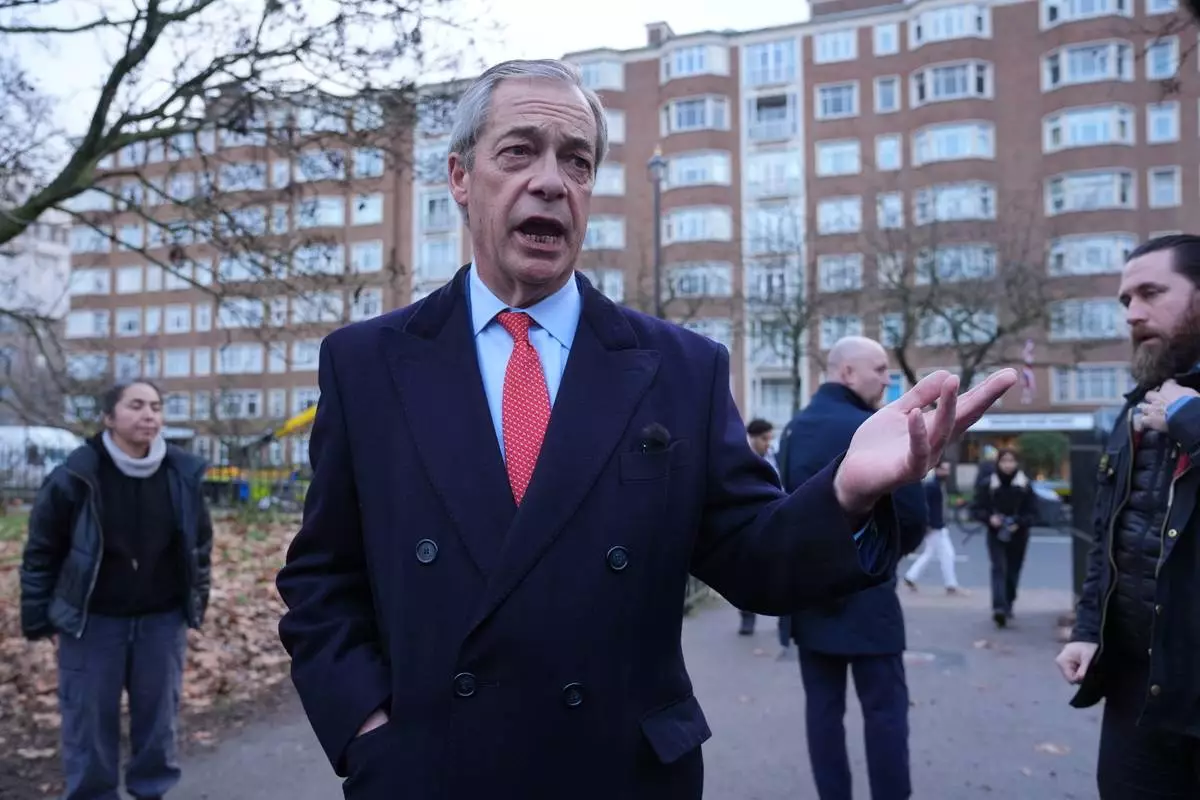
Reform Party leader Nigel Farage addresses protesters outside the Iranian embassy, in London, Monday, Jan. 12, 2026. (Yui Mok/PA via AP)
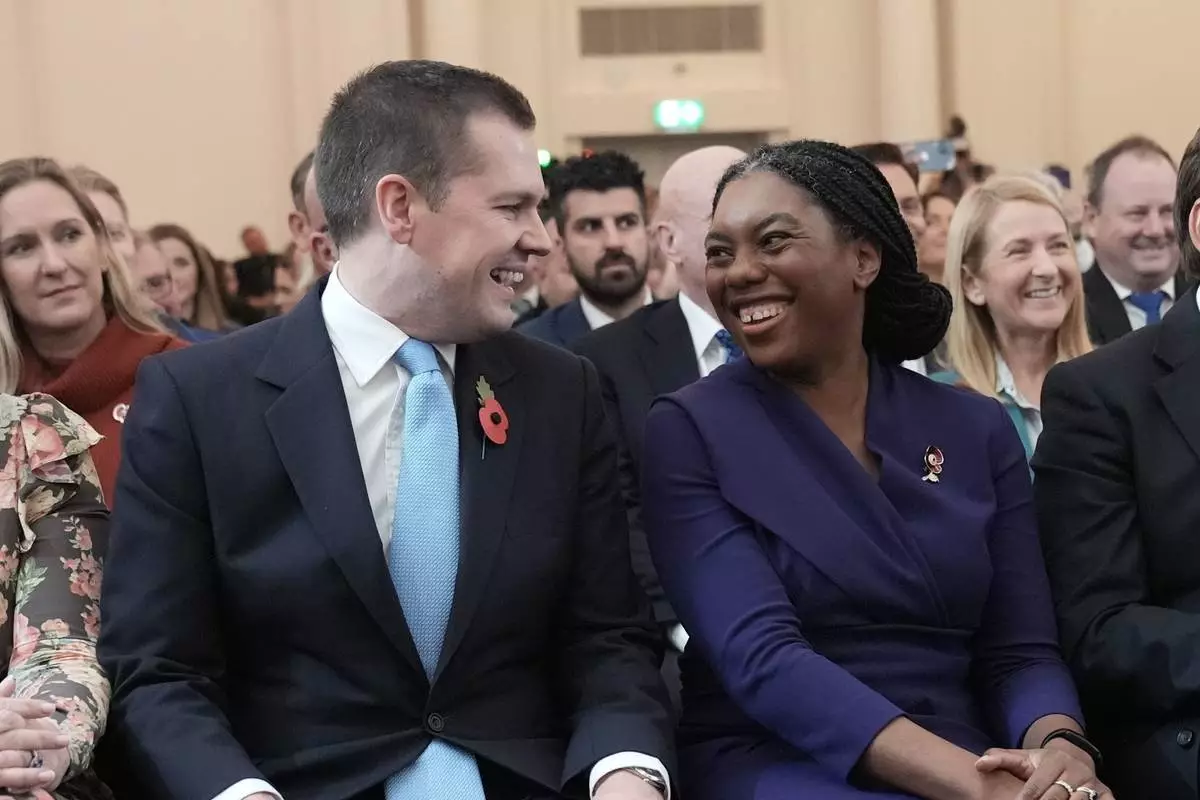
Kemi Badenoch with Robert Jenrick before being announced as the new Conservative Party leader following the vote by party members at 8 Northumberland Avenue in central London, Nov. 3, 2024. (Stefan Rousseau/PA via AP)