SAN FRANCISCO--(BUSINESS WIRE)--Oct 10, 2025--
Unikraft, the first truly millisecond-native, highly scalable cloud platform, has publicly launched and announced Unikraft Cloud, an infrastructure platform purpose-built to support the complexity of AI-driven cloud workloads. The company also raised a $6 million seed round led by Heavybit, with participation from Vercel Ventures, Mango Capital, Firestreak, Fly VC, First Momentum Ventures, and a group of strategic angels. The funding marks Vercel Ventures’ first startup investment.
This press release features multimedia. View the full release here: https://www.businesswire.com/news/home/20251009046776/en/
Cloud economies of scale for the AI era
As AI-generated code, agents, and applications multiply, traditional cloud platforms are struggling to keep up. Always-on, resource-heavy infrastructure has become an economic bottleneck, and likely to worsen as Gartner forecasts that 50% of all cloud resources will be devoted to AI workloads in the coming years.
Unikraft was built from the ground up to address the inherent instability and significant cost of such workloads by unlocking the potential of a little-used technology called unikernels: lightweight, specialized operating system images that combine only the minimal OS components required to run a single application. By re-engineering the low-level components of cloud infrastructure to leverage the efficiency, speed, and inherently secure isolation of unikernels for production environments, Unikraft could achieve a 10-100x reduction in the cost and footprint of cloud workloads.
Developed in 2017 at NEC Laboratories Europe by computer science researchers Felipe Huici, Simon Keunzer, and Alexander Jung, the Unikraft OS project secured backing from The Linux Foundation in 2019 and formed as a corporate entity in 2022. The scientific paper about Unikraft’s technology received the prestigious EuroSys Best Paper Award in 2021.
"Legacy cloud infrastructure was never designed for the scale and unpredictability of today's AI workloads," said Felipe Huici, Unikraft's co-founder and CEO. "We've spent the better part of a decade rethinking cloud from first principles to deliver significant speed, scalability, and security gains at a fraction of the cost. It's the foundation companies need to keep pace with the next wave of AI applications."
The culmination of Unikraft’s eight years of research and development are dramatic economies of scale and cost reduction, as well as strong security advantages, achieved by the Unikraft Cloud platform:
Proven results in enterprise deployments
Unikraft has partnered with numerous companies to run their production workloads, with transformational results. Some have been able to launch new business lines that were previously the realm of imagination, while others have revamped commercial strategies or achieved exponentially better unit economics to outpace competition.
"With Unikraft, we can run over 100,000 strongly isolated PostgreSQL instances on a single machine," said Soren Bramer Schmidt, founder and CEO of Prisma. "That density is unheard of in traditional architectures and fundamentally changes the economics of the game — we’re stepping into a new infrastructure paradigm."
"With Unikraft, we successfully scaled our enterprise web agent infrastructure to handle increased demand while maintaining the reliability and performance standards our enterprise customers expect," said Shuhao Zhang, co-founder and CPO of enterprise web agent platform TinyFish. "Working with the Unikraft team has been exceptional - their expertise and responsiveness made our deployment smooth and successful."
"Choosing Unikraft to power our platform was one the best decisions we’ve made," said Alex Greaves, co-founder of cross-platform mobile app platform Flutterflow. "It’s a powerful and reliable service that supercharges our users’ experience."
Heavybit will join Unikraft’s board with this funding round, with Fly VC adding a board observer seat.
"AI is changing the speed and scale at which companies build software. Cloud infrastructure hasn't kept pace,” said Tom Drummond, founder and managing director at Heavybit. “Unikraft dramatically increases the scalability and reduces the cost of infrastructure for agents and AI workloads. We are thrilled to be partnering with talented technical founders like Felipe, Alexander, and Simon to help companies unlock their next stage of product and business growth."
"When code is generated by AI and deployed automatically, the infrastructure behind it must be radically faster and lighter," said Guillermo Rauch, founder and CEO of Vercel. "That's why Vercel Ventures invested in Unikraft: its cloud infrastructure technology provides exponentially higher efficiency and scalability, along with the strong isolation this new frontier demands."
About Unikraft
Unikraft is building the first truly millisecond-native, highly scalable cloud platform, designed from the ground up to handle the scope and unpredictability of modern, often AI-driven workloads. Built on a body of research backed by NEC Laboratories Europe and the Linux Foundation, Unikraft helps companies scale without limits: thousands of strongly isolated instances on single servers, millisecond cold boots, scale-to-zero, and seamless integration with existing developer tooling like Dockerfiles, Kubernetes, Prometheus, and Grafana. Learn more at unikraft.com.
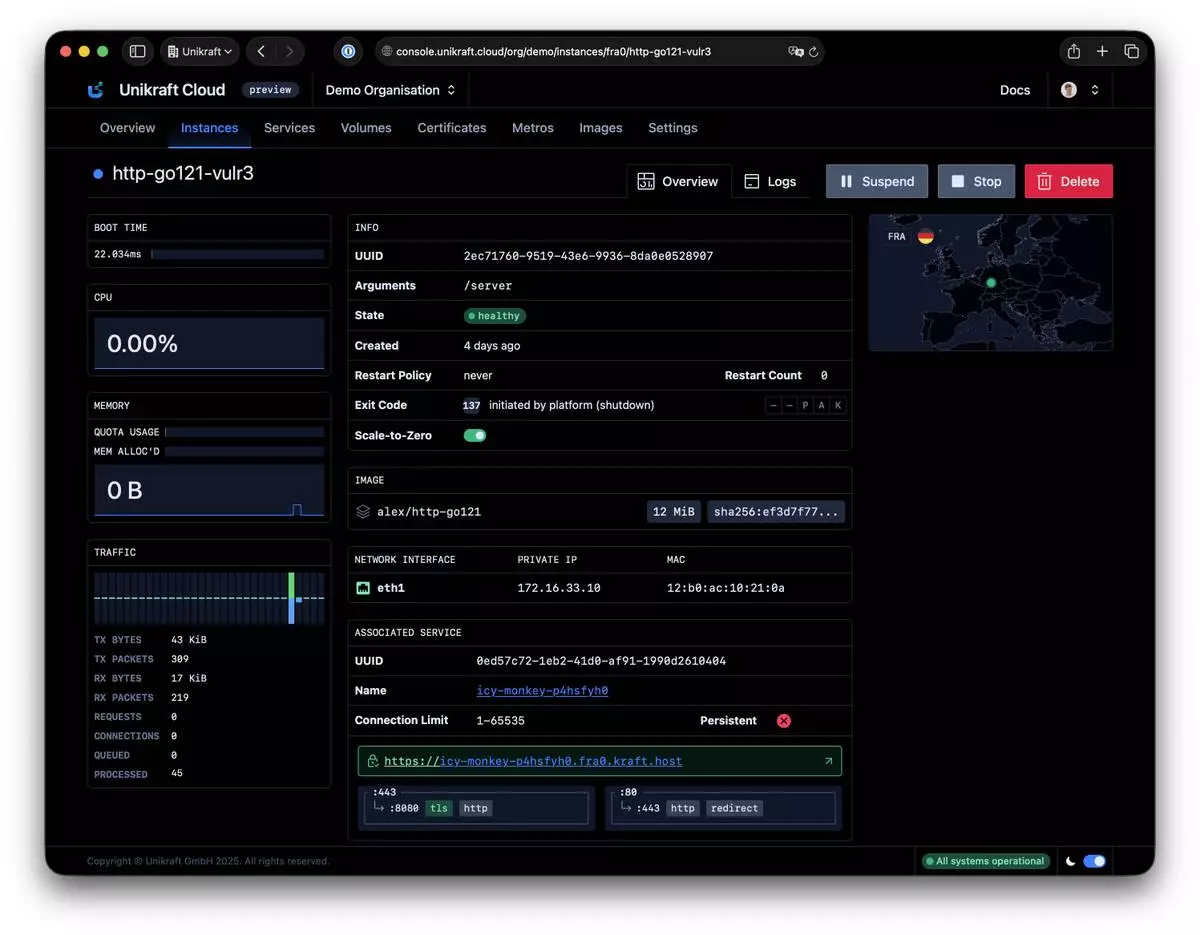
Displaying an instance scale to zero in Unikraft Cloud
WASHINGTON (AP) — Chaotic weather, from surprising heat in California to damaging winds around Washington, D.C., put over half the U.S. population in the path of extreme conditions Monday.
Storms across the nation's eastern half forced airlines to cancel more than 3,000 flights nationwide Monday, and many schools closed early in the mid-Atlantic states, where high winds and tornadoes were in the forecast for the evening.
Blizzards buried parts of Michigan, Wisconsin and Minnesota while torrential rains flooded homes and washed out roads in Hawaii.
In Washington, the House of Representatives postponed votes because of difficulty traveling with inclement weather, and federal agencies told workers to go home early.
Airport delays and cancellations piled up Monday in some of the nation’s largest airports — including those in New York, Chicago and Atlanta.
The private weather service AccuWeather calculated that more than 200 million people were under threat Monday of some kind of dangerous weather.
Those range from extreme heat and wildfire advisories to flood and freeze watches from the National Weather Service.
The storm system that dropped snow by the foot in the Midwest is barreling toward the East Coast with dangerously high winds and potential for “producing strong and long track tornadoes,” the weather service warned Monday.
“Wind is the primary threat, but within any of these areas of strong wind there could be some embedded tornadoes and even the potential for a tornado to develop ahead of the line,” said Evan Bentley, a meteorologist with the weather service.
The biggest threat stretched from Maryland to the upper edge of South Carolina.
North Carolina Gov. Josh Stein urged residents to enable emergency alerts on their phones ahead of expected gusts topping 70 mph (112 kph).
Blizzard conditions continued in the Upper Midwest and Great Lakes on Monday after the storm walloped parts of Wisconsin and Michigan with several feet of snow.
Since Saturday, nearly 3 feet (61 centimeters) had fallen in the northern Wisconsin town of Mountain.
Another round of snow and gusts on Monday could bring another foot of snow across Michigan's Upper Peninsula.
A heat dome over the Southwest will push temperatures well into the triple digits in Arizona most of the week, much earlier than the region usually sees.
Much of California is starting to feel like summer too. The San Francisco Bay Area and Sacramento will see temperatures pushing toward 90 F (32 C) by midweek.
“This is a heat wave that we have not seen before in recorded history in the Southwest,” said AccuWeather meteorologist Dan DePodwin.
Phoenix is expected to have five straight days of triple digit temperatures this week — only once before, in 1988, has the city recorded a 100 F (37.8 C) day in March, DePodwin said.
Dry and windy conditions were charging the largest wildfire in Nebraska’s history. Fires in the state have consumed more than 937 square miles (2,428 square kilometers) of mostly grassland.
Unrelenting rains triggered landslides, washed away roads and flooded homes and farmland in Hawaii over the weekend.
All of Hawaii’s islands had spots with more than 15 inches (38 centimeters) of rain while parts of Maui were overwhelmed with double that amount, the weather service said.
While the worst of the storm has passed, more heavy rain is forecast for later this week. Maui Mayor Richard Bissen said there were no reports of injuries or deaths and crews were assessing damage.
Forecasters said the East Coast storms were expected leave sharply colder weather in its wake.
The storm will stick around parts of the Northeast until Tuesday morning. By then, wind chills below freezing were expected to reach the Gulf Coast and the Florida Panhandle with warnings in effect across the Southeast and in part of Arkansas, Oklahoma, Louisiana, and Texas, forecasters warned.
To the north, rain was expected to change over to snow behind the cold front with heavy snow possible in the central Appalachians of West Virginia.
__
Brumfield reported from Cockeysville, Maryland, and Seewer from Toledo, Ohio. Associated Press writers Jennifer Kelleher in Honolulu; Margery Beck in Omaha, Nebraska; Julie Walker in New York; Jeff Martin in Atlanta; and Gary Fields in Washington contributed.
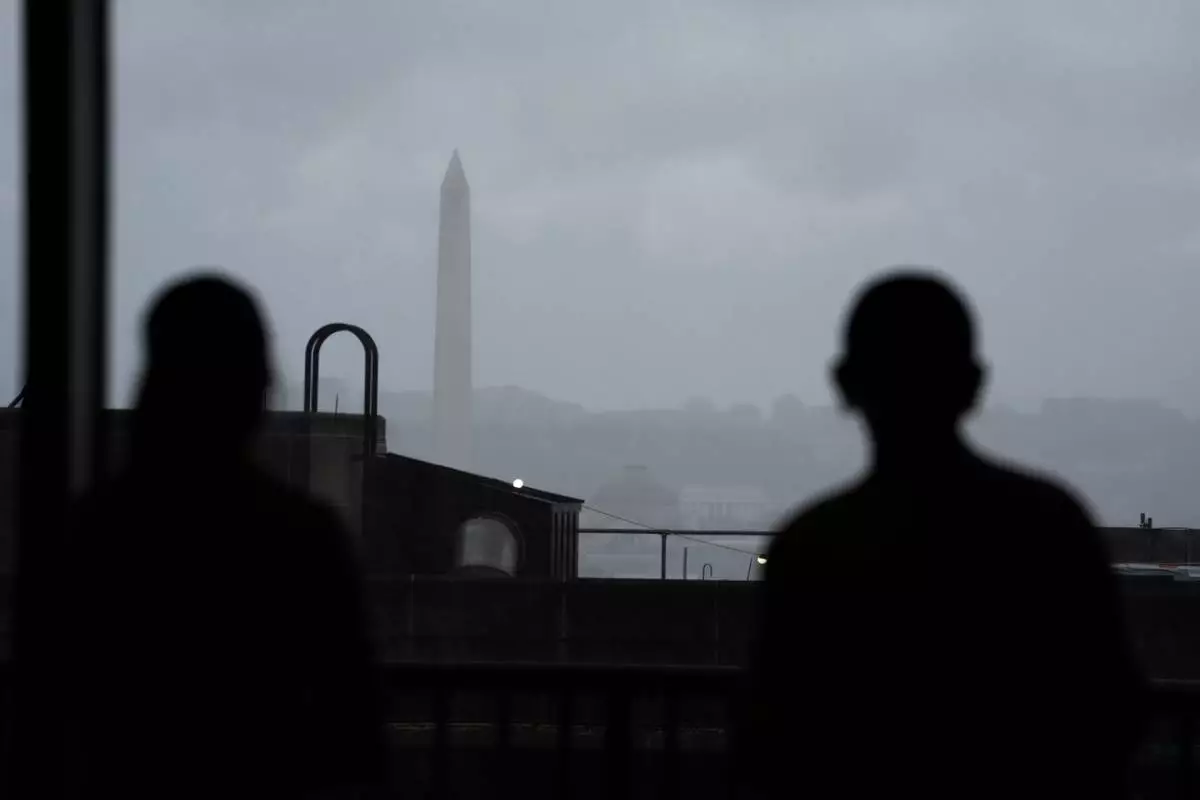
People watch as storms roll over the U.S. Capitol Monday, March 16, 2026, in Washington. (AP Photo/Allison Robbert)

Morning traffic is seen on Lake Shore Drive, after the overnight snow, Monday, March 16, 2026, in downtown Chicago. (AP Photo/Kiichiro Sato)
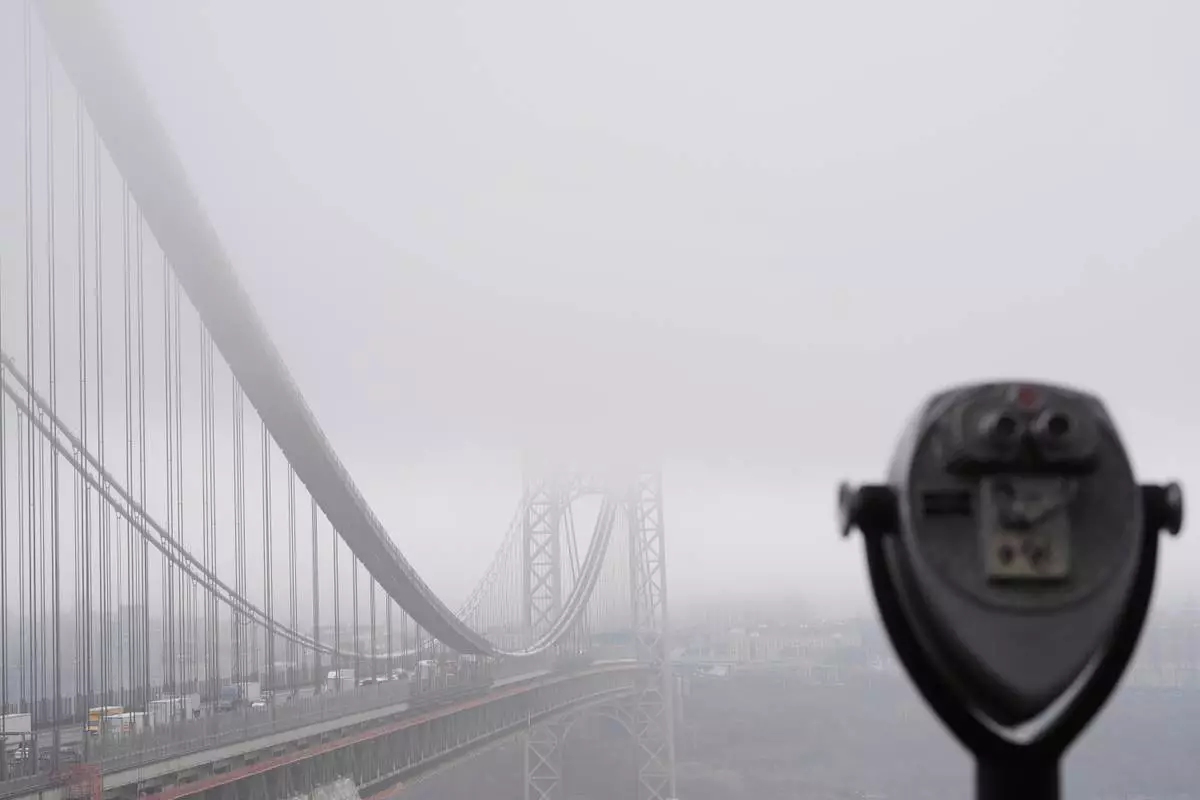
Dense fog and low clouds cover parts of the George Washington Bridge as seen from Fort Lee, N.J., Monday, March 16, 2026. (AP Photo/Seth Wenig)

A person bundles up and fishes on a breakwater by Montrose Harbor, Monday morning, March 16, 2026, in downtown Chicago. (AP Photo/Kiichiro Sato)
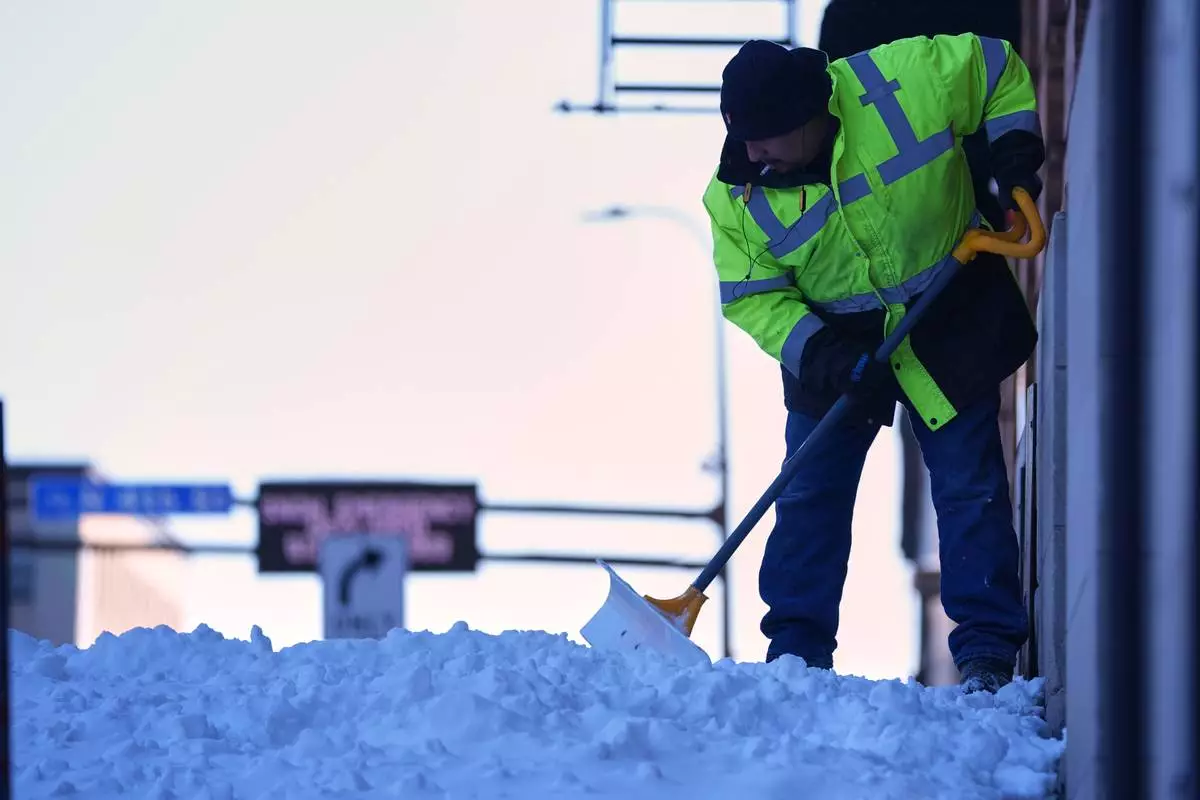
A man shovels snow after a snowstorm Monday, March 16, 2026, in Minneapolis. (AP Photo/Abbie Parr)
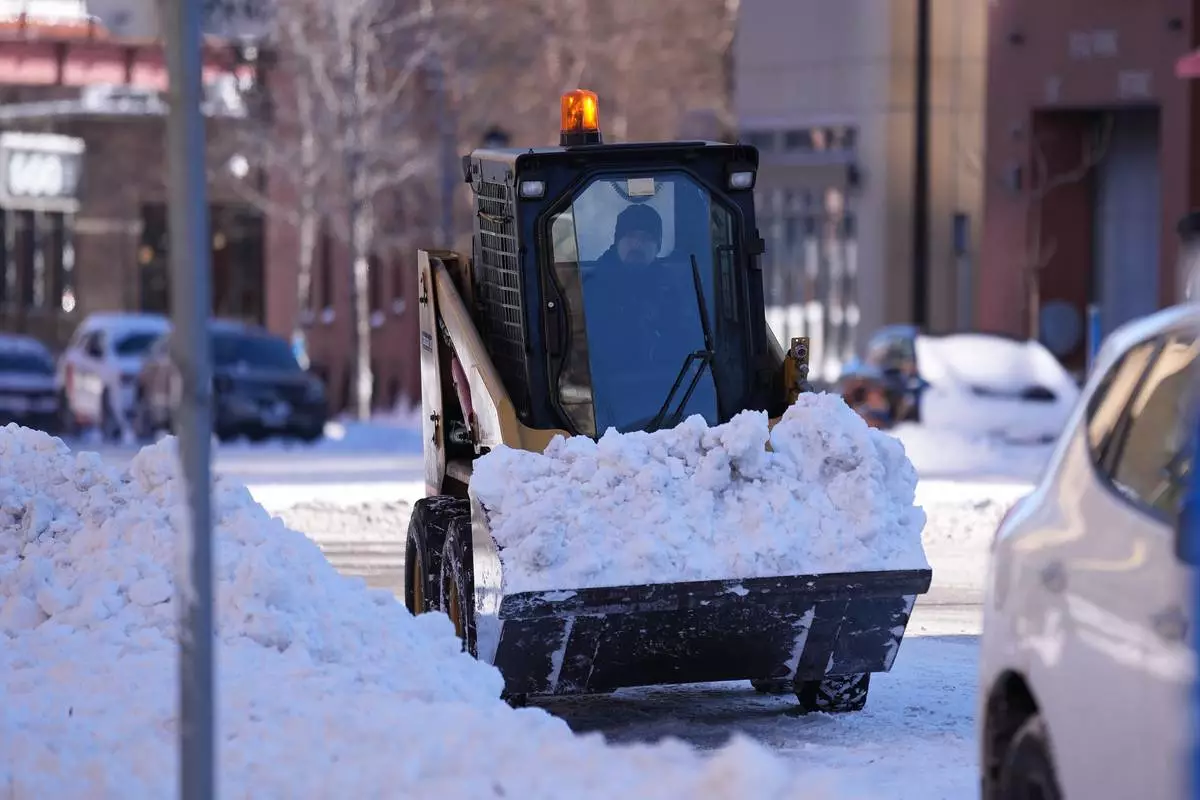
Snow is plowed after a snowstorm Monday, March 16, 2026, in Minneapolis. (AP Photo/Abbie Parr)
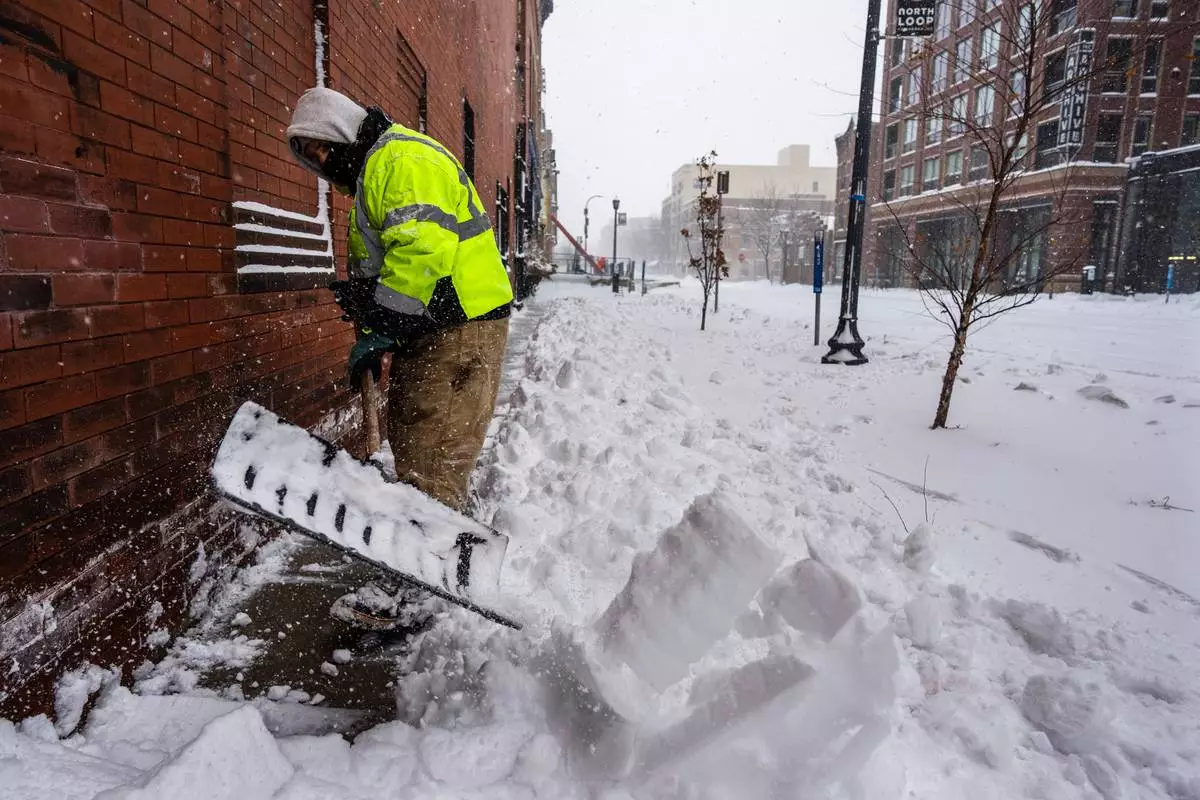
Victor Alomoto who is from Ecuador cleared the sidewalk for the River Valley Church in the North Loop Pedestrians during the snow storm in Minneapolis, Minn., on Sunday, March 15, 2026.(Richard Tsong-Taatarii/Minnesota Star Tribune via AP)
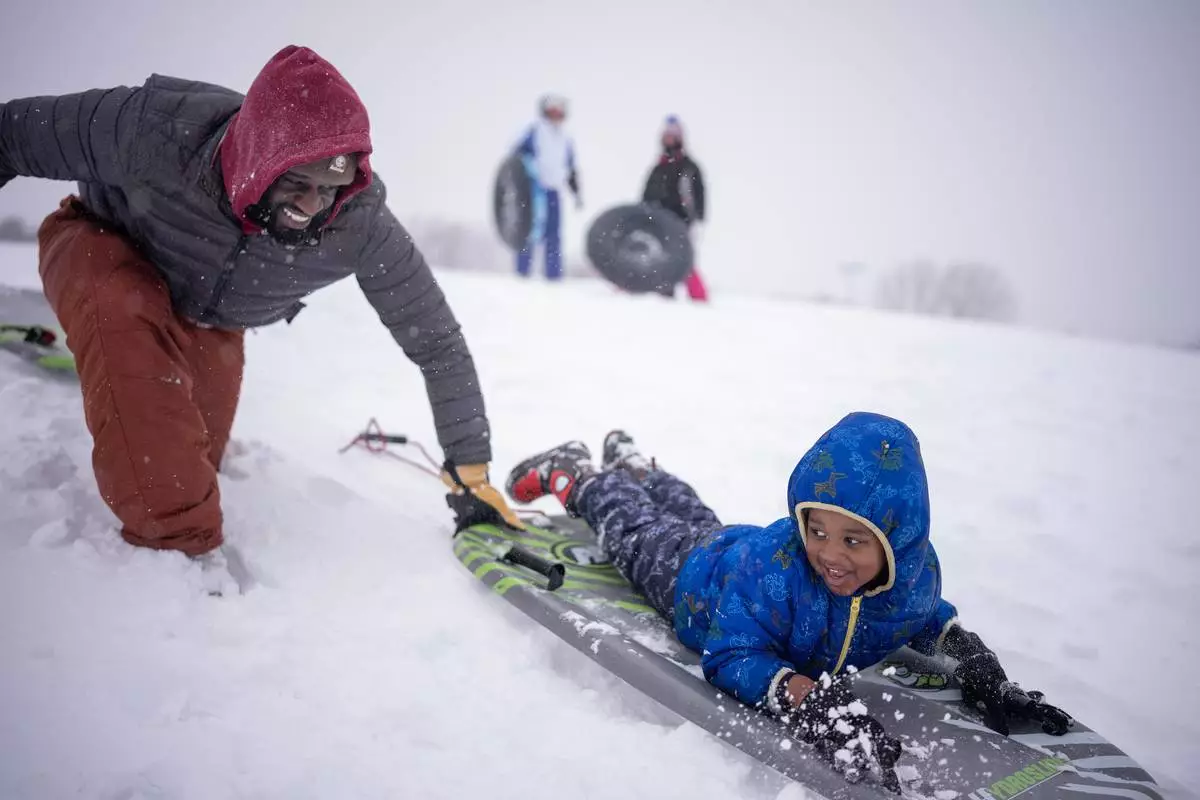
Ogo Akpati and his son Brycson Akpati, 3, braved the strong winds and had fun sliding down a hill in Central Park Sunday, March 15,2026 in Brooklyn Park, MN. (Jerry Holt/Minnesota Star Tribune via AP)
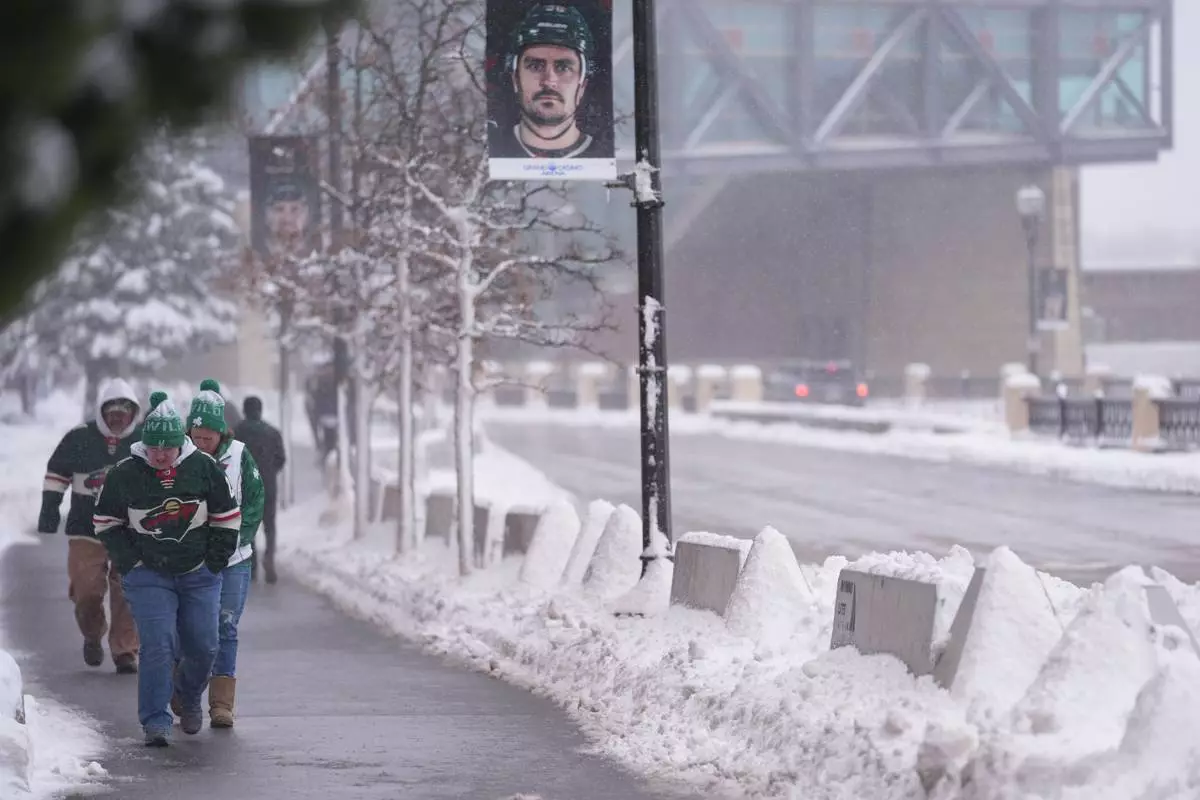
Fans walk through snowy streets before an NHL hockey game between the Minnesota Wild and Toronto Maple Leafs, Sunday, March 15, 2026, in St. Paul. (AP Photo/Abbie Parr)
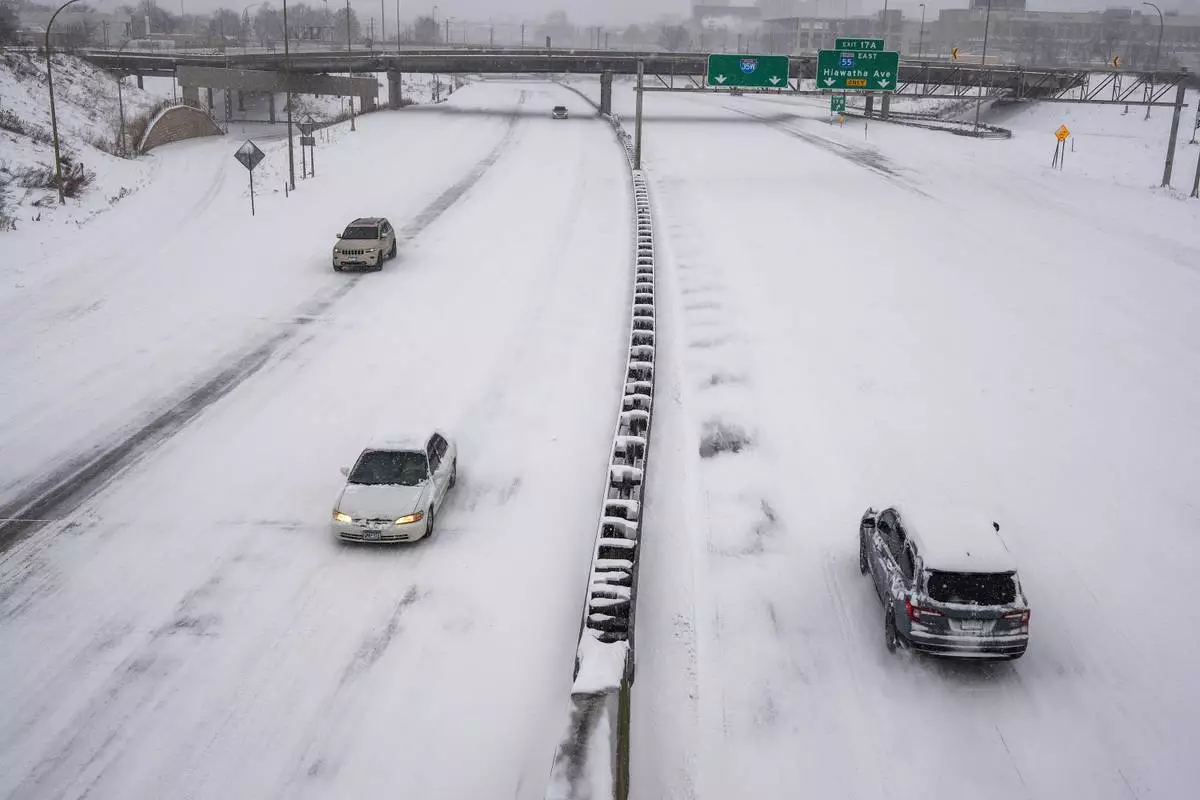
People drive on a snow-covered freeway during a snow storm Sunday, March 15, 2026, in Minneapolis. (Richard Tsong-Taatarii/Minnesota Star Tribune via AP)
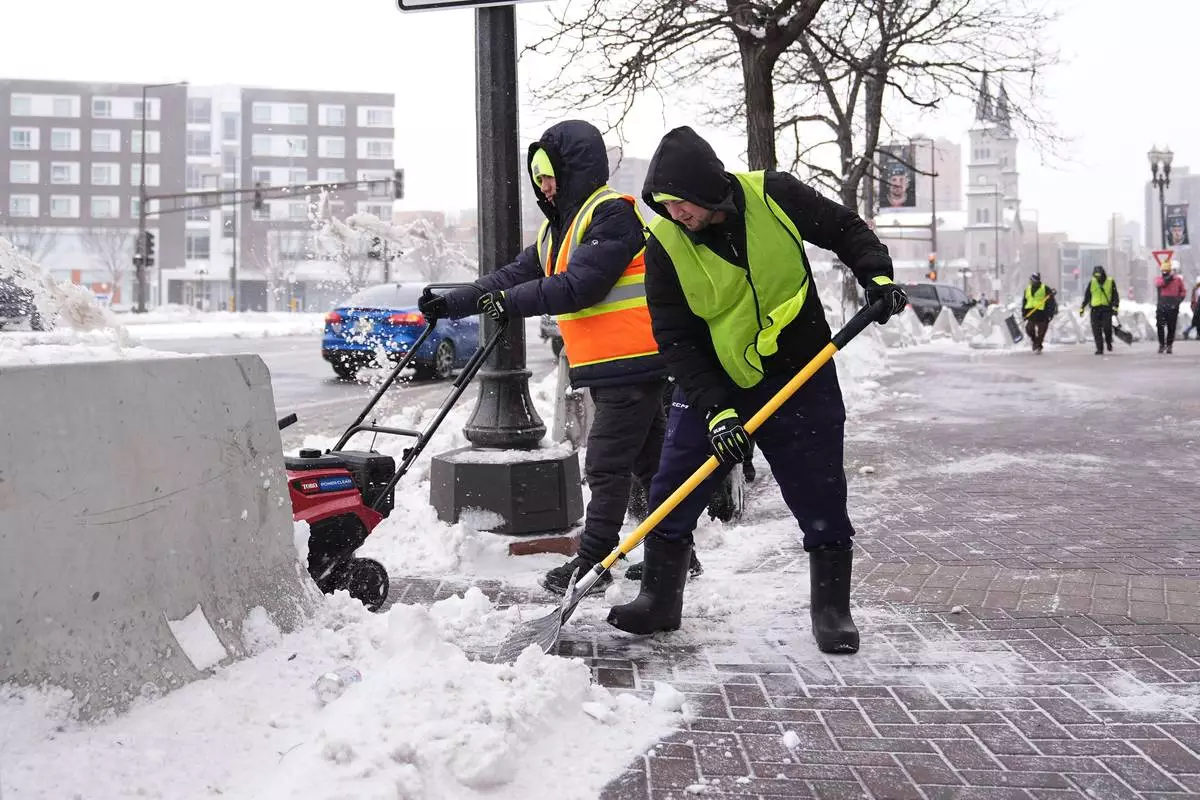
Workers clear snow off the ground Sunday, March 15, 2026, in St. Paul, Minn. (AP Photo/Abbie Parr)