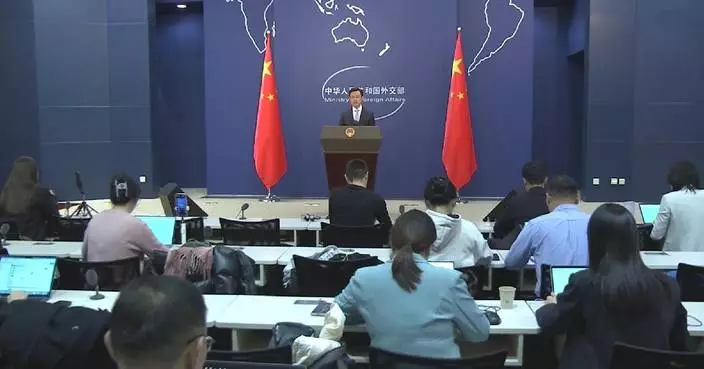
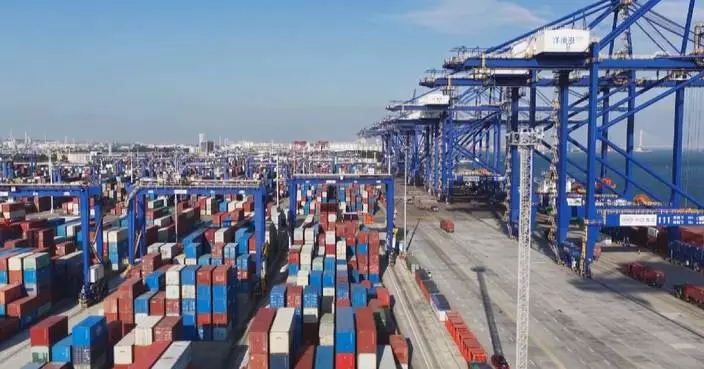
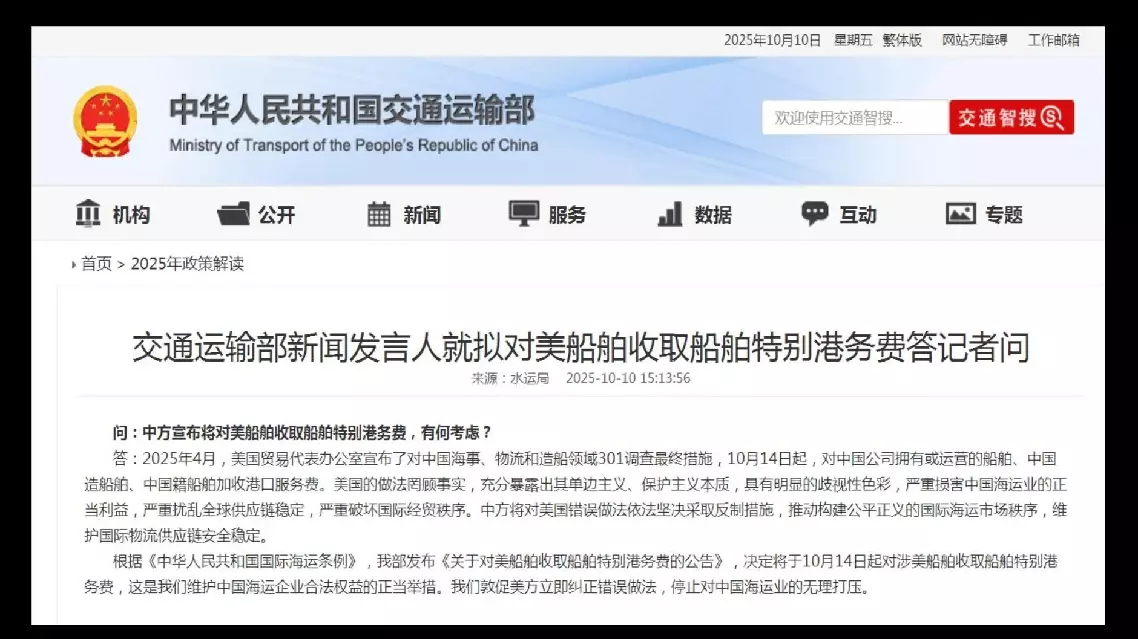
China's Ministry of Transport announced Friday that the country will charge special port fees on ships owned or operated by U.S. enterprises, organizations and individuals starting Oct. 14.
The announcement came in response to the U.S. decision to impose additional port fees on Chinese ships after a Section 301 investigation, effective Oct. 14, according to the ministry.
Ships subject to the special port fees also include those owned or operated by entities where U.S. enterprises, organizations and individuals hold a direct or indirect stake of 25 percent or more, as well as all the U.S.-flagged and U.S.-built vessels, the ministry said.
The transport ministry outlined a phased escalation for the special port fees on eligible U.S. vessels berthing at Chinese ports, which will initially be 400 yuan (about 56.3 U.S. dollars) per net tonne from Oct. 14 and increase annually on April 17 for the subsequent three years.
"It is a justified move to safeguard the legitimate rights and interests of Chinese maritime enterprises," the ministry said, noting that the U.S. actions have seriously violated relevant international trade principles and the China-U.S. maritime transport agreement and caused severe disruption to maritime trade between the two countries.
China urges the United States to immediately correct its wrongdoings and cease its unwarranted suppression of China's maritime industry, the ministry added.
China to charge special port fees on US ships
The Republic of Korea (ROK)'s former impeached President Yoon Suk-yeol on Friday was sentenced to five years in prison on arrest obstruction charges.
The criminal division of the Seoul Central District Court in charge of Yoon's obstruction of justice case handed down the prison sentence to Yoon for abusing the presidential security service to hinder the anti-corruption agency from executing its arrest warrant in January 2025.
The Corruption Investigation Office for High-ranking Officials (CIO) was once thwarted in its attempt to arrest Yoon as the presidential security service formed human shields and bus blockades to prevent investigators from entering the presidential residence.
The team of Cho Eun-suk, an independent counsel who led investigations into Yoon's insurrection and other charges, demanded a 10-year prison term for Yoon.
The court said Yoon privatized the presidential security service for personal safety and private interests by blocking the law enforcement agencies' lawful execution of an arrest warrant and attempting to destroy evidence, pointing out that despite the very bad nature of his crime, he consistently offered unconvincing excuses and showed no remorse.
The court stressed that severe punishment was necessary, considering the need to restore the rule of law damaged by Yoon's crime, but it noted that the fact that he was a first-time offender with no criminal record was considered a favorable factor.
The sentencing, which was broadcast live, was Yoon's first verdict coming from his botched martial law bid.
The first-instance sentencing for Yoon's insurrection charges was scheduled for Feb 19. The special counsel sought a death penalty for Yoon on the charges.
Yoon declared emergency martial law on the night of Dec 3 in 2024, but it was revoked hours later by the National Assembly.
The constitutional court upheld a motion to impeach Yoon in April 2025, officially removing him from office.
The ousted leader was indicted while in detention in January 2025 on charges of leading an insurrection, becoming the first sitting ROK president facing such prosecution.
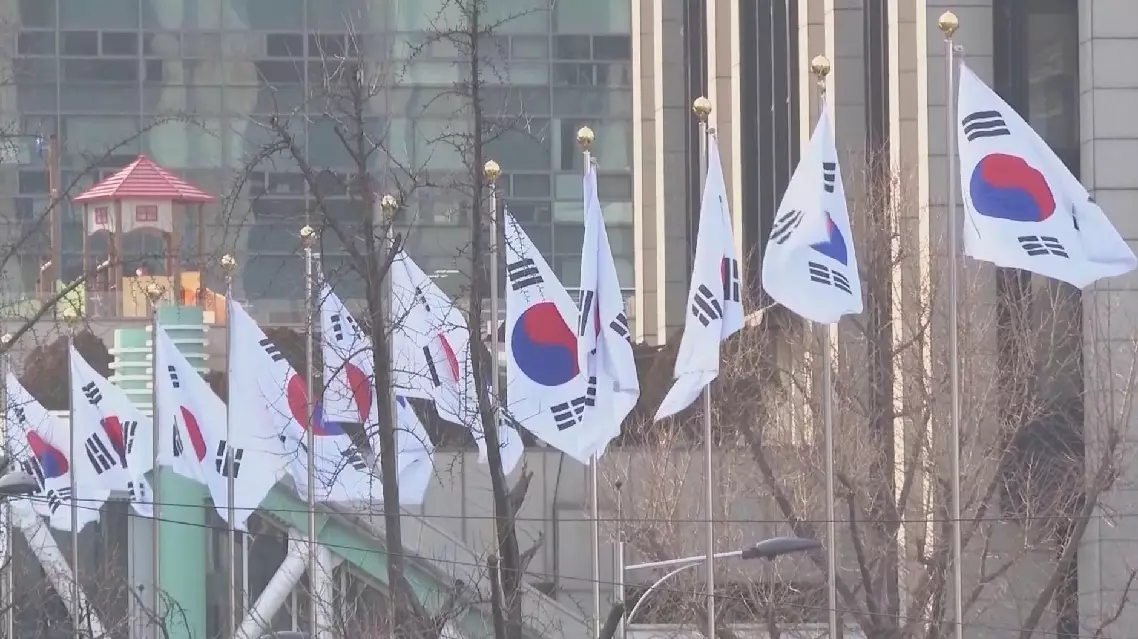
ROK ex-president Yoon sentenced to 5 years in prison on arrest obstruction charges