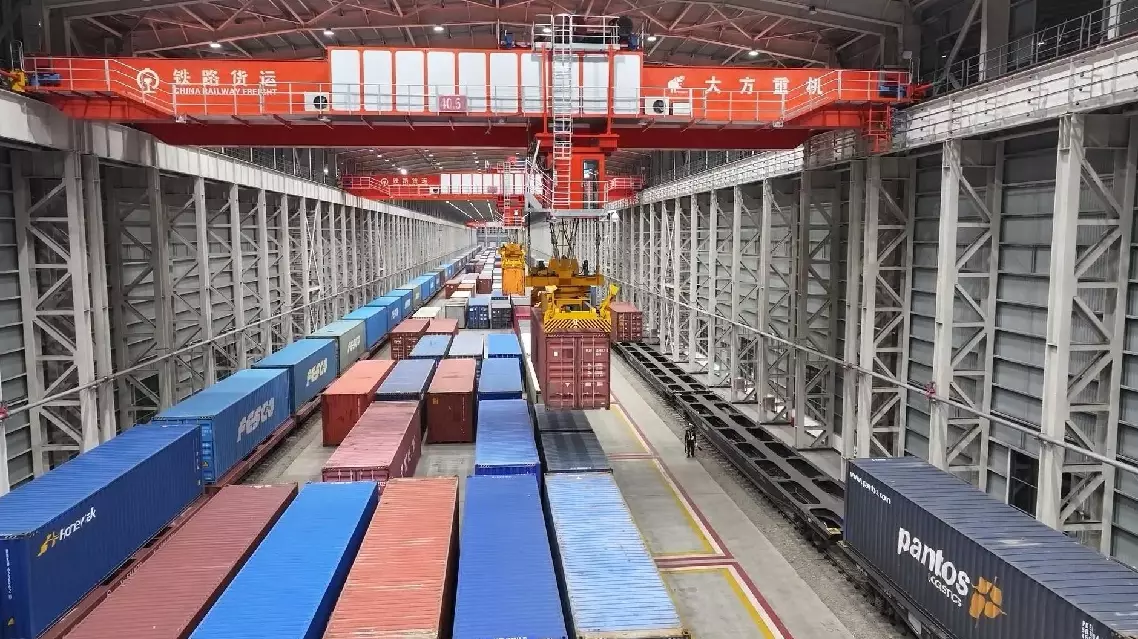
The Alashankou Port in northwest China's Xinjiang Uygur Autonomous Region handled over 7,600 China-Europe (Central Asia) freight train trips in 2024, making it the busiest China-Europe train gateway in the country, according to local railway authorities.
At Alashankou station, a train loaded with goods departs every 70 minutes. The station, located at the Alashankou border hub, is the most active border exit point with a constant flow of daily freight bound for destinations across Central Asia and Europe.
With 17 rail tracks, this site moves over 200 types of Chinese-made goods, including new energy vehicles, electronics, and daily consumer products, into international markets.
During China's 14th Five-Year Plan period (2021-2025), China Railway Urumqi Group completed key infrastructure projects, such as the second line from Jinghe to Alashankou on the Lanzhou-Xinjiang railway. These upgrades, including new customs facilities like the container transfer yard, have significantly enhanced the station's operational capacity.
"We've built a comprehensive inspection yard with three standard-gauge lines and three broad-gauge lines, a total of six lines. That has clearly improved our efficiency," said Yan Huapeng, director of the container transfer yard, Alashankou Station.
Further boosting efficiency is the technological upgrade of customs facilities. At the newly launched Alashankou Railway integrated inspection yard, UAVs patrol train routes, and sealed corridor bridges automatically dock with trains for cargo scanning and inspection.
In 2021, 5,848 China-Europe freight trains passed through Alashankou. By 2024, that number surged to 7,684, a more than 30 percent increase from 2021.
"That was our old vehicle inspection room. It could only handle four trucks at a time. Now we've switched to a four-lane setup that can inspect eight trucks at once. By combining human inspection with smart systems, we've nearly cut customs processing time by half," said Gao Jian, deputy captain of the third patrol team, Alashankou Border Inspection Station.
The high efficiency at the Alashankou port has fueled local economic growth and industrial upgrading.
"In 2025, we're handling over 1,000 truckloads of parcels every month. Our destinations now include the UK, Belgium, Germany, and the Netherlands. That's more than two million parcels per month," said Yang Haicheng, chairman of Alashankou Oushengtong International Air and Trucking Logistics.
"Over the past few years, many of our cross-border e-commerce routes have seen annual growth rates of 50 percent to even 100 percent," said Mo Shengjun, secretary general of Alashankou Import and Export Trade Chamber of Commerce.
Today, Alashankou is home to nearly 800 enterprises clustered around logistics, processing, and trade. In 2024, the total import and export trade volume of the Alashankou Comprehensive Bonded Zone exceeded 30 billion yuan (about 4.21 billion U.S. dollars), with annual cross-border e-commerce export parcels surpassing 27 million.
Over the past five years, Alashankou has rapidly developed into a critical gateway for China's western opening-up strategy, serving as a powerful hub for connecting the country's economy with global trade routes.
"Our freight volume grew from 22.188 million tons in 2021 to 28.927 million tons in 2024. More 'Made in China' goods are speeding through Alashankou toward global markets, while 'global bestsellers' are entering China faster to meet consumer demands," said Zhang Chengjun, deputy director of Alashankou Bonded Zone Administrative Committee.
Xinjiang's Alashankou port sees surge in China-Europe rail freight