Southwest China's Guizhou Province, once isolated by steep karst terrain, is now home to the world's tallest bridges, a record‑setting radio telescope, and villages where centuries‑old traditions endure.
Long described as the land of "no three days of clear skies and no three feet of flat ground," Guizhou now shows how engineering reshapes nature and how roads lead not just across mountains but deep into Chinese culture.
Guizhou's dramatic karst landscape, with peaks rising one after another, long made travel arduous. As captured in the film "Kaili Blues", journeys once meant winding mountain roads. Today, bridges turn natural barriers into pathways.
Nearly half of the world's 100 tallest bridges are in Guizhou, including the Huajiang Canyon Bridge at 626 meters, the tallest globally.
Rugged terrain also makes Guizhou an ideal site for science. The world's largest single‑dish radio telescope, FAST, sits in a natural karst depression, where silence replaces phone signals and discoveries of more than 1,000 stars have brought pride to Chinese scientists.
The same spirit of perseverance can be found much closer to the ground, in the villages and workshops where centuries-old traditions live on.
Take Xijiang Qianhu Miao Village, where homes are built into the mountainside.
"Built into the mountainside, these Miao stilt houses reflect a way of life shaped by the terrain. There's so little flat land that it's all dedicated to farming, and homes are built along the slopes - partly elevated, partly anchored into the hill. We call them 'Diaojiaolou.' It's a practical solution to the limited space, where architecture and necessity meet," said village elder Tang Shouhe.
That same ingenuity extends to the region's artistic traditions. In the batik workshop of Li Wenfang, an intangible cultural heritage artisan, the craft has been handed down for generations.
"This form of batik uses wax to help create the pattern. What's covered stays white, while the rest is dyed with indigo. It's a craft that's been handed down for over 1,900 years. In my family, we're now into the fifth generation. Many of our patterns feature butterflies. It's a symbol of the Miao people, connecting us to our ancestors," said Li.
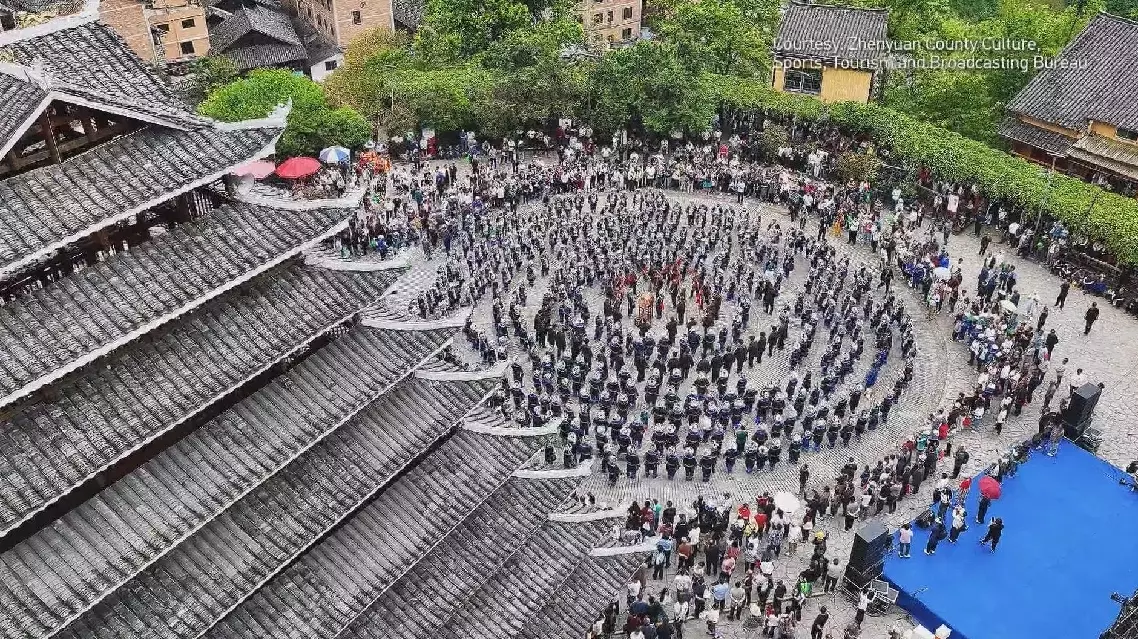
About 150 kilometers from Xijiang Qianhu Miao Village lies the ancient town of Zhenyuan, once a military stronghold. Here, another tradition takes center stage - the Sanyuesan Festival, also known as the Double Third Festival, where love is found through song.
"The Sanyuesan festival honors an ancient love story between Liang Yin and Qiao Sheng, two people who fell in love despite family opposition to the match. Their story ended in tragedy, but today it lives on as a symbol of devotion," said Tian Dongmei, Sanyuesan event organizer.
Engineering records, centuries-old traditions highlight Guizhou's transformation