German Chancellor Friedrich Merz said on Sunday that the recent U.S.decision to reduce its troop presence in Germany has no connection to his earlier critical remarks regarding the Iran conflict.
The Pentagon announced on Friday that it is planning to withdraw about 5,000 U.S. troops from Germany, which is expected to be completed over the next six to 12 months. This announcement came after Merz's remarks about the United States being "planless" in its military engagement in Iran and "humiliated by the Iranian leadership."
During an interview with public broadcaster ARD, Merz said that he was not surprised by the U.S. decision on troop reduction.
Merz said that, despite the recent verbal tensions with U.S. President Donald Trump, he would not give up on cooperation with the U.S. side. Calling the United States as Germany's most important partner within the North Atlantic Treaty Organization (NATO), Merz said that there has been no reduction in U.S. nuclear-sharing arrangements and that the U.S. commitment to providing nuclear deterrence for the NATO region remains in place.
Merz also confirmed that the United States will not deploy Tomahawk cruise missiles in Germany for the time being, but he believed that the plan has not been permanently abandoned. "The Americans currently do not have enough themselves," he said.
The Tomahawk weapon systems were originally pledged by former U.S. President Joe Biden in 2024 to bolster European deterrence. Along with the troop cut announcement, multiple U.S. media outlets recently said Washington has also canceled the plan to reinforce European troops.
Trump said on Saturday that the United States plans to withdraw "a lot further" than the 5,000 troops from Germany that the Pentagon had said earlier.
"We're going to cut way down, and we're cutting a lot further than 5,000," Trump told reporters before boarding Air Force One in the southeastern U.S. state of Florida.
German Foreign Minister Johann Wadephul said on Thursday that Germany is prepared for a possible reduction of the U.S. troops in the country.
More than 36,000 U.S. active duty troops were deployed to bases throughout Germany as of the end of last year, along with nearly 1,500 reservists and 11,500 civilians, according to Defense Department data.
Germany also hosts the headquarters of U.S. European Command and Africa Command, and its Ramstein Air Base serves as a key hub for U.S. military operations.

German Chancellor Merz says US troop withdrawal not related to his remarks on Iran conflict
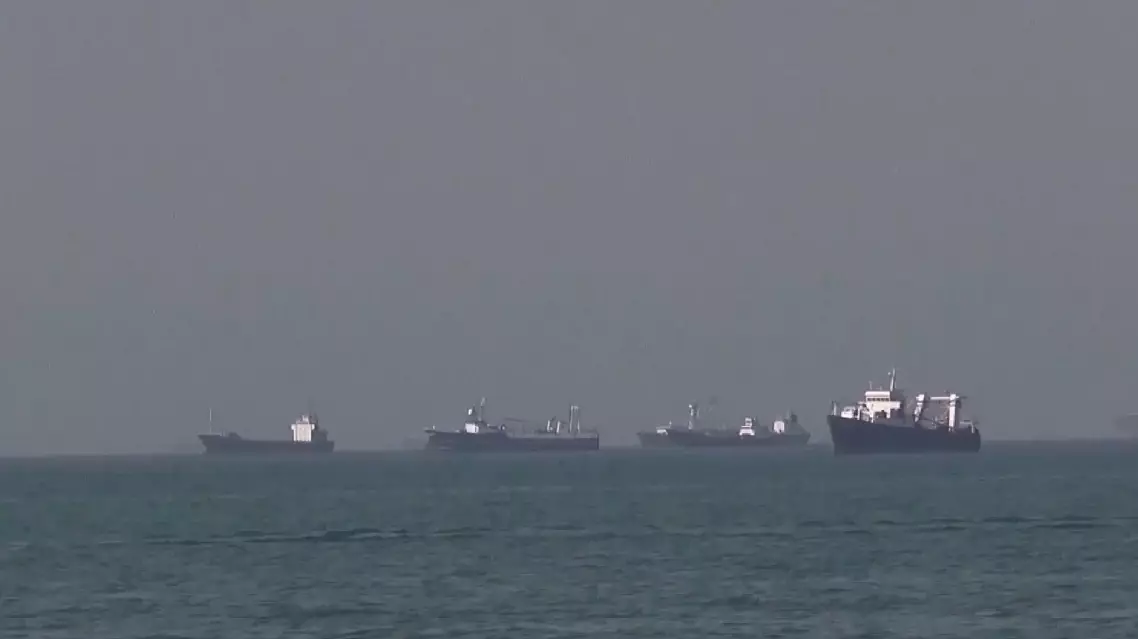
A top Iranian parliament official said Monday that any U.S. interference in Iranian new maritime management rules for the Strait of Hormuz would be seen as a ceasefire violation.
Ebrahim Azizi, chairman of the Iranian parliament's national security and foreign policy committee, made the remarks in a social media post.
That warning came alongside other sharp condemnations from Tehran.
According to Iranian media reports, Ali Akbar Velayati, adviser to Iran's supreme leader, said on Sunday that the United States, ignoring the fact that global food and fertilizer supply chains pass through the Strait of Hormuz under Iranian control, has threatened Iran with famine, which reflects the U.S. side's lack of understanding of the global economic and political situation.
Also on Sunday, according to Iran's Press TV, Mohsen Rezaee, a military adviser to Iran's supreme leader, said that Iran has prepared a grave for U.S. forces and aircraft carriers. He called the United States the only pirate state that possesses aircraft carriers and said that if tensions escalate, those carriers will face destruction. He also said that Iran has the capability to counter pirates and sink warships.
As Iranian officials issued those warnings, the U.S. began its operation.
U.S. President Donald Trump said Sunday in a social media post that the United States will begin guiding ships out of the Strait of Hormuz on Monday morning, Middle East time.
Calling the action "Project Freedom," Trump said it is "a humanitarian gesture."
Trump also said in his post that U.S. representatives are in very positive discussions with Iran that could bring very positive results. Iran had not officially responded.
The U.S. Central Command (CENTCOM) said its forces would start supporting the "Project Freedom" on Monday to restore commercial shipping through the strait.
Brad Cooper, commander of the CENTCOM, said the support is critical to regional security and the global economy while the United States maintains a maritime blockade.
According to Iranian sources on Sunday, oil-shipping monitor TankerTrackers.com reported that 25 crude oil tankers left Iran in April. Seven returned due to the U.S. blockade in the Arabian Sea, two were seized by the United States in the Indian Ocean, and one sailed to the Far East. Most of the remaining 15 arrived at their destinations in the first half of April.
The United States and Israel launched large-scale military operations against Iran in late February, and Iran launched counterattacks. After U.S.-Iran talks in Islamabad, Pakistan, ended without results in April, the United States began imposing a maritime blockade on Iran. The aircraft carriers, USS Abraham Lincoln and the USS George H.W. Bush strike groups are operating in the Arabian Sea to enforce the maritime blockade on Iranian ports.
Iran warns U.S. interference in Strait of Hormuz violate ceasefire