CAIRO (AP) — As the Middle East broadly welcomes a ceasefire in the Israel-Hamas war in Gaza, Iran finds itself at one of its weakest moments since its 1979 Islamic Revolution.
Tehran has operated its self-described “Axis of Resistance” over several decades, supporting militant groups and nations allied with it against Israel and the United States. But as Israel bombed the Gaza Strip, it also turned its crosshairs toward top leaders abroad in militant groups like Hamas, Lebanon's Hezbollah and even the top echelon within Iran's military and nuclear program — killing many and disrupting their ability to fight back.
Click to Gallery
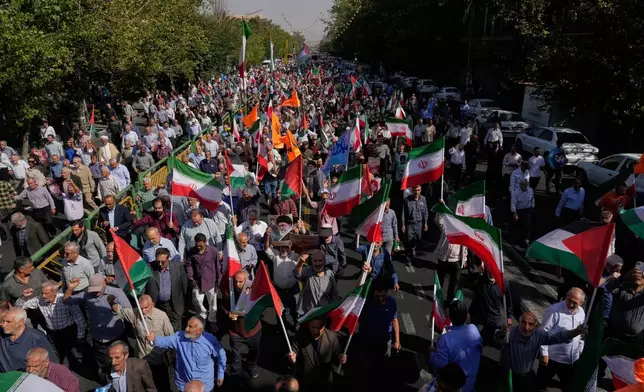
Iranian worshippers hold Iranian and Palestinian flags during an anti-Israeli rally after their Friday prayers at the Enqelab-e-Eslami (Islamic Revolution) street, in Tehran, Iran, Friday, Oct. 10, 2025. (AP Photo/Vahid Salemi)
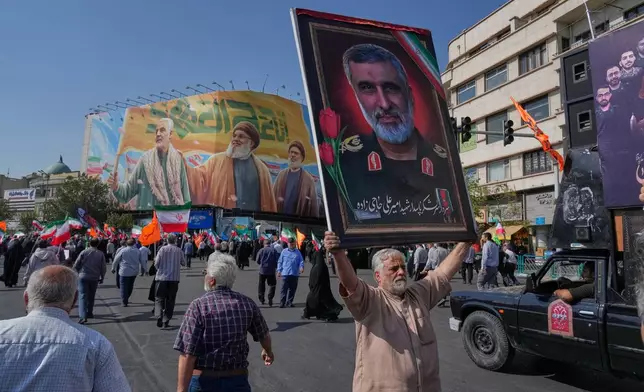
A man holds up a portrait of the late commander of Iran's Revolutionary Guard aerospace division Gen. Amir Ali Hajizadeh, who was killed in an Israeli strike in June, as a huge banner is seen at background showing the late commander of the Iran's Revolutionary Guard expeditionary Quds Force, Gen. Qassem Soleimani, left, who was killed in a U.S. drone attack in 2020, and two late Hezbollah leaders Hassan Nasrallah, center, and Hashem Safieddine, who were killed in Israeli airstrikes in 2024, during an anti-Israeli rally after the Friday prayers at the Enqelab-e-Eslami (Islamic Revolution) square, in Tehran, Iran, Friday, Oct. 10, 2025. (AP Photo/Vahid Salemi)
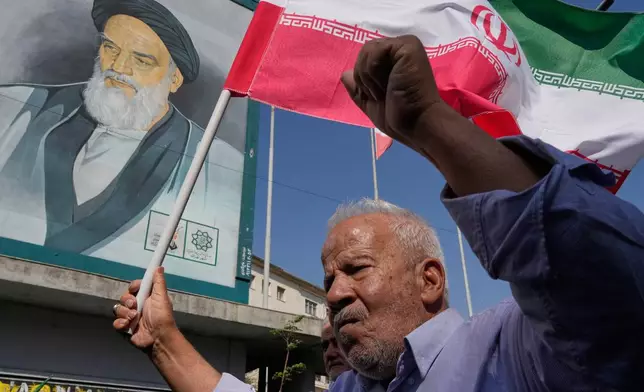
An Iranian worshipper holds his country's flag in front of a portrait of the late revolutionary founder Ayatollah Khomeini during an anti-Israeli rally after the Friday prayers at the Enqelab-e-Eslami (Islamic Revolution) street, in Tehran, Iran, Friday, Oct. 10, 2025. (AP Photo/Vahid Salemi)
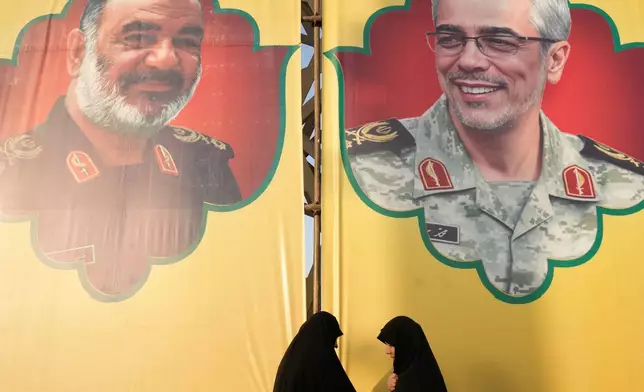
Women talk in front of the banners showing portraits of the late chief of the general staff of Iran's armed forces, Gen. Mohammad Hossein Bagheri, right, and the late commander of Revolutionary Guard Gen. Hossein Salami, who were killed in Israeli strike in June, during a commemoration marking the first death anniversary of Hezbollah leaders Hassan Nasrallah and Hashem Safieddine, who were killed in Israeli airstrikes in Beirut, in Tehran, Iran, Thursday, Oct. 2, 2025. (AP Photo/Vahid Salemi)
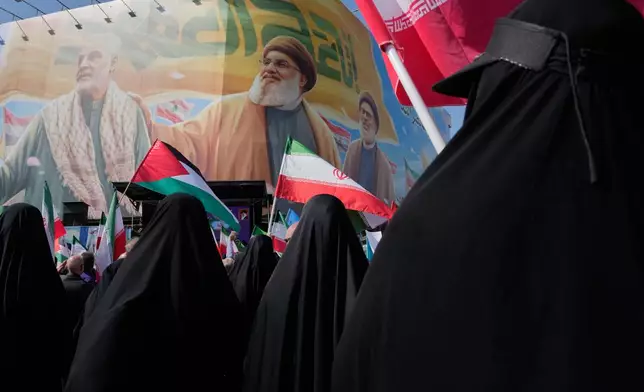
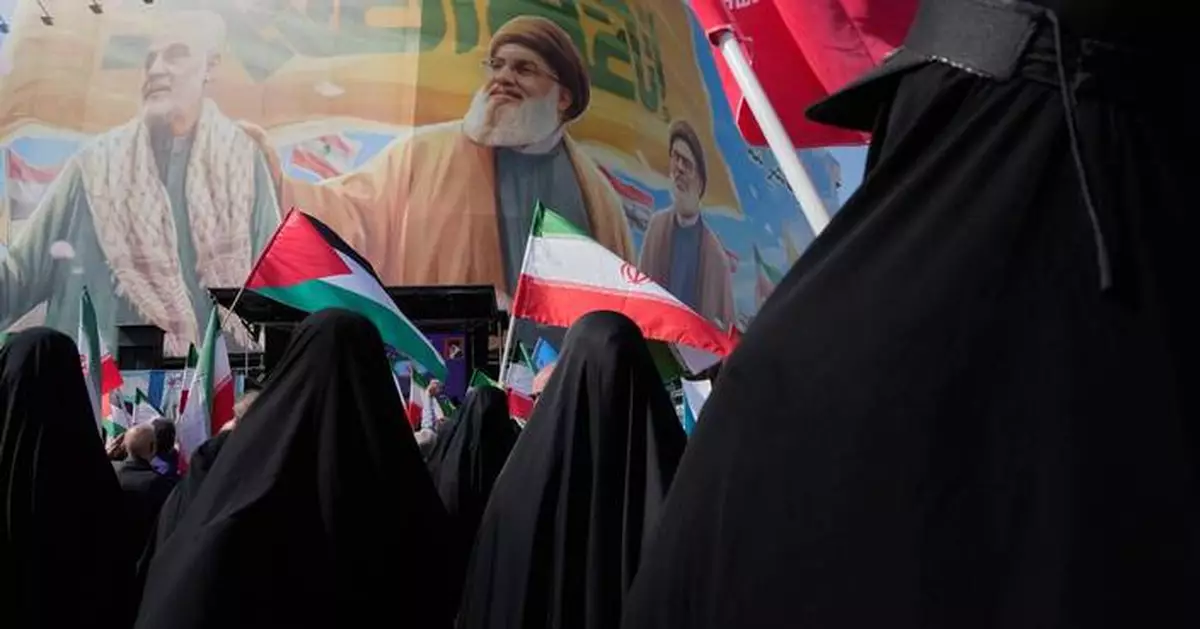
Iranian worshippers wave Palestinian and Iranian flags in front of a banner showing the late commander of the Iran's Revolutionary Guard expeditionary Quds Force, Gen. Qassem Soleimani, left, and two late Hezbollah leaders Hassan Nasrallah, center, and Hashem Safieddine, during an anti-Israeli rally after the Friday prayers at the Enqelab-e-Eslami (Islamic Revolution) square, in Tehran, Iran, Friday, Oct. 10, 2025. (AP Photo/Vahid Salemi)
As President Donald Trump prepares for a Middle East trip that likely will see him praised by Israel and Arab nations, Iran won't be at the table as it still struggles to recover from June's 12-day war.
How Tehran's theocracy responds in the weeks and months ahead, whether that means lashing out or trying to rebuild its hobbled economy at home, will be crucial.
“Undoubtedly this is a not a proud moment for Iran," said Ali Vaez, the Iran project director at the International Crisis Group. “Its alliance system in the region is in ruins but it doesn’t mean that the 'Axis of Resistance' is no more.”
Iranian state media has sought to describe the Gaza ceasefire as a victory for Hamas, despite the war destroying the Gaza Strip and killing over 67,000 Palestinians, according to Gaza's Health Ministry, which doesn't differentiate between civilians and combatants but says around half the dead are women and children.
Iran's Foreign Ministry welcomed “any decision ... that guarantees halting the genocide of Palestinians.” Iranian Foreign Minister Abbas Araghchi reiterated that on Saturday, telling state television that Hamas decided to accept the deal and that Tehran has "always supported any plan, any action that led to the halt of crimes, genocide” by Israel against the people of Gaza.
But perhaps more tellingly, an adviser to Iran's 86-year-old Supreme Leader Ayatollah Ali Khamenei suggested the ceasefire would only lead to conflict elsewhere in the region.
“The start of the ceasefire in Gaza may be the behind-the-scenes end of the ceasefire somewhere else!” Ali Akbar Velayati, an adviser to Khamenei, wrote on X, referencing Hezbollah, Yemen's Iranian-backed Houthi rebels and Iraq.
The fear of further Israeli strikes, particularly on Iran, remains acute in the public's mind as much of Iranian air defenses likely were destroyed by Israel in June. Khamenei has not resumed his usual routine of weekly speeches to audiences. Without explanation, Iran avoided holding a major military commemoration marking the end of the Iran-Iraq war in September, which typically sees top officials watch drones and missile launchers parade past them.
Iran's economy also has suffered under international sanctions and as global energy prices fall.
“Iran has always focused on its interests, we do not have resources anymore, our economy has weakened," said Tehran-based analyst Saeed Leilaz. "Our support to Hamas was a reaction to U.S. to divert conflicts from our borders.”
Others are less optimistic.
“Iran is like a bankrupt gambler after winning some small money in the first rounds," said Amir Kazemi, a university student in Tehran. "When Hamas attacked Israel, Iran was happy about it. But now, after the ceasefire, Iran finds nothing in its pocket.”
In the immediate years after Iran's revolution, its theocratic government sought to export its Shiite revolutionary ideology more widely in the Middle East. That morphed following its devastating 1980s war with Iraq into more of an effort to provide a level of deterrence as Arab nations around it purchased sophisticated American bombs, warplanes and tanks that Tehran couldn't access due to sanctions.
The U.S. military's presence across the Persian Gulf also expanded following the 1991 Gulf War, with Arab nations granting basing rights to American forces to Tehran's constant anger.
The peak of the “Axis of Resistance” came in the chaotic years after the 2003 U.S.-led invasion of Iraq and Yemen's subsequent collapse into a civil war. Then, it could count on Hezbollah, Syrian autocrat Bashar Assad, the Houthis, Iraqi militant groups and even Hamas — a Sunni militant group.
Today, the Mideast looks far different.
In Syria, rebels overthrew Assad last year, Israeli strikes killed Hezbollah and Hamas' top leaders, while Iraqi militant groups faded into the background. Yemen's Houthis, while still capable of launching attacks on Israel and commercial shipping in the Red Sea corridor, find themselves now targeted by increasingly precise Israeli strikes.
And the 12-day war in June left Iran likely no longer enriching uranium for its nuclear program, which the West long has worried could be weaponized.
Iran, meanwhile, has yet to receive any major support from either China or Russia, despite providing Beijing with likely discounted oil and Moscow with the drones it uses in its war on Ukraine. Tehran has also shied away from confronting women who are increasingly abandoning the hijab, or headscarf, instead executing prisoners it already holds at a rate unseen in decades.
“The ceasefire is reflective of Tehran’s collapsing regional clout following the unraveling of its long-powerful ‘Axis of Resistance’ since 2024,” said Ali Fathollah-Nejad, the director of the Berlin-based Center for Middle East and Global Order. “The ceasefire will free Israeli military capacities that would now be used against Iranian interests — whether in Lebanon against Hezbollah or directly against Iran.”
For his part, Trump seized on Iran accepting the ceasefire as “terrific" news. However, there's been no move toward renewed public negotiations with Tehran over its nuclear program.
“Time is not on Iran’s side but their problem is no one is really giving them an exit ramp,” Vaez said. But whether Tehran would take the ramp also remains in question as its leaders still debate what turn to now take.
Associated Press writer Nasser Karimi in Tehran, Iran, contributed to this report.
EDITOR’S NOTE — Jon Gambrell, the news director for the Gulf and Iran for The Associated Press, has reported from each of the Gulf Cooperation Council countries, Iran and other locations across the Mideast and the wider world since joining the AP in 2006.
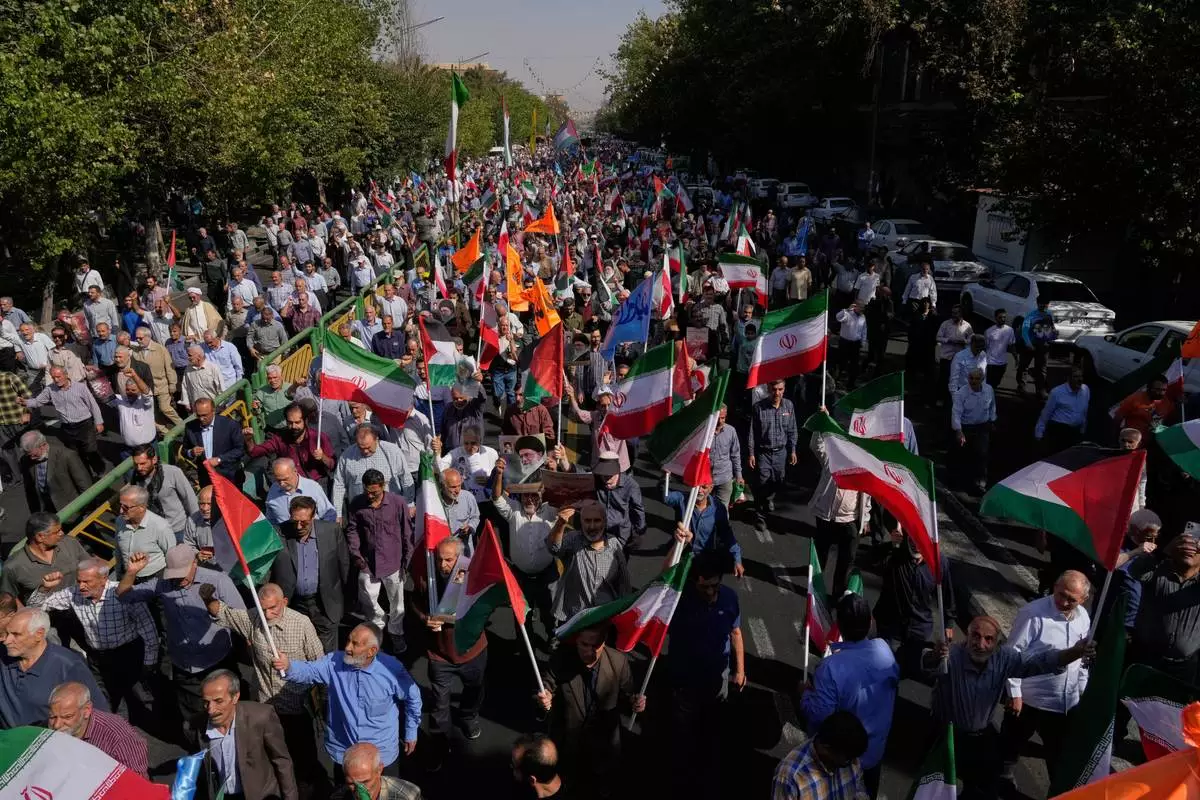
Iranian worshippers hold Iranian and Palestinian flags during an anti-Israeli rally after their Friday prayers at the Enqelab-e-Eslami (Islamic Revolution) street, in Tehran, Iran, Friday, Oct. 10, 2025. (AP Photo/Vahid Salemi)
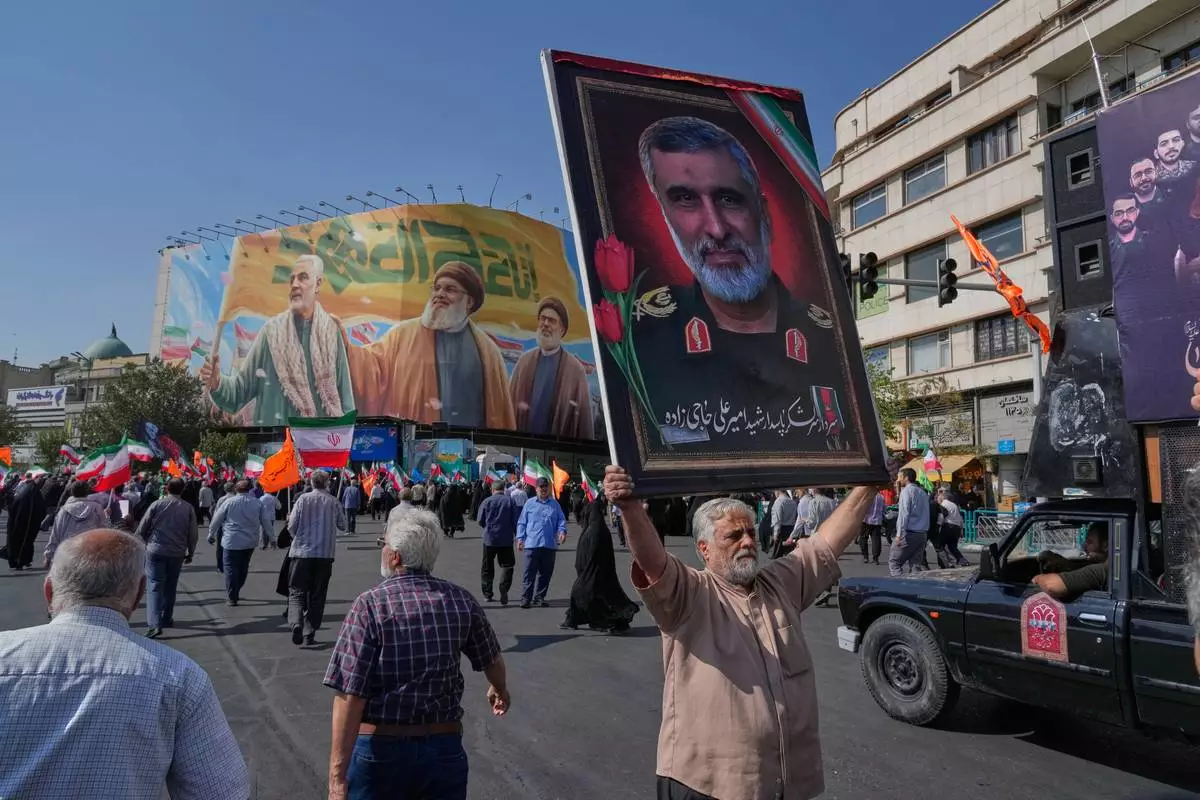
A man holds up a portrait of the late commander of Iran's Revolutionary Guard aerospace division Gen. Amir Ali Hajizadeh, who was killed in an Israeli strike in June, as a huge banner is seen at background showing the late commander of the Iran's Revolutionary Guard expeditionary Quds Force, Gen. Qassem Soleimani, left, who was killed in a U.S. drone attack in 2020, and two late Hezbollah leaders Hassan Nasrallah, center, and Hashem Safieddine, who were killed in Israeli airstrikes in 2024, during an anti-Israeli rally after the Friday prayers at the Enqelab-e-Eslami (Islamic Revolution) square, in Tehran, Iran, Friday, Oct. 10, 2025. (AP Photo/Vahid Salemi)

An Iranian worshipper holds his country's flag in front of a portrait of the late revolutionary founder Ayatollah Khomeini during an anti-Israeli rally after the Friday prayers at the Enqelab-e-Eslami (Islamic Revolution) street, in Tehran, Iran, Friday, Oct. 10, 2025. (AP Photo/Vahid Salemi)
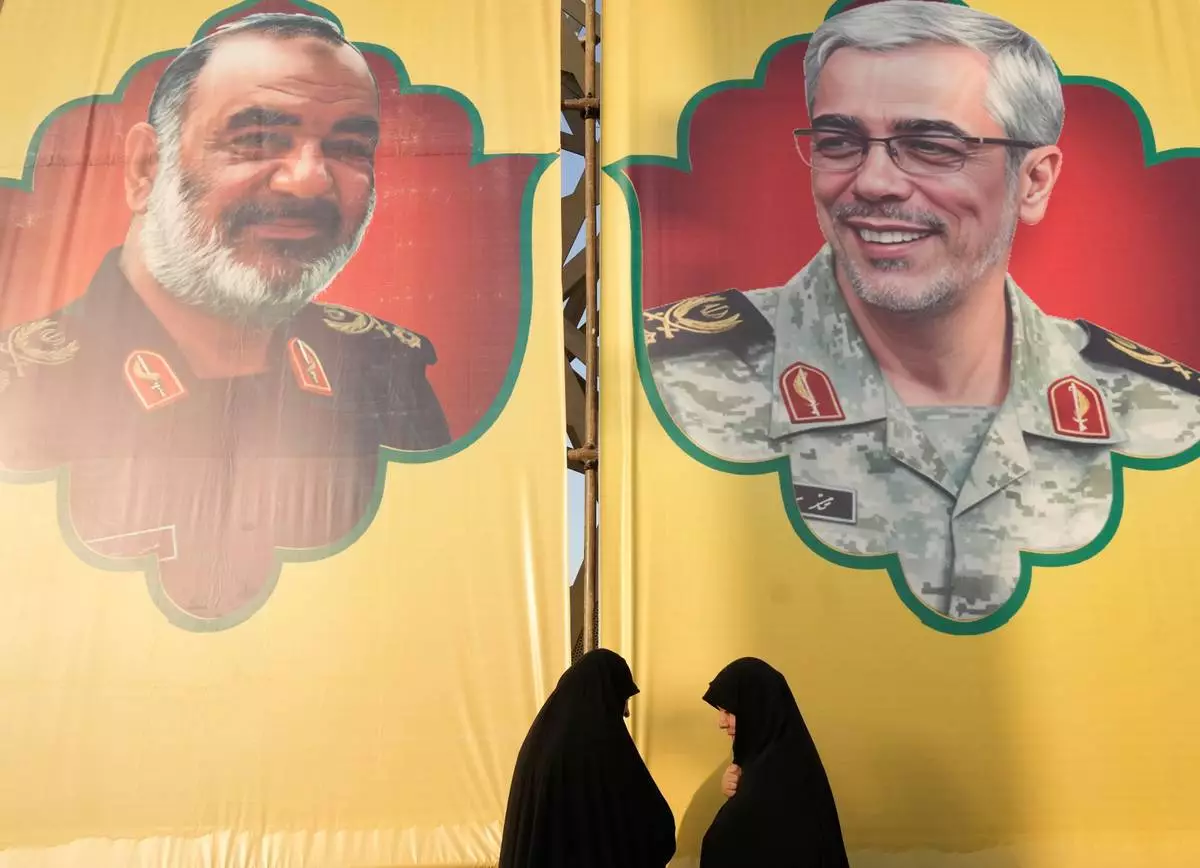
Women talk in front of the banners showing portraits of the late chief of the general staff of Iran's armed forces, Gen. Mohammad Hossein Bagheri, right, and the late commander of Revolutionary Guard Gen. Hossein Salami, who were killed in Israeli strike in June, during a commemoration marking the first death anniversary of Hezbollah leaders Hassan Nasrallah and Hashem Safieddine, who were killed in Israeli airstrikes in Beirut, in Tehran, Iran, Thursday, Oct. 2, 2025. (AP Photo/Vahid Salemi)
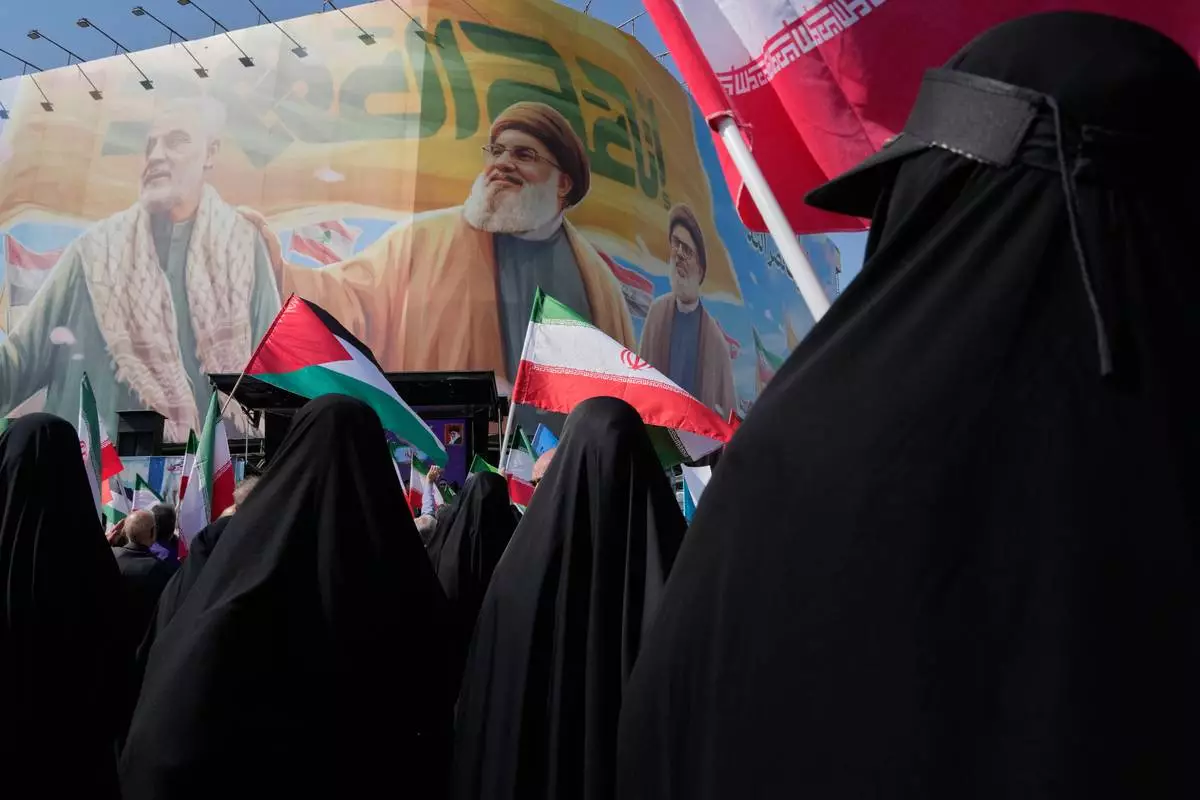
Iranian worshippers wave Palestinian and Iranian flags in front of a banner showing the late commander of the Iran's Revolutionary Guard expeditionary Quds Force, Gen. Qassem Soleimani, left, and two late Hezbollah leaders Hassan Nasrallah, center, and Hashem Safieddine, during an anti-Israeli rally after the Friday prayers at the Enqelab-e-Eslami (Islamic Revolution) square, in Tehran, Iran, Friday, Oct. 10, 2025. (AP Photo/Vahid Salemi)