Skip to Content Facebook Feature Image

Gazans begin clearing rubbles in Nasser as immense destruction slows recovery

China

China

China

Gazans begin clearing rubbles in Nasser as immense destruction slows recovery

2025-10-13 16:31 Last Updated At:10-14 00:27

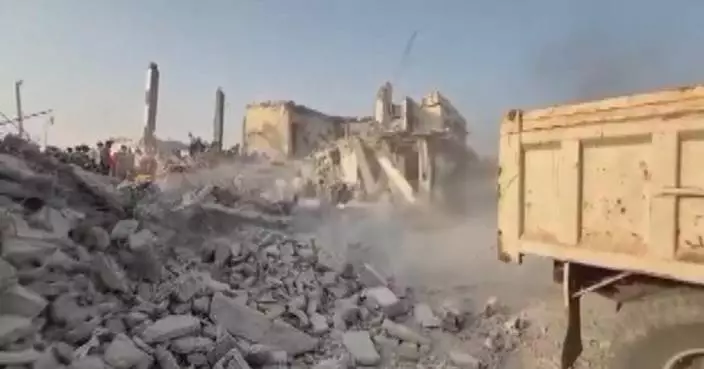
Municipal teams in western Gaza City have begun clearing rubbles and reopening roads in Nasser following the Israeli army's withdrawal, but widespread devastation and equipment shortages are severely hampering recovery efforts across the war-torn enclave.

Israel and Hamas on Thursday agreed to a Gaza ceasefire deal, which went into effect the next day, offering a tentative path toward ending the two-year conflict that has killed over 67,000 Palestinians, injured almost 170,000 others.

Municipal maintenance crews across the Gaza Strip are relying on a limited supply of heavy machinery to clear debris and restore access. But with fuel in short supply and much of their equipment destroyed during the conflict, the work is progressing at a painfully slow pace.

"We, the municipal department of Gaza City, are clearing and opening the streets of Gaza. Now we are working on Nasser Street. The Israeli army had destroyed everything here, with streets and houses almost completely demolished, 90 percent of the sewage treatment and drainage facilities wiped out, and all infrastructure in Gaza City in ruins," said Muhannad Sukkar, head of the highway and street division of Gaza City's municipal department.

Following the Israeli army's withdrawal, previously cordoned-off neighborhoods have reopened, but the ubiquitous ruins and collapsed streets have created enormous difficulties for residents returning home.

Locals also fear that unexploded munitions or other hazardous items may still remain in areas once occupied by the Israeli forces.

"Previously, the roads were completely blocked from Al-Shifa all the way to the end of the street. We walked back on foot. It was too difficult along the way. The road is full of stones, iron pieces, and even possibly unexploded munitions. We felt very uneasy and scared the whole way back. Fortunately, we finally made it home," said local resident Mohammed Mushtaha, recalling the difficulties his family had faced on their way back home.

"You can see how devastating the destruction is right in front of you. We are trying to settle back in. But in an environment like this, normal life is simply impossible. How are we supposed to live in all this devastation? No one - whether children, young people, the elderly, or women - can live here. This building used to have seven floors, now only one remains intact. This building over here was bombed too. We are doing our best to clear the rubble, trying to repair the houses. There are very few heavy machines left in Gaza City. Relying on just one or two excavators is not enough. We hope the international community can provide aid, giving us a chance to rebuild our homes," another local resident Mahmoud Sabry said amid the shattered buildings.

Gazans begin clearing rubbles in Nasser as immense destruction slows recovery

Gazans begin clearing rubbles in Nasser as immense destruction slows recovery

Gazans begin clearing rubbles in Nasser as immense destruction slows recovery

Gazans begin clearing rubbles in Nasser as immense destruction slows recovery
The inaugural Africa Health Summit has recently concluded in Kampala, Kenya, charting a course for the continent's push to reduce reliance on external support and achieve health sovereignty through innovation and collaboration.

More than 1,000 delegates from Africa and beyond attended the summit held under the banner "Reclaiming Africa's Health Future: From Dependency to Sovereignty through Innovation and Solidarity." Discussions focused on lessons from the COVID-19 pandemic and the urgent need to boost the continent's capacity to detect, prevent, and respond to health threats, with a collective call to build stronger, home-grown health systems.

"Africa is already a laboratory of ideas, mobile money, health payments, drone deliveries, and AI-assisted diagnostics. Our scientists lead in genomics surveillance. Our researchers and programs have driven the trials and roll-out of malaria vaccines, now expanding across the continent," said Dr. Abdourahmane Diallo, director of Program Management at the WHO Regional Office for Africa, when addressing the summit on Friday.

Speakers said at the summit that self-reliance in the health sector can be achieved through building stronger research institutions, expanding local production, and ensuring African governments' lead on policy, while treating health as a foundation for long-term growth.

"The time has come to redefine health as a pillar of economic growth and not as a social afterthought. We must build sovereignty in production, in research, and in policy," said Dr. Jane Ruth Aceng, Uganda's health minister.

Delegates also linked health sovereignty to economic stability and continental security, calling for coordinated actions among African states.

According to the delegates, the summit helped establish critical foundations by advancing African manufacturing, training health workers, and adopting technologies like drones and diagnostic apps. The goal is to be ready for the next crisis long before it emerges.

There was also a strong push to harmonize regulations to facilitate cross-border movement of African-made medicines, vaccines, and diagnostics.

"We must harmonize regulatory frameworks to allow medicines, vaccines, diagnostics, and health technologies developed in one African State to be distributed efficiently across the continent," said Amason Kingi, Speaker of the Senate of Kenya.

Participants urged governments to match political commitments with real investments in local industry, research, and technology.

Throughout the venue, innovators demonstrated home-grown health tools, from diagnostic apps to locally produced medical supplies, as delegates positioned Kampala as a rising hub for Africa's health agenda and the start of a long-term push for health sovereignty.

First Africa Health Summit charts continent's transition from health dependency to sovereignty

First Africa Health Summit charts continent's transition from health dependency to sovereignty

Recommended Articles